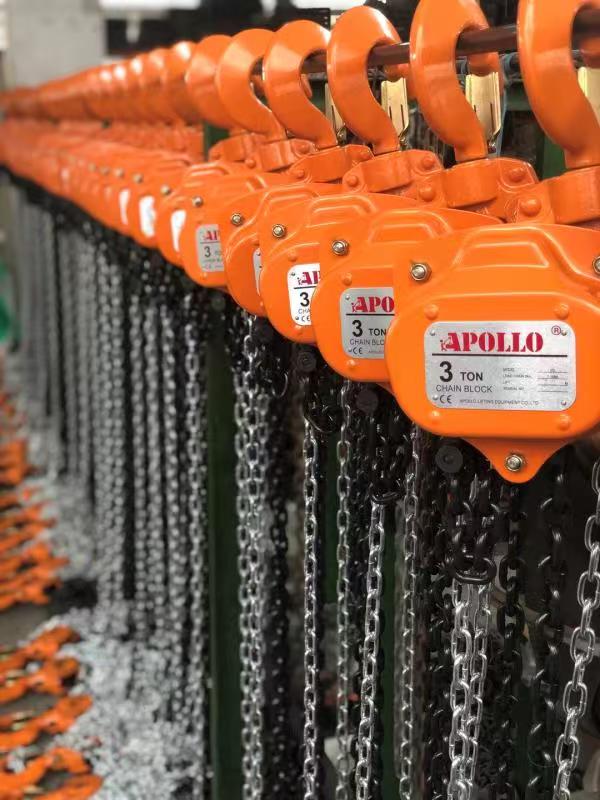
1. Introduction: The Critical Role of Manual Hoists in Industry
In the landscape of heavy lifting solutions, manual hoists remain indispensable tools across manufacturing plants, construction sites, warehouses, and utility installations. Despite the proliferation of powered alternatives, the hand chain hoist (commonly known as a chain block) and the lever hoist (ratchet lever hoist) continue to be preferred by project engineers and facility managers for their portability, reliability, and low maintenance. Choosing between these two types is not simply a matter of price or availability; it directly affects operational efficiency, safety, and the ability to execute specific lifting or pulling tasks correctly.
As a leading chain hoist manufacturer and one of the most respected manual hoist suppliers in the global market, Hangzhou Apollo Lifting Equipment Co., Ltd. frequently encounters clients who ask: “What exactly is the difference between a lever hoist and a chain block, and which one fits my application?” This article answers that question in depth, exploring the internal mechanisms that define each product’s capabilities, delineating their ideal application scenarios, and providing expert guidance on selection. By the end, procurement managers and engineers will understand why sourcing from knowledgeable hoist manufacturers is as important as the equipment specifications themselves.
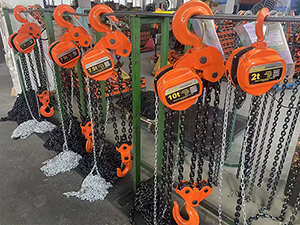
2. Working Principle and Internal Mechanism: The Core Distinctions
While both devices belong to the family of industrial manual hoists, their internal workings diverge significantly. These differences determine whether a unit can be used vertically, horizontally, or at an angle, and how load control is achieved.
2.1 How a Hand Chain Hoist (Chain Block) Operates
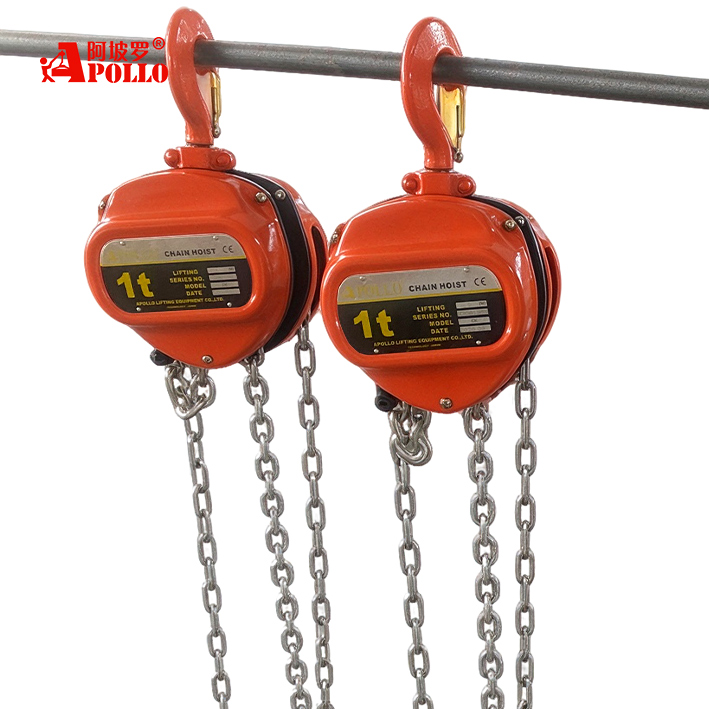
A chain block lifts a load by pulling on a hand chain loop. This hand chain turns a pocket wheel (hand chain sprocket), which is connected via a drive shaft to a reduction gear train. The gearing multiplies the input force, allowing a single operator to raise several tonnes. The load chain sprocket, driven through the gearbox, engages the load chain to lift or lower the hook.
Crucially, the braking system relies on a mechanical load brake—typically a ratchet-and-pawl mechanism combined with a friction disc assembly. When the hand chain is released, the load automatically engages the brake, holding the weight suspended without any additional locking action. The brake is entirely mechanical and functions irrespective of whether the operator maintains tension on the hand chain. This automatic load-holding characteristic is fundamental to chain block safety. The entire mechanism is enclosed in a housing, with the hand chain hanging vertically below. Because the pocket wheel only operates when the hand chain is pulled directly downward, the chain block is designed primarily for vertical lifting. Any side loading or angled pulling can cause the chain to jump the guide, damage the chain guides, and lead to catastrophic failure.
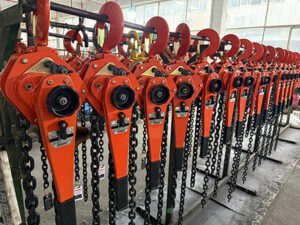
2.2 How a Lever Hoist (Ratchet Lever Hoist) Operates
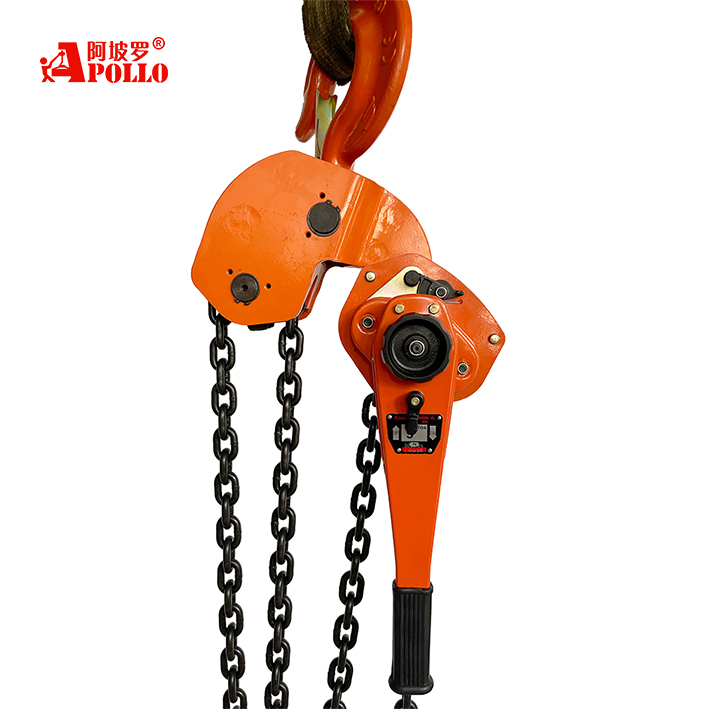
A lever hoist generates lifting or pulling force by ratcheting a lever handle. Inside the housing, the lever action drives a pair of pawls that engage a ratchet gear, converting reciprocating motion into rotary motion on the load sheave. The operator shifts a selector lever to choose between lifting (winding in load chain), lowering, or free-wheel (neutral) mode. In free-wheel mode, the load chain can be rapidly pulled through the hoist to take up slack without ratcheting, a major advantage when setting up a rigging.
The braking system is similar in principle—a Weston-style load brake with friction discs—but the actuation method allows the hoist to function in any orientation. Because the lever mechanism does not depend on gravity-oriented hand chain tension, the lever hoist can be used horizontally, vertically, inverted, or at any angle. The load chain anchor point and the top hook are designed to take the rated load in any direction, provided the load is aligned with the chain path. This versatility makes the lever hoist a preferred tool for tensioning, pulling, and positioning applications, not merely lifting.
2.3 Key Mechanical Differences: Gearing, Braking, and Load Control
The gear train in a chain block typically uses multiple stages of spur gears or an epicyclic (planetary) gear set to achieve the necessary reduction ratio in a compact form. Lever hoists also use gear reduction, but the ratchet and pawl advance mechanism creates a slightly different torque profile. The handle length and leverage determine the effort required at the handle; lever hoist suppliers carefully calibrate this to keep the handle force within ergonomic limits (usually below 35 kg for a rated load).
Another profound difference is load control during lowering. With a chain block, lowering is achieved by pulling the opposite side of the hand chain, which very slightly releases the brake and allows the load to descend at a controlled speed. If the operator pulls too quickly or loses grip, the brake re-engages instantly. In a lever hoist, lowering is managed by ratcheting in the opposite direction, or in some models by moving the selector to the “down” position and operating the lever against brake resistance. This gives the operator fine incremental control during lowering and positioning, making it ideal for aligning flange faces or setting machinery onto foundations.
3. Application Scenarios: Where Each Hoist Excels
Understanding the internal logic above enables the user to match the tool to the task. While some overlap exists, each hoist has clearly defined territory in heavy lifting solutions.
3.1 Typical Applications for Chain Blocks
-
Vertical Lifting in Workshops and Warehouses: Chain blocks are the standard choice for lifting machine parts, molds, engines, and palletized materials onto workbenches or storage racks. Their simple overhead suspension and direct-pull operation suit repetitive vertical lifts.
-
Machine Shop Cranes and Jib Cranes: When paired with a manual trolley on an I-beam, a chain block becomes the heart of a low-cost manual workstation crane. For machine shops, chain blocks from reputable hoist lift manufacturers provide dependable lifting without electricity.
-
Assembly Lines and Maintenance Bays: Any environment where items must be lifted straight up and held suspended, such as removing a heavy pump for repair, a chain block is the tool of choice. Its pure vertical motion and automatic brake give maintenance crews confidence.
-
Construction Sites for Vertical Lifting: While construction sites increasingly use powered hoists, a chain block remains useful for lifting tools, rebar bundles, or small prefabricated forms when power is unavailable.
3.2 Typical Applications for Lever Hoists
-
Horizontal Load Tensioning and Pulling: This is the primary advantage. Lever hoists are used extensively for pipe pulling, cable tensioning, and adjusting structural steel during erection. No other manual tool can simultaneously apply several tonnes of horizontal force with this degree of control.
-
Load Positioning and Alignment: When installing heavy machinery, a lever hoist can tilt, rotate, or precisely shift a component in any direction. The ratcheting action allows millimeter-by-millimeter advancement, a capability prized by millwrights.
-
Overhead Applications in Tight Spaces: Because the lever is operated independently of chain alignment, a lever hoist can be used in confined areas where pulling a full loop of hand chain is impossible—for instance, inside a duct or between pipe racks. It can be mounted upside down or sideways.
-
Temporary Guying and Structural Support: Lever hoists are often employed as temporary turnbuckles or come-alongs to hold a load in position while permanent fasteners are applied. Their ability to lock securely without drifting is critical in such scenarios.
-
Working with Industrial Lifting Clamps: In plate handling or steel erection, lever hoists are frequently used in conjunction with lifting clamps to pull steel plates into alignment. This synergy between a lever hoist and specialized lifting clamp manufacturers’ products is a common sight in shipyards and steel fabrication shops.
3.3 Overlapping and Specialized Use Cases
It is worth noting that a lever hoist can also perform vertical lifting, and in many maintenance toolkits it substitutes for a chain block. However, for sustained vertical production lifting, the chain block is more ergonomic. Conversely, a chain block must never be used for horizontal pulling, as the load chain guide is not designed for off-axis loads and the hand chain alignment becomes impossible. Hence, companies seeking comprehensive manual hoist suppliers should assess their full range of tasks before deciding.
4. Key Factors for Selecting the Appropriate Manual Hoist
When procuring industrial manual hoists, engineering and procurement teams should evaluate not just capacity and lift height, but a matrix of factors:
-
Direction of Force: Is the primary motion vertical, horizontal, or multi-directional? For any non-vertical task, a lever hoist is required.
-
Duty Cycle and Frequency: Chain blocks are more comfortable for repetitive lifting due to the hand chain’s long pull stroke. Lever hoists are better for occasional lifting combined with frequent pulling and positioning.
-
Environment and Space: Check if there is enough clearance for the hand chain loop. In low-headroom areas, a lever hoist paired with a low-headroom trolley might be a better solution.
-
Load Holding Duration: If loads must remain suspended for extended periods, both devices are safe, but the chain block’s fully enclosed brake is marginally more protected from dust and moisture ingress.
-
Chain Containment: Lever hoists typically have a shorter standard chain length and require proper chain bag management. Chain blocks can be supplied with significantly longer lifts by adjusting the chain length, making them suitable for high-bay facilities.
-
Certification and Compliance: As a top hoist manufacturers’ brand, Hangzhou Apollo ensures both its lever hoists and chain blocks comply with international standards (EN 13157, ASME B30.16, etc.), and provides documentation essential for safety audits.
5. Hangzhou Apollo: Your Partner for Industrial Manual Hoists and Heavy Lifting Solutions
With decades of experience, Hangzhou Apollo Lifting Equipment Co., Ltd. has established itself among the leading chain hoist manufacturers and hoist manufacturers globally. Our portfolio encompasses a full spectrum of heavy lifting solutions, from manual lever and chain blocks to electric wire rope hoists and custom-designed crane systems. What sets us apart is not merely the breadth of our catalog, but our commitment to deep application engineering. We routinely help clients analyze their lifting and rigging workflows, ensuring the selected manual hoist perfectly matches the operational requirement.
For clients needing specialized combinations—such as explosion-proof lever hoists for petrochemical plants, stainless steel chain blocks for food processing, or integrated trolley systems for warehouse cranes—our in-house R&D and strict quality control deliver products that other manual hoist suppliers struggle to match. Our global distribution network and responsive after-sales support solidify our reputation as a reliable partner for industries ranging from heavy manufacturing to logistics.
6. Best Practices for Safe Operation and Maintenance
To maximize the working life of any manual hoist, operators should adhere to these guidelines:
-
Pre-Use Inspection: Check the load chain for twists, nicks, or corrosion; verify that the hooks rotate freely and latches close securely; test the brake by lifting a light load just off the ground and checking for drift.
-
Avoid Overloading: Respect the rated capacity. Dynamic loads or jerking can instantaneously exceed the limit, causing chain failure or brake damage.
-
Correct Chain Alignment: Ensure the load chain is not twisted or knotted before lifting. For lever hoists, confirm that the chain feeds straight into the hoist body without side bending.
-
Lubrication: Keep the load chain clean and lightly lubricated. The brake housing should never be lubricated with heavy grease that could compromise friction disc performance.
-
Periodic Thorough Examination: Regulatory standards and manufacturer recommendations require disassembly and inspection of the internal gear train, brake discs, and pawls at intervals defined by usage severity. Apollo provides comprehensive service manuals and genuine spare parts, reinforcing our position as hoist lift manufacturers that support the entire lifecycle of the product.
-
Storage: Store hoists in a dry environment, with the load chain retracted and the hand chain neatly coiled. Avoid leaving them hanging in weather-exposed locations where corrosion can degrade chain strength.
7. Future Trends in Manual Lifting Technology
While the fundamental mechanisms of manual hoists are well established, innovation continues. Ergonomic handle design, lightweight yet stronger alloy chains, and advanced friction materials for even smoother braking are recent evolutions. Digitalization is also entering the manual lifting sphere: integration with RFID tags for inspection tracking, and load cells that connect to smartphones for overload alerting are in development. Moreover, the convergence of manual hoist elements with portable power drives is giving rise to hybrid tools that combine the control of a lever hoist with the speed of a battery-powered drive, expanding the definition of heavy lifting solutions. As a forward-looking chain hoist supplier, Hangzhou Apollo actively invests in such advances, ensuring that our clients always have access to efficient and safe lifting technology.
8. Conclusion
The difference between a lever hoist and a chain block is not superficial; it is founded on fundamentally distinct internal mechanisms that dictate their respective application domains. A chain block is a dedicated vertical lifting device, unbeatable for overhead crane operations and workshop lifting. A lever hoist is a versatile pulling, tensioning, and positioning tool that can lift vertically as well, but truly shines in multi-directional and precision load control scenarios.
For procurement professionals and project engineers seeking robust industrial manual hoists and reliable manual hoist suppliers, the decision must start with a thorough analysis of the intended task. By partnering with a top hoist manufacturer like Hangzhou Apollo Lifting Equipment Co., Ltd., customers gain not only superior products but also the technical guidance to select exactly the right equipment. As a comprehensive provider of chain hoists, lever hoists, lifting clamps, and complete crane hoist systems, we stand ready to help you design the safest and most productive lifting operations. Contact our engineering team today to discuss your specific heavy lifting needs.