

1 How does the anti-chain guide wheel design work, and can it completely eliminate chain jamming or slippage problems?
In modern lifting systems, safety and reliability are no longer defined solely by rated capacity. For electric chain hoists, one of the most critical yet often underestimated components is the anti-chain-drop guide wheel, also known as the anti-disengagement chain guide mechanism.
For global customers working with electric chain hoist suppliers and chain hoist manufacturers, a recurring technical question arises:
How does the anti-chain-drop guide wheel design actually work, and can it completely prevent chain jamming or derailment?
This article provides a comprehensive engineering-level explanation of anti-chain-drop guide wheel design, its working principles, limitations, and best practices—helping buyers make informed decisions when selecting safe and reliable heavy lifting solutions.
1.1 Why Chain Guidance Is Critical in Electric Chain Hoists
Unlike wire rope hoists, electric chain hoist systems rely on precise engagement between the load chain and the lifting sprocket. Any misalignment, twisting, or improper entry can result in:
- Chain jamming
- Chain jumping off the sprocket (derailment)
- Abnormal wear
- Sudden load stoppage or shock
For electric hoist manufacturers, preventing these failures is a fundamental design responsibility rather than an optional feature.
2 Common Causes of Chain Jamming and Derailment
Understanding why chain problems occur is essential before evaluating anti-drop solutions.
2.1 Improper Chain Entry Angle
If the chain enters the sprocket at an incorrect angle, especially under side load conditions, it may fail to seat properly in the pocket.
This risk increases in:
- Oblique lifting scenarios
- Poor hook alignment
- Improper installation
2.2 Chain Twist and Knot Formation
Twisted chains are one of the leading causes of chain derailment. Even high-quality chains supplied by reputable chain hoist manufacturers can jam if twisted during operation.
2.3 Worn or Deformed Sprockets
Excessive wear on the sprocket teeth reduces pocket accuracy, increasing the chance of chain skipping or jumping under load.
2.4 External Contamination
Dust, metal debris, and corrosive particles—common in electric hoist for mining operations—can interfere with chain guidance.
3 What Is an Anti-Chain-Drop Guide Wheel?
The anti-chain-drop guide wheel is a mechanical guiding component installed near the load sprocket. Its primary function is to control chain alignment and entry path, ensuring the chain remains properly seated throughout operation.
For professional electric hoist manufacturers, this component is a core safety feature rather than an accessory.
3.1 Structural Position and Layout
The guide wheel is typically positioned:
- Adjacent to the load sprocket
- At the chain entry and exit points
- In close coordination with chain guide plates
Its geometry is precisely matched to the chain pitch and sprocket profile.
3.2 Working Principle
The anti-chain-drop guide wheel works by:
- Physically restricting lateral chain movement
- Correcting minor misalignment before chain engagement
- Preventing chain lift-out under tension fluctuations
This ensures consistent meshing between chain links and sprocket pockets.
4 Can Anti-Chain-Drop Design Completely Eliminate Jamming or Derailment?
This is a critical question for buyers evaluating hoist manufacturers and suppliers.
4.1 What the Design Can Effectively Prevent
A properly engineered guide wheel can:
- Prevent accidental chain jump-off
- Reduce misfeed during low-speed operation
- Improve operational stability under vertical lifting
In controlled conditions, derailment risk is significantly reduced.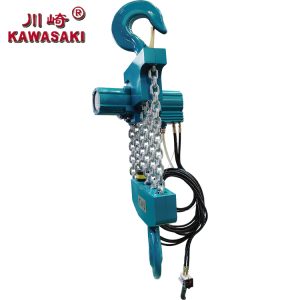
4.2 Inherent Technical Limitations
However, no mechanical design can guarantee 100% elimination of chain problems.
Anti-chain-drop systems cannot fully compensate for:
- Severely twisted chains
- Extreme side pulling
- Overloading beyond rated capacity
- Poor maintenance practices
Responsible crane hoist manufacturers clearly define these boundaries in technical documentation.
5 Types of Anti-Chain-Drop Guide Designs
Different electric chain hoist suppliers adopt varying design philosophies.
5.1 Fixed Guide Wheel Systems
These designs offer:
- Simple structure
- High rigidity
- Low maintenance
They are widely used in standard-duty hoists.
5.2 Floating or Spring-Loaded Guide Systems
Advanced designs allow limited movement to:
- Adapt to minor chain deviations
- Absorb vibration
- Improve smoothness under variable load
Such systems are common in premium heavy lifting solutions.
5.3 Integrated Multi-Guide Assemblies
High-end hoists may combine:
- Guide wheels
- Guide plates
- Enclosed chain paths
This layered protection approach is increasingly favored by leading electric hoist manufacturers.
6 Design Considerations Used by Professional Manufacturers
From the perspective of experienced hoist manufacturers and suppliers, effective anti-drop design requires system-level thinking.
6.1 Chain Quality and Tolerance Matching
Guide wheels must match:
- Chain pitch
- Link diameter
- Heat treatment characteristics
Mismatch increases friction and wear.
6.2 Precision Machining and Surface Finish
Poor machining can create:
- Sharp edges
- Uneven contact surfaces
High-quality manufacturers maintain strict dimensional control.
6.3 Enclosure and Environmental Protection
In dusty or corrosive environments, enclosed chain guides provide better reliability, particularly in industrial lifting crane applications.
7 Best Practices to Minimize Chain Jamming Risks
Based on long-term field experience, Hangzhou Apollo recommends the following best practices:
7.1 Select Hoists with Verified Anti-Drop Design
Always confirm:
- Presence of dedicated guide wheels
- Design drawings or test reports
- Compliance with international standards
Reputable electric chain hoist suppliers provide transparent technical data.
7.2 Avoid Side Pulling
Electric chain hoists are designed for vertical lifting. Side loads dramatically increase derailment risk, regardless of guide design.
7.3 Regular Inspection and Maintenance
Routine checks should include:
- Chain twist inspection
- Guide wheel wear
- Sprocket condition
Preventive maintenance remains the most effective safeguard.
8 Comparison with Wire Rope Hoist Systems
Unlike chain hoists, wire rope hoist suppliers rely on drum grooves rather than sprocket pockets. While rope hoists face different failure modes, chain hoists require more precise entry control—making anti-chain-drop design uniquely important.
9 Future Trends in Anti-Chain Safety Design
The next generation of electric chain hoist systems is evolving toward:
- Self-centering guide mechanisms
- Wear sensors for chain path components
- Smart monitoring systems with fault alerts
As forward-looking electric hoist manufacturers, Hangzhou Apollo continuously integrates structural optimization and quality control into product development.
10 Conclusion
The anti-chain-drop guide wheel is a critical safety component in electric chain hoists, designed to control chain alignment and significantly reduce the risk of chain jamming or derailment. While no mechanical system can completely eliminate all failure scenarios, well-engineered guide wheel designs—combined with proper operation and maintenance—can effectively prevent the vast majority of incidents.
As one of the experienced hoist manufacturers and suppliers, Hangzhou Apollo Lifting Equipment Co., Ltd. is committed to delivering robust, precisely engineered, and application-specific heavy lifting solutions. Through strict quality control, customized design capabilities, and global service support, Apollo helps customers lift safely, reliably, and with confidence.