
Introduction: The Hidden Danger of Identical Radios
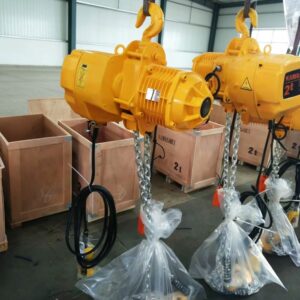
Imagine a busy fabrication shop or a warehouse overhead crane system where five identical electric chain hoists are installed side by side. An operator on the far left picks up his remote control, presses “lift,” and watches — not his own hoist — but the hoist two bays down, suddenly jerking a load into the air. This scenario, known as signal cross-talk or remote interference, is not a rare glitch. It is a serious safety hazard that can cause dropped loads, equipment damage, and severe injuries.
As global electric hoist manufacturers continue to improve product performance, the convenience of wireless remote control has become standard. However, when multiple units of the same model operate in close proximity, radio frequency (RF) interference can lead to unintended commands. At Hangzhou Apollo Lifting Equipment Co., Ltd. , a trusted name among heavy lifting hoist suppliers, we have helped hundreds of customers solve this exact problem. This article provides a technical yet practical guide to understanding why interference happens, how to prevent it, and what to look for when sourcing hoist manufacturers and suppliers for multi-hoist environments.
Part 1: Understanding the Root Causes of Remote Interference
1.1 The Basics of Wireless Hoist Control
Most industrial electric hoists use radio transmitters operating in license-free ISM bands (e.g., 433 MHz, 868 MHz, or 2.4 GHz). The remote control (transmitter) sends a coded signal; the hoist’s receiver decodes it and executes the command. When multiple electric hoist suppliers offer identical systems, they often default to the same factory frequency and simple identification codes. This is the primary source of interference.
1.2 Three Main Interference Mechanisms
-
Same-frequency collision: Two or more transmitters using the exact frequency and modulation. When activated simultaneously, their signals overlap, causing the receivers to misinterpret commands or fail to respond.
-
Adjacent-channel interference: Transmitters on nearby frequencies (e.g., 433.0 MHz and 433.1 MHz) with insufficient filtering. A strong signal can bleed into adjacent receivers.
-
Identical digital ID: Many low-cost electric chain hoist systems use a fixed, non-unique digital address (e.g., a 4‑bit code). If two hoists share the same address, one remote can control both — exactly what operators fear.
1.3 Why “Same Model, Same Factory” Worsens the Problem
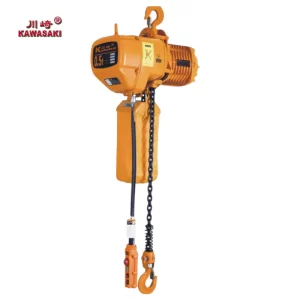
Reputable top hoist manufacturers typically assign each hoist a unique factory ID or support pairing procedures. However, budget-oriented products — especially from generic hoist manufacturers and suppliers — may skip this feature to reduce cost. When a buyer purchases ten identical hoists from such a source, all ten receivers will respond to any one of the ten transmitters. This is a recipe for disaster.
Part 2: Key Factors That Determine Interference Risk
Before selecting solutions, facility managers and project engineers must evaluate these four critical parameters.
2.1 Frequency Hopping vs. Fixed Frequency
-
Fixed frequency: The transmitter and receiver lock onto one specific channel. Simple but highly prone to interference when multiple systems share the same channel.
-
Frequency hopping spread spectrum (FHSS): The system jumps between dozens or hundreds of channels in a pseudo-random pattern known only to its paired transmitter and receiver. FHSS virtually eliminates cross-talk. Leading crane hoist manufacturers now offer FHSS as standard on industrial hoists.
2.2 Digital Addressing Length and Uniqueness
The number of available digital IDs determines how many unique hoists can coexist. A 12‑bit system offers 4,096 addresses — usually sufficient. An 8‑bit system has only 256 addresses. Some low-end electric hoist suppliers use even smaller spaces or no addressing at all. Always ask for the address space and whether addresses are factory-programmed or user-settable.
2.3 Transmitter Power and Receiver Sensitivity
Higher RF power (e.g., 10 mW vs. 1 mW) increases range but also increases the chance of interfering with nearby receivers. Conversely, overly sensitive receivers can pick up weak signals from unintended transmitters. A well-designed system balances power and sensitivity based on the typical working distance (usually 30–100 meters for hoist applications).
2.4 Physical Proximity and Antenna Placement
Even with good digital encoding, if two hoists are placed less than 3 meters apart with their receiver antennas parallel and unshielded, RF coupling can occur. Metal structures (I‑beams, crane rails) can also reflect signals, creating unexpected coverage overlaps.
Part 3: Solutions Comparison — How to Prevent Interference
Based on our experience as one of the leading overhead crane manufacturers and hoist manufacturers and suppliers, the following solutions range from simple operational procedures to advanced hardware features.
| Solution | Effectiveness | Cost | Best For |
|---|---|---|---|
| Physical separation & zoning | Moderate (40–60%) | Low | Temporary setups, small sites |
| Manual channel/frequency selection | Moderate (60–70%) | Low to medium | Shops with 2–4 hoists |
| Unique digital ID pairing | High (90%) | Medium | Permanent multi-hoist installations |
| Frequency hopping (FHSS) | Very high (99%+) | Medium to high | Dense environments, safety-critical operations |
| Time-division multiple access (TDMA) | Very high (99%+) | High | Large crane systems, automated yards |
3.1 Physical Separation and Zoning
The simplest method: assign each hoist to a defined zone, and ensure operators do not enter another zone with their remote. For example, zone A (hoist #1) at 0–20 meters, zone B at 20–40 meters, with physical barriers (walls, curtains) or visual markings. This works only when hoists are far apart and movement is restricted.
3.2 Manual Channel Selection
Some electric hoist manufacturers provide DIP switches or rotary selectors on both transmitter and receiver, offering 8 to 16 channels. The installer sets each hoist to a different channel. However, if two operators accidentally set the same channel, interference returns. Regular audits are required.
3.3 Unique Digital ID Pairing (Recommended Baseline)
This is the minimum acceptable standard for any professional heavy lifting hoist supplier. Each hoist’s receiver is paired with a specific transmitter via a “learn” button or software. The transmitter sends its unique ID (e.g., a 32‑bit serial number) with every command; the receiver ignores commands with mismatched IDs. This is highly effective as long as the pairing process is tamper-proof. Hangzhou Apollo implements rolling-code pairing similar to automotive key fobs on our electric chain hoist product lines.
3.4 Frequency Hopping Spread Spectrum (FHSS)
FHSS is the gold standard for dense RF environments. The transmitter and receiver hop across 50 to 100+ frequencies in a synchronized sequence. Even if another transmitter operates on one of those frequencies, the hopper only loses a fraction of a second (and error-correction protocols resend the command). Many top hoist manufacturers now integrate FHSS modules from brands like Schneider Electric or HBC. When sourcing crane hoist manufacturers, explicitly ask: “Does your wireless remote system use FHSS? What is the hop rate and number of channels?”
3.5 Advanced: TDMA and Centralized Control
For large facilities with dozens of hoists (e.g., port crane manufacturers or warehouse overhead crane systems), time-division multiple access (TDMA) or a central control system can be deployed. Each hoist is assigned a dedicated time slot to transmit. This requires a master controller and is typically used in automated or semi-automated environments.
Part 4: Best Practices for Procurement and Site Management
4.1 What to Ask Your Electric Hoist Suppliers
Before purchasing, present the following checklist to potential hoist manufacturers and suppliers:
-
Does your system support unique transmitter-receiver pairing? If yes, how many unique IDs are available?
-
What frequency band is used? (433 MHz, 868 MHz, 2.4 GHz — 2.4 GHz offers more bandwidth but shorter range.)
-
Is FHSS implemented? Request a datasheet showing hopping sequence and adjacent-channel rejection.
-
Can the system work in “teach mode” to replace a lost transmitter without reprogramming all units?
-
Is there a built-in “deadman” function (the hoist stops if signal is lost for more than 0.5 seconds)?
4.2 Site Implementation Best Practices
-
Label every hoist and its paired remote control with large, durable numbers or colors.
-
Store remote controls in individual locked slots when not in use, so operators cannot pick up the wrong unit.
-
Conduct a site RF survey using a spectrum analyzer (or hire a contractor) to identify existing interference sources — other radios, welders, or nearby crane suppliers‘ equipment.
-
Install ferrite cores or shielding on receiver cables if electrical noise is high.
-
Train operators to test the response before every lift: press a non-critical button (e.g., horn or auxiliary) and verify that only their hoist reacts.
4.3 When to Retrofit Existing Hoists
If you already own multiple identical hoists from electric hoist manufacturers that lack unique ID or FHSS, you do not necessarily need to replace the entire hoist. Many aftermarket remote control kits from specialized hoist lift manufacturers or industrial crane manufacturers can be retrofitted. These kits offer 32‑bit rolling codes and FHSS for a few hundred dollars per unit — a small price compared to a potential accident.
4.4 The Role of Regulatory Compliance
Check local regulations. For example, in the European Union, EN 60204‑32 and EN 15011 require that remote-controlled cranes and hoists have “unequivocal identification” of the controlled machine. In the US, ASME B30.16 (Hoists) requires that “the control system shall prevent unintended operation from interference.” Non-compliance not only risks safety but also liability. Reputable top hoist manufacturers provide CE, FCC, or IC certifications confirming interference immunity.
Part 5: Future Trends — Smarter, Safer Wireless Hoist Control
As Industry 4.0 advances, the days of dumb RF interference are numbered. Here is what leading crane hoist manufacturers are developing:
5.1 Adaptive Frequency Management
Next-generation systems will automatically scan the RF environment at startup and select the cleanest channels — much like Wi‑Fi routers. Some electric hoist suppliers already offer “auto-pairing” that avoids occupied channels.
5.2 Bluetooth 5.0 and Mesh Networking
Bluetooth 5.0 with mesh capabilities allows each hoist to act as a relay and also to communicate its control channel status to neighboring hoists. This prevents two hoists from ever using the same channel. Bluetooth also offers inherent pairing and encryption.
5.3 Ultra-Wideband (UWB) Positioning
UWB can determine the precise location (within 10 cm) of the remote control relative to each hoist. The hoist will only respond if the remote is within a predefined zone (e.g., within 5 meters of its own hoist). This eliminates cross-site interference completely.
5.4 IoT-Enabled Hoist Fleets
Hangzhou Apollo is actively integrating industrial IoT (IIoT) into our product lines. In the near future, a central dashboard will show every remote’s signal strength, battery level, and last command. The system can automatically lock out a remote that is attempting to control the wrong hoist based on geofencing.
Conclusion: Choose Hoist Manufacturers That Prioritize Coexistence
Remote control interference is not an unsolvable problem. It is an engineering challenge that separates competent hoist manufacturers and suppliers from those who cut corners. As a buyer or facility manager, you have the power to demand:
-
Unique digital pairing as a minimum requirement
-
FHSS for any site with three or more hoists
-
Clear documentation on addressing capacity and interference rejection
At Hangzhou Apollo Lifting Equipment Co., Ltd. , we design and manufacture electric chain hoists, wire rope hoists, and overhead crane components with industrial-grade remote systems. Every hoist leaving our factory undergoes rigorous cross-talk testing in a multi‑receiver chamber. Our global engineering team also offers on-site interference audits and retrofits for existing fleets — whether you bought from us or from other electric hoist suppliers.
Do not wait for a mislift accident to happen. Contact Hangzhou Apollo today to learn about our heavy lifting solutions with advanced FHSS and unique ID pairing. Whether you need manual hoist suppliers for simple applications or large crane manufacturers for port operations, our commitment remains: safe, interference-free lifting, every time.
For a free remote interference risk assessment of your facility, send your layout and hoist list to our engineering department. We will recommend the most cost‑effective way to eliminate cross‑control hazards.