Handling steel plates seems straightforward at first, yet folks in fabrication yards, shipbuilding areas, or steel supply hubs realize that selecting an improper lifting clamp can drag down operations or, even worse, lead to major safety hazards. Horizontal and vertical lifting clamps serve quite distinct load patterns, despite appearing alike from afar.
This overview details how horizontal and vertical lifting clamps function in actual work environments, where each type shines most, and how Apollo Hoist’s KAWASAKI lifting clamps integrate into routine lifting duties.
What Are Horizontal Lifting Clamps?
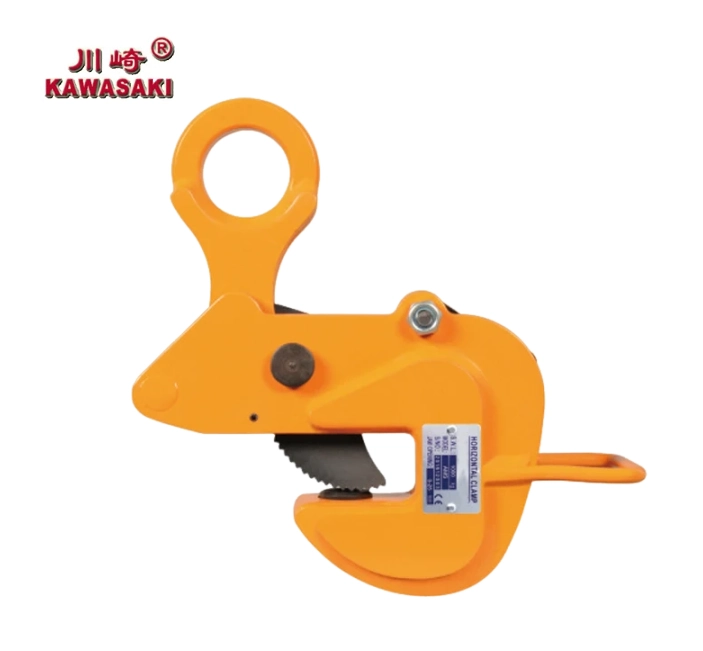
Horizontal lifting clamps primarily serve to raise and shift steel plates or structural beams while keeping them in a level stance. Rather than dangling downward, the load remains even throughout the raise, typically held by a pair of clamps that share the effort.
Before contrasting them against vertical types, it proves useful to grasp how horizontal clamps respond to weight and what ensures their dependability in regular material shifts.
Definition And Key Features
A horizontal lifting clamp seizes the side of a steel plate and maintains it flat during the raise. As weight presses down, the grip strengthens, drawing on gravity and jaw shape more than springs or hand-operated locks by themselves.
Operators often pair these clamps for two-point setups. Such even arrangement divides the burden between them, easing pressure on the plate and curbing any warping while in transit.
Builders craft most horizontal clamps from hammered alloy steel, complete with toughened jaws that ensure a firm hold, even on glossy steel faces. When paired aptly with plate depth and mass, they deliver reliable, foreseeable raises.
Best Use Cases In Material Handling
Horizontal lifting clamps suit well for shifting steel plates off slicing benches, stacking them on platforms, or setting flat pieces ready for cutting and joining. They prove handy especially when guarding the surface counts, since the load holds steady and skips wild swings.
In facilities where workers shift plates over short spans often, these clamps cut down on adjustment time. Moreover, they handle well when plates require precise flat placement at lift’s close, without needing turns.
That being said, these clamps do not fit for solo-point raises or upright holds. Employing them beyond their planned angle might lead to lopsided jaw force and risky maneuvers.
Apollo Product Recommendations
Apollo Hoist provides various KAWASAKI horizontal lifting clamps built for factory tasks, featuring uniform construction and straightforward capacity labels.
The KAWASAKI Horizontal Lifting Clamp KNMK+ fits general steel plate shifts where toughness and solid grasp are key. Its jaw form keeps touch firm amid small load wobbles, rendering it a sensible pick for assembly areas.
In lighter duties or snug work zones, the KAWASAKI Horizontal Lifting Clamp AMS 1T+ brings a slim build with 1-ton handling power. It commonly serves thinner plates or roles where easy steering trumps peak burden.
What Are Vertical Lifting Clamps?
Vertical lifting clamps handle an altogether separate task. Far from holding plates level, they hoist items straight up, letting plates dangle downward in the process.
Seeing how vertical clamps operate clarifies why teams often select them for warehousing, piling, and extended-distance hoists.
Definition And Key Features
A vertical lifting clamp latches onto the plate’s edge and secures the weight in an upright pose. Many models incorporate a cam or secure device that firms up under burden, stopping any slide during the hoist.
Unlike their horizontal counterparts, vertical clamps typically operate solo. This setup simplifies attachment and speeds up use, particularly in confined spots.
Numerous vertical clamps boast safety catches that block unintended drops once unloaded. Such traits aid greatly when settling plates into shelves or leaning them on barriers.
Best Use Cases In Vertical Lifting
Vertical lifting clamps find frequent roles in depots, steel yards, and building sites, where plates lift from piles and store standing. They also suit lengthy hoists in space-scarce areas.
When shifting plates via gateways, paths, or amid gear, the upright stance eases passage troubles. Thus, vertical clamps offer a workable fix for packed settings.
However, vertical clamps do not aim to maintain level plates. Trying to set one down flat with such a clamp might spark shaky motion close to the floor.
Apollo Product Recommendations
Apollo Hoist delivers KAWASAKI vertical lifting clamps that see broad use in factory hoist systems, with plain capacity tags and steady jaw action.
The KAWASAKI Vertical Lifting Clamp E+ serves as a basic tool for daily plate hoists. Its build ensures dependable hold over diverse plate depths, fitting well for storage and line processing.
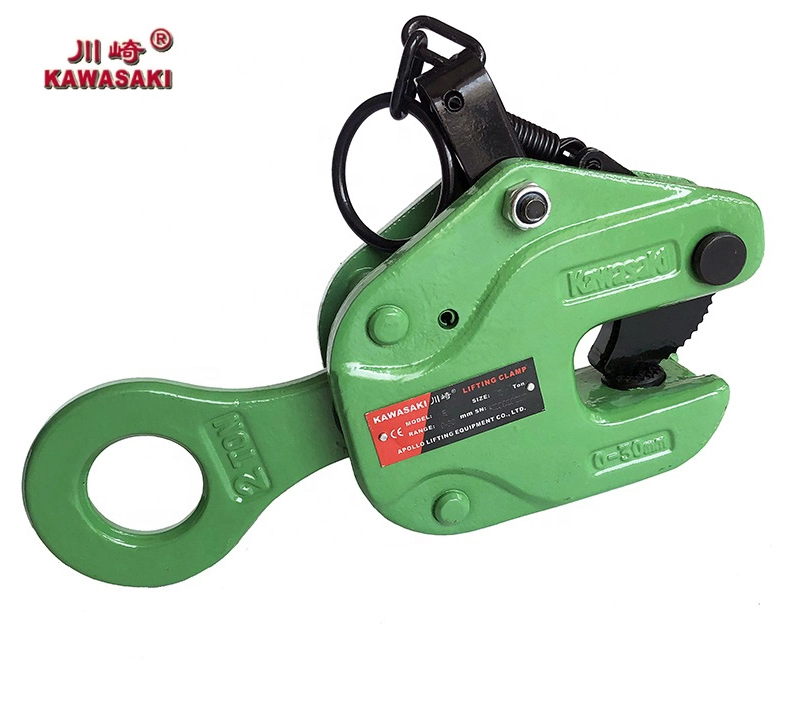
For tasks stressing quickness and simple management, the KAWASAKI Vertical Lifting Clamp QC+ includes a fast-release setup. This approach shortens shift times when plates move often from spot to spot.
Why Choose Horizontal Over Vertical Clamps?
Although vertical clamps gain favor for storing and shifting, horizontal ones hold vital spots in numerous hoist arrangements. The decision frequently hinges on load action and end positioning.
Stability And Load Distribution Benefits
Horizontal clamps spread weight via dual hold points, which lightens focused strain on the plate’s rim. This aids particularly for slim or broad plates prone to bend in solo-point hoists.
The even hoist further checks turning, simplifying guidance to spot. In duties needing precision, this firmness yields clear gains.
Surface Contact And Safety Considerations
Since horizontal clamps latch sideways and bolster the plate uniformly, they rarely trigger abrupt changes in motion. Such steady path cuts risks of surprise sways.
Within managed spots like workrooms, this consistent conduct boosts general safety, notably when staff direct the burden manually.
Ideal Project Scenarios
Teams often pick horizontal clamps for slicing benches, joining posts, and line assemblies. They also help when plates demand flat sets with little follow-up tweaks.
Why Choose Vertical Over Horizontal Clamps?
Vertical clamps might appear basic, yet their strengths emerge plainly in fitting setups.
Advantages In Vertical Lifting Efficiency
A lone clamp shortens setup duration. In shifts handling loads of plates, this pace builds fast.
Upright hoisting moreover leverages overhead room, enabling plates to pass snug areas sans bumping nearby tools.
Compact Design For Tight Spaces
Vertical clamps occupy minimal side room in hoists. This eases their application in slim lanes or shelf units with scant headway.
Specific Material Orientation Benefits
For upright piling of plates or slotting into standing frames, vertical clamps match the load’s end stance naturally. Hence, they lessen post-hoist adjustments.
How To Pick The Right Clamp For Your Job?
Opting between horizontal and vertical lifting clamps involves no universal superior choice, but rather which aligns with the task in play.
Evaluate Load Direction And Structure
Begin by noting the plate’s travel path and destination. Level sets typically lean toward horizontal clamps, whereas standing storage guides to vertical ones.
Assess Material Thickness And Surface
Jaw span counts heavily. Clamps beyond their thickness limits lose hold strength and face quicker erosion.
Edge finish influences too. Smooth, even rims yield steadier clamps than jagged or layered ones.
Match With Apollo Clamp Specifications
Apollo Hoist lists full details for every KAWASAKI lifting clamp, covering handling limits and depth spans. Aligning these with site realities supports secure, firm hoists long-term.
FAQs
Q1: Can horizontal lifting clamps be used alone instead of in pairs?
A: No. Horizontal lifting clamps are designed to work in pairs to balance the load. Using a single clamp can cause uneven stress and unsafe lifting.
Q2: Are vertical lifting clamps safe for long-term hanging loads?
A: Vertical clamps are intended for lifting and positioning, not for leaving loads suspended for long periods. Loads should be set down as soon as practical.
Q3: How often should lifting clamps be inspected?
A: Regular visual checks before each use are recommended, along with scheduled inspections based on usage frequency. Worn jaws or damaged mechanisms should be addressed immediately.