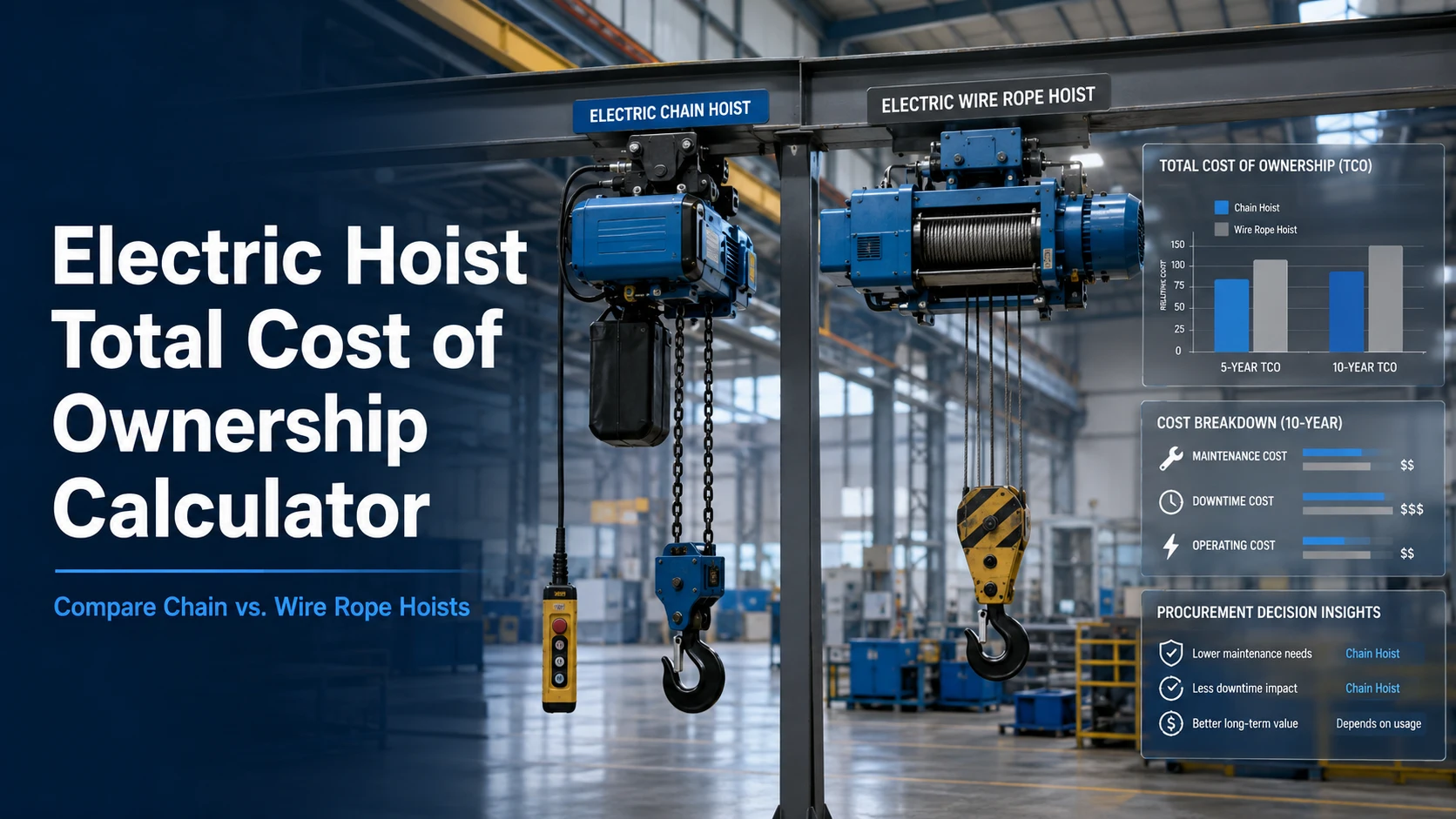
The purchase price of an electric hoist is only the first line in the ownership-cost calculation. For a factory, warehouse, fabrication shop, or production line, the larger question is what the equipment will cost over five or ten years after installation, maintenance, wear parts, energy use, downtime, and major repair or replacement are considered. A useful electric hoist total cost of ownership calculation therefore compares technically suitable options under the same operating assumptions instead of choosing the lowest quotation first and calculating the consequences later.
What Costs Should Be Included in Electric Hoist Total Cost of Ownership?
A practical electric hoist TCO model separates initial costs from recurring and risk-based costs. This matters because two quotations can appear similar while including different accessories, installation scope, maintenance responsibilities, or service support.
Acquisition, Installation, and Commissioning Costs
Start with the hoist purchase price, then confirm exactly what the quotation includes. Depending on the application, the project may also require a trolley, controls, suspension components, shipping, installation labor, electrical work, commissioning, or other site-specific items.
A lower unit price does not automatically mean a lower initial project cost. If one quotation includes required accessories while another excludes them, the apparent price difference is not a meaningful TCO advantage.
Before comparing chain hoist vs. wire rope hoist cost, normalize the technical scope. Capacity, lifting height, speed, controls, mounting arrangement, electrical requirements, and included equipment should be comparable.
A simple starting point is:
Initial Project Cost = Hoist + Required Accessories + Installation + Commissioning + Other Project-Specific Costs
Maintenance, Wear Parts, and Unplanned Downtime
Electric hoist maintenance cost should be based on the actual service plan and operating environment rather than a generic online average. Include scheduled inspection, routine maintenance labor, applicable lubrication, chain or wire rope replacement, brake or other wear components, and external service charges that can reasonably be forecast.
Downtime deserves a separate line. A repair invoice may be modest while the production impact is much larger. Facilities with continuous processes, time-sensitive loading, or a hoist at a critical workstation should estimate how many hours of production could be lost or delayed and assign an internal cost to those relevant downtime hours.
For overhead and gantry crane applications within the scope of OSHA 29 CFR 1910.179, OSHA requires a preventive maintenance program based on the crane manufacturer’s recommendations. Maintenance should therefore be treated as a planned ownership requirement, not simply as a cost that can be removed from a TCO model.
How to Calculate Electric Hoist TCO Over 5 or 10 Years
The strongest hoist TCO calculator uses the buyer’s own operating and maintenance information. The objective is not to predict every future repair precisely. It is to make competing options comparable under transparent assumptions.
Build the TCO Model From Actual Operating Data
A practical formula is:
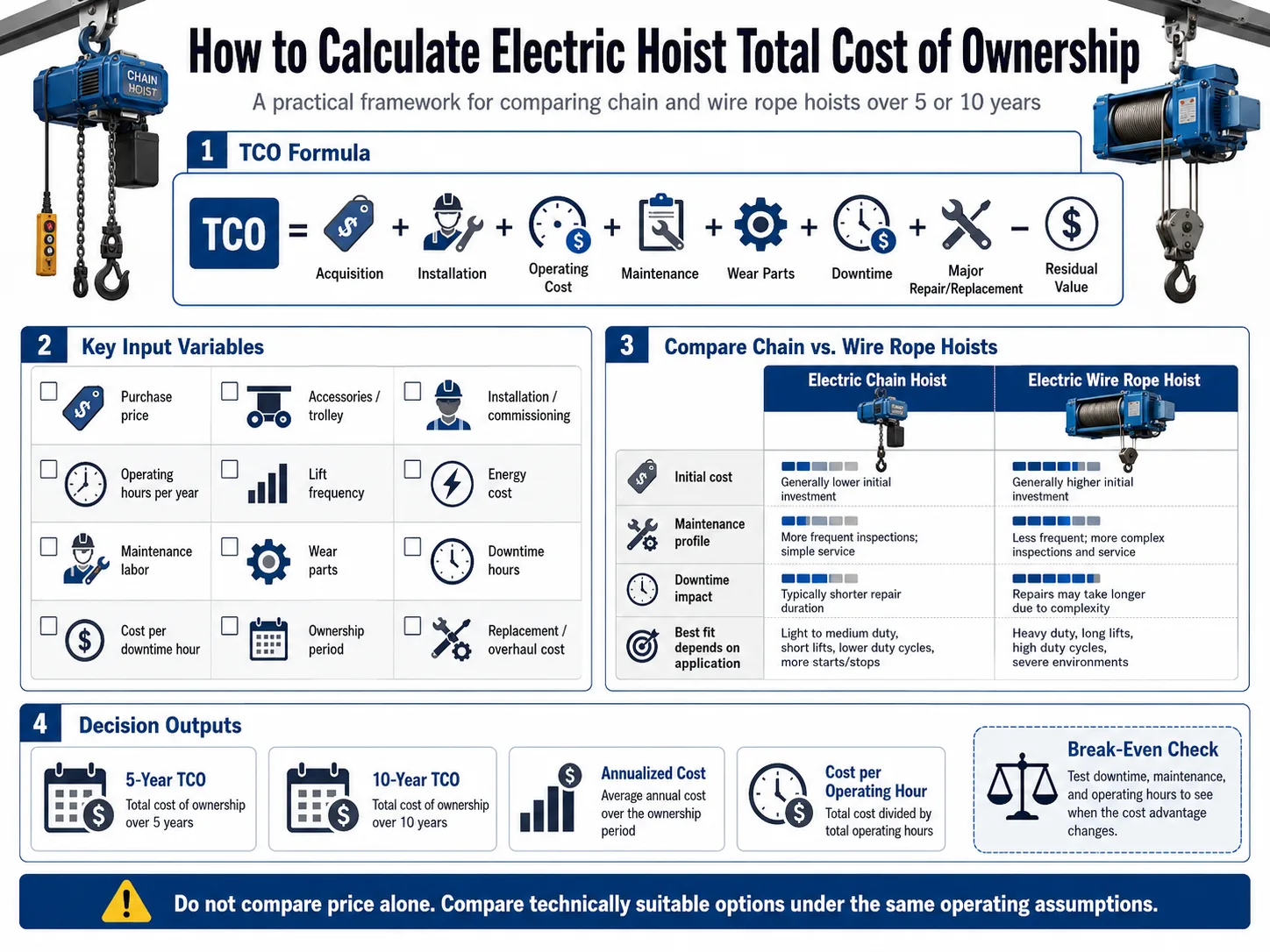
TCO = Acquisition + Installation + Operating Cost + Maintenance + Wear Parts + Downtime + Major Repair or Replacement − Residual Value
Select a realistic ownership period, then enter annual operating hours, lifting frequency, maintenance spending, estimated wear-part costs, relevant energy costs, and expected downtime.
If a major overhaul or replacement is expected within the analysis period, include it in the year when it would occur. Residual value should only be included when there is a reasonable basis for estimating it.
When information is uncertain, use scenarios instead of false precision. For example, calculate low, expected, and high downtime cases. The same approach can be applied to maintenance spending or annual operating hours.
A 5-year hoist cost comparison may favor one option while a 10-year hoist lifecycle cost model produces a different result because recurring maintenance, parts, and downtime become more influential as the ownership period increases.
Compare Total Cost, Annualized Cost, and Cost per Operating Hour
Total TCO answers the main question, but procurement teams often need more than one output.
Useful results include:
- 5-Year TCO
- 10-Year TCO
- Annualized Ownership Cost
- Cost per Operating Hour
For stable production work, cost per lift can also be useful if the number of lifting cycles is known.
The important rule is consistency. Both electric chain and wire rope options should use the same production assumptions. Changing utilization, ownership period, or downtime assumptions for only one option makes the comparison unreliable.
Chain Hoist vs. Wire Rope Hoist: Which Cost Drivers Actually Change?
The technical differences between chain and wire rope systems matter to a TCO calculation only when they change actual costs or production risk.
Apollo Hoist already provides a broader electric chain hoist vs. wire rope hoist comparison covering technical selection factors. A lifecycle-cost analysis should avoid repeating that entire comparison and instead focus on the variables that eventually become maintenance, downtime, installation, or replacement costs.
Duty Cycle and Utilization Can Change the Cost Winner
Low-frequency lifting and multi-shift production should not be evaluated with the same economic assumptions.
When a hoist operates occasionally, acquisition cost may carry more weight. As annual operating hours and lift frequency increase, maintenance requirements, wear-part consumption, service time, and downtime may become more influential.
Before drawing a cost conclusion, confirm that both options are technically suitable for the required load, lifting height, speed, duty, mounting arrangement, and operating environment. A lower-priced hoist that does not match the required duty is not a valid comparison candidate.
The reverse also matters. Specifying far more capacity or duty capability than the application requires can add capital and installation cost without producing a corresponding economic benefit.
Buyers considering a chain-based configuration can review Apollo Hoist’s electric chain hoist options after defining the operating requirements. Apollo’s product category includes multiple electric chain hoist configurations rather than a single model. A rope-based system should be evaluated on the same application data through the available electric wire rope hoist options.
| TCO Variable | Chain Hoist | Wire Rope Hoist | Buyer Should Verify |
|---|---|---|---|
| Purchase cost | Enter actual quote | Enter actual quote | Same technical scope |
| Installation | Enter project cost | Enter project cost | Mounting and interfaces |
| Maintenance | Use actual estimate | Use actual estimate | Labor and service requirements |
| Wear parts | Enter parts + labor | Enter parts + labor | Inspection and replacement basis |
| Energy | Use verified data | Use verified data | Operating hours and configuration |
| Downtime | Use plant data | Use plant data | Hours × business impact |
| Major repair | Scenario input | Scenario input | Ownership period |
| Replacement | Scenario input | Scenario input | Installed replacement cost |
Maintenance and Serviceability Must Be Converted Into Cost Inputs
The price of a replacement component is only part of its economic impact. Labor, inspection time, production interruption, parts availability, and the time required to return the hoist to service may all affect electric hoist lifecycle cost.
Maintenance records from existing equipment are especially useful. Instead of assuming a chain or wire rope lasts a fixed number of years, use actual duty, environment, inspection history, and applicable manufacturer requirements to create a realistic scenario.
If internal history is limited, request maintenance requirements, replacement-part information, and service documentation from potential suppliers. Run more than one cost scenario rather than turning an uncertain estimate into a fixed number.
When Can a Higher Purchase Price Produce a Lower TCO?
A higher quotation can result in a lower total cost of ownership when the additional investment reduces recurring costs or production risk enough to recover the initial difference. The opposite is also true: paying more for capability that the application does not use does not automatically create value.
Avoid Both Under-Specification and Over-Specification
Under-specification may contribute to more frequent service, unplanned shutdowns, or earlier replacement if real operating conditions exceed the equipment’s intended duty.
Over-specification can increase acquisition cost, installation requirements, and system complexity without providing an economic return.
The purchasing decision should therefore start with actual load, operating hours, cycles, lifting height, speed, environment, and expected ownership period. Only then should the buyer identify which cost variables genuinely differ between suitable options.
Use Break-Even and Sensitivity Analysis Before Buying
Break-even analysis asks when a higher-cost option recovers its initial premium. Sensitivity analysis asks whether the answer changes when uncertain assumptions change.
The most useful variables to test are:
- Annual operating hours
- Annual maintenance cost
- Downtime hours
- Cost per downtime hour
- Ownership period
If a small change in one assumption reverses the recommendation, that variable deserves additional verification before purchase. If the same option retains a lower TCO across conservative and demanding scenarios, the procurement case is stronger.
Should You Repair, Overhaul, or Replace an Existing Electric Hoist?
An older electric hoist may still be repairable, but repairability and economic value are different questions.
Compare the current repair or overhaul quotation with expected future maintenance, parts availability, downtime history, and the installed TCO of a replacement electric hoist.
Past spending should not dominate the decision. What matters is the expected cost and operational risk from this point forward.
For replacement projects, include removal, installation, electrical or mounting changes, commissioning, and production interruption associated with the changeover. Repeated breakdowns, difficulty obtaining parts, or a changed operating duty can also justify creating a fresh technical specification instead of automatically ordering a like-for-like replacement.
How to Prevent Hidden Hoist Ownership Costs After Purchase
TCO should continue to be measured after the equipment enters service.
Record actual operating hours or cycles where practical, maintenance labor, replacement parts, downtime, and major repairs. Compare those figures with the assumptions made during procurement.
If the application changes, review whether the original specification still fits. Changes in load, lifting frequency, environment, lift height, or production schedule may alter both technical suitability and lifecycle economics.
Maintenance should continue according to applicable manufacturer instructions, site procedures, and regulatory requirements. Consistent cost and service records also create better data for the next repair-versus-replace or supplier-selection decision.
What Should Buyers Compare When Selecting an Electric Hoist Supplier?
Supplier comparison should begin with technical equivalence. A quotation is useful for TCO analysis only when the proposed equipment meets the same application requirements and the included scope is clearly defined.
Normalize Supplier Quotations Before Comparing Price
Confirm capacity, lifting height, lifting speed, duty requirements, voltage, controls, suspension or trolley arrangement, operating environment, included accessories, documentation, and after-sales scope.
Clarify what is standard, what requires customization, and what is excluded from the quotation.
Apollo Hoist publishes separate electric chain hoist and electric wire rope hoist product categories, giving procurement teams two relevant equipment families to evaluate under the same lifecycle-cost framework. Apollo also states that OEM and ODM services are available. These capabilities can support supplier evaluation, but the proposed configuration should still be checked against the specific application.
Prepare an Electric Hoist RFQ With TCO-Relevant Data
A useful RFQ should include:
- Application and material-handling task
- Required capacity
- Lifting height
- Lifting speed
- Operating hours or lifting cycles
- Duty requirements
- Voltage and control requirements
- Suspension, trolley, or mounting details
- Operating environment
- Required quantity
- Existing model for replacement projects
For replacement work, add nameplate information, drawings, dimensions, maintenance history, and equipment or installation photographs where relevant.
Buyers who have already built a TCO model can submit the same operating assumptions with the RFQ. This makes quotations easier to compare because the supplier is working from the same load, duty, and lifecycle context.
Once the technical scope is defined, procurement teams can contact Apollo Hoist with the application details for further configuration and quotation discussion. Apollo’s published contact page provides direct inquiry channels for purchasing requests.
Conclusion
Electric hoist total cost of ownership is most useful when real operating conditions are converted into comparable financial inputs. Start with acquisition and installation, then add maintenance, wear parts, relevant operating costs, downtime, and major repair or replacement.
Chain and wire rope options should only be compared after confirming that both meet the same technical duty. Then test different ownership periods, maintenance assumptions, and downtime scenarios to identify where the economic decision changes.
Apollo Hoist offers both electric chain and electric wire rope product categories that can be evaluated using this lifecycle-cost framework. Before requesting a quotation, prepare the load, lifting height, duty, operating schedule, voltage, mounting arrangement, quantity, existing model where applicable, and relevant drawings or equipment photos. Better input data creates a more meaningful TCO comparison and a more useful supplier quotation.
Frequently Asked Questions About Electric Hoist Total Cost of Ownership
How do I calculate the total cost of ownership of an electric hoist?
Add acquisition, installation, operating, maintenance, wear-part, downtime, and major repair or replacement costs across the selected ownership period. Subtract residual value only when there is a reasonable basis for including it. Use actual plant and maintenance data whenever possible.
Is an electric chain hoist cheaper than a wire rope hoist?
Not necessarily. Purchase price is only one part of the comparison. The lower-TCO option depends on the application, duty, utilization, installation requirements, maintenance, parts, downtime, and ownership period.
Which hoist has lower maintenance costs?
There is no universal answer. Electric chain hoist maintenance cost and wire rope hoist maintenance cost depend on the specific equipment, operating intensity, environment, inspection requirements, labor, wear parts, and serviceability.
How should downtime be included in hoist TCO?
Estimate the number of relevant downtime hours and multiply them by the facility’s internal business impact per hour. If the figure is uncertain, calculate several downtime scenarios rather than relying on a single assumption.
Should I repair or replace an old electric hoist?
Compare the immediate repair cost with expected future maintenance, downtime, parts availability, and the installed cost of replacement. If the operating duty has changed, review the technical specification rather than assuming a like-for-like replacement remains appropriate.