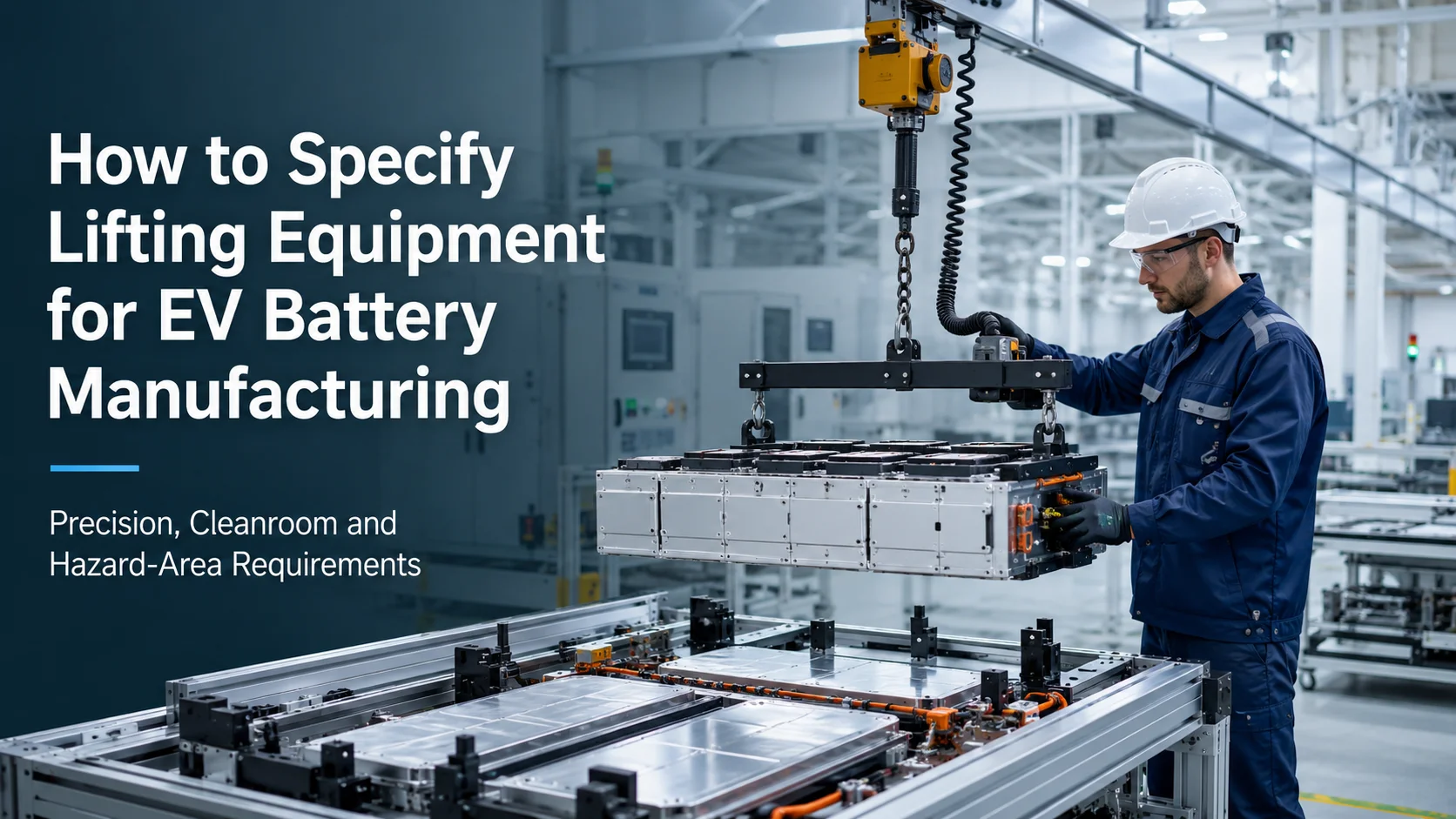
Selecting EV battery manufacturing lifting equipment starts with the production process, not with hoist capacity. A lifting system used around cell manufacturing may face very different environmental requirements from equipment handling finished modules or battery packs. Buyers therefore need to define the manufacturing stage, load geometry, positioning requirements, cycle rate, clean or dry-room conditions, and any hazardous-area classification before choosing an electric hoist, pneumatic balancer, or other lifting solution.
The goal is to turn those operating conditions into a specification that equipment suppliers can verify rather than relying on broad descriptions such as “clean,” “precision,” or “explosion-proof.”
Start With the Battery Manufacturing Stage Before Selecting Lifting Equipment
Battery manufacturing is not one uniform lifting environment. Cell production, module assembly, and pack assembly can create different material-handling requirements, so the first purchasing question should be: What exactly is being lifted, and at which stage of production?
Cell Manufacturing: When Clean and Dry-Room Conditions Change the Specification
Cell manufacturing can involve controlled environments where moisture and contamination matter to the process. U.S. Department of Energy resources document lithium-ion cell manufacturing and prototyping facilities using clean and dry rooms, including facilities where temperature and humidity control are critical to production.
That does not mean every hoist inside a battery facility automatically needs a specific cleanroom classification. The process owner should first define the actual room conditions and contamination restrictions.
For lifting equipment, buyers should review exposed materials, wear surfaces, lubrication, surface treatments, maintenance practices, and any project-specific particle or material restrictions. A product described as “clean operation” should still be checked against the environmental specification for the actual workstation.
Module and Pack Assembly: When Precision and Positioning Become the Priority
Module and pack assembly often shifts the purchasing focus toward controlled movement. The load may need to approach a fixture slowly, be guided by an operator, change orientation, or be positioned repeatedly during a production cycle.
Capacity alone cannot describe this application. The specification should include component dimensions, center of gravity, lifting points, tooling weight, pickup and placement positions, required rotation, horizontal travel, and lifts per hour.
A system that safely raises the required weight may still be unsuitable if load swing, coarse controls, limited reach, or slow positioning interfere with the assembly process. The correct lifting technology therefore depends on how the battery component must move, not simply how much it weighs.
What Precision Requirements Matter for EV Battery Lifting?
“Precision lifting” should be translated into measurable or verifiable operating requirements. Buyers need to define what the operator is trying to control before asking a supplier for a precision hoist.
Specify Motion Control and Load Behavior Before Capacity Alone
Start by determining whether the task requires ordinary lifting and lowering or repeated controlled positioning. Consider approach speed near the fixture, load swing, braking and holding behavior, travel distance, operator interaction, and whether the part must remain suspended while another process is completed.
Different control approaches can suit different tasks. Apollo Hoist’s HQ5 pneumatic balance crane, for example, is described with stepless speed control and precise lifting and positioning, making that equipment direction relevant when the operator needs continuous hands-on control of the load.
However, descriptions such as “precise positioning” should not be converted into an assumed positioning tolerance. If the assembly process has a numerical accuracy requirement, that capability should be confirmed against the selected configuration and project specification.
Include Battery Geometry, Tooling, and Cycle Rate in the Specification
Battery module lifting equipment should be specified around the complete suspended load. Tooling, clamps, fixtures, or other end effectors can change total weight, center of gravity, clearance, and handling behavior.
The RFQ should therefore identify the minimum and maximum load, dimensions, tooling weight, lifting points, required rotation or tilt, vertical lift, horizontal movement, and normal and peak cycle rate.
This information is especially important when multiple module or pack sizes share one workstation. A configuration developed only around the heaviest SKU may not grip, balance, or position smaller variants correctly. Drawings, photos, layout information, and representative samples give the supplier a better basis for evaluating the full application.
Does the Lifting Equipment Need Cleanroom or Dry-Room Compatibility?
Cleanroom lifting equipment and dry-room lifting equipment should not be treated as interchangeable marketing terms. Battery processes may impose different requirements for moisture, particles, materials, and maintenance, and those requirements should come from the facility or process specification.
What Can Make a Lifting System Unsuitable for a Controlled Environment?
Potential concerns include particles generated through wear, exposed lubricants, surface coatings, materials used in moving components, and maintenance activities that introduce contamination. Extremely dry operating environments may also create requirements that differ from an ordinary industrial room.
DOE-supported battery manufacturing facilities demonstrate that dry-room environments are genuinely relevant to cell manufacturing, but the exact environmental conditions vary by process and facility.
Apollo lists a clean-operation electric chain hoist within its current product range and describes customization options such as two-speed operation, frequency conversion, surface treatment, and other functional changes. That makes it a relevant product direction for technical review, but the project still needs to verify the required cleanroom class, particle limits, lubrication requirements, dry-room conditions, and other acceptance criteria rather than inferring them from the product name.
What Evidence Should Buyers Request From a Cleanroom Lifting Equipment Supplier?
A purchasing specification should convert “cleanroom compatible” into evidence that can be reviewed.
Depending on the application, buyers may need to request the applicable environmental classification, the basis for that classification, material and surface-treatment information, lubrication details, maintenance procedures, and operating-environment limits. If a battery process prohibits certain materials or substances, those restrictions should be included directly in the RFQ.
A common procurement risk is accepting a label such as “clean,” “dust-proof,” or “special environment” without establishing what it means for the project. Where a specific cleanroom or dry-room performance requirement applies, it should become an acceptance condition rather than an informal supplier preference.
Does an EV Battery Workstation Actually Need Explosion-Proof Lifting Equipment?
Battery manufacturing involves hazards, but that does not make every production area a hazardous classified location. The classification of the actual workstation must come before selection of an explosion-proof hoist.
Classify the Area Before Choosing the Hoist
OSHA requires hazardous locations to be evaluated according to the flammable gases, vapors, liquids, combustible dusts, or fibers that may be present and the likelihood of a hazardous concentration. Importantly, each room, section, or area is considered individually. Equipment used in a classified location must also be suitable for that particular classification and the relevant combustible properties.
For a U.S. project, buyers should therefore obtain the applicable Class/Division or Zone information and any required group, temperature, or approval information before requesting lifting equipment.
A pneumatic device should not automatically be treated as approved hazardous-location equipment simply because compressed-air operation can avoid some electrical ignition sources. Likewise, an “explosion-proof” product description does not by itself prove suitability for the project’s exact classification.
Once a workstation has been formally classified, buyers needing more background can review Apollo’s guide to explosion-proof hoists in hazardous environments before moving into model-level selection.
Electric Chain Hoist or Pneumatic Balancer for EV Battery Assembly?
The right technology depends mainly on the required movement and operator interaction.
| Application Need | Equipment Direction to Evaluate |
|---|---|
| Primarily controlled lifting and lowering | Electric chain hoist |
| Frequent operator-guided positioning | Pneumatic balancer or balance crane |
| Controlled approach to fixtures | Lifting system with suitable speed and positioning control |
| Classified hazardous location | Equipment verified for the actual classification |
| Clean or dry-room process | Equipment supported by appropriate environmental evidence |
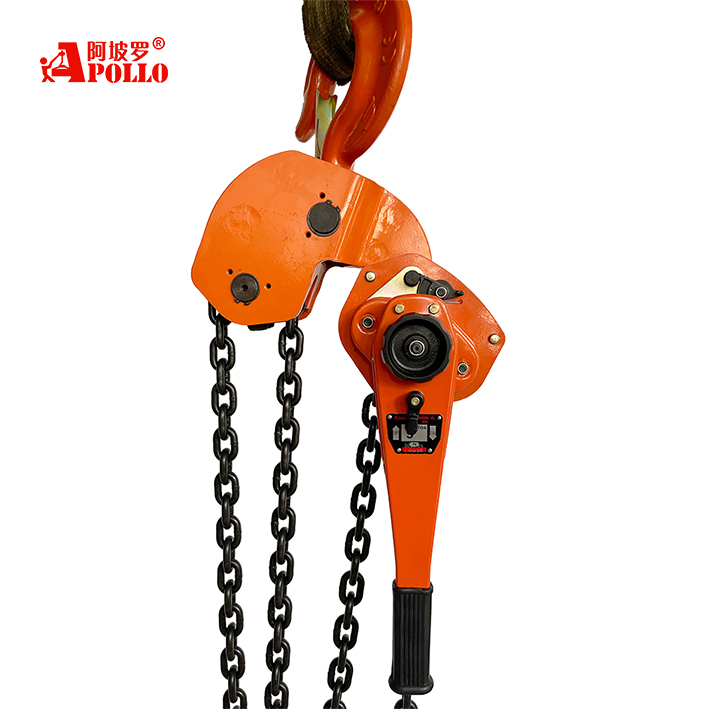
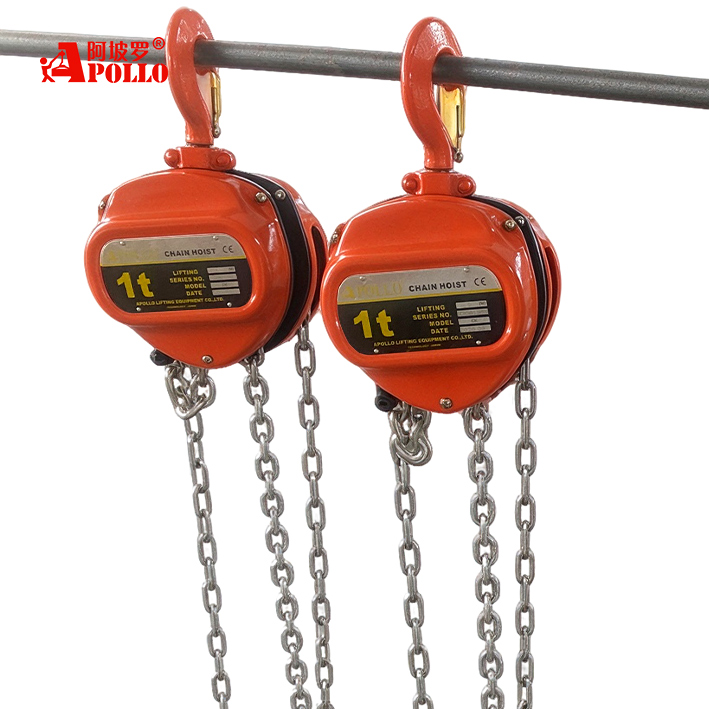
An electric chain hoist may be suitable when the process is primarily vertical lifting with defined pickup and placement positions. A pneumatic balancer becomes more relevant when an operator must repeatedly guide, float, or position the load through the assembly cycle.
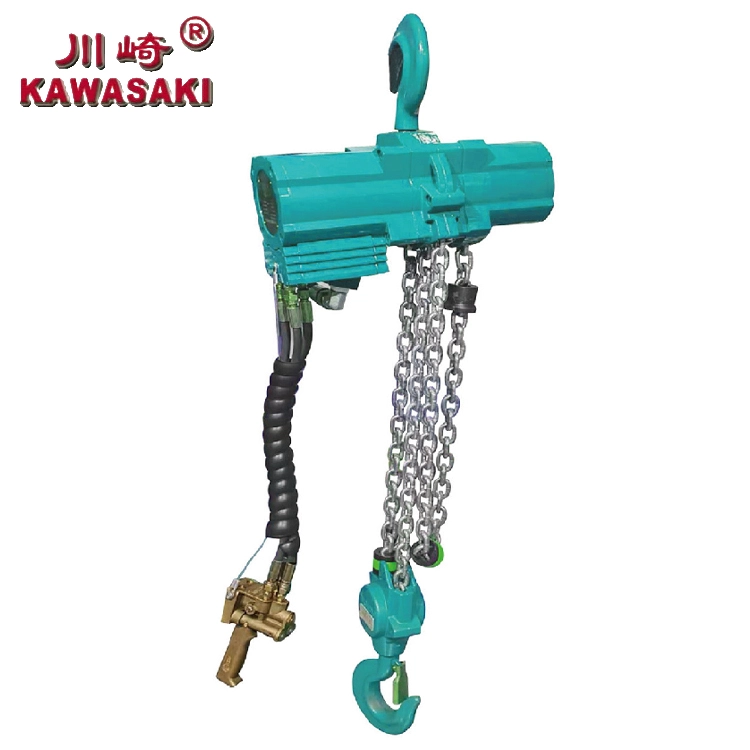
Neither technology should be chosen from its power source alone. Capacity, travel, utilities, tooling, duty, cycle rate, control behavior, environmental conditions, and workstation structure all need to be considered together.
How to Prevent Specification Gaps in an EV Battery Lifting Equipment RFQ
An incomplete RFQ forces suppliers to make assumptions, which makes quotations difficult to compare. A useful EV battery lifting equipment specification should include:
- Cell, module, or pack manufacturing stage
- Part description, dimensions, and weight range
- Center of gravity and lifting or gripping points
- Tooling or end-effector requirements
- Pickup and placement locations
- Vertical and horizontal travel
- Rotation, tilt, or positioning requirements
- Normal and peak production cycle
- Electrical or pneumatic utilities
- Cleanroom or dry-room conditions, where applicable
- Material restrictions, where applicable
- Hazardous-area classification, where applicable
- Installation and clearance constraints
- Required testing, documentation, and acceptance criteria
Avoid specifications such as “1-ton cleanroom explosion-proof hoist” without defining the operating environment and movement. Those labels describe possible product characteristics, not the complete application.
How to Qualify an EV Battery Lifting Equipment Supplier
Supplier qualification should focus on whether the proposed equipment is tied to the actual process. A useful technical review should show that the supplier understands the battery manufacturing stage, complete suspended load, travel path, positioning requirement, workstation layout, cycle rate, utilities, and environmental restrictions.
Claims involving clean operation or hazardous-area suitability deserve additional scrutiny. Buyers should ask what documentation supports the claim and whether it applies to the exact configuration being quoted.
Apollo Hoist currently offers electric lifting products, pneumatic balance cranes, and special-environment product directions, providing several starting points for application review. These product categories should still be evaluated against project-specific requirements rather than treated as universal EV battery solutions.
Conclusion
Selecting lifting equipment for EV battery manufacturing is a sequence of engineering decisions: identify the process stage, define the load and movement, determine precision needs, document clean or dry-room conditions, confirm any hazardous-area classification, and then compare equipment and suppliers against the same RFQ.
For a project review, buyers can use contact Apollo Hoist to submit the manufacturing stage, load dimensions and weight, drawings, workstation layout, travel, cycle rate, environmental conditions, required quantity, and any project-specific classification or documentation requirements. Providing these details gives the supplier a clearer basis for evaluating an appropriate lifting configuration.
Frequently Asked Questions
What lifting equipment is used in EV battery manufacturing?
It depends on the manufacturing stage and handling task. Electric hoists, pneumatic balancers, workstation lifting systems, and other handling equipment may be evaluated according to load, positioning, travel, production cycle, and environmental requirements.
Does EV battery manufacturing require cleanroom lifting equipment?
Not at every workstation. Cell manufacturing can involve clean and dry-room environments, but the required conditions depend on the process. Buyers should obtain the actual environmental specification before selecting a cleanroom hoist or other lifting equipment.
Do EV battery plants need explosion-proof hoists?
Not automatically. Hazardous-location equipment is required based on the classification of the specific area, not simply because the facility manufactures batteries. For U.S. applications, the relevant classification and equipment suitability should be verified against project documentation and applicable OSHA requirements.
Is a pneumatic balancer suitable for battery module assembly?
It may be suitable when the operator needs frequent, controlled positioning rather than simple vertical lifting. Load, travel, cycle rate, compressed-air availability, tooling, environmental conditions, and any safety classification should still be verified for the application.
What information should be sent to an EV battery lifting equipment supplier?
Provide the process stage, part dimensions and weight, drawings or photos, tooling requirements, pickup and placement points, travel, cycle rate, utilities, clean or dry-room conditions, hazardous-area classification if applicable, installation constraints, quantity, and required documentation.