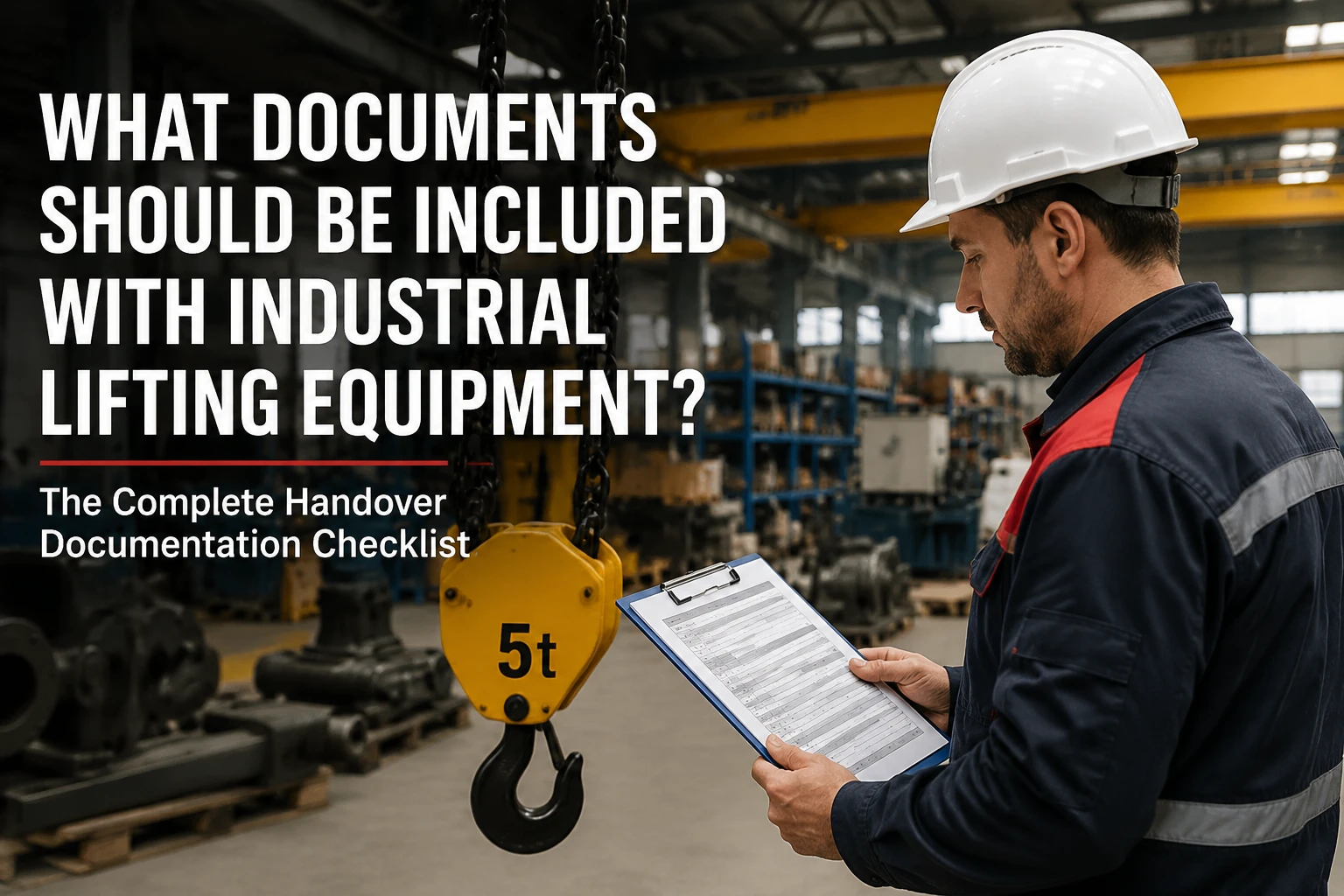
Industrial lifting equipment should arrive with a document pack that explains what the equipment is, how it may be used, how it was verified, and how its service history will be controlled. The exact legal set depends on the country, equipment type, configuration, and contract, but a proper handover goes beyond a brochure and an invoice. Missing drawings, instructions, or examination records can delay commissioning and make later inspections harder to defend.
For buyers of electric chain hoists, wire-rope hoists, winches, and related lifting equipment, the practical test is simple: can a competent person identify the machine, operate it within its limits, inspect it, maintain it, and trace every safety-relevant decision? The following checklist separates documents that should accompany delivery from records that the owner must create or retain during operation.
Product identity and configuration record
Start with a controlled identity sheet for each delivered unit. It should connect the equipment to a model, serial number, rated capacity, lift or travel arrangement, power supply, control method, and installation location. Include a nameplate photograph and the final configuration or order reference. If the equipment has options, list them explicitly rather than relying on a generic family name.
- Manufacturer, model, serial number, production or delivery reference, and revision status.
- Rated capacity, lift height, duty classification, speed or control arrangement where specified.
- Motor, brake, limit-device, trolley, pendant, radio, or other fitted options that affect operation or maintenance.
- A marked-up general arrangement or equipment photograph showing orientation and attachment points.
This record is the index for the rest of the pack. It prevents a manual, test certificate, or spare-parts list from being filed against the wrong hoist when several similar units are installed.
Operating and installation documents
The user and installer need current instructions, not only marketing literature. The operating manual should explain intended use, rated limits, controls, warnings, pre-use checks, abnormal conditions, and shutdown. Installation instructions should cover mounting, electrical connections, anchorage or support interfaces, adjustments, and post-installation checks within the manufacturer’s stated scope.
Include wiring diagrams, control schematics, dimensional drawings, and load-chain or wire-rope reeving information when they apply to the delivered configuration. Keep the revision used at commissioning. A later generic manual may omit an option or show a different control circuit, creating avoidable troubleshooting risk.
- Operator instructions and clear warnings for foreseeable misuse.
- Installation, commissioning, adjustment, and removal instructions for the supplied configuration.
- Electrical diagrams, component lists, lubrication guidance, and recommended inspection points where provided.
Conformity, test, and quality evidence
The delivery pack should identify which conformity and test documents apply to the equipment and the destination market. Depending on jurisdiction and contract, this may include a manufacturer’s certificate, declaration of conformity, certificate of incorporation or assembly, routine test results, factory acceptance records, or a load or proof-test certificate. Do not treat a logo or a general quality statement as a substitute for a document tied to the actual unit.
The document should state the equipment identity, applicable standard or procedure where relevant, test date, result, responsible organization, and any limitations or outstanding actions. Where a certificate covers an assembly, confirm that the hoist, trolley, controls, and accessories are within its stated scope. Legal terminology varies; have the responsible compliance professional confirm what is required for the installation’s market and use.
For US projects, review the applicable employer and manufacturer obligations in the OSHA construction standard for equipment with a rated hoisting or lifting capacity rather than assuming one certificate satisfies every duty.
Inspection and examination records
New equipment may require an initial inspection, commissioning check, or thorough examination before being placed into service. Provide the inspection form or report that records what was examined, the identity of the equipment, findings, corrective actions, and the next due date where applicable. The record should distinguish a visual pre-use check from a more detailed periodic examination; they are not interchangeable.
For a fleet, retain a history for each serial number. Link repairs, overload events, changes, replacement components, and out-of-service decisions to the corresponding report. If local rules require a competent person or a specific interval, follow those rules and the manufacturer’s instructions together. The document pack supports compliance, but the owner remains responsible for a workable inspection system.
Maintenance and spare-parts information
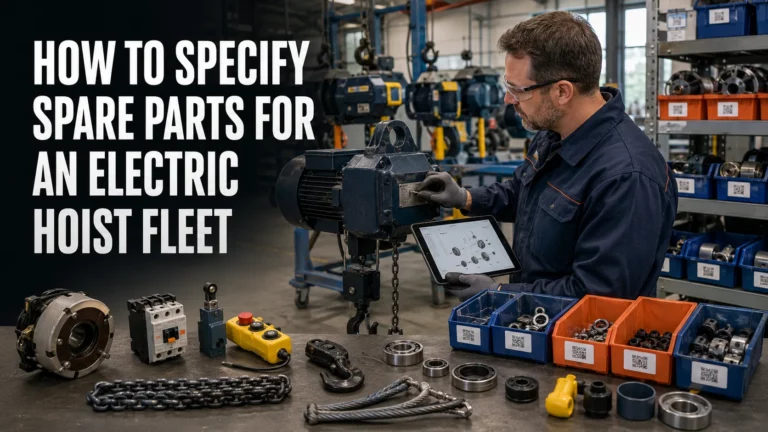
Maintenance documentation should tell the team what to inspect, lubricate, adjust, clean, replace, and record. Include the preventive-maintenance schedule, lubrication specifications, wear limits, fault codes, troubleshooting logic, and component or exploded-view diagrams when supplied. A spare-parts list should identify official part numbers, assembly positions, revisions, and compatible models; a generic description such as brake or chain is not enough for a mixed fleet.
- Recommended inspection points and conditions that require isolation or specialist review.
- Part numbers for safety-relevant components, electrical controls, load chains, wire ropes, hooks, brakes, and limit devices where listed by the manufacturer.
- Instructions for post-maintenance testing, functional checks, and return to service.
- Revision history so superseded drawings and manuals are not used accidentally.
Risk, application, and site records
Some important documents are created by the owner or integrator rather than shipped in the box. The site file may include a lifting plan, risk assessment, method statement, electrical inspection, support-structure verification, operator training record, and local emergency or isolation procedure. These records explain how the equipment is used in the actual workplace, including hazards that a manufacturer cannot know from the order alone.
Keep a clear boundary between supplier evidence and site evidence. A manufacturer’s manual does not replace a site risk assessment, and a site checklist does not prove the equipment’s design conformity. Cross-reference both sets by asset ID so an auditor or maintenance planner can follow the decision chain.
What to request in the purchase order
Make the documentation deliverables contractual. State the file format, language, revision control, serial-number mapping, and delivery timing. Ask for electronic copies that can be searched and archived, plus any originals required by the jurisdiction or customer. Define whether updated documents will be supplied after an approved modification or component supersession.
- A document index showing the title, revision, date, equipment identity, and file name for each record.
- A list of exclusions or documents that are not applicable, with the reason stated.
- A process for correcting errors, issuing revisions, and notifying the owner of safety-relevant changes.
- Confirmation of which tests, certificates, drawings, and manuals are included with each serial-numbered unit.

How Apollo documentation fits the handover
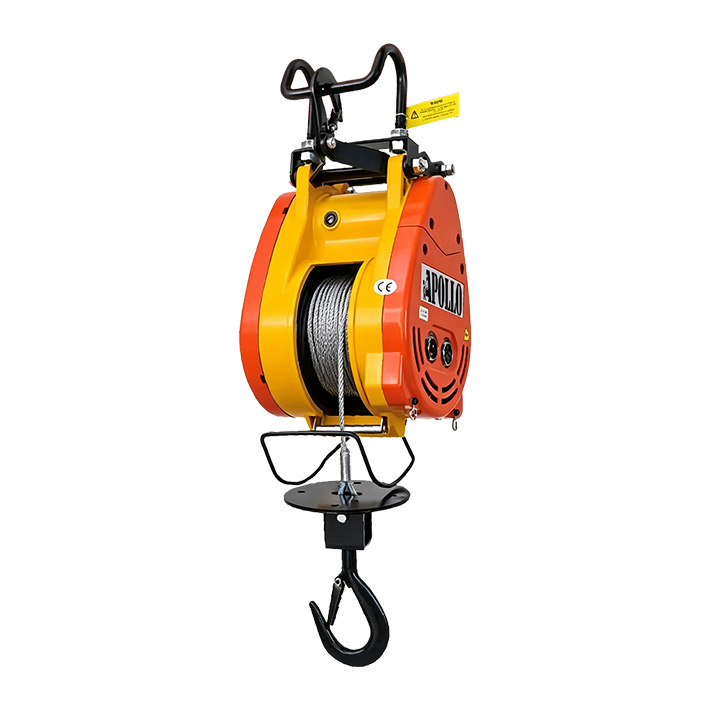
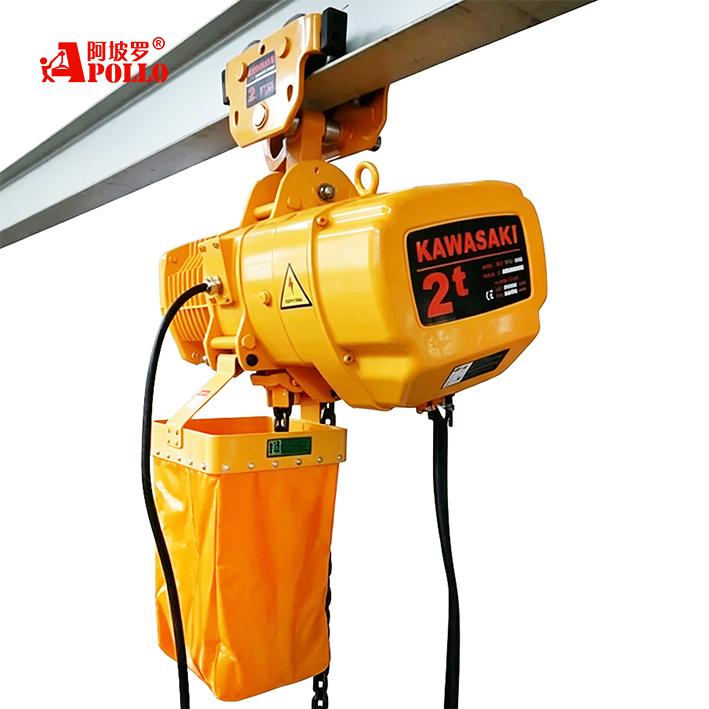
Apollo’s published product navigation covers electric chain hoists, electric wire-rope hoists, electric winches, explosion-proof hoists, and other lifting equipment. Use the electric hoist product categories to identify the equipment family, then request documents against the exact model and configuration. The category page is not itself a conformity certificate or a substitute for the unit-specific manual and test record.
Apollo also presents service and customization capabilities. For a project with several configurations, ask which drawings, manuals, inspection forms, and spare-parts lists apply to each unit. Send the asset schedule, installation details, destination market, and required document list through the technical contact channel before shipment so missing records do not become a commissioning delay.
Conclusion
A complete industrial lifting equipment handover connects identity, operation, installation, conformity, testing, inspection, maintenance, and site controls. The strongest document pack is unit-specific, revision-controlled, and explicit about what is included, what is not applicable, and who owns each ongoing record. Build the requirement into the purchase order, verify it at receipt, and keep every safety-relevant revision linked to the equipment’s serial number.
FAQs
Is a user manual enough for industrial lifting equipment?
No. A manual explains use, but a complete handover may also need identity records, drawings, conformity evidence, test results, inspection reports, maintenance information, and site-specific risk records.
Who is responsible for inspection records?
The supplier should provide applicable factory or delivery evidence. The owner or employer normally maintains operating, inspection, repair, and examination records required for the installed equipment and jurisdiction.
Should documents be supplied for every hoist in a fleet?
Yes, each serial-numbered unit should have a traceable document set. Shared manuals can be used when compatibility is documented, but certificates, configuration records, and inspection reports must remain tied to the relevant unit.
What should be checked when documents arrive?
Match model and serial information, revisions, options, ratings, test scope, dates, signatures or responsible organization, and any stated limitations. Quarantine unclear or mismatched records until the supplier confirms them.