The specification nobody asks about until the load arrives
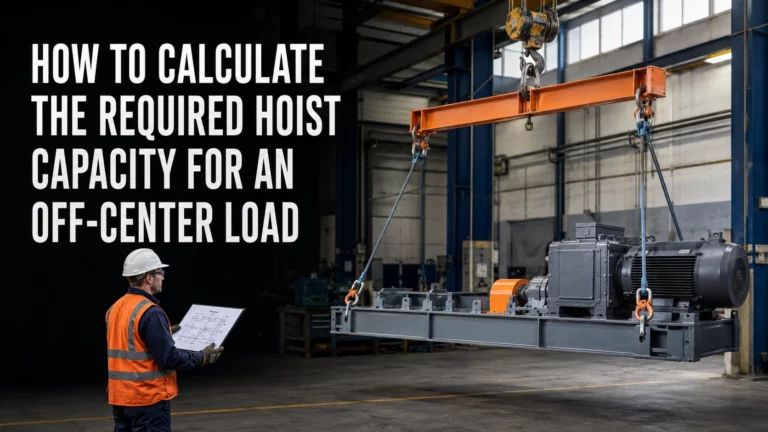
A workshop buys a compact electric hoist rated for 500 kg to lift pump housings off a bench. The heaviest housing weighs 480 kg, and the crew adds a spreader bar of 40 kg and slings of 20 kg. On the first heavy lift the hoist is working with a thin margin, and someone asks the question that should have been asked at the quotation stage: should the rope be running single or double? The same unit answers both ways, but nobody specified which configuration the rating referred to.
Rope configuration is the quietest decision in this product class. It does not change the price, it does not change the motor, and it changes both the capacity and the speed of the hoist on the same rope.
The choice gets made late for four reasons:
- The rating is read on its own, without asking whether it describes single rope or reeved operation.
- The load is estimated by eye, so the rigging weight is never added to the number the hoist actually carries.
- Speed is judged after installation, once the crew discovers how slow a reeved hoist feels on light, frequent lifts.
- Rope inspection is planned for one rope, when the reeved configuration puts two rope runs in the load path.
This guide is written for workshop supervisors, maintenance planners, plant buyers, and distributors who specify compact electric hoists for loads between 100 kg and 750 kg. It explains what single and double rope actually change, how to total the load properly, and how to pick the configuration that suits the work rather than the paperwork.
Get a free load assessment: send the part weight, the rigging weight, the lift height, and how often the hoist runs to sales@apollohoist.com, and receive a configuration recommendation within one business day.
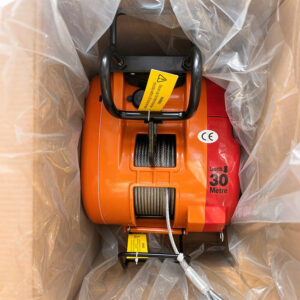
What a rope configuration actually changes
How a single rope runs
In a single rope configuration the rope leaves the drum, passes over the sheave, and terminates at the hook. One rope line carries the weight, and the hook rises by the length of rope wound onto the drum. That direct relationship is why the single rope mode is the faster of the two for the same motor setting: every metre of rope the drum takes in becomes a metre of hook travel. It is the arrangement that suits light loads lifted often, where the crew cares about how quickly the part comes off the bench.
How a double rope runs
In a double rope configuration the rope is reeved so that two lines share the load between the drum and the hook. The same hoist then lifts about 85 percent more than it does on a single rope, because the load is divided between two rope runs instead of one. The trade-off is speed: for each metre the hook rises, the drum has to take in more rope, so the hook moves more slowly at the same motor setting. Neither configuration is better. They are two answers to the same question, and the question is whether you value lifting capacity or lifting speed on this job.
| What changes | Single rope | Double rope |
| Capacity from the same hoist | The rating in single rope mode | About 85 percent more than single rope |
| Hook speed at the same motor setting | Faster | Slower, because more rope is taken in per metre of hook travel |
| Rope runs in the load path | One run to inspect | Two runs to inspect |
| Best suited to | Light loads lifted often, where speed matters | Heavier loads that still have to be lifted with the same unit |
| Rope length used per metre of lift | One metre of rope per metre of lift | More rope per metre of lift, so check the usable height |
How to decide which mode to use
- Total the load that the hoist actually carries.The part, plus the spreader bar or lifting beam, plus the slings and shackles. A 480 kg housing with a 40 kg spreader bar and 20 kg of slings is a 540 kg load before anything else is considered.
- Compare that total with the capacity in the mode you intend to use.The rating in single rope mode and the rating in double rope mode are different numbers, and the margin between them is what the configuration decision is really about.
- Leave margin above the total rather than working on the limit.A hoist running at its rating on every lift wears faster and leaves no room for a load that is not perfectly balanced.
- Match the configuration to the duty, not to the maximum load.If most lifts are light and frequent, single rope keeps the cycle short. If the same unit has to handle occasional heavy parts, double rope earns its slower speed.
- Check the usable lifting height for that mode.A reeved configuration uses more rope for each metre of hook travel, so the height available from a given drum capacity is lower than in single rope mode. Compare the figure with the height you need before ordering.
Get a free load assessment: send the load total, the number of lifts per shift, and the height you need to reach, and Apollo’s engineers will confirm the rope configuration and the capacity margin in writing within one business day, at no cost.
What the compact hoist does beyond the rope choice
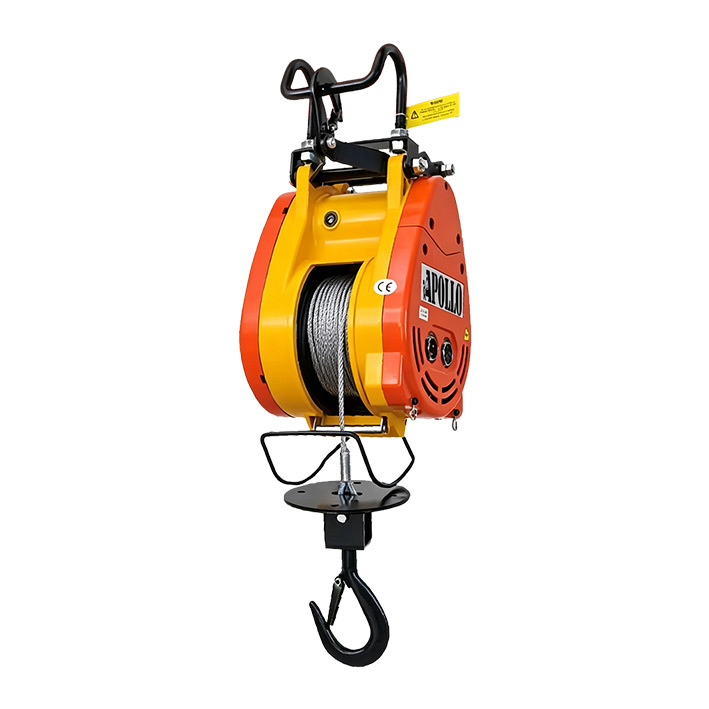
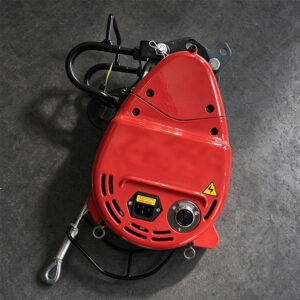
The rope configuration sits on top of a machine that is designed for loads from 100 kg to 750 kg, and the rest of the design is what makes the choice practical. The body weighs 16 kg or 24 kg, so one technician can hang the unit on a beam without a lifting frame, which matters in workshops that have never had powered lifting. A permanent magnet inverter motor drives the hoist, which means the speed is set electronically rather than fixed by the supply, so the same unit can creep at 5 to 12 metres per minute for a final placement and run at 14 to 34 metres per minute when the load is travelling. Braking is dual: an electric brake for normal stops, plus a mechanical brake that holds the load if the power is lost. The protection set covers overload, overheat, the limit switch, and anti-reverse as standard rather than as options, and the pendant runs on a 4 volt safe control voltage, which reduces the electrical exposure at the operator’s hand. Rope sizes run from 5 mm to 8 mm with standard lifting heights of 20 m, 29 m, and 49 m, the standard supply is 220 volts, and each unit ships with CE documentation and a one year warranty. The pendant can be specified as a two button cable control, a cable control with a remote, or a wireless remote, and the standard power cable is 4.5 m with a 6 m control cable.
The Apollo compact wire rope hoist range, with rope options and lifting heights for every size, is listed on the mini wire rope hoist category page (https://www.apollohoist.com/product-category/electric-hoist/electric-wire-rope-hoist-mini/).
Rope care: the checks that decide rope life
A wire rope is replaced as a rope rather than link by link, which makes inspection the whole maintenance story. Six checks cover almost everything a compact electric hoist will ask of a maintenance team:
- Inspect the rope before each shiftfor broken wires, kinks, flat spots, and corrosion. Those four conditions are the reasons a rope is condemned, and a reeved configuration means two runs to look at rather than one.
- Test the limit switch weeklyby running the empty hook slowly into the upper stop, so a failed switch is found before a load is relying on it.
- Check brake holding at the start of a heavy jobwith the rated load, not with an empty hook.
- Check the hook latchso it closes fully on its own and is not held open by wear or by a bent latch.
- Check the pendant and the control cablefor cuts and for the correct return of the hoist when the button is released.
- Record every inspection, because a trend is what turns a wear question into a planned rope replacement instead of an unplanned stoppage.
The height at which the hoist is mounted affects how much of the rope is in use on every lift, and the same layout questions come up on every compact hoist installation. The headroom guide covers how to work out the space a hoist needs above the hook (https://www.apollohoist.com/product-news/hoist-headroom-calculator-standard-vs-low-headroom/).
Why the supplier matters as much as the rating
A compact hoist is easy to buy and harder to keep running, because the parts that fail are the parts a buyer never sees in a photograph. Ask any mini electric hoist supplier four questions before the order: what rope diameter is fitted, whether the capacity figure quoted is for single or reeved operation, what the replacement interval is for the rope and the brake, and which of those parts are held in stock. A supplier who answers all four has thought about the second year of ownership, not only the first sale.
Apollo is a small wire rope hoist manufacturer that has built lifting equipment for more than 20 years, exports to over 50 countries, and holds ISO9001, CE, and GS. The compact range is produced in the Apollo factory from 100 kg to 750 kg, which means one rope specification, one brake design, and one documentation set across the sizes a workshop is likely to buy. As an established heavy duty lifting equipment manufacturer, Apollo also builds the electric chain hoists and manual hoists that share the same beams and the same inspection paperwork, and working with one industrial lifting equipment supplier across the range keeps one approval file for the whole site. The full compact range, including rope options and control configurations, is listed on the mini wire rope hoist category page (https://www.apollohoist.com/product-category/electric-hoist/electric-wire-rope-hoist-mini/), and the wider powered range sits on the electric hoist category page (https://www.apollohoist.com/product-category/electric-hoist/).
How to buy from Apollo: choose your channel
Plant, workshop, and project procurement
Get a free load assessment: send the part weight, the rigging weight, the lift height, the number of lifts per shift, and the supply available on site. Within one business day you receive a matched hoist recommendation, the rope configuration that fits the duty, and the CE documents and warranty terms in writing.
Distributors and dealers
The compact range covers 100 kg to 750 kg with body weights of 16 kg to 24 kg and small carton sizes that suit parcel carriers rather than pallets, which keeps dealer logistics simple. Pairing the hoist with Apollo electric chain hoists, beam trolleys, and manual hoists in one order keeps one documentation set for the customer.
OEM and private label
Custom branding, packaging, and documentation are produced at the Apollo factory, built to the compliance requirements of your market.
Request conformity document samples now
- Get a free load assessment via WhatsApp / Phone: +86 18989488615
- Request conformity document samples by email: sales@apollohoist.com
- Submit an online inquiry: https://www.apollohoist.com/contact-us/
- Browse the full product range: https://www.apollohoist.com