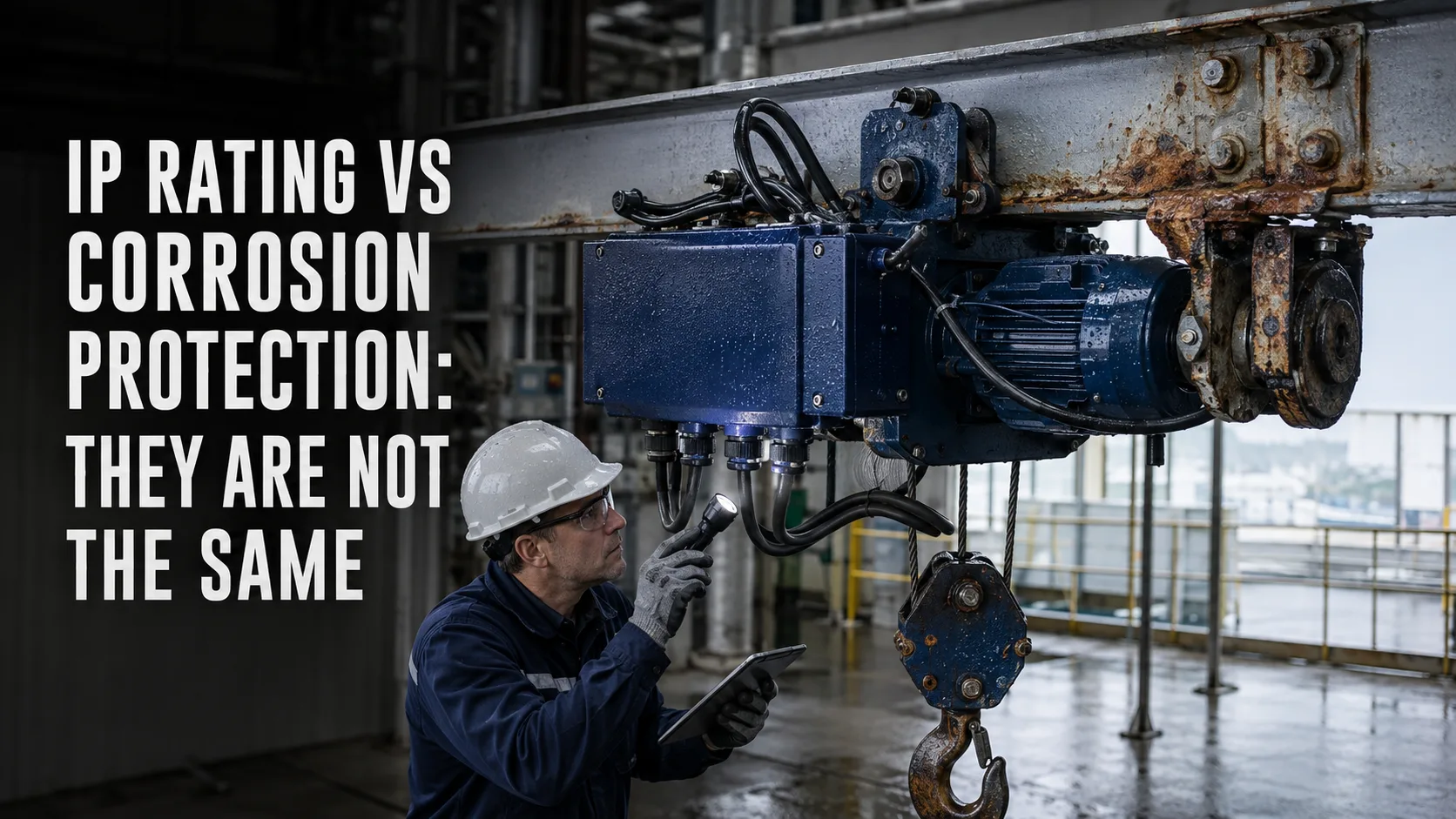
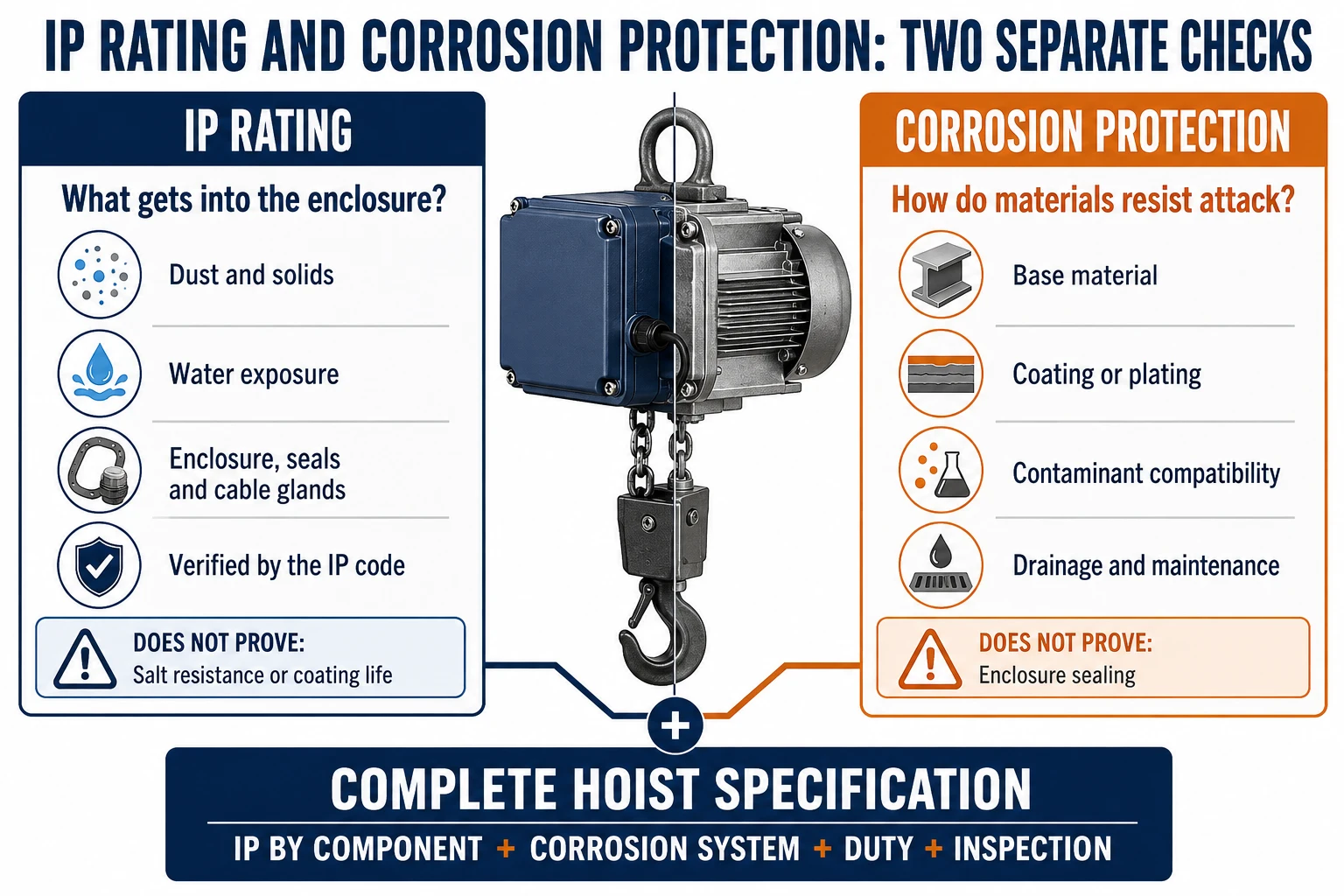
An IP rating tells you how well an enclosure limits the entry of solids and water. Corrosion protection tells you how the materials, finishes, and maintenance approach withstand chemical or electrochemical attack over time. A hoist can have a useful IP rating and still rust in salt air, while a corrosion-resistant frame can fail if water reaches an unsealed electrical compartment. For industrial buyers, the two checks belong in the same risk review, but they answer different questions.
The distinction matters when a lifting device moves from a dry workshop into a washdown area, coastal plant, wastewater facility, or process line. The right specification combines ingress control, material selection, coating or plating, drainage, inspection, and a duty-appropriate service plan.
What an IP rating actually measures
The IEC IP code uses two principal digits. The first grades protection against access to hazardous parts and the entry of solid foreign objects, from no stated protection to dust-tight performance. The second grades resistance to water entry under defined test conditions, from no stated protection through jets and temporary or continuous immersion at the highest levels. The International Electrotechnical Commission’s IP rating guidance is the authoritative reference for the code’s scope.
An IP number is therefore an enclosure test result, not a universal environmental durability score. It does not, by itself, state that exposed steel is stainless, that a coating resists salt spray, that fasteners will not seize, or that a gearbox lubricant is compatible with chemicals. It also does not replace a hazardous-area, temperature, load, or lifting-duty assessment.
How to read the code in a hoist specification
- Check which component the rating covers: a motor terminal box, pendant, control cabinet, brake housing, or the complete hoist assembly may have different ratings.
- Match the test condition to the real task. Hose-down exposure, driving rain, condensation, and immersion are different risks even when they all involve water.
- Confirm installation assumptions such as cable glands, covers, orientation, drain paths, and whether maintenance can restore seals after opening the enclosure.
What corrosion protection actually covers
Corrosion protection addresses the metal surface and the environment around it. Options can include a compatible base material, galvanizing, plating, paint or powder systems, conversion treatments, sealed joints, and a maintenance program that removes deposits before they hold moisture against the surface. The correct choice depends on the contaminant, humidity, temperature, exposure time, abrasion, crevice geometry, and the consequences of a weakened component.
Apollo’s electric-hoist range includes an OHFM European electric wire rope hoist described with a European pickling and galvanizing process for harsher or humid environments. The same product page lists IP54/IP55 protection for its electrical protection performance. Those are complementary claims: the finish addresses material durability, while the IP grade addresses ingress into specified enclosures. Both details should still be checked against the exact configuration and application conditions before purchase.
Review the electric hoist category for available configurations.
Why a high IP rating does not stop rust
Water exclusion and corrosion resistance overlap only indirectly. A sealed housing can slow the arrival of water at electrical parts, yet the exterior frame, chain, hooks, pins, welds, and fasteners remain exposed. Even inside a sealed enclosure, trapped condensation or a damaged gasket can create a persistent electrolyte film. Chlorides, acids, alkalis, cleaning agents, and dissimilar-metal contact can accelerate attack without violating the original IP test conditions.
Conversely, a galvanized or coated component may tolerate a corrosive atmosphere while still needing an enclosure that blocks dust and water. If moisture reaches a brake, contactor, sensor, or control board, the immediate failure mode may be electrical rather than visible rust. Treat IP and corrosion as two layers in a protection strategy, not as interchangeable labels.
A practical selection workflow
Use the following sequence when comparing hoists for an exposed installation:
- Define the exposure: indoor, outdoor, marine, washdown, chemical, high-condensation, or intermittent immersion. Record contaminants and cleaning methods, not just a general word such as harsh.
- Separate protected and exposed parts. List the enclosure, motor, controls, load chain or wire rope, hook, trolley, beam interface, and structural fasteners.
- Specify ingress needs by component and verify the test basis. Ask what IP54 or IP55 covers, how cable entries are configured, and what changes after field installation.
- Specify corrosion controls by mechanism. Request the base material, finish or coating system, preparation process, repair method, and any limitations for abrasion or chemicals.
- Check the lifting duty separately: working load limit, lift height, speed, duty cycle, ambient temperature, and required controls must suit the application and the manufacturer’s documentation.
- Plan inspection. Look for blistering, white corrosion products, red rust, coating holidays, pitting, seized pins, chain discoloration, and water paths around covers and glands.

Common specification mistakes
The most frequent mistake is writing a single requirement such as waterproof hoist and assuming it covers everything. Another is copying an enclosure rating from a motor datasheet to the complete lifting system. Buyers also overlook galvanic couples, unsealed cut edges, coating damage from rigging contact, and the difference between occasional rain and repeated chemical washdown. A corrosion-resistant finish can extend service life, but it does not authorize operation beyond the stated load, duty, temperature, or safety limits.
When a project needs a formal environmental classification, ask the supplier to map each requirement to a document: product specification, coating or plating description, enclosure test information, installation instructions, and inspection guidance. This makes gaps visible before the hoist is installed above a production line.
How Apollo can fit the decision
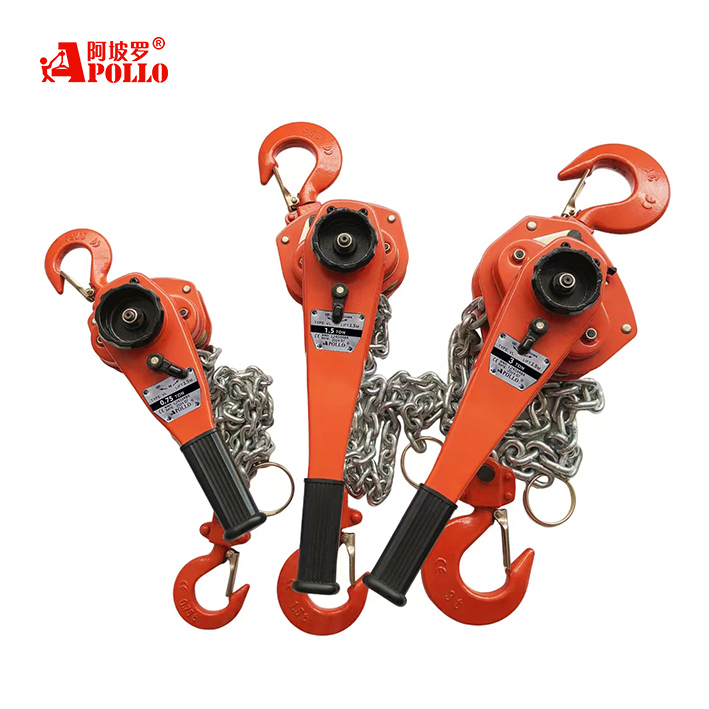
Apollo presents electric chain hoists, electric wire rope hoists, electric winches, explosion-proof hoists, and manual lifting equipment in its online product categories. Its OHFM listing is particularly relevant to a corrosion discussion because it combines a stated pickling-and-galvanizing process with an IP54/IP55 electrical protection grade. That combination may be a useful starting point for humid or harsh environments, but the final fit remains configuration- and site-dependent.
For an RFQ, provide the model or preferred category, working load limit, lift height, duty cycle, installation arrangement, material or chemical exposure, washdown method, ambient temperature, power supply, and quantity. Apollo’s service and customization capabilities can then be considered alongside the technical specification rather than treated as a substitute for it. For a site-specific review, contact the technical team with drawings or photos of the installation area.
Conclusion
IP rating and corrosion protection solve different parts of the same reliability problem. IP describes resistance to solid and liquid ingress at tested interfaces. Corrosion protection describes how materials and finishes manage chemical or electrochemical deterioration. Select both deliberately, verify which components each claim covers, and connect the choice to exposure, duty, installation, and inspection. That approach produces a defensible hoist specification and reduces the risk of mistaking a sealed enclosure for a corrosion-proof machine.
FAQs
Does IP66 mean a hoist is corrosion-resistant?
No. IP66 addresses dust-tightness and protection against powerful water jets under defined tests. Corrosion resistance requires separate evidence about materials, finishes, environmental exposure, and maintenance.
Is galvanized steel automatically suitable for marine service?
Not automatically. Marine exposure varies with salt concentration, wetness, abrasion, temperature, and cleaning. Confirm the finish, exposed parts, repair method, and application limits with the supplier.
Can a hoist have different IP ratings for different parts?
Yes. A motor, control enclosure, pendant, and cable entries may be evaluated separately. Ask for the rating and installation assumptions for each relevant component.
What should an RFQ include for a corrosive environment?
Include load, lift height, duty cycle, location, contaminants, washdown practice, temperature, power, installation arrangement, quantity, and any drawings or photos. This lets the supplier check both ingress and corrosion requirements.