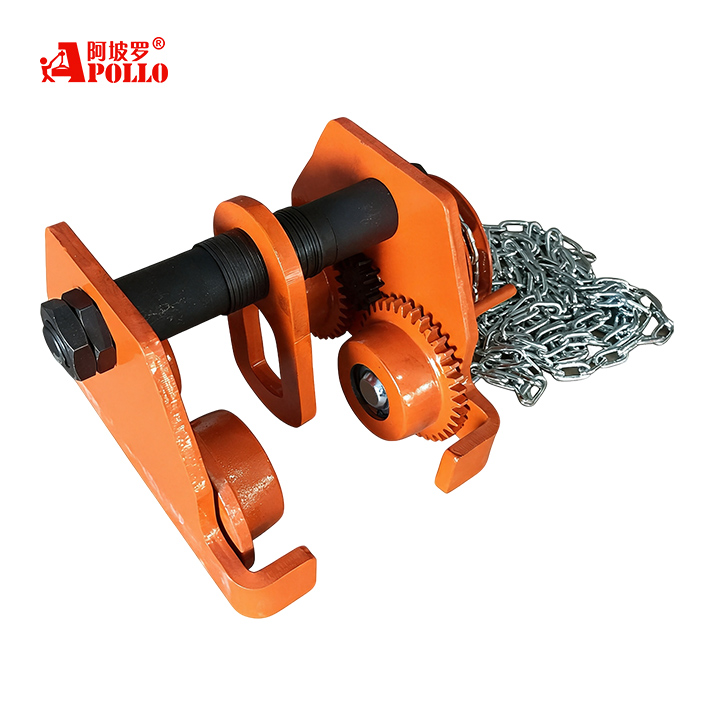
Why a geared trolley starts fighting the operator
A five tonne load rides a monorail in a fabrication bay. For the first year the geared trolley moves with one hand on the hand chain. Eighteen months later the same load needs two people, and it moves in jerks. Nothing has broken, no part has fallen off, and the inspection sheet still says the beam is fine. That is the problem with trolley wear: it does not announce itself as a breakdown, it announces itself as extra effort, and extra effort is easy to live with until the day it is not.
Maintenance slips on trolleys for reasons that have nothing to do with negligence:
- The trolley is treated as part of the beam, so it never appears on a machine maintenance schedule.
- Wheels and the gear train are never toucheduntil a load stops moving smoothly, by which time the wear is already advanced.
- The beam is inspected, the contact surface is not, so a worn tread and a lipped flange stay invisible.
- The hand chain is judged by eye, even though it stretches and wears like any other load chain.
- Spare parts are ordered after the damage, which turns a same-week fix into a three-week wait.
This guide is written for maintenance planners, workshop supervisors, plant engineers, and distributors who keep overhead lifting equipment running for years rather than seasons. It explains what actually wears on a geared beam trolley, how to read the early signs, and which installation mistakes cause most of the wear in the first place.
Get a free load assessment: send the beam flange width, the trolley capacity you are running, and a photo of the wheel tread to sales@apollohoist.com, and receive a condition review and a parts list within one business day.
What actually wears on a geared beam trolley
The wheels and the flange contact
The wheels carry everything: the hoist, the rigging, and the load. Apollo builds them as machined steel wheels with a hardened tread surface, so the contact face resists flattening where a softer casting would polish into a flat spot. Wear shows in two ways. The tread develops a polished flat that clicks as it crosses a joint in the beam, and the flange lip thins where it has been rubbing the side of the beam. Both are measurable. Compare the tread diameter across the wheel with the figure in the manual, and check the gap between the wheel flange and the beam flange on both sides of the trolley. A difference between the left and right gap means the trolley is not sitting square on the beam, and it will wear one side faster from that day on.
The gear train and the housing around it
A geared trolley moves the load by pulling a hand chain through a chain wheel that drives a geared axle. Apollo uses a precision-cut gear train with hardened steel pinions, held inside a fully enclosed gear housing. The enclosure is the part buyers underrate: it keeps dust, grit, and weld spatter away from the tooth contact, so the drive keeps its backlash instead of grinding itself loose. On a workshop trolley that lives under a beam in a fabrication bay, that single detail decides whether the drive is still precise after five years. What you check is simple: look for oil weeping at the housing joint, listen for a change in the sound of the drive under load, and confirm that every fixing on the housing still holds torque.
The hand chain and the chain wheel
The hand chain is the part that wears fastest because it is handled, dragged, and left lying on the floor. Two numbers decide when it is finished. The first is elongation: a load chain is due for replacement when it has stretched by about 5 percent of its original length. The second is the link count test, which is easier to do on site: measure a section of 10 links when the chain is new, and check that the same section still spans 10 links. When it spans 11, the chain is done. A stretched chain rides high in the chain wheel pocket and starts skipping teeth under load, which feels like a slipping trolley rather than a worn chain. Keep the chain clean and lightly oiled, and never repair a chain by welding or by joining it with a link that is not part of the original assembly.
The chassis, the fixings, and the anti-tilt geometry
A geared trolley runs on either two wheels per side or four, and Apollo builds the series with a four-wheel chassis so the trolley resists tilting without auxiliary devices. That geometry only works while the chassis is straight. Check the side plates after any event where the trolley took a side load, such as a load swinging into a column, and re-check every fixing in the first week of service and then at each scheduled inspection. A side plate that has been pulled out of true will hold the wheels at an angle, and an angled wheel wears the beam flange on one edge only.
A maintenance schedule you can actually keep
Most trolley problems are not caused by a missing procedure. They are caused by a procedure that nobody can remember. The table below uses short intervals and one clear signal per line, so a fitter can decide in a minute whether a trolley is due.
| What to check | Interval | What tells you it is due |
| Flange clearance and alignment | Monthly | Paint rubbed off one side of the beam flange, or a load that drifts sideways as it moves |
| Wheel tread and flange lip | Quarterly | A polished flat on the tread, or a lip you can feel with a fingernail |
| Hand chain and chain wheel | Quarterly | 11 links measure what 10 measured when the chain was new |
| Gear housing and fixings | Every six months | Oil weeping at the housing joint, or a fixing that moves under a spanner |
| Documented inspection | Annually | A date in a file, rather than a date in someone’s memory |
Two rules make the table work. Write the result down every time, because a trend is what tells you a wheel is wearing faster than the beam it runs on. And keep one sheet per trolley rather than one sheet per bay, so a trolley that moves between beams carries its own history with it.
Get a free load assessment: send the checks you already record, and Apollo’s engineers will turn them into a trolley condition review with the wear limits for your capacity, delivered within one business day, at no cost.
The installation mistakes that cause most trolley wear
Measuring the flange width with a tape measure
The single most common installation error is a flange width measured roughly. A tape measure held at an angle across the flange gives a number that looks right and is not, and the result is a trolley that either will not fit or rides with a gap that lets the load swing. Measure the flange width with a caliper at three points along the beam, because a used beam is rarely the same width at both ends, and note the flange thickness as well as the width. Apollo sizes its light and mid range trolleys with two axle length options, which covers two flange width bands with one model and reduces the number of sizes a distributor has to hold. The measurement procedure, and the checks that catch an out of true beam, are set out in the beam measurement guide (https://www.apollohoist.com/product-news/beam-measurement-mistakes-that-cost-you-money-apollo-lifting-equipment-manufacturer/). For the wheel side of the same question, the fit calculator walkthrough covers flange width, beam shape, and wheel geometry (https://www.apollohoist.com/product-news/beam-trolley-fit-calculator-flange-and-wheel-checks/).
Matching the trolley to the hoist badge instead of the load
Trolley capacity and hoist capacity are two different numbers, and the confusion between them is the most expensive one in this product family. A trolley is rated for the total weight it carries along the beam, which is the lifted load plus the hoist body plus any rigging hanging with it. Matching the tonnage printed on the hoist is not the same as checking the total, and a trolley working at the edge of its rating on every move wears its wheels and its gear train faster than one working with room to spare. Add the numbers up before you order, and if the total lands on a rating, step up one size.
Ignoring the minimum curve radius
On a curved monorail the trolley has to steer, and steering has a cost. Every size has a minimum curve radius, and the figure grows with capacity: the smallest models in the series run on a curve of about 0.8 m, while a 20 tonne trolley needs a radius of roughly 3.5 m. Put a heavy trolley on a tighter curve and the flanges drag against the beam on every pass, which flattens the tread and wears the flange lip in months instead of years. If your layout has curves, check the radius before the capacity, and remember that the radius is measured to the centre line of the beam, not to the inside edge.
What Apollo builds into a geared beam trolley
Four details decide how long a trolley stays precise, and all four are design decisions rather than maintenance tasks:
- One design architecture from 0.5 tonnes to 20 tonnes, so spare parts and maintenance procedures are the same across the whole series.
- An enclosed gear housing, which keeps the tooth contact clean without daily attention.
- Hardened steel pinions and a precision-cut gear train, so the drive keeps consistent engagement across the load range.
- A four-wheel chassis, which gives the trolley anti-tilt stability as built rather than as an accessory.
The series runs from a 7.6 kg unit at the light end to a 160 kg unit at 20 tonnes, so the same inspection sheet and the same spare parts list cover a workshop’s whole overhead lifting fleet.
Why the supplier matters as much as the trolley
A geared trolley is a simple machine, and the difference between two examples is rarely visible in a photograph. It shows up when a wheel needs replacing: a supplier who stocks wheels, pinions, and side plates turns that into a same-week fix, while a supplier who only sells complete units turns it into a procurement exercise. Ask any beam trolley manufacturer two questions before you order: what is the flange width range and the minimum curve radius of the size you are quoting, and which spare parts are held in stock. A supplier who answers both from a drawing rather than from a catalogue is the one to keep.
Apollo is an overhead lifting equipment manufacturer that has built lifting equipment for more than 20 years, exports to over 50 countries, and holds ISO9001, CE, and GS. Geared beam trolleys are produced in the Apollo factory across the full 0.5 tonne to 20 tonne range, which means one documentation set, one spare parts list, and one point of contact for a fleet that grows. Working with a geared beam trolley supplier at that level also matters for the rest of the load path, because a trolley is only as good as the hoist hanging under it and the beam carrying it. As an established heavy duty lifting equipment manufacturer, Apollo also builds the electric hoists and manual hoists that pair with the range, so the whole assembly can be specified and documented together. The full trolley range, with flange width bands and curve radius figures for every size, is listed on the beam trolley category page (https://www.apollohoist.com/product-category/manual-hoist/beam-trolley/).
How to buy from Apollo: choose your channel
Plant, shutdown, and project procurement
Get a free load assessment: send the beam flange width and thickness, the load to be moved, the travel length, and the capacity you are considering. Within one business day you receive a matched trolley recommendation, the curve radius and flange range for that size, and a spare parts list for the fleet file.
Distributors and dealers
The 0.5 tonne to 20 tonne series shares one design, so a dealer can stock fewer sizes and still cover a wider range of beam flanges. Pairing the trolley with Apollo electric chain hoists, hand chain hoists, and lever hoists keeps one documentation set for the customer and one spare parts list for the workshop.
OEM and private label
Custom branding, packaging, and documentation are produced at the Apollo factory, built to the compliance requirements of your market.
Request EN certificate samples now
- Get a free load assessment via WhatsApp / Phone: +86 18989488615
- Request EN certificate samples by email: sales@apollohoist.com
- Submit an online inquiry: https://www.apollohoist.com/contact-us/
- Browse the full product range: https://www.apollohoist.com