The lift that looked fine until the slings went wide
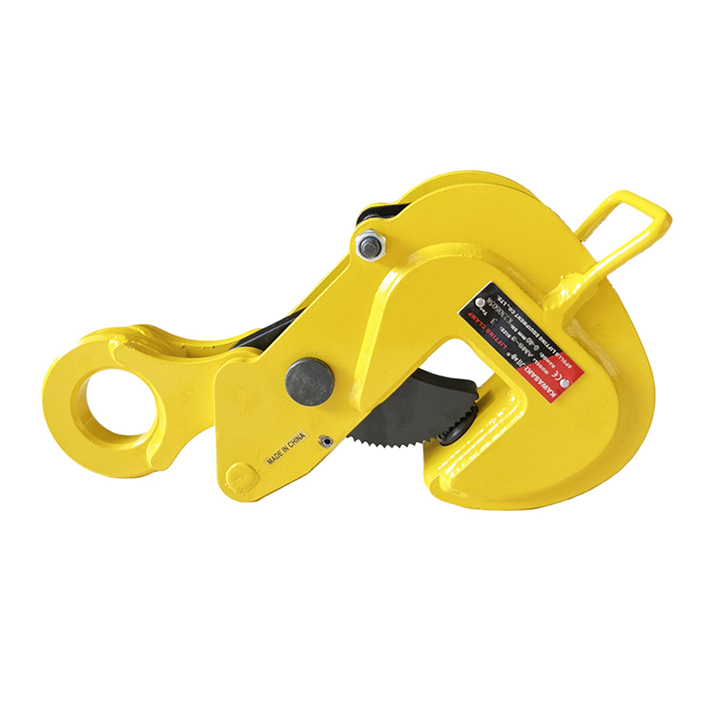
A steel stockholder sets two clamps on the long edges of a 4 by 2 metre sheet so it can be carried flat across the yard. To clear a stack on the route, the crew spreads the slings wider than usual. The sheet lifts, then skews, and one clamp rides up the edge while the other takes the whole load. The sheet lands on its corner.
Nothing was overloaded in the sense the crew understood it. Each clamp was rated for more than half the sheet. What went out of specification was the geometry of the slings, and that geometry is printed on the drawing in two numbers that most buyers never look at.
Horizontal is a different job from vertical
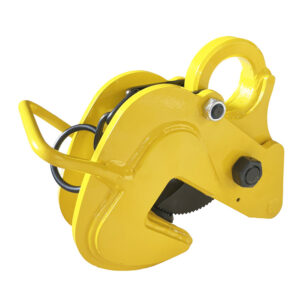
A horizontal lifting clamp grips a plate on its edge and carries it flat. A vertical clamp grips the same plate on its face and carries it upright. The two are built around different loads, different jaw geometry and different failure modes, and one cannot do the other’s job.
Apollo builds both postures, which is why the distinction gets stated plainly at quotation stage rather than discovered on site. A stockholder who carries sheets flat all day needs the horizontal clamp; a fabricator who stands plates up for a press brake needs the vertical one; a plant that does both needs two designs, not one compromise.
The two angles, and what each one measures
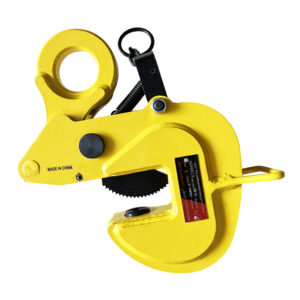
The drawing carries a max 15 degree figure and a max 60 degree figure. They measure different things, and both have to be satisfied at once:
- Max 15 degreesis the limit on how far a single sling may deviate from its own vertical plane. It constrains how far off-centre the hook can sit relative to a clamp.
- Max 60 degreesis the limit on the included angle between the two slings, measured in the same vertical plane. It constrains how far apart the two clamps can be spread for a given hook height.
The practical consequence is a triangle. The distance between the two clamps is the base, the hook height above the plate is the height, and the sling angle is what comes out. Spread the clamps wider, or lower the hook, and the included angle grows until it hits 60 degrees. Move the hook off-centre and the 15 degree limit binds first on the short side.
That is why the two figures belong in a lifting plan rather than in a brochure. A plate lift that looks generous on capacity can be outside both limits, and the crew will not see it because the load still rises.
Worked through once, the geometry is simple. Two clamps 1,200 mm apart with the hook 1,000 mm above the plate put each sling about 31 degrees off vertical, so the included angle is about 62 degrees and the lift already sits outside the 60 degree limit. Raising the hook to 1,200 mm brings the included angle back to about 53 degrees, inside it. Apollo runs this arithmetic on the enquiry rather than leaving it to the yard to discover.
Three capacities, and one trap in the opening range
| Rated capacity | Opening range | Net weight | Where it fits |
| 1 tonne | 1 to 13 mm | 1.6 kg | Thin sheet and light plate, carried flat |
| 2 tonne | 3 to 22 mm | 3.9 kg | General plate work from thin to medium |
| 3 tonne | 12 to 25 mm | 9 kg | Heavier plate that is also thicker |
Read the opening column carefully, because it does not behave the way capacity does. The 3 tonne clamp opens from 12 mm, so it cannot grip a 6 mm sheet at all, while the 2 tonne clamp grips from 3 mm. A buyer who selects by tonnage alone will order the heavier clamp for a heavy but thin load and find that it does not close on the plate.
Apollo publishes the opening range as the primary selection figure for this reason. In a plate yard the thickness spread is usually wider than the weight spread, and the clamp that fits the thickness is the clamp that can be used.
Apollo keeps three capacities in the range rather than six, on the reasoning that a plate yard selects on thickness and the spread that matters is the opening rather than the tonnage.
Paired or single, and what the clamp does not require
This range is not required to be used in pairs, and it does not require two clamps from the same model or the same production batch. That matters commercially: a stockholder can put a single unit into service for a short lift, and a distributor can supply a second clamp to complete a pair without matching a batch number.
Two clamps on one plate is still the normal arrangement for carrying a long sheet, because a single clamp on a long plate gives the plate a pivot rather than a hold. The point is that the pairing is a rigging decision, not a product restriction, and it should be described that way in a quotation.
Apollo quotes a pair as two clamps rather than as a kit, so a yard that already owns one unit can complete the set without buying it twice.
What this range does not publish, and what to ask instead
The specification for this range carries capacity, opening, dimensions and weight, and it does not carry a test load figure. That is a gap a buyer will notice, and the honest way to close it is with the certificate rather than with an estimate.
The question to put to any supplier is not what the test load is, but which standard the proof test was run to and whether the certificate can be supplied per model. Apollo certifies this range to EN 13155 and to CE, supplies the documentation with the unit and covers it with a one year warranty. A figure inferred from another product family is worth nothing in an inspection file, and a certificate is worth everything.
Apollo supplies the certificate per model with the unit, which is the document an inspector asks for and the one a buyer should hold before the first lift rather than after it.
Reading the dimensions without guessing
The dimension columns are lettered rather than named, and the letters follow the drawing rather than a standard convention. Each one should be read against the drawing before it goes into a drawing or a beam calculation, because a dimension copied into the wrong column produces a clamp that fits the calculation and not the plate.
For a first order, the two dimensions that matter are the one across the jaw and the one from the jaw to the lifting eye, because those set how the clamp sits on the edge and how the sling leaves it. The rest are useful for storage and for clearance checks, and they are the ones most often quoted from memory.
Apollo letters the drawing the same way on the specification sheet, so a clamp quoted this year and a spare jaw ordered in three years still line up on the same reference.
Why Apollo builds both postures
Apollo is a horizontal lifting clamp manufacturer, and the same factory also builds the vertical range, so a plate yard can be equipped for both postures from one supplier with one documentation set and one spare parts conversation.
Apollo is also a horizontal plate clamp supplier with more than 20 years of production, its own plant and exports to over 50 countries, which is what makes a three capacity range practical for a distributor rather than a special order.
As a steel plate handling supplier, Apollo states the two angle limits on the drawing rather than in a footnote, publishes the opening range as the primary selection figure, and supplies the range with EN 13155 and CE documentation plus a one year warranty. Both clamp postures are listed on the Apollo lifting clamp category page (https://www.apollohoist.com/product-category/lifting-clamp/), and the wider range sits under the Apollo product index (https://www.apollohoist.com/product/).
For what a factory audit should cover before a first order, the Apollo traceability checklist sets out the questions worth asking (https://www.apollohoist.com/product-news/how-to-audit-a-hoist-manufacturer-factory-qc-and-traceability-checklist/).
The five questions that settle a quotation
- What is the plate thickness at its thinnest and thickest?The opening range decides this, and it binds before the tonnage does.
- How far apart will the two clamps sit?That distance sets the included sling angle for a given hook height.
- How high can the hook go above the plate?Hook height is the second half of the angle triangle.
- Will the hook always sit centred between the clamps?If not, the 15 degree limit applies to the short side.
- Is the plate carried flat at any point?If yes, this is the clamp. If it is stood up, the vertical range is the one to quote.
Apollo answers the five questions in one reply rather than in three, because the clamp and the sling geometry are one decision and not two. A quotation that names the capacity and leaves the spacing open has solved half of the lift, and the yard finds out which half it is missing on the first sheet, at the top of the lift, with the load already in the air.
Get a sling geometry check: send the plate size, the clamp spacing, the hook height and the plate thickness, and Apollo’s engineers will confirm whether the arrangement sits inside both angle limits, in writing, within one business day, at no cost.
Request conformity document samples now
Get a sling geometry check via WhatsApp / Phone: +86 18989488615
Request conformity document samples by email: sales@apollohoist.com
Submit an online inquiry: https://www.apollohoist.com/contact-us/
Browse the full product range: https://www.apollohoist.com