Two rows, one capacity
A buyer works down the capacity column of a hand chain hoist catalogue and stops at 2 tonnes, because that is the row that matches the job. The row appears twice. One unit weighs 27 kg, the other 14 kg, and both are marked 2 tonnes with a 3 tonne test load. The obvious assumption is a printing error, so the buyer picks the cheaper-looking one, or the heavier one on the theory that heavier means stronger.
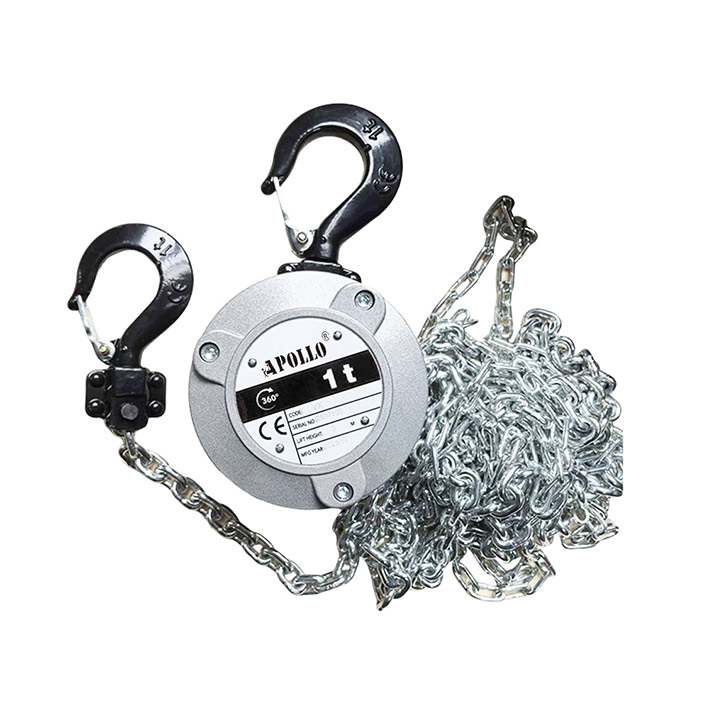
Both units are real, and the difference is not a mistake in the catalogue. They are two configurations of the same capacity, built around different answers to the same question: does the hoist stay on one beam, or does it travel with the crew?
This guide is written for the people who specify manual lifting equipment for a workshop, a site or a distributor catalogue. It sets out what actually differs between the two 2 tonne units, why the lighter one is not the weaker one, and the single question that settles the choice.
What actually differs
| Item | The single fall unit | The dual fall unit |
| Rated capacity | 2 tonnes | 2 tonnes |
| Test load | 3 tonnes | 3 tonnes |
| Load chain diameter | 8 mm | 6 mm |
| Standard lift | 3 m | 2.5 m |
| Net weight | 27 kg | 14 kg |
| Hand-pull effort | 294 N | 314 N |
| Chain falls in the load path | One | Two |
Apollo lists both units under the same capacity heading rather than hiding one in a table note, because the choice between them is a buying decision rather than a specification detail.
Everything else follows from the last line of that table. Two falls share the load between them, so each fall carries half of it, and a 6 mm chain does the work that a single 8 mm chain would otherwise do on its own. The thinner chain is what takes the weight out of the body, and the body is where 13 of the 27 kg live.
Why the lighter unit is not the weaker one
A dual fall arrangement looks like a compromise to anyone who reads specifications by weight. It is the opposite. The rated capacity is the same 2 tonnes, the test load is the same 3 tonnes, and both units carry the same safety factor. What changes is how the load is shared on its way from the hook to the drum.
The trade-off sits in the hand-pull figure rather than in the strength. On a dual fall unit the operator pulls more chain for each metre of hook travel, because two falls have to move for the hook to move one. That is why the effort reads 314 N against 294 N: a 20 N difference on paper, and a real one at the end of a shift.
Apollo builds both configurations, and the pair exists for a practical reason rather than a catalogue reason. A dealer who stocks one 2 tonne line can quote a unit that hangs permanently on a beam and a unit that a technician carries up a ladder, without opening a second supplier.
A two fall arrangement also changes what the pre-use check looks like. There are two chain runs to look at rather than one, and both have to sit correctly in their sheave pockets before the lift. Apollo fits the dual fall configuration with the same double-pawl brake as the single fall unit, so the brake check is unchanged even though the chain check is longer.
Where 13 kg decides the purchase
Thirteen kilograms is nothing on a beam and everything on a staircase. The cases where it settles the choice:
- The hoist moves with the crew. A maintenance team that re-hangs a unit at three or four anchors a week feels every kilogram, twice per move, at the top of a ladder.
- One person has to install it. A 14 kg unit goes up on a shoulder and a sling. A 27 kg unit needs a second person or a temporary lift, and that changes who can do the job.
- It travels in a van. Portable units get loaded and unloaded, and the case, the chain and the body are all counted at the tailgate.
- The anchor is a beam clamp, not a beam. The lighter unit puts less load on a clamp that was sized for the hoist rather than for the building.
The arithmetic is worth doing on the actual route rather than on the specification sheet. Walk the path the hoist takes from the store to the anchor, count the ladder rungs, and 13 kg stops being a rounding error and becomes two trips per move.
Where the extra half metre matters
The single fall unit comes with a 3 m standard lift, the dual fall unit with 2.5 m. Half a metre sounds like a rounding difference until the job is measured. On a mezzanine with 2.7 m from the beam to the floor, the 3 m unit lifts a load clear of the deck while the 2.5 m unit runs out of chain with the load still on it.
The fix is to order a longer chain from Apollo, which costs little, but it has to be decided before the order rather than after the unit arrives. The measurement that decides it is beam underside to the highest point the load has to reach, plus the height of the load itself, plus the hook block.
Twenty newtons, over a shift
Apollo supplies chain longer than the standard lift against the order, which most often happens on the 2.5 m unit when the beam height was judged by eye rather than measured.
Hand-pull effort is a published figure on every capacity, and it runs from about 221 N at half a tonne to roughly 392 N at 20 tonnes. The 20 N between the two 2 tonne units is small next to that spread, and it is worth judging against how the hoist will be used rather than in isolation.
Apollo publishes the figure for every capacity, so the comparison between the two 2 tonne units is a matter of reading rather than of testing, and the lightest unit in the range shows what a comfortable pull looks like: about 221 N at half a tonne.
For a unit that lifts twice a day, 20 N is invisible. For a unit in a rework bay that lifts forty times a shift, the difference between 294 N and 314 N is forty extra hard pulls, and that is the sort of thing operators report as a hoist that has become tiring, long before anything on it has changed.
The question that settles it
Ask where the hoist will be in a year. If the answer is the same beam, take the single fall unit: 3 m of standard lift, one chain in the load path, and the lower hand-pull figure. If the answer involves a van, a ladder or a rotation between anchors, take the dual fall unit and accept the shorter standard lift and the 20 N.
Apollo quotes both against the same capacity line, so what the customer compares is 14 kg against 27 kg rather than two suppliers. That is the useful comparison, because the unit that suits a fixed beam does not suit a van, and no amount of specification closes that gap.
Two follow-up questions are worth asking before the order goes in: whether the chain can be supplied longer than the standard lift, and whether the same spare parts fit both configurations. The second one matters at the five year point, when the choice between repairing and replacing turns on what is on the shelf.
Where both units come from
Apollo is a chain block manufacturer, and both configurations are built on the same body architecture, the same double-pawl brake and the same Grade 80 load chain specification, so a workshop can hold both without holding two inspection routines.
Apollo is also a manual chain block supplier with its own factory, more than 20 years of production and exports to over 50 countries, and both units carry a four to one safety factor and are built to EN 13157, with forged hooks and steel safety latches on both ends.
As an industrial chain hoist supplier, Apollo keeps the range consistent from half a tonne to 20 tonnes: one brake architecture, one chain specification and one inspection method, with net weights running from 8 kg to 156 kg across the range. The two 2 tonne units, their chain sizes and their hand-pull figures are listed on the hand chain hoist category page (https://www.apollohoist.com/product-category/manual-hoist/chain-hoist/).
For what a long-serving unit needs in the way of checks, see the Apollo hand chain hoist maintenance guide (https://www.apollohoist.com/product-news/hand-chain-hoist-maintenance-extending-chain-life-apollo-lifting-equipment-manufacturer/). For sites with no power at all, where a manual unit is the only option, the no-power lifting guide covers how Apollo hand chain hoists are used there (https://www.apollohoist.com/product-news/manual-lifting-without-power-how-apollo-hand-chain-hoists-work-apollo-lifting-equipment-manufacturer/).
Ordering the pair
Apollo builds both configurations in the same factory, so a distributor holds one chain specification for the single fall units and one for the dual fall units rather than a part number per model.
A distributor who quotes both configurations against the same customer usually wins the second order, because the crew discovers which one they actually wanted after the first month. Apollo quotes both units against the same capacity line and the same test load, so the comparison the customer makes is about weight and lift rather than about strength.
Get a configuration recommendation: send the load, the beam height, the lift height and how often the hoist is re-hung, and Apollo’s engineers will confirm which of the two 2 tonne units fits the work, in writing, within one business day, at no cost.
Request conformity document samples now
Get a free configuration recommendation via WhatsApp / Phone: +86 18989488615
Request conformity document samples by email: sales@apollohoist.com
Submit an online inquiry: https://www.apollohoist.com/contact-us/
Browse the full product range: https://www.apollohoist.com