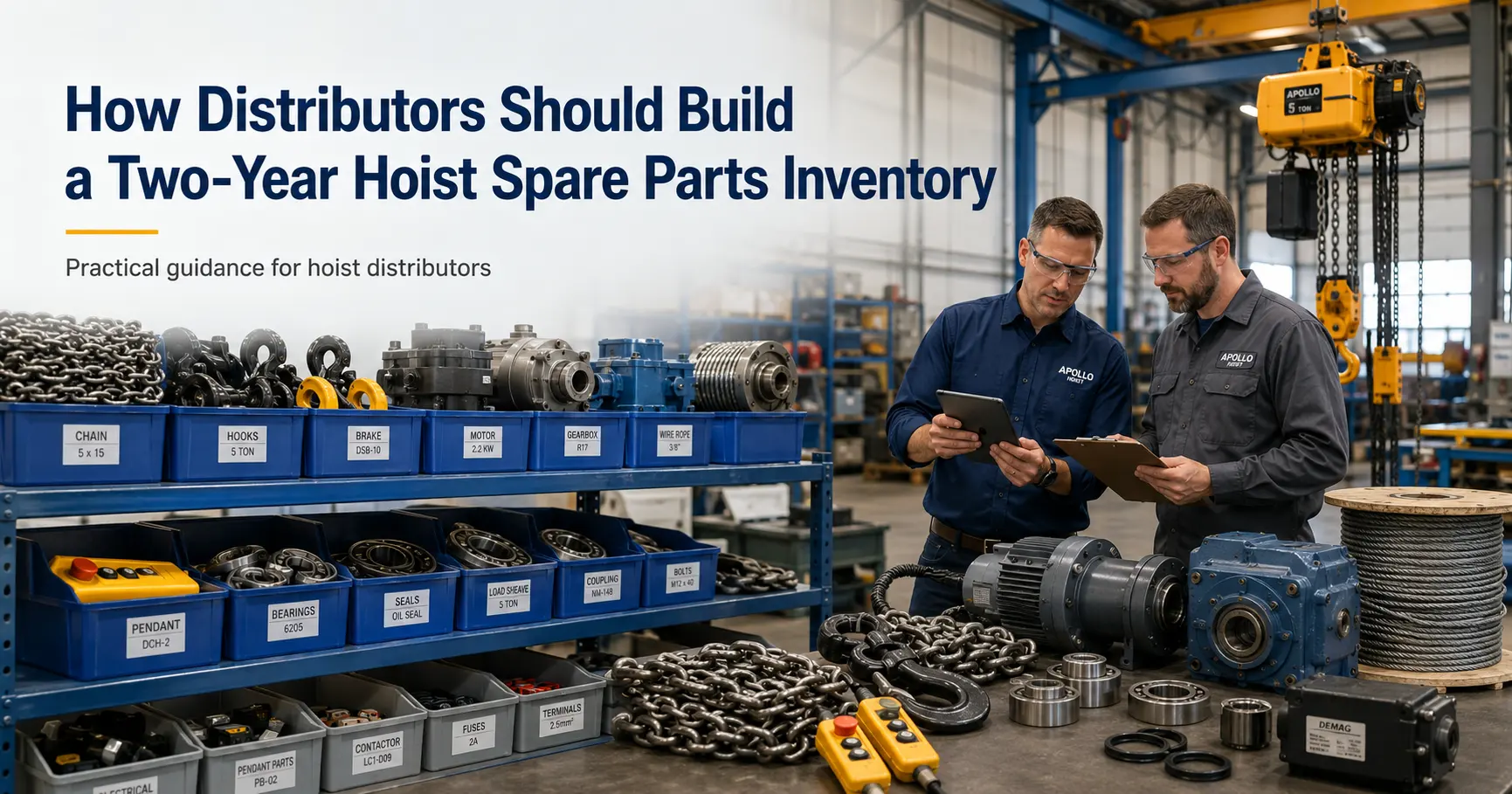
A two-year hoist spare-parts inventory is a risk plan, not a pile of popular components. Distributors must balance customer uptime, safety-critical availability, cash tied up in stock, shelf condition, and the reality that several hoist models may share only some parts. The right inventory is built from the installed base and service evidence, then reviewed as the fleet changes.
This guide gives distributors a practical method for electric chain hoists, wire-rope hoists, winches, and related lifting equipment. It explains how to create the fleet baseline, classify parts, forecast two-year demand, set reorder rules, work with the manufacturer, and keep the inventory accurate without promising a universal quantity for every product family.
Define what the two-year promise means
Start by defining the service promise behind the horizon. Two years may mean coverage for expected warranty repairs, a target response time for stocked parts, support for a known installed base, or protection against a long supplier lead time. These are different objectives and produce different stocking levels.
- State the models, capacities, configurations, countries, and customer applications included in the program.
- Set the response target for safety-critical failures, production stoppages, and routine wear items.
- Decide whether the distributor will stock individual parts, repair kits, complete subassemblies, or exchange units.
- Record exclusions such as obsolete models, customer-modified equipment, or parts restricted to qualified service teams.
Build an accurate fleet and compatibility baseline
Create one asset line for every hoist supported by the distributor. Capture the manufacturer, model, serial or customer asset ID, rated capacity, lift, power supply, control arrangement, trolley, installation type, commissioning date, and current revision of the manual and parts list. Link service history and installed options to the same record.
- Group assets by genuine interchangeability, not by similar appearance or capacity label.
- Map each part number to compatible models, revisions, assembly positions, and any substitution restriction.
- Separate distributor-owned stock from customer consignment, warranty stock, and parts reserved for a project.
- Identify single-unit or remote customers whose downtime exposure justifies a different stocking decision.
Classify parts by consequence and demand
Use two dimensions: what happens if the part fails, and how often the distributor actually uses it. A safety-critical part may have low demand but still need immediate availability. A frequently sold consumable may be operationally routine but still deserve a high service level because it supports many customers.
A practical four-group model
- Safety-critical: brakes, load-bearing chains or wire ropes, hooks, limit devices, overload-related controls, and other items whose failure requires isolation or specialist review.
- Uptime-critical: motors, gearboxes, contactors, pendants, radio controls, trolley components, or assemblies that can stop a customer’s operation.
- Wear and service items: seals, bearings, contact tips, fasteners, lubrication accessories, and other planned-maintenance parts.
- Non-stock or engineered items: obsolete, highly customized, low-use, or long-lead components purchased against a confirmed order.
Forecast two-year demand from evidence
Do not multiply the current month’s usage by twenty-four and call the result a forecast. Build demand from the number of compatible assets, service history, warranty claims, planned maintenance, customer forecasts, age profile, and known product changes. Where history is thin, mark assumptions and use a review date rather than presenting a guess as a fact.
- Calculate usage by exact part number and compatible asset group; avoid mixing different revisions in one demand line.
- Separate planned replacement from random failure and from one-time project demand.
- Include returns, scrapped parts, warranty replacements, and parts consumed during commissioning or repair campaigns.
- Apply a documented adjustment for new installations, fleet retirement, seasonal demand, or a known engineering change.
Set stock levels and reorder points
Set a minimum, maximum, and reorder point for each stocked part. The reorder point should reflect expected demand during replenishment lead time plus a risk buffer appropriate to the part’s consequence and demand uncertainty. The maximum should consider the two-year plan, package quantity, shelf life, storage cost, and the possibility of model changes.
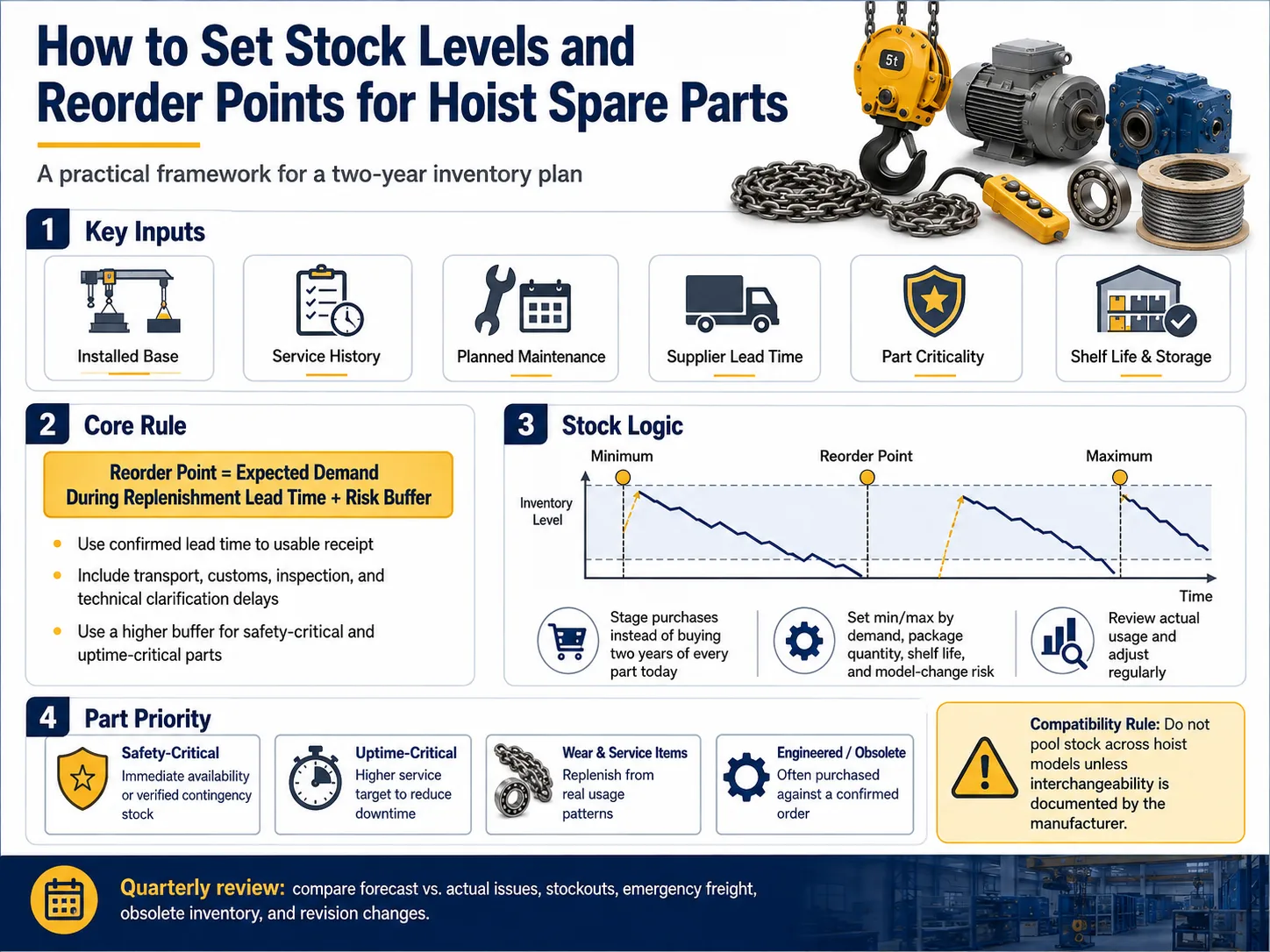
- Use supplier lead time measured from confirmed order to usable receipt, not only the quoted production time.
- Add transport, customs, inspection, quarantine, and technical-clarification time when they regularly delay release.
- Use a higher service target or a verified contingency unit for parts that can immobilize a hoist or affect the load path.
- Avoid pooling stock across models unless interchangeability is documented by the manufacturer.
A two-year horizon does not mean buying two years of every part today. Stage purchases, use scheduled reviews, and place long-lead orders early while keeping routine replenishment responsive to actual usage.
Protect and identify the physical stock
Storage quality affects whether a part is usable when needed. Assign a bin or controlled location and preserve the manufacturer part number, revision, lot or batch information, and compatibility note. Keep incoming items in quarantine until identity and condition are checked.
- Protect chains, wire ropes, seals, lubricants, electrical controls, and painted components according to applicable supplier instructions.
- Use first-expire or first-received rotation where shelf life or storage condition matters.
- Photograph or scan labels for high-risk parts and keep the image linked to the inventory record.
- Record issued part, installed asset, technician, work order, removed-part condition, and any return-to-stock decision.
Align the plan with the manufacturer
A distributor’s two-year plan works better when the manufacturer sees the same asset and part data. Share the model mix, forecast, criticality list, and expected reorder pattern. Ask how superseded parts, new revisions, minimum order quantities, and technical substitutions will be communicated.
- Request current exploded views, parts lists, manuals, and compatibility statements for the supported models.
- Agree how safety-critical substitutions are approved and how obsolete parts are handled in open orders.
- Ask for expected lead-time ranges and escalation contacts for urgent or engineered components.
- Use a periodic supplier review to compare actual fill rate, backorders, defects, warranty demand, and document accuracy with the plan.
Review the inventory every quarter
Quarterly review keeps a two-year plan from becoming stale. Compare forecast with actual issues, stockouts, emergency freight, obsolete inventory, and customer complaints. Reclassify parts when a model becomes more common, a supplier changes a revision, or a recurring failure pattern appears.
- Count high-value and safety-critical parts more frequently than routine consumables.
- Investigate negative stock, duplicate SKUs, unissued returns, and parts with no compatibility owner.
- Reduce or redeploy stock when the supported fleet retires, consolidates, or moves to a new revision.
- Keep an approved change log so catalog, ERP, service manuals, and purchase orders stay aligned.
How Apollo fits a distributor inventory plan
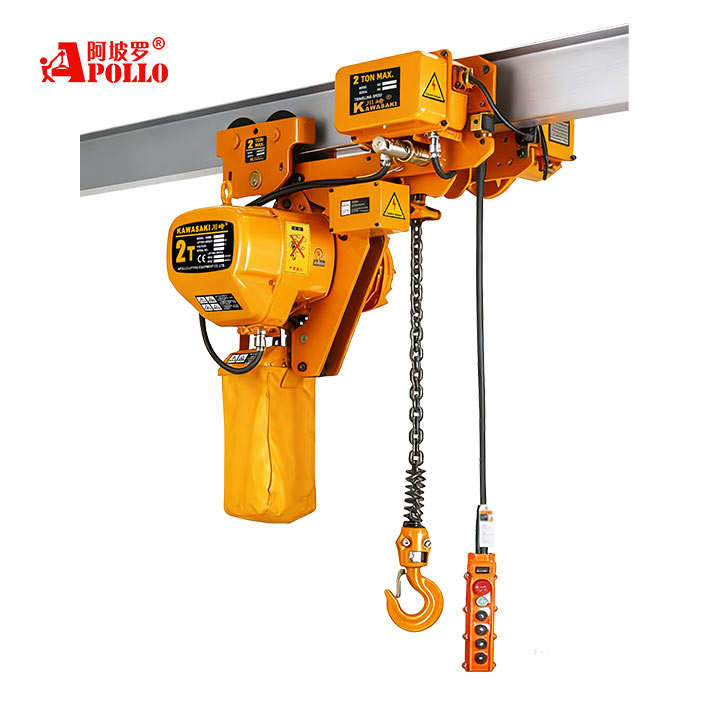
Apollo’s electric hoist product categories include electric chain hoists, electric wire-rope hoists, electric winches, and explosion-proof hoists. A distributor can use the relevant product families to define the supported fleet, then request model- and revision-specific parts information before setting stock. Apollo also presents
R&D capabilities and service and customization capabilities. For a two-year program, confirm which configurations, manuals, part numbers, lead times, and substitution rules apply to your customers. Send the fleet baseline and proposed inventory questions through Apollo’s contact channel so the reorder process is based on written compatibility and support information.
Conclusion
A two-year hoist spare-parts inventory should be built from traceable assets, not broad product labels. Define the service promise, map compatible machines and revisions, classify parts by consequence, forecast from real evidence, set lead-time-aware reorder rules, protect physical stock, and review the result every quarter. This approach gives distributors better uptime coverage without treating every part as equally urgent or equally interchangeable.
FAQs
Should distributors stock two years of every hoist part?
No. Stocking should reflect criticality, installed base, demand evidence, lead time, shelf condition, interchangeability, and the cost of a stockout. Some engineered or obsolete parts are better purchased against a confirmed order.
How should a distributor handle a low-demand safety-critical part?
Keep a verified contingency quantity when the consequence and replenishment risk justify it, even if historical demand is low. Record the technical reason separately from the statistical forecast.
Can one SKU cover several hoist models?
Only when compatibility is documented for those models and revisions. Similar appearance or capacity is not proof that a brake, chain, rope, control, or limit device is interchangeable.
How often should the two-year inventory be reviewed?
Review it at least quarterly, with more frequent counts for high-value or safety-critical parts. Recalculate after major fleet additions, retirements, supplier changes, or recurring field failures.