Ninety seconds on the line, two minutes at the hoist
An assembly cell runs on a ninety second takt. The line was balanced on the station times, the operators were trained to the sequence, and the cell was signed off. Six weeks later the throughput is short of plan, and the reason is not the operators: it is the hoist that feeds the station, which needs close to two minutes for a full move once the lift, the travel, the lowering and the return are added together.
Nobody lied in the specification. The hoist was selected on capacity, which is the number that appears first in every catalogue. Cycle time appears nowhere on the data sheet as a single figure, because it is not a property of the hoist: it is a property of the hoist, the rail layout and the height of the pick and place points together.
This guide is written for production engineers, line planners and the distributors who quote powered handling equipment. It shows how to turn published lift and travel speeds into a cycle time you can defend, where the time actually goes on a monorail, and which questions change the answer before the order is placed.
The four legs of a move
A complete handling cycle is longer than the lift. It has four legs, and each one runs at its own speed.
- Lift, measured in metres per minute, and the slowest leg on most hoists.
- Travel, measured in metres per minute along the rail, and usually the fastest.
- Lower, at the same speed as lift, but often over a shorter distance because the part is set down rather than picked up from the floor.
- Return, the empty trip back to the pick point, which is the leg everyone forgets when they mentally estimate a cycle.
Published speeds are steady-state figures. Acceleration, hooking on, hooking off and the operator’s own movement add time that no data sheet contains, which is why the arithmetic below gives a floor for the cycle rather than the cycle itself. Treat it as the best case and the number becomes useful: if the floor is already above the takt, no amount of operator practice will close the gap.
Doing the arithmetic for one workstation
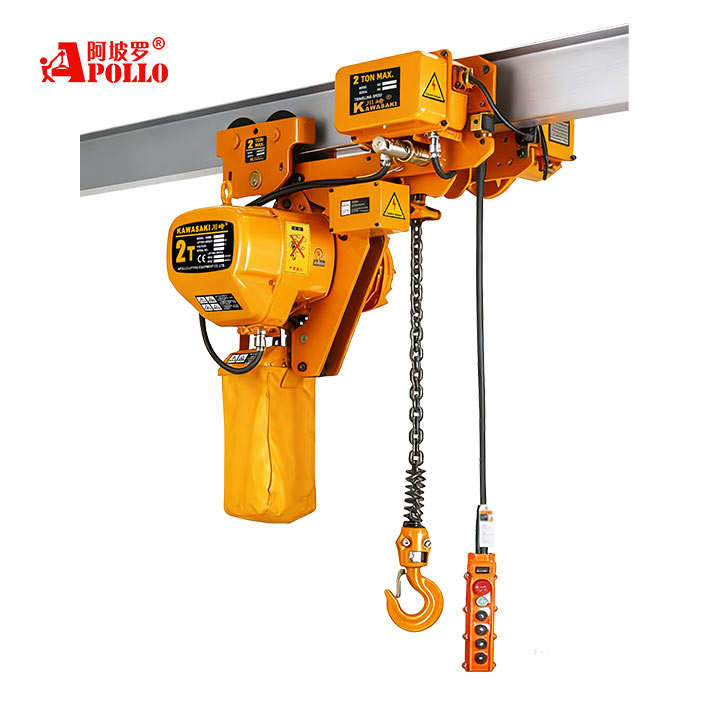
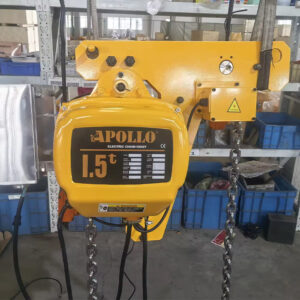
Take a common layout: a 1 tonne unit lifting 2.5 metres, travelling 12 metres to the line, lowering 2.5 metres and returning empty. The Apollo electric chain hoist lifts at 6.6 metres per minute in that capacity and travels at 11 or 21 metres per minute.
Lift: 2.5 metres at 6.6 metres per minute is 23 seconds. Travel at the high setting: 12 metres at 21 metres per minute is 34 seconds. Lower: 23 seconds. Return: 34 seconds. Total 114 seconds, against a 90 second takt. The move does not fit, and the shortfall is not in the hoist motor.
Now change one variable. Run the travel leg at 11 metres per minute instead of 21 and the two travel legs become 65 seconds each, for a total of 176 seconds. Same hoist, same rail, twice the cycle. That single figure is why the travel speed deserves as much attention as the tonnage in a line specification, and why a quotation that lists only capacity is not yet a specification.
The same arithmetic across the range shows where capacity starts to cost time:
| Capacity | Lift speed | One 2.5 m lift takes |
| 0.3 t | 7.1 m/min | 21 seconds |
| 1 t | 6.6 m/min | 23 seconds |
| 2 t | 6.6 m/min | 23 seconds |
| 3 t | 5.4 m/min | 28 seconds |
| 5 t | 2.7 m/min | 56 seconds |
| 10 t | 2.7 m/min | 56 seconds |
The step from 3 tonnes to 5 tonnes more than doubles the lift time. That is not a design fault, it is the arithmetic of lifting a heavier load on a standard chain speed, and it is the reason a line that may grow should be specified on the capacity it will carry in two years rather than the capacity it carries today.
Why the travel leg usually decides the outcome
On a short rail the lift dominates. On any rail longer than about ten metres the two travel legs do, because they are covered twice while the lift is covered once in each direction.
This is where the dual speed travel motor earns its place. The high setting covers distance, the low setting covers the last metre, and a cycle that uses both is shorter than a cycle that uses either alone. A single-speed travel motor forces a choice: fast enough for the rail, or slow enough to stop where the operator wants, never both.
Apollo fits a dual speed travel motor across the motorized trolley range, at 11 and 21 metres per minute on the standard models, with a 0.4 kW travel motor on the light and mid capacities and 0.75 kW from 3 tonnes upward. The lift motor scales separately, at 1.5 kW for 1 tonne and 3.0 kW for 2 and 3 tonnes, because lifting and travelling are two different jobs that happen to share a frame.
A practical rule for the operator: high setting for every leg longer than two metres, low setting inside the last metre, and no setting change between the pick and the set-down if the part is heavy enough to swing. Every change of setting costs a fraction of a second, and on a 200 move shift those fractions add up to minutes, which is why Apollo publishes both travel speeds rather than an average.
Headroom is part of the cycle too
A hoist that needs 900 mm of headroom in a building that has 700 does not have a slow cycle, it has no cycle. The headroom figure, usually marked as H on a capacity table, sets the highest the hook block can be raised and therefore the usable lift height under a fixed beam.
Apollo builds the motorized trolley range with headroom as low as 630 mm on the light models, which is what makes a powered hoist viable in a building that was laid out for manual chain blocks. On a retrofit the headroom figure decides whether the beam has to be lowered, and lowering a beam changes the lift height, which changes the cycle, which brings the arithmetic back to the start.
What to put in the enquiry
Cycle time is quoted rather than guessed when the enquiry contains the four distances and the required takt.
- The takt, in seconds.State it as a number. A target expressed as parts per hour converts badly and hides the shift pattern.
- The lift height and the travel distance.Both directions, including the empty return. The return is where estimates usually go wrong.
- The pick and place heights.A part picked from the floor and set on a bench is not the same cycle as a part picked from a bench and set on a bench.
- The number of moves per shift.Duty drives the motor rating and the cooling, and it is also the multiplier on every second saved.
In the Apollo range both the 5 tonne and the 10 tonne units run at 2.7 metres per minute, so the doubling of lift time happens at the step from 3 tonnes upward rather than gradually. A line that may grow should be checked at the tonnage it will carry in two years, because the cycle that fits today may not fit after the next throughput review.
- The beam height available.Give the dimension from the floor to the underside of the flange, not the building height.
Apollo answers cycle questions with the four distances rather than with a recommended model, because the same hoist produces a 114 second cycle on a 12 metre rail and an 80 second cycle on a 6 metre rail. The rail is part of the machine, and a supplier who quotes the hoist alone is quoting half of it.
Who builds the unit, and what that changes
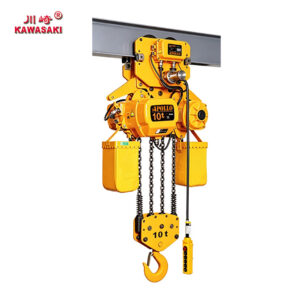
Apollo is an electric chain hoist manufacturer with its own production line in Hangzhou, and the motorized trolley range covers 0.3 tonnes to 10 tonnes on one architecture with single, dual and four-fall chain configurations. The lift speeds published per capacity are the figures this arithmetic runs on, which is why they belong on the capacity table rather than in a separate note.
Apollo is also a motorized trolley hoist supplier for production cells, where the travel leg is what decides whether the cell meets its takt. Because the travel motor and the lift motor are selected separately, the pairing can be changed without changing the hoist: a faster travel leg on a long rail does not require a larger lift motor, and a heavier lift does not force a faster trolley.
Apollo is an overhead lifting equipment supplier as well, so a cell that needs a rail, a trolley and a hoist can be specified as one package with the interface dimensions agreed once rather than three times. The motorized trolley range and its capacities are listed on the Apollo electric hoist category page (https://www.apollohoist.com/product-category/electric-hoist/).
Before the units are released, the speeds and the brake response should be verified rather than assumed, and Apollo’s factory acceptance guide sets out what that test should record (https://www.apollohoist.com/product-news/factory-acceptance-testing-for-electric-hoists-a-buyers-guide/). For a multi-cell project, the traceability questions in Apollo’s manufacturer audit checklist are the ones worth asking before the first order rather than after the tenth (https://www.apollohoist.com/product-news/how-to-audit-a-hoist-manufacturer-factory-qc-and-traceability-checklist/).
Booking the cycle check with Apollo
Send the four distances and the takt, and Apollo returns the model, the travel setting and the resulting cycle as a number, with the assumptions written down so the line planner can challenge them.
Request conformity document samples now: send the takt, the lift height and the rail length to sales@apollohoist.com, and Apollo’s engineers will return the cycle calculation and the applicable documents within one business day.
Contact Apollo
WhatsApp and phone: +86 18989488615
Email: sales@apollohoist.com
Contact page: https://www.apollohoist.com/contact-us/
Website: https://www.apollohoist.com