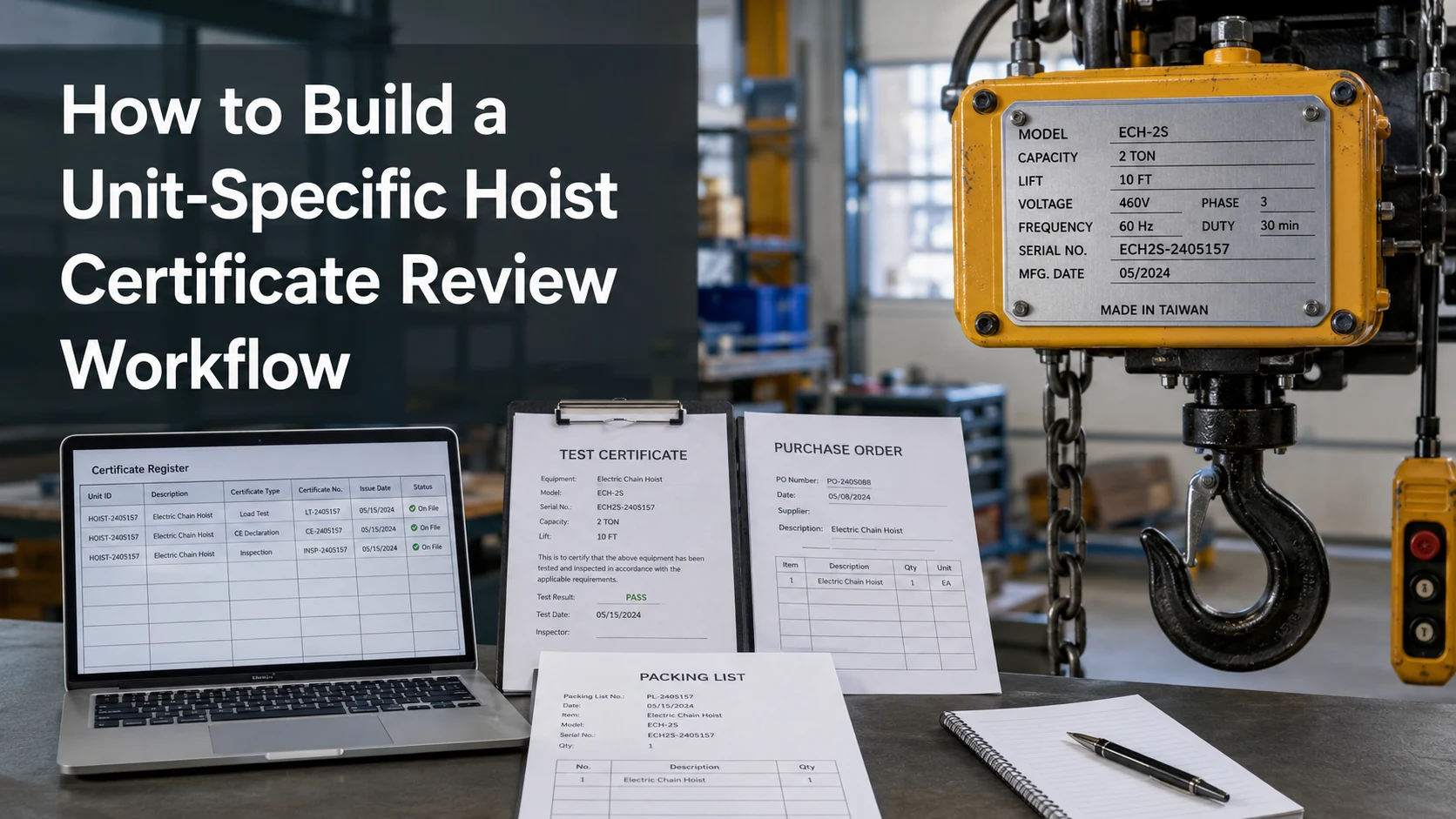
A hoist test certificate is useful only when a procurement team can prove what it belongs to, what was tested, and whether the result supports the purchase requirement. In a multi-unit order, a generic certificate or an unlabeled PDF can create the appearance of compliance while leaving the buyer unable to release the correct equipment with confidence.
The answer is a unit-specific certificate review workflow. It connects the purchase order, physical nameplate, technical specification, test evidence, and final approval to one model and serial number. This guide gives procurement, engineering, and quality teams a practical process for receiving, checking, escalating, and storing hoist certificates before shipment or site release.
Define the workflow and ownership
Write the workflow before the first certificate arrives. Decide who owns document intake, who performs the technical review, who can accept a deviation, and who gives the final release. Procurement can coordinate the process, but a commercial approver should not silently replace the competent technical reviewer for a safety-relevant discrepancy.
- Procurement controls the supplier request, due date, document register, and purchase-order hold points.
- Engineering or a qualified reviewer checks capacity, configuration, test scope, and technical consistency.
- Quality records findings, corrective actions, revisions, and evidence of closure.
- Site or asset management receives the approved file and registers the unit for commissioning and future inspection.
Set a simple status vocabulary such as Received, Under Review, Clarification Required, Rejected, Approved with Action, and Released. A visible status prevents an incomplete certificate from being mistaken for an approved one.
Create the unit record before ordering
The workflow starts with an asset record, not with a certificate. Create one line for each hoist that will be purchased or received. Use the same identifier in the request for quotation, purchase order, drawing register, inspection report, test certificate, packing list, and site asset register.
- Record manufacturer, model, serial number or agreed temporary identifier, rated capacity, lift, speed, power supply, controls, trolley, and options.
- Add the application, installation location, destination market, and any project or regulatory document requirement.
- Store the approved specification, general arrangement, wiring information, and deviation list with the unit record.
Put certificate requirements in the RFQ and PO
The phrase certificate required is too vague. State what the supplier must provide, when it is due, and which fields must appear. A unit-specific test certificate may be only one part of the handover; the project may also need a declaration, inspection report, calibration reference, manual, drawing, or factory acceptance record. Requirements depend on the equipment, contract, jurisdiction, and intended use.
- Require the model, serial number, rated capacity or WLL, actual test load or test condition, date, result, and test method or reference where applicable.
- Define acceptable issuer, signature or approval, language, file format, revision, and retention requirements when relevant to the project.
- State whether certificates must be submitted for review before shipment and whether payment or shipment is held until approval.
Request a sample certificate during technical clarification. Reviewing the format early reveals whether the supplier can provide the traceability your team expects and avoids a dispute after production is complete.
Receive and register the certificate package
When documents arrive, register them before judging their content. Record the file name, receipt date, supplier, document type, revision, linked buyer reference, and review status. Keep the original file and protect the register from uncontrolled overwriting. If several units share a manual or declaration, link the shared document to each applicable unit while keeping individual test records separate.
- Check that every ordered unit has an expected certificate or a documented reason for non-applicability.
- Use a controlled naming convention such as project-model-serial-document-revision.
Perform the identity and configuration check
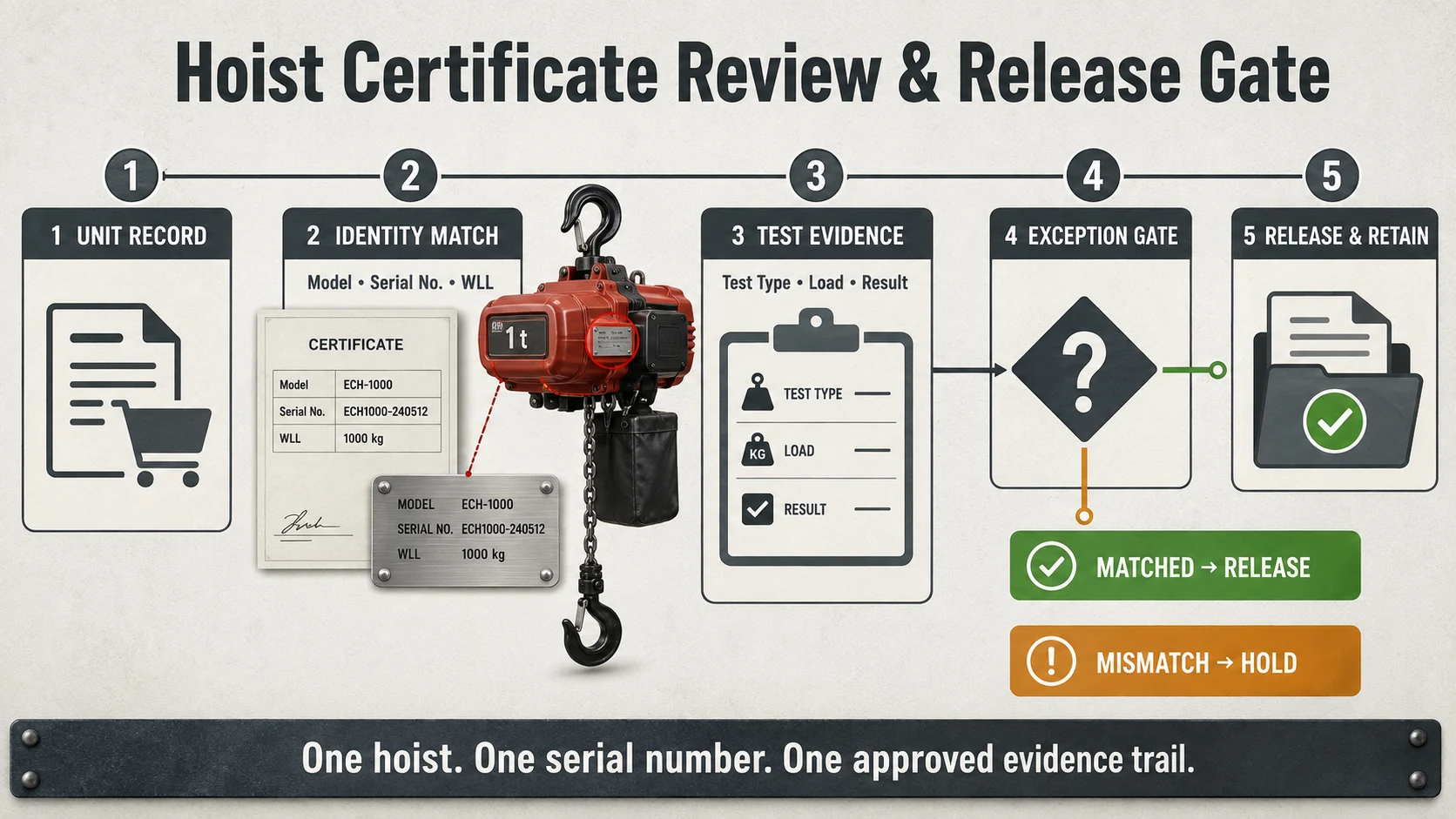
The first technical question is whether the certificate belongs to the physical hoist. Compare the document with the nameplate, packing list, purchase order, approved drawing, and configuration record. Check every field that could change the test scope or the safe operating limit.
- Match model, serial number, rated capacity or WLL, lift, speed, voltage, phase, control arrangement, and trolley or hook configuration where stated.
- Confirm that load chain, wire rope, hook assembly, brake, limits, and other safety-relevant options are consistent with the released configuration.
- Check dates and revisions against production, inspection, approved changes, and shipment timing.
- Compare units in a batch separately; never assume one certificate covers all hoists without explicit scope and serial mapping.
A mismatch does not automatically prove that the hoist failed testing. It does mean the document is not ready for release. Place the unit on hold and request a written correction or a technical disposition.
Review the test content and authority
After identity, review what the certificate actually demonstrates. A statement such as tested or passed is weaker than a record that identifies the procedure, test condition, measurements, result, and responsible organization. Do not apply one assumed proof-load percentage to every hoist; the applicable requirement can depend on design, test purpose, contract, and jurisdiction.
- Confirm the test type: factory routine test, proof or load test, functional test, commissioning test, or post-repair retest.
- Check the stated load or test condition, duration or cycle, functional checks, acceptance criteria, and result when those fields are in scope.
- Verify the responsible tester or approval authority and any calibration or test-equipment traceability required by the specification.
If the certificate references a standard or procedure, compare the stated scope with your purchase requirement and have the designated technical reviewer resolve differences. A certificate can be authentic yet still insufficient for a particular project.
Route exceptions through a release gate
Use a formal decision gate so commercial urgency does not override evidence. Minor formatting corrections may be returned for revision, while an identity mismatch, missing test result, unexplained deviation, or unclear load limit should stop shipment or site release until resolved.
- Log the finding, affected serial number, risk, owner, due date, and required evidence.
- Quarantine the unit or mark the purchase line as blocked when the discrepancy could affect safe use or legal acceptance.
- Accept a deviation only through the authority named in the workflow, with a written technical basis and expiry or follow-up requirement.

Retain the evidence for future decisions
The review is not finished when the shipment leaves. Store the approved certificate with the asset record so maintenance, inspectors, and future buyers can understand the original configuration. Link later repairs, replacement parts, re-tests, and revised certificates to the same serial number. This history helps distinguish a factory test from a site commissioning check or a post-repair verification.
How Apollo fits the workflow
Apollo’s published electric hoist product categories include electric chain hoists, electric wire-rope hoists, electric winches, and explosion-proof hoists. Use the exact model and configuration from the selected category or product page when creating the unit record. Apollo also publishes
R&D capabilities and service and customization capabilities. For a purchase, ask which test certificates, drawings, manuals, and configuration records apply to each serial-numbered unit. Send the required certificate fields and approval gate through Apollo’s contact channel before shipment; website product information is a starting point, while release depends on the agreed unit-specific evidence.
Conclusion
A unit-specific hoist certificate workflow turns scattered PDFs into a controlled procurement decision. Define ownership, build the asset record before ordering, contract the required fields, register every file, match each certificate to the physical hoist, review the test scope, and hold exceptions at a clear release gate. The result is faster approval with a stronger audit trail and fewer disputes over what was actually tested.
FAQs
Can a generic certificate cover several hoists?
Only when the document explicitly defines its scope and maps every applicable serial number and configuration. Individual test results should remain separate when the units differ.
Who should approve a certificate mismatch?
Procurement should log and control the issue, but a designated engineering, quality, or other competent technical authority should determine whether the evidence is acceptable.
Should the certificate be reviewed before shipment?
Yes, when the purchase specification or project risk makes pre-shipment approval important. State the hold point in the RFQ or purchase order so the supplier knows the release condition.
Does a test certificate replace site commissioning records?
No. A factory certificate documents its stated test scope. Site commissioning must address installation, supports, power, controls, integration, and local operating conditions.