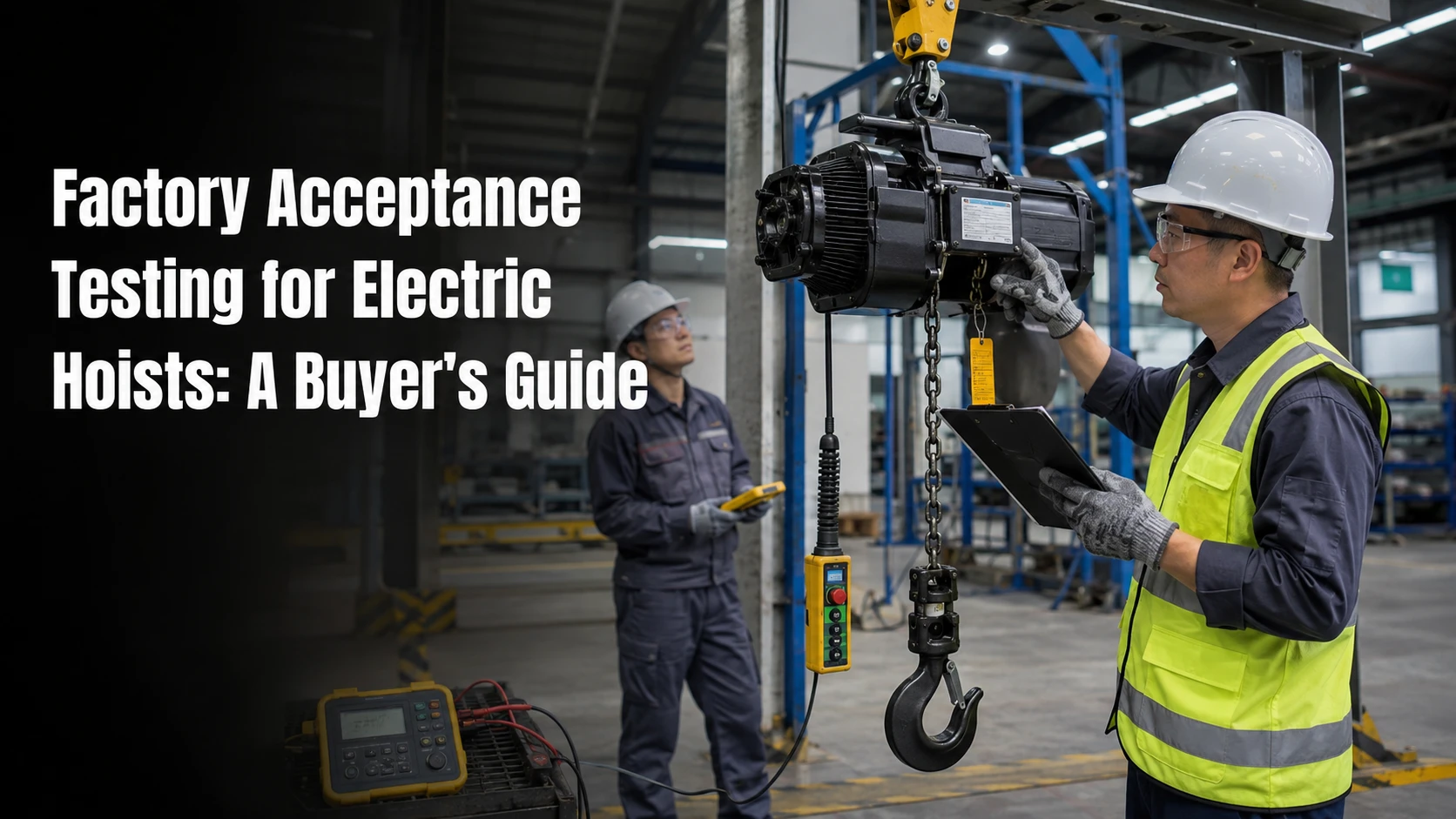
Factory Acceptance Testing (FAT) is the buyer’s controlled opportunity to verify an electric hoist before it leaves the manufacturer’s facility. A good FAT does more than demonstrate that a motor runs. It confirms that the supplied configuration matches the purchase order, safety functions respond as specified, test instruments are suitable, and open issues are resolved before shipment.
This buyer’s guide explains how to prepare, witness, and close a FAT for an electric chain hoist, wire-rope hoist, or electric winch. The exact acceptance criteria must come from the approved design, contract, applicable standards, and destination requirements. Use the checklist to make those criteria visible and testable; do not invent a universal load or performance value.
What FAT should prove
FAT is a pre-shipment verification, not a substitute for installation commissioning, site acceptance, or periodic inspection. At the factory, the buyer should gain evidence that the unit was built and tested against the released configuration. At the site, the owner must still verify supports, power, guarding, controls, operating environment, and integration with the lifting system.
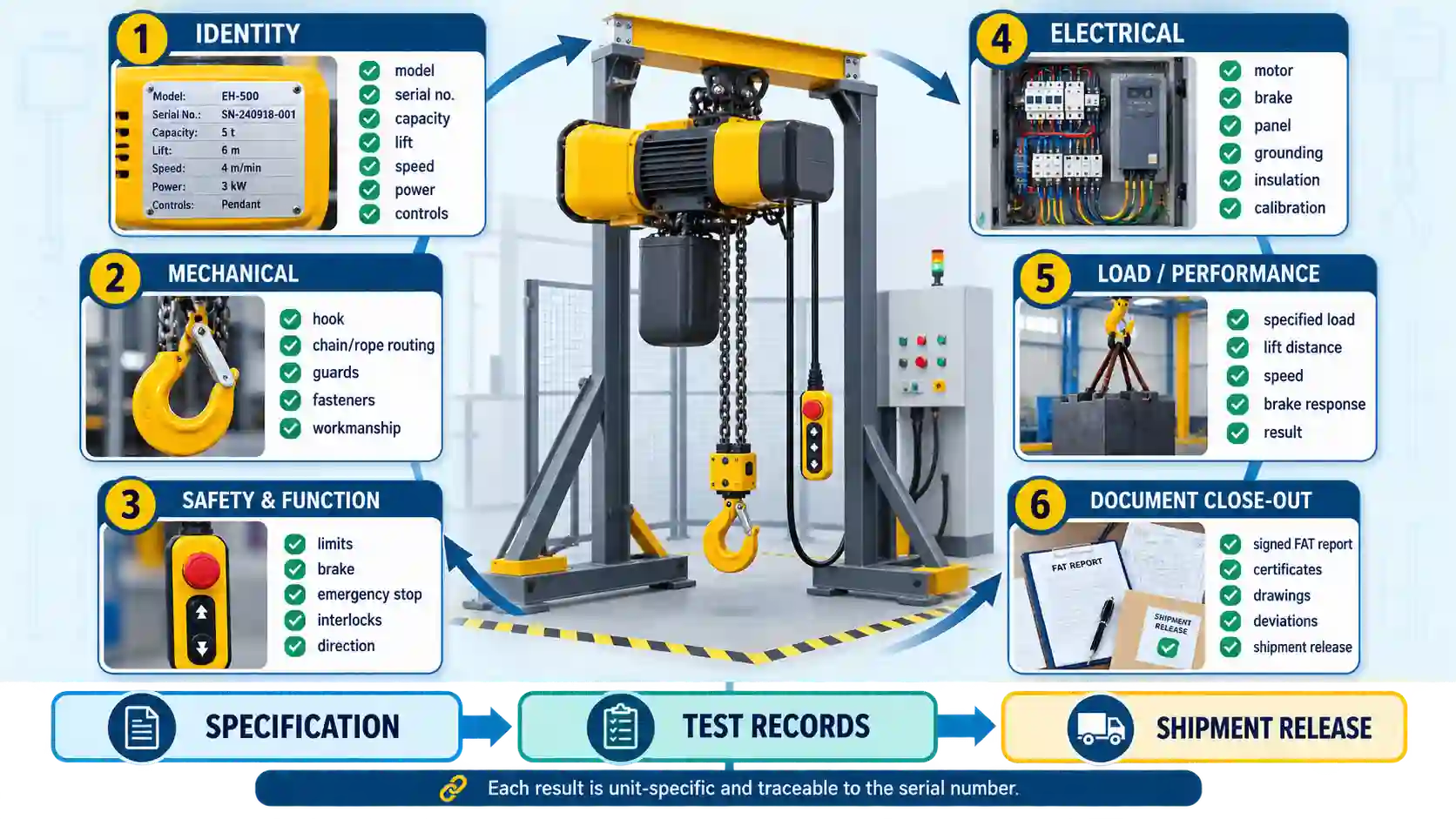
- Identity: model, serial number, rated capacity, lift, speed, power, controls, trolley, and options match the approved order.
- Workmanship: assembly, fasteners, guards, hooks, chain or rope routing, finishes, labels, and accessories are complete and undamaged.
- Function: controls, travel direction, limits, brake action, emergency functions, and indicators operate as specified.
- Evidence: results are recorded on a unit-specific report with the test method, instruments, date, responsible person, and disposition of deviations.
Prepare the FAT protocol with the purchase order
A FAT becomes difficult to defend when the protocol is written after the equipment is finished. Issue the protocol with the purchase order or design review package, and ask the manufacturer to return a marked-up version before the test date. Every test should have an objective, method, acceptance criterion, witness role, and record field.
- Attach the latest general arrangement, wiring diagrams, bill of materials, nameplate data, and approved deviations.
- Define the test boundary: hoist only, hoist plus trolley, controls, pendant or radio, and any supplied accessories.
- Name buyer, manufacturer, and third-party witnesses; state whether tests are hold points, witness points, or review points.
- Specify the document package required before release, including manuals, drawings, certificates, inspection records, and the signed FAT report.
For a fleet, identify each serial number and configuration separately. A successful test on one model does not automatically accept a different capacity, voltage, reeving arrangement, or control revision.
Verify visual and mechanical condition
Begin with a document-to-equipment walk-down. Compare the nameplate and physical build with the approved drawings and order. Check that safety-relevant components are identifiable and that no temporary test arrangement will be shipped accidentally. Photograph the nameplate and key interfaces for the project file where permitted by the contract.
- Check frame, drum or chain container, hook block, hook latch, guards, trolley interface, fasteners, and visible welds for completeness and damage.
- Confirm load-chain or wire-rope routing, reeving, lubrication condition, end termination, and markings against the approved instructions.
- Verify pendant, radio receiver, cable entry, grounding points, labels, warning plates, and access covers.
- Record any paint, corrosion, sharp-edge, packaging, or transport-protection issue that could affect service or installation.
Witness functional and safety tests
Run the hoist through its intended operating sequence using the approved test setup. Test unloaded functions first, then any specified loaded or simulated conditions. The witness should observe both the result and the control of the test: correct instrument identification, defined starting condition, repeatable method, and a clear pass, fail, or conditional status.
- Check hoist-up and hoist-down commands, travel direction, speed selection, inching or variable control where supplied, and control labeling.
- Operate upper and lower limits, trolley limits, overload or load-limiting functions, emergency stop, and other interlocks included in the design.
- Observe brake holding, stopping behavior, abnormal noise, vibration, heating, leakage, and controls returning to a safe state after a fault.
- Verify that measured values, alarms, and fault indications are recorded rather than described only as satisfactory.
Review electrical and control-system evidence
Electrical FAT checks should follow the released schematic and the equipment’s intended supply. Confirm that the test setup is clearly identified if the factory uses temporary power or simulation. A buyer should not approve a different component merely because the hoist operates; changes to contactors, brakes, limit switches, drives, or protection devices may affect the design and documentation.
- Match motor, brake, control panel, contactor or drive, overload protection, transformer, connectors, and cable identifiers to the bill of materials.
- Check insulation, continuity, grounding, phase or direction, control voltage, and functional interlocks when required by the approved procedure.
- Confirm enclosure, ingress or environmental requirements only to the extent stated in the approved specification; do not infer protection from appearance.
- Record calibration or verification status for electrical measurement equipment used for acceptance decisions.
Handle load tests and performance claims carefully
Load or proof testing is often the most sensitive FAT activity. The buyer should confirm the specified test load, duration, setup, measurement method, and safety controls before witnessing it. Requirements vary by equipment design, jurisdiction, contract, and whether the hoist is tested alone or as part of a lifting assembly. The report should identify the actual unit and state any limitations.
- Record test load or simulated load, lift distance, duty or cycle, speed measurement method, brake response, and result where these are in scope.
- Confirm that the test area, rigging, reaction structure, and personnel controls are suitable for the planned test.
- If a test fails, quarantine the unit, document the nonconformance, repeat affected tests after correction, and preserve the revision history.
Close the punch list before shipment
A FAT report is not a release note if it hides open actions. Classify each deviation as accepted, corrected and retested, or unresolved with an approved disposition. The buyer should receive a final index linking the serial number to the signed report, revised drawings, manuals, certificates, and outstanding-action evidence. Define who can authorize shipment when a minor item remains open.
- Check serial number, model, capacity, voltage, options, and revision on every certificate and report.
- Require the final FAT report, test data, calibration references, photographs or inspection sheets, and approved deviation list.
- Confirm packaging and preservation protect the hoist for transport and clearly identify loose accessories and documentation.
- Record the shipment release decision and transmit the approved document set to the installation and maintenance teams.

How Apollo fits a buyer’s FAT plan
Apollo’s published product navigation includes electric chain hoists, electric wire-rope hoists, electric winches, and explosion-proof hoists. For a FAT, use the exact model and configuration in the purchase order, then request a protocol that matches that unit rather than relying on a category description. Apollo also publishes
R&D capabilities and service and customization capabilities. Ask which drawings, options, test methods, and records apply to your project, and send the proposed witness agenda through Apollo’s contact channel before the FAT date. Published product information is a starting point; acceptance still depends on the approved, unit-specific evidence.
Conclusion
The strongest factory acceptance test is agreed before production is complete and closed with traceable evidence. Define the boundary and criteria, reconcile documents to the actual hoist, witness mechanical, electrical, safety, and performance checks, and control every deviation through correction and retest. When the signed FAT package travels with the serial number, the buyer can make a clear shipment decision and begin site commissioning with fewer surprises.
FAQs
Is FAT the same as commissioning?
No. FAT verifies the supplied equipment at the factory. Commissioning verifies installation, supports, power, controls, integration, and site conditions before operation.
Who should witness an electric hoist FAT?
The buyer’s engineering or quality representative should attend, with manufacturer personnel and any contractually required third-party or customer witnesses. Assign responsibilities in the protocol.
What if the hoist passes but documents are incomplete?
Treat the document gap as an open release action. A functional demonstration does not replace unit-specific drawings, test records, certificates, or instructions needed for installation and service.
Can one FAT report cover several hoists?
Only when the protocol clearly identifies each serial number and configuration and records the results separately. Shared procedures are acceptable; shared identity or ambiguous results are not.