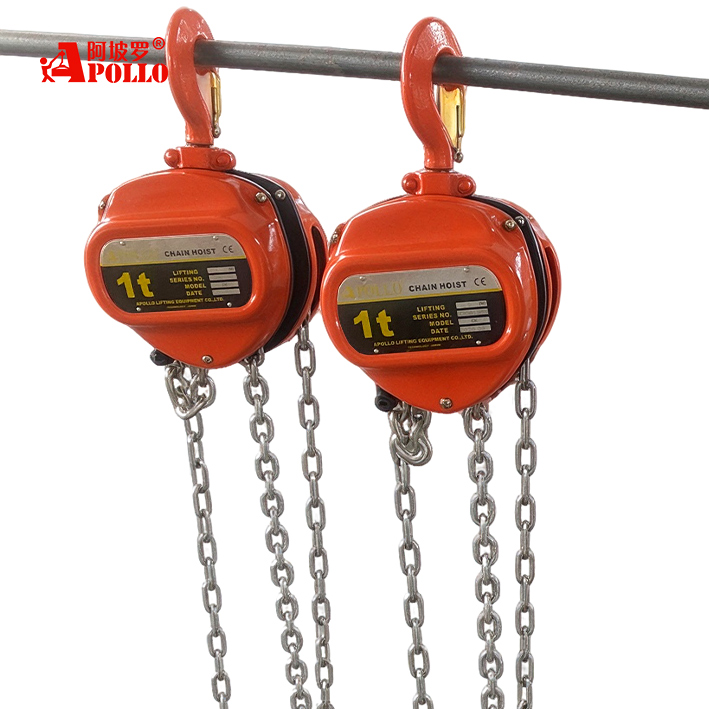
Why a hand chain hoist gives no warning
A rigging crew has used the same hand chain hoist on a mezzanine beam for six years. It still lifts. Then one afternoon a 1.5 tonne motor comes up half a metre and stalls, the operator notices the load chain sitting high in the load sheave, and the hand chain needs a hard yank before anything moves. Nothing has broken. That is the difficulty with manual lifting equipment: wear announces itself as extra effort, not as an event.
A manual hoist degrades slowly, which is exactly why it gets neglected. There is no motor to service, no control panel to fault, and no oil change on the planner. So the unit drops off the maintenance list until a lift feels wrong, and by then the chain and the sheave have usually been wearing each other for months.
Crews miss the early signs for four reasons:
- The hoist is treated as part of the beam, not as a machine with wear parts and an inspection interval.
- The chain is judged by eye, although a stretched load chain shows up in a measurement, not in a glance.
- The brake is only noticed when it slips, because a brake that holds correctly gives no feedback at all.
- Lubrication is skipped, on the reasonable but wrong assumption that a manual tool needs nothing.
This guide is written for the people who keep manual lifting equipment working: maintenance supervisors, workshop planners, site safety officers, and distributors supporting crews in the field. It covers what wears, how to measure it, what the replacement limits are, and which of those checks a crew can do itself.
Get a free load assessment: send the capacity, the lift height, and the environment the hoist works in to sales@apollohoist.com, and receive a matched recommendation with the wear-part list within one business day.
What wears first, and why it matters
The load chain
The load chain carries the load link by link, and every link wears at the points where it bears on its neighbours and on the sheave. That wear shows up as elongation. Once a chain stretches, it no longer seats at the bottom of the sheave pockets, so it rides high, engages on fewer contact points, and wears faster still. The rule is simple and does not need an instrument beyond a ruler: replace the chain at about 5 percent elongation, or when 11 links measure the length that 10 links measured when the chain was new.
The load sheave and the hand chain wheel
A worn sheave is the quiet cause of a second chain replacement. The pockets lose their profile, the chain sits unevenly, and a brand new chain wears into the shape of the worn wheel within a season. Check the pockets when the chain comes off. The hand chain has the same problem in miniature: it stretches, sits proud of the pocket wheel, and starts to jump under a fast pull.
The brake pawls
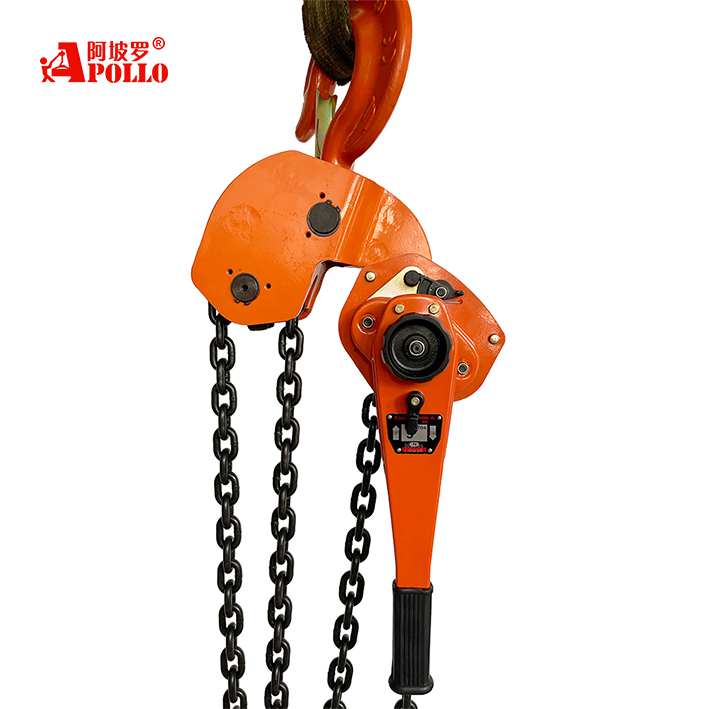
Apollo hand chain hoists use a double-pawl brake, so two independent locking elements hold the load and no single component can release it on its own. That redundancy only pays off if both pawls are free to move. Check that each one springs back into engagement, that the teeth are not rounded over, and that the load holds when the hand chain is released. A brake that lets a load creep is not a maintenance item to schedule. It is a unit to take out of service.
Hooks and latches
Both hooks are forged with steel safety latches on Apollo units, and the latch is the part that gets abused. A latch that stays open, a hook with visible twist, or a throat that has opened noticeably is a stop, not a note for next month. A hook that has been heated, straightened, or welded is scrap regardless of how it looks.
A maintenance schedule the crew can keep
A schedule that survives contact with a busy site has five lines, not fifty. These are the checks that catch the wear described above before it turns into a chain replacement or a dropped load.
| What to check | Interval | What tells you it is due |
| Hand chain and load chain | Before each shift | Twisted links, stiff joints, or a chain that jumps in the pocket wheel |
| Chain elongation | Quarterly | 11 links measure what 10 measured when the chain was new |
| Brake holding | Monthly, with a light load | The load creeps down after the hand chain is released |
| Hooks and latches | Monthly | A latch that stays open, or a hook with visible twist |
| Documented inspection | Annually | A competent person signs the record, and again after any overload |
Two practical notes make the table work. First, the checks are cumulative rather than alternatives: a chain that passes the elongation check still fails if a link is nicked. Second, put the annual inspection in the same system as the beam and the slings, so the record is found when an auditor asks rather than reconstructed afterwards.
Get a free load assessment: send the capacity and duty of the hoists in your fleet through the inquiry page, and Apollo’s engineers will return a wear-part and inspection plan within one business day, at no cost.
Lubrication: the ten minute job that keeps the pull honest
Hand-pull effort is a published number on these hoists: about 221 newtons at 0.5 tonnes, rising to roughly 392 newtons at 20 tonnes. Those figures assume a chain and gear train in normal condition. A dry chain, a dry hand chain and a gear housing that has collected grit will push the effort above the published figure, and the operator pays for it at every lift of the shift.
The routine is short. Wipe the load chain with a rag to remove grit before adding anything, apply a light film of chain lubricant rather than a heavy coat that traps dust, and keep lubricant away from the brake friction surfaces. On a hoist used outdoors or in a dusty plant, the wipe matters more than the oil: grit held against a link by grease is a grinding paste.
Chain replacement: the measurement that ends the argument
Chain wear arguments usually end with a measurement, so take the measurement before the argument starts. Lay the chain straight on a clean floor, mark a section and compare it with the same section of a new chain, or use the 11 links against 10 rule. If the section has grown by about 5 percent, the chain is due.
Elongation is not the only reason to replace. A chain comes off the hoist when a link is cracked, deeply nicked, bent, twisted, or pitted by corrosion, and when the weld flash on a link has started to fail. Replace the whole chain rather than a section, use the grade and pitch the hoist was built for, and check the sheave pockets at the same time. A new chain running in a worn sheave is money spent twice.
What Apollo builds in that makes maintenance simpler
Maintenance is easier on some hoists than others, and the difference is designed in rather than added later. Apollo hand chain hoists use a cast body with an integrated gear housing, so there are no bolted plate joints to work loose or to re-torque on a schedule. Load plates, gears and shafts are heat treated, which keeps tooth engagement stable through thousands of cycles instead of rounding over early. The load chain is high-tensile alloy steel, Grade 80 equivalent, with calibrated link geometry so wear stays predictable and the 11 link rule means something.
The gear ratio is matched to each capacity class, which is why the pull effort stays between about 221 newtons and 392 newtons across a range that runs from 0.5 tonnes to 20 tonnes. Weights run from 8 kg on the smallest unit to 156 kg on the largest, so the same maintenance procedure covers a hoist one technician can carry and one that needs a beam trolley to install.
When to repair and when to replace
A manual hoist is usually worth repairing while the body, hooks and load plates are sound. Chains, hand chains, latches, pawls and sheaves are wear parts, and replacing them restores the unit to its rated condition. The decision turns on three questions: is the body free of cracks and deformation, are the hooks still the hooks that were certified, and can the parts be bought separately.
Replacement makes more sense at the small end of the range. An 8 kg unit that needs a chain, a sheave and a brake service can cost more in labour than the unit is worth, while a 156 kg twenty tonne hoist is worth rebuilding for years. Either way, the answer depends on parts availability, which is a question for the supplier rather than the workshop.
Why the supplier matters as much as the schedule
Apollo is a hand chain hoist manufacturer, and the answers that decide whether the unit still holds load in year ten are about wear parts: which chain is fitted, how the brake is built, and whether the parts can be bought separately five years after the order.
Three questions settle it before you buy: the chain specification and the replacement rule, whether the brake is single pawl or double pawl, and the spare parts list with lead times. Apollo is a manual chain hoist supplier that answers all three in writing, from the factory that builds the unit rather than from a trading desk, so the maintenance plan still works when the first chain is due.
Apollo is a manual lifting equipment supplier with its own factory, more than 20 years of production, exports to over 50 countries, and ISO9001, CE, and GS. Apollo hand chain hoists are built in our own factory rather than assembled from bought-in parts, and the same documentation set covers the 0.5 tonne to 20 tonne range. For a maintenance team that means one procedure, one parts list, and one point of contact as the fleet grows.
As a heavy duty lifting equipment manufacturer, Apollo also keeps the range deliberately consistent: one brake architecture, one chain specification and one inspection method across every capacity, so a supervisor does not need a different checklist for the small hoist in the workshop and the large one in the yard. The full range, with capacities, chain sizes and hand-pull figures, is listed on the Apollo hand chain hoist category page (https://www.apollohoist.com/product-category/manual-hoist/chain-hoist/).
Crews that also pull as well as lift usually carry an Apollo lever hoist (https://www.apollohoist.com/product-category/manual-hoist/lever-hoist/) alongside the Apollo hand chain hoist, and the maintenance logic is the same for both tools. For the jobs where the hoist has to work with no power at all, see how Apollo hand chain hoists are used in no-power zones (https://www.apollohoist.com/product-news/manual-lifting-without-power-how-apollo-hand-chain-hoists-work-apollo-lifting-equipment-manufacturer/).
How to buy from Apollo: choose your channel
Plant, shutdown and project procurement
Get a free load assessment: send the capacity, lift height, environment and inspection interval your site requires. Within one business day you receive a matched Apollo hand chain hoist recommendation, a wear-part list, a formal quotation and the conformity documents your inspection team needs.
Distributors and dealers
The full 0.5 tonne to 20 tonne range ships under one documentation set, so a distributor can support a customer fleet with one parts list and one procedure. Combining Apollo hand chain hoists, Apollo lever hoists and Apollo beam trolleys in a single order protects margin and simplifies the customer’s spares holding.
OEM and private label
Custom branding, packaging and documentation are produced at the Apollo factory, built to the compliance requirements of your market.
Request conformity document samples now
- Get a free load assessment via WhatsApp / Phone: +86 18989488615
- Request conformity document samples by email: sales@apollohoist.com
- Submit an online inquiry: https://www.apollohoist.com/contact-us/
- Browse the full product range: https://www.apollohoist.com