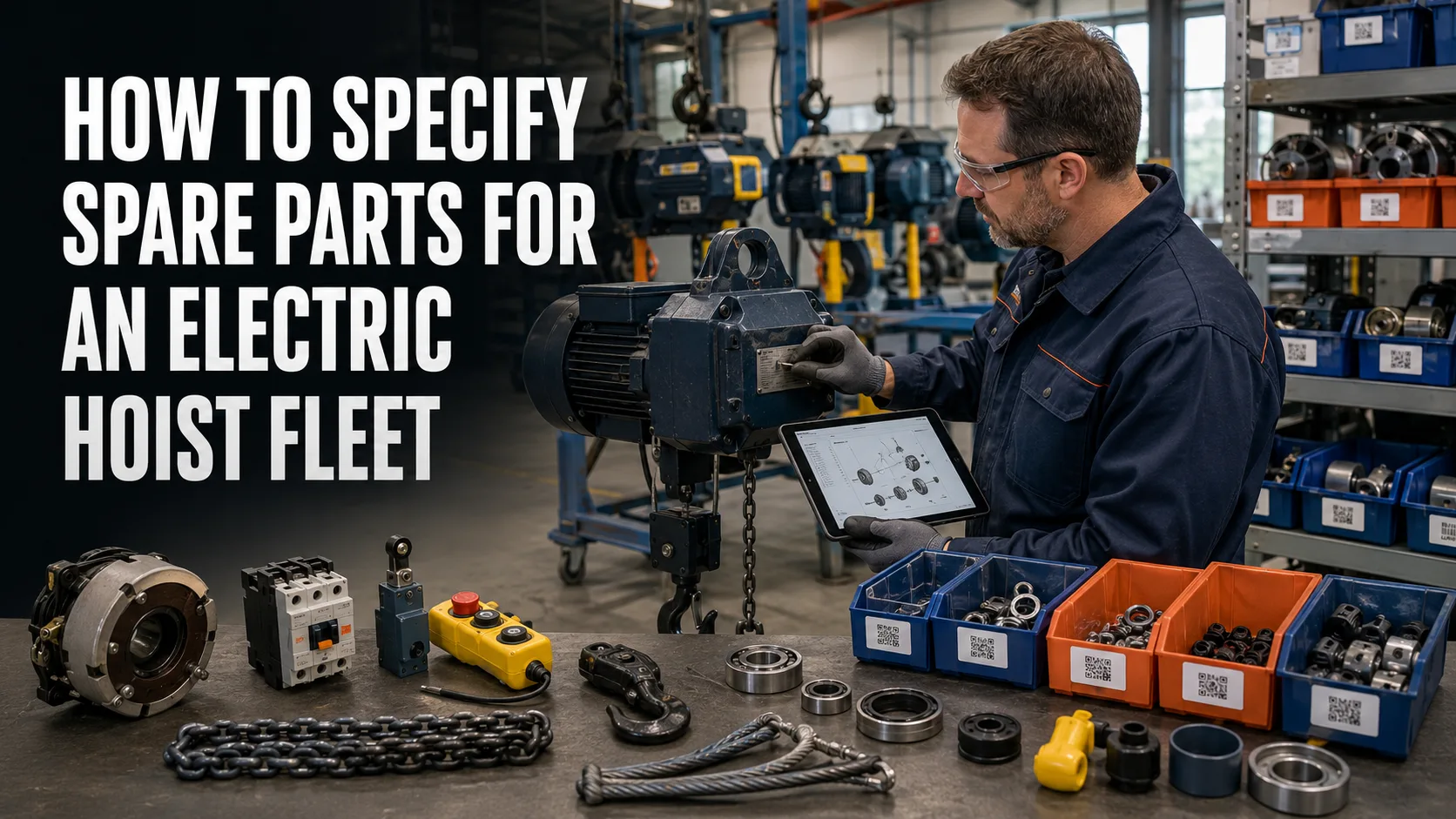
A fleet spare-parts specification should identify the hoist configuration, the part’s function, its failure consequence, and the evidence needed to verify fit. A list that says motor, brake, or chain is not enough when several capacities, voltages, duty classes, control systems, or revisions operate across one site. The goal is a controlled parts master that lets maintenance order correctly and procurement compare quotes without risk.
This guide lays out a practical method for electric chain and wire-rope hoist fleets. It covers asset identification, part data, criticality, stocking logic, supplier requests, and receiving checks. Manufacturer documentation remains the authority for dimensions, ratings, materials, interchangeability, and installation.
Start with an asset-level equipment register
Create one record for every hoist, not one generic record for a product family. Capture the manufacturer’s name, model, serial number, rated capacity, lift height, travel arrangement, control method, power supply, installation location, commissioning date, and current revision of the manual or parts breakdown. Add a photo of the nameplate and a drawing or clear image of the assembly where practical. A fleet register prevents a common error: ordering a visually similar part for a different frame size or control revision.
Separate fleet identity from part identity
Use two linked records. The asset record describes the complete hoist. The part record describes one replaceable item and includes the manufacturer’s part number, description, assembly position, revision, and approved alternatives. Link the part to every compatible asset rather than copying free-text notes into each asset record. When a supplier changes a revision, you can then see which machines and work orders are affected.
- For electric chain hoists, identify the chain grade or size, chain container arrangement, hook block, motor, brake, limit devices, pendant or radio control, and trolley interface where fitted.
- For wire-rope hoists, identify rope construction and diameter from the approved documentation, drum and reeving arrangement, hook assembly, brake, gearbox, motor, controls, and limit devices.
- For every electrical item, record voltage, frequency, phase, enclosure or protection details, connector style, and control-circuit revision when those fields apply.
Write a complete spare-parts specification
A useful specification answers five questions: What is the part? Where is it installed? What does it do? Which assets accept it? What proof is required before release? Use a consistent template so a technician, buyer, and supplier see the same information.
- Identification: manufacturer, model family, serial or asset references, official part number, drawing number, and revision.
- Function and location: brake coil, contactor, upper limit switch, load chain, wire rope, pendant, hook latch, bearing, seal, or another specific function and assembly position.
- Technical fit: dimensions, electrical values, connection details, material, finish, or setting limits only where the approved documentation states them.
- Evidence: drawing, exploded view, nameplate photo, dimensional inspection, certificate, or test record required for acceptance.
- Quantity basis: one unit per hoist, one per location, planned replacement interval, or contingency stock. Do not mix these quantities in one field.
Classify parts by failure consequence
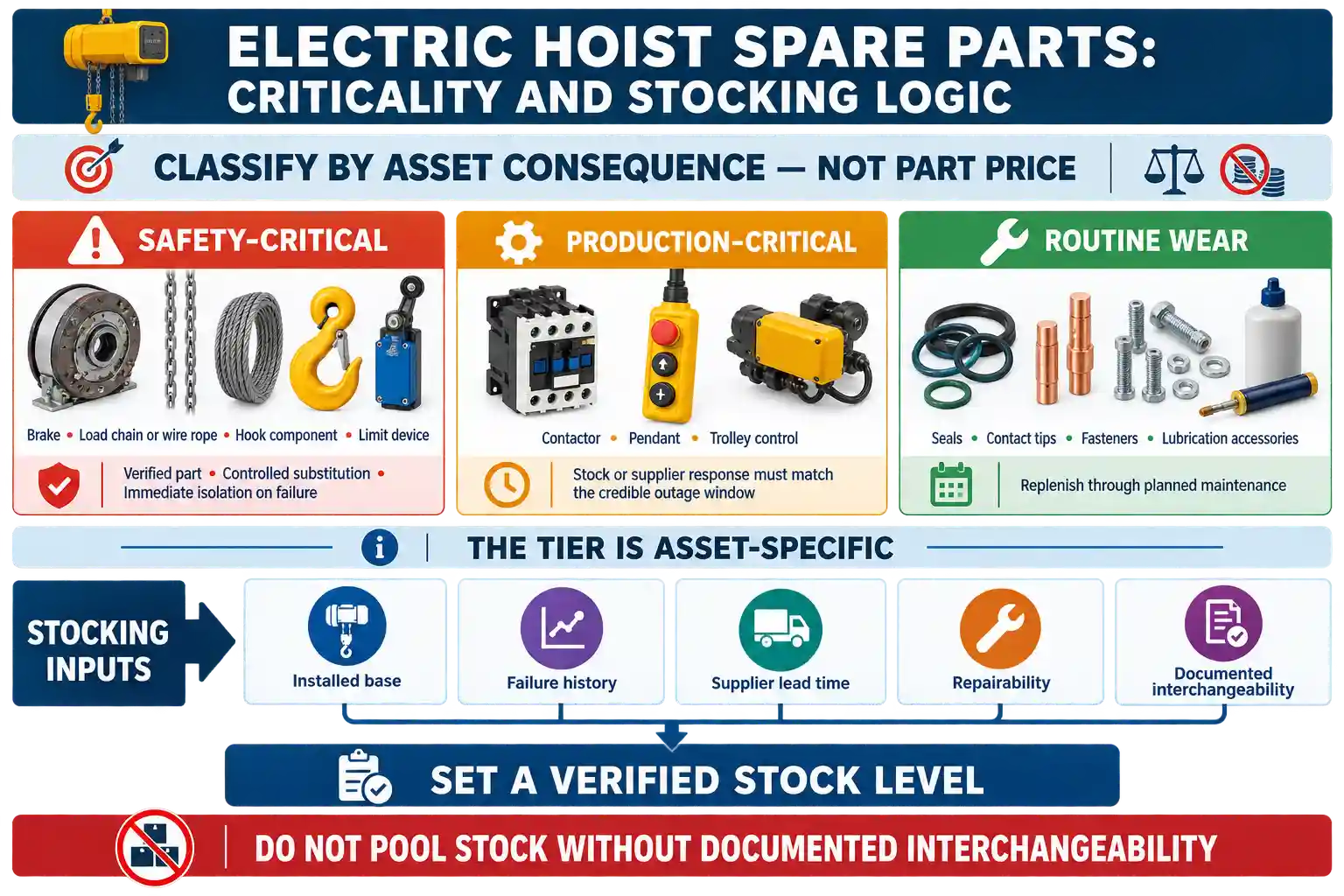
Stocking decisions should reflect risk, not only purchase price. A low-cost fuse can stop a production cell, while a higher-cost gearbox may be repairable before failure if a reliable lead time exists. Classify each item by its effect on safe lifting, regulatory inspection, production continuity, and repair time.
Three practical criticality tiers
- Safety-critical: a failed brake, hook component, load-bearing chain or rope, limit device, or control element may require immediate isolation. Release only a verified part, and define who approves substitution.
- Production-critical: failure stops a line or crane bay but does not by itself change the safe load path. Set stock or supplier response around the credible outage window.
- Routine wear or consumable: items such as seals, contact tips, fasteners, or lubrication accessories can be replenished through planned maintenance, subject to the manual and site procedure.
Criticality is asset-specific. The same contactor may be routine on a lightly used spare hoist and production-critical on a single-point lifting station. Record the reason for the tier so the classification can be reviewed when the operating context changes.
Set stocking levels from evidence
Avoid using a blanket min-max quantity for every model. Start with installed base, observed consumption, failure history, supplier lead time, repairability, and the number of interchangeable units. For a mixed fleet, calculate demand by part number and compatible asset group. Where data is limited, mark the assumption and set a review date instead of presenting a guessed safety stock as a fact.
- Keep a small, verified kit for parts that can immobilize a hoist and have uncertain replenishment time.
- Use pooled stock only when interchangeability is documented; visual similarity is not proof of fit.
- Protect shelf life and condition. Store electrical controls, seals, lubricants, ropes, and chains according to the applicable supplier instructions.
- Track issued parts against work orders so the next stocking review uses actual consumption rather than memory.

Build the RFQ around verification
A spare-parts RFQ should make it easy for a supplier to confirm compatibility and easy for your team to reject an ambiguous quote. Include the asset register extract, nameplate images, the relevant drawing or parts-list page, required quantity, delivery location, and requested evidence. Ask the supplier to quote each line against the exact part number and revision, and to identify any proposed supersession separately.
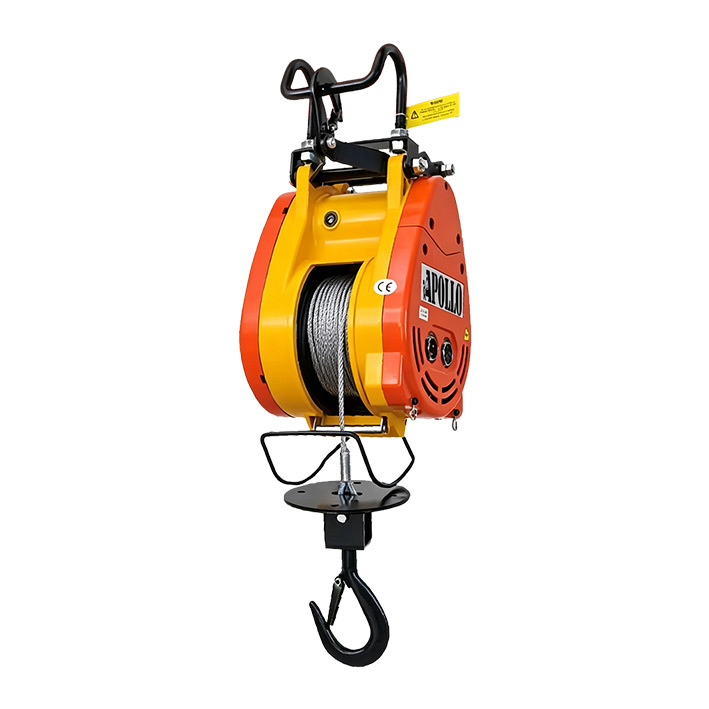
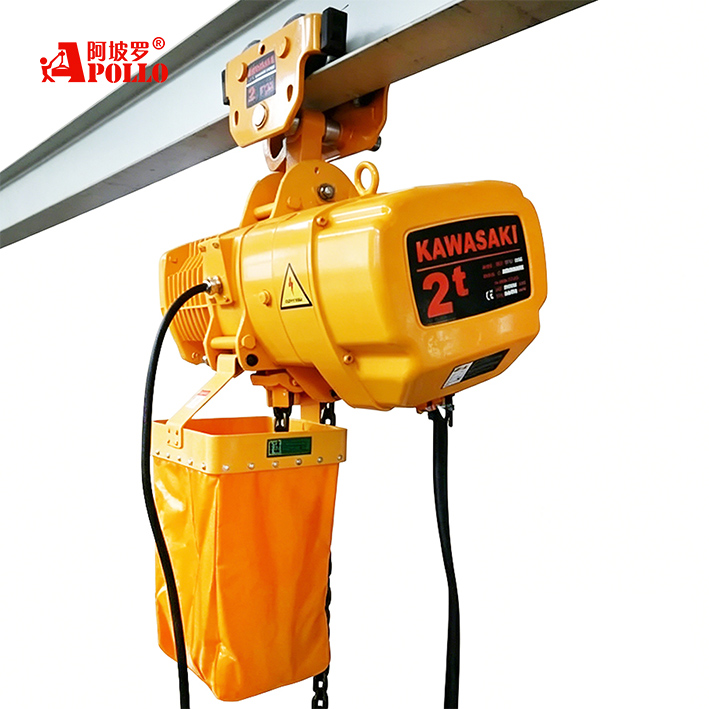
Apollo’s published range includes electric chain hoists, electric wire-rope hoists, electric winches, and explosion-proof hoists. The electric hoist product category is useful for confirming the equipment family before you send a request. The OHFM product listing illustrates why model-level identification matters. Do not assume a category label proves interchangeability; provide model, serial information, and assembly reference for a fit check.
Receiving, quarantine, and release
Receiving is part of the specification process. Compare the shipment with the purchase order, packaging label, manufacturer part number, revision, quantity, and visible condition. Quarantine any item with an unclear identity, damaged packaging, missing evidence, or a mismatch between the quoted and delivered description. A part should not enter the maintenance crib simply because it fits physically.
- Record lot, batch, or serial information when supplied and retain the drawing or certificate linked to the receipt.
- Check connectors, keyways, mounting holes, chain or rope markings, and protective caps without modifying the item.
- Release safety-critical parts only after the responsible technical authority confirms the documentation and compatibility.
For replacement work, close the loop by recording the installed part number, removed part condition, inspection result, and any updated revision. This history improves future failure analysis and exposes recurring problems such as contamination, overload, misalignment, or incorrect installation.
Use the supplier relationship deliberately
A supplier should be evaluated on traceability and technical responsiveness as well as price. Ask how it handles superseded parts, model changes, non-standard configurations, and technical questions. Apollo describes service and customization capabilities that may be relevant when a fleet contains different configurations, but support scope should be confirmed for the requested assets and parts.
For a controlled sourcing process, send the final asset register, part template, photos, drawings, operating duty, and quantities through the technical contact channel. Request written fit confirmation for any substitute, and keep the approval with the part master and purchase record.
Conclusion
Specifying spare parts for an electric hoist fleet is an identification and risk-control exercise before it is a purchasing exercise. Build an asset-level register, link exact part records to compatible machines, describe function and evidence requirements, classify criticality, set stock from real operating data, and verify every receipt. This discipline reduces wrong-part orders, shortens diagnosis time, and keeps safety-critical decisions tied to controlled documentation.
FAQs
What information is most important on a hoist spare-parts request?
The model and serial or asset reference, official part number, revision, assembly position, quantity, and a nameplate photo are the core fields. Add electrical or dimensional data only from approved documentation.
Should a fleet keep one spare for every hoist?
Not necessarily. Stocking depends on criticality, installed base, interchangeability, failure history, repair options, and lead time. Document the basis for each quantity and review it as usage changes.
Can a visually similar part be used as a substitute?
No assumption should be made from appearance alone. Require a documented fit confirmation covering the model, revision, dimensions, interfaces, ratings, and safety implications.
How should obsolete or superseded parts be handled?
Keep the old part number in the asset history, mark its status, and record the approved successor and affected models. Do not delete historical identifiers that are needed to interpret maintenance records.