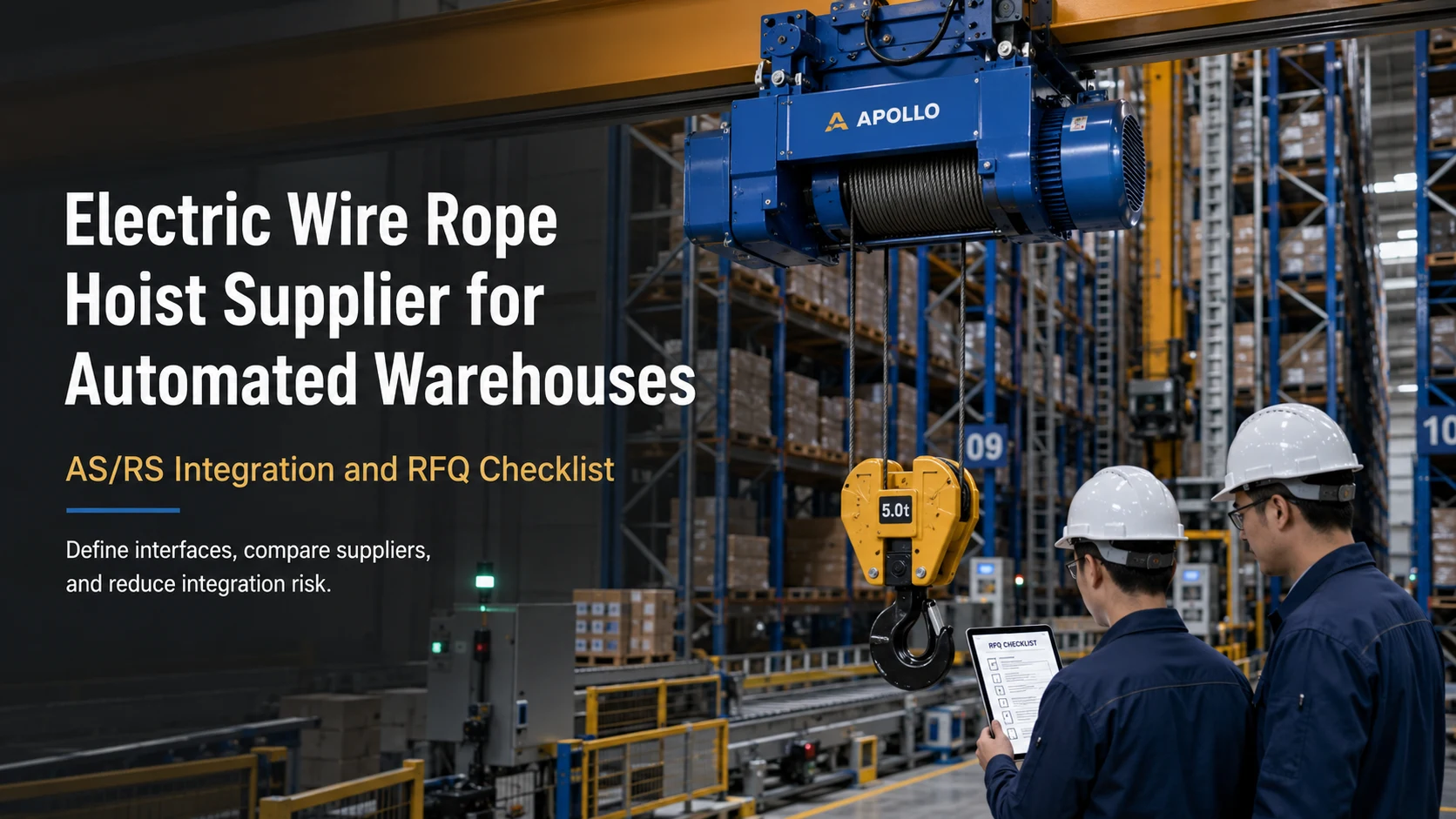
An electric wire rope hoist for an automated storage and retrieval system (AS/RS) cannot be selected from capacity alone. It must exchange status and command signals with the warehouse control architecture, fit the load path, and repeat its motion within acceptance criteria. A supplier can still be unsuitable if the RFQ leaves interfaces undefined.
This guide helps warehouse integrators, distributors, and project engineers define supplier scope before requesting a quotation. It separates the hoist from AS/RS controls, identifies evidence a supplier should provide, and gives an RFQ checklist for comparable offers.
Why AS/RS projects change the hoist specification
In a conventional crane application, an operator can compensate for small differences in speed, stopping distance, or control behavior. An AS/RS relies on sequenced commands, sensors, interlocks, and a warehouse management or control system. The lifting device becomes one node in a larger machine. The RFQ must describe the sequence: pick request, travel permissive, lift, positioning, load confirmation, release, fault, and reset.
The phrase automated warehouse can hide different layouts. A hoist may serve a maintenance bay, monorail transfer, service platform, stacker-crane subsystem, or special load-handling station. Each arrangement changes the envelope, duty profile, safety functions, and data exchange. Treat AS/RS integration as a project interface, not a marketing label.
Define the system boundary before selecting a supplier
Hoist role versus stacker-crane role
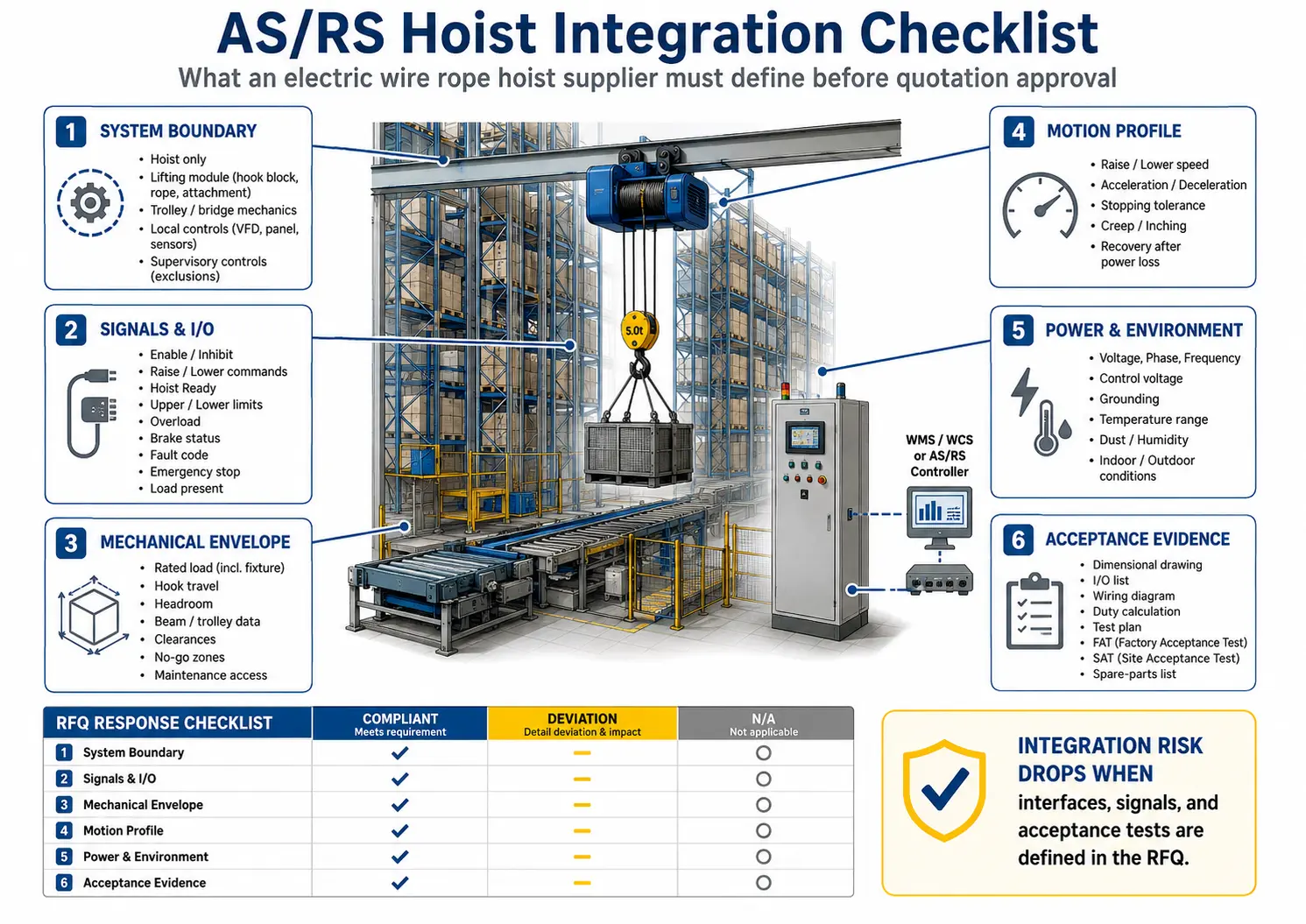
State whether the supplier provides only the wire rope hoist, the trolley and bridge mechanics, local controls, or a complete lifting module. Identify who owns the vertical axis, horizontal travel, load attachment, safety circuit, and supervisory controls. If a stacker crane or shuttle already provides positioning, the hoist supplier should receive its motion envelope and handshaking requirements instead of guessing how the machine operates.
Signals, data, and control ownership
List every command and feedback point in the RFQ. Typical fields include enable, raise, lower, travel permissive, ready, running, upper and lower limits, overload, brake status, fault code, emergency stop, and load-present confirmation. Define signal type, voltage, network protocol if applicable, update behavior, and fail-safe state. Ask for an I/O list and a cause-and-effect matrix. Do not assume that a standard pendant or remote-control package can be connected directly to an AS/RS PLC.
Mechanical envelope and load path
Provide the maximum lifted mass including the fixture, hook block, spreader, or container interface. Add center of gravity, allowable sway, hook orientation, lowest and highest hook positions, headroom, beam dimensions, approach clearances, and maintenance access. For an automated station, include the no-go zones used by sensors and the clearance needed when the load is transferred. The supplier should return a dimensioned drawing and identify every interface that remains by others.
Select the wire rope hoist architecture for AS/RS duty
Load spectrum and duty class
Describe lifts per hour, average lift duration, load spectrum, idle time, operating hours per day, and expected service life. Include starts and stops, not only running time, because brakes, contactors, drives, and rope systems experience the complete cycle. Require the supplier to state the design classification and calculation basis. A phrase such as heavy duty is not enough for an automated machine that must meet a repeatable cycle.
Motion profile and positioning
Specify raise and lower speeds, acceleration and deceleration limits, stopping tolerance, creep or inching behavior, and the conditions under which speed changes occur. If the AS/RS uses position feedback, define encoder type, resolution, mounting, cable routing, and ownership of the feedback loop. Confirm how the hoist behaves after a power interruption, communication loss, limit switch trip, or overload event. These are integration and acceptance questions, not optional operating details.
Environment and safeguarding
State indoor or outdoor location, temperature, humidity, dust, washdown, corrosive exposure, altitude, noise limits, and any hazardous-area classification. Describe guarding, access doors, light curtains, lockout points, emergency-stop zones, and safe maintenance access. For US projects, ask the responsible engineer to identify applicable OSHA requirements for the complete crane or hoist installation; a supplier statement alone does not establish compliance for the whole AS/RS.
Integration evidence to request before award
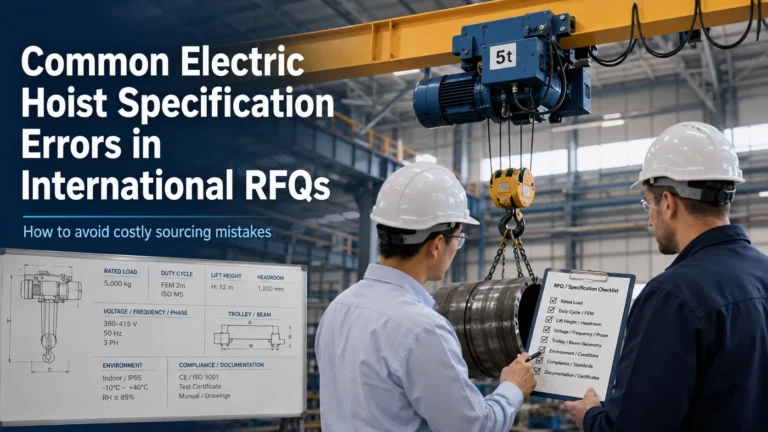
Ask for documents that let the integrator test the proposed interface before equipment arrives. The package should include a model-specific data sheet, dimensional drawing, load and duty assumptions, motor and brake data, wiring diagrams, I/O list, communication description, alarm and reset behavior, spare-parts list, maintenance instructions, and a deviations register. Where a custom interface is proposed, require a revision-controlled interface control document.
Define factory and site acceptance separately. Factory testing can verify unloaded and loaded motion, limits, brakes, fault handling, and signal mapping. Site acceptance should verify the installed load path, clearances, sensors, interlocks, communication with the AS/RS controller, recovery after a stop, and the agreed cycle sequence. Put pass/fail criteria, test weights, test records, and responsibility for corrections in the contract.
AS/RS electric wire rope hoist RFQ checklist
Use one response line for each requirement and require the supplier to mark it compliant, deviating, or not applicable. Include at least:
- Application: AS/RS layout, hoist role, load unit, fixture, center of gravity, and transfer sequence.
- Capacity and duty: rated load, load spectrum, lifts per hour, cycle time, starts, stops, and service life.
- Geometry: hook travel, headroom, beam or trolley data, clearances, maintenance access, and no-go zones.
- Motion: raise/lower speeds, acceleration, stopping tolerance, positioning feedback, and recovery behavior.
- Power: voltage, phase, frequency, tolerance, control voltage, grounding, and power-loss response.
- Controls: I/O list, network or hardwired interface, permissives, alarms, emergency stops, and reset logic.
- Evidence: drawings, calculations, manuals, software or parameter files, test plan, certificates, and spares.
- Commercial scope: packaging, delivery point, installation boundary, commissioning support, warranty, training, and change control.

Compare suppliers on integration risk
A lower equipment price can be offset by engineering hours, delayed testing, custom wiring, or unavailable spares. Compare each offer against the same interface schedule and record assumptions separately from confirmed inclusions. Check whether the proposed model is a standard product, a modified configuration, or a new design. Ask who owns software parameters, drawings, and field changes, and how revisions will be approved.
Apollo lists an electric wire rope hoist product category alongside mini and European electric wire rope hoist categories. Its product pages identify OEM customization and options such as function, voltage, surface treatment, and packaging. For an AS/RS project, treat these as starting points and request model-specific drawings, control interfaces, and acceptance evidence before approval.
Apollo’s ODM and OEM service page states that electric hoists can be customized for functions such as explosion-proof, dust-proof, rain-proof, frequency conversion, and two-speed operation, with single- or three-phase 110V-575V voltage customization. The R&D capabilities page can be relevant when the standard configuration does not match the required interface. Any AS/RS integration claim should remain subject to the approved specification and test plan.
Conclusion
The right electric wire rope hoist supplier for an automated warehouse is the one that can document the complete interface, not simply quote a lifting capacity. Define the machine boundary, duty cycle, motion profile, signals, safety behavior, evidence package, and acceptance tests in the RFQ. Then compare suppliers on what is included, what is conditional, and who owns the remaining engineering. This approach reduces integration surprises and gives the AS/RS team a traceable basis for approval.
FAQs
Can any electric wire rope hoist be connected to an AS/RS controller?
No. Compatibility depends on the hoist controls, safety architecture, feedback, signal method, motion requirements, and agreed interface testing. Confirm these items with the system integrator and supplier.
What should an AS/RS hoist RFQ specify first?
Start with the load unit and sequence: what is lifted, where it starts and ends, how often it cycles, and which system owns each motion and safety function. Then add electrical and documentation requirements.
Is a wire rope hoist always better than a chain hoist for automated warehousing?
The answer depends on load, lift, duty, geometry, environment, and control needs. Compare product families only after the application and interface schedule are defined.
What information should be sent to a potential supplier?
Send the layout or interface drawing, load and fixture details, duty profile, power supply, control architecture, environmental conditions, destination market, quantity, and required test documents.
For an application fit-check, contact Apollo with the AS/RS layout, load data, duty cycle, interface schedule, destination market, quantity, and acceptance criteria.