Introduction: The Frustration of a Misaligned Lift
In the precise world of material handling, few issues are as disruptive and potentially hazardous as an electric hoist trolley that refuses to track straight. Whether you are managing a busy warehouse overhead crane operation or relying on a heavy-lifting workstation jib, the phenomenon of a trolley slipping under acceleration or skewing diagonally across the beam flange is a clear sign of mechanical distress. It’s more than an annoyance; it leads to accelerated wear on crane parts, dangerous load swing, and significant downtime in industrial crane environments.
As a leading voice among global hoist manufacturers, Hangzhou Apollo Lifting Equipment Co., Ltd. frequently fields this specific inquiry from plant managers and maintenance engineers: “Is it the track, or is it the wheels?”
The answer, as with most complex lifting equipment diagnostics, is rarely binary. It is almost always a dynamic interaction between the runway condition and the trolley drive mechanics. This guide provides a comprehensive, engineering-level breakdown of the root causes of trolley slippage and skewing, offering actionable diagnostic steps and solutions rooted in decades of heavy lifting solutions expertise.
Part 1: The Symptom Analysis – Slipping vs. Skewing
Before assigning blame to the track or the wheel, it is critical to distinguish between two distinct, though often related, failure modes:
-
Slipping (Longitudinal Slip): The drive motor spins, the gearbox engages, but the trolley wheels either spin in place or lurch forward intermittently. This is a failure of traction.
-
Skewing (Lateral Drift or Dog-Tracking): The trolley moves, but the electric chain hoist or wire rope hoist body angles left or right relative to the beam. This is a failure of alignment.
Understanding which symptom dominates guides the diagnostic path. Slipping points heavily toward drive force and friction coefficients. Skewing points heavily toward geometry and parallelism.
Part 2: The Track (Runway Beam) – The Foundation of Stability
As overhead crane manufacturers and structural engineers will confirm, the runway is the single largest variable in long-term trolley performance. Even a perfectly machined trolley from top-tier hoist lift manufacturers will fail prematurely on a defective beam. Here is what to inspect when the track is suspect.
2.1. Contamination and Lubrication (The #1 Cause of Slipping)
This is the most common, yet most overlooked, culprit in crane used in industry settings. Overhead cranes operating near machining centers, welding bays, or paint booths accumulate airborne particulates.
-
The Problem: Oil mist, grease overspray, or even heavy dust settles on the lower flange of the runway beam.
-
The Physics: Steel wheels on steel track require a specific coefficient of friction (typically 0.15–0.20 for dry steel). A film of oil reduces this to near 0.05, causing the drive wheel to lose grip—especially under the sudden torque of a cross-travel motor start. This is why a heavily loaded electric chain hoist might slip only during the initial acceleration “jerk.”
-
Apollo Insight: In our experience as heavy lifting hoist suppliers, we have seen facilities replace expensive drive motors when the only required fix was a rigorous flange cleaning protocol and the installation of rail sweeps.
2.2. Flange Wear and Taper (The #1 Cause of Skewing)
Standard I-beams or patented track rails are not designed with perfectly flat, parallel contact surfaces. Patented track has a slight crown; I-beams have a natural taper on the bottom flange.
-
The Problem: Over years of service, trolley wheels wear a groove into this taper. If the wear is uneven—perhaps the trolley operates 80% of the time in the center 20% of the runway—the wheels encounter a “step” or a different taper angle as they move outboard.
-
The Result: The wheel on the worn side rides lower and at a slightly different angle. This forces the trolley frame to rotate (skew). For wire rope hoist suppliers and users, this skew is particularly dangerous as it induces lateral swing in the wire rope, drastically reducing rope life.
2.3. Misaligned Rail Splices
In longer warehouse crane types of installations, the runway consists of multiple beam sections bolted together.
-
The Problem: Thermal expansion, building settlement, or poor initial installation causes a lateral offset or a vertical step at the splice joint.
-
The Impact: As the trolley crosses this joint, one wheel lifts slightly or is jolted sideways. This instantaneous loss of contact on one side causes the trolley to “kick” into a skewed orientation. If you hear a rhythmic “clunk” once per bay, the splice joint is the prime suspect. Leading crane manufacturers invest heavily in splice alignment jigs to mitigate this.
Part 3: The Trolley Wheels and Drive – The Mechanical Heart
If the runway inspection reveals a clean, smooth, and parallel surface, the focus must shift to the trolley assembly itself. This is where the design quality and precision engineering of crane hoist manufacturers become evident.
3.1. Wheel Diameter Variance and Concentricity
This is a fundamental issue often found in lower-quality chain hoist suppliers or worn equipment.
-
Tapered Tread Design: Quality trolley wheels are not cylindrical; they are slightly tapered. This taper allows the trolley to self-center on an I-beam. If one wheel has a steeper wear pattern than the other, or if replacement wheels from non-OEM crane parts suppliers have a different taper angle, the self-centering force becomes unbalanced, causing skewing.
-
Concentricity: If the wheel bore is worn or the wheel was machined off-center, the trolley effectively becomes “egg-shaped” in motion. This causes a cyclical variation in wheel speed, leading to micro-slipping and vibration-induced skewing. Hangzhou Apollo ensures all our electric hoist trolley wheels are CNC-machined with strict tolerance for concentricity to eliminate this variable.
3.2. Drive Wheel Slippage: Motor Torque and Wheel Load
For an electric hoist with a motorized trolley (as opposed to a manual push trolley), the tractive effort must exceed the rolling resistance.
-
Insufficient Wheel Load: If the hoist is lifting a load far below its rated capacity, the weight pressing the drive wheel onto the beam may be too light to prevent slip during cross-travel start. This is a classic issue for small cranes manufacturers dealing with light-duty cycle applications. Conversely, if the counterweight on the non-drive side is incorrectly adjusted, the drive wheel loses traction.
-
Brake Drag: A common internal issue where the trolley brake does not fully release. The motor fights its own brake, leading to overheated motors and wheel slippage.
3.3. Coupling and Shaft Deflection
In long-frame trolleys or those used with twin wire rope hoist configurations, the drive shaft connecting the motor to the drive wheels (cross-shaft) can deflect under heavy load.
-
Torsional Wind-Up: As the motor applies torque, the shaft twists. The far-side wheel receives power a fraction of a second later. This phase lag causes the near-side wheel to “scrub” sideways before the far side catches up, resulting in a skewing motion that repeats every start. This is a critical engineering consideration for heavy lifting solutions involving capacities over 10 tons.
Part 4: The Interaction Effect – When Track and Wheel Collude
In many long-term industrial settings, the root cause is a vicious cycle created by both components:
-
A minor track misalignment causes the trolley to skew slightly.
-
Skewing causes the wheel flange to rub against the side of the beam web.
-
This friction creates heat and wear, flattening a spot on the wheel or creating a “flat” spot due to sliding.
-
The flat spot now causes vibration and slippage even on straight track.
-
Vibration loosens fasteners and accelerates bearing failure in the trolley wheels.
This cycle is why industrial crane manufacturers recommend a holistic inspection rather than a simple part swap.
Part 5: Diagnostic Protocol and Remediation Strategies
For maintenance teams working with manual hoist suppliers for auxiliary lifts or complex powered systems, we recommend the following step-by-step protocol:
| Step | Inspection Point | Likely Finding | Recommended Action |
|---|---|---|---|
| 1 | Runway Cleanliness | Grease/Oil film on flange | Clean with degreaser; Install rail sweeps. |
| 2 | Flange Profile (Depth Gauge) | Uneven taper or vertical step | Grind smooth OR (if severe) consult overhead crane manufacturers for rail replacement. |
| 3 | Wheel Tread Condition | Polished/shiny spots (slippage) or one-sided wear (skewing) | Replace wheel sets as a matched pair (NEVER replace just one wheel). |
| 4 | Alignment (String Line) | Wheel not parallel to beam web | Adjust eccentric mounting pins on trolley side plates. |
| 5 | Drive Train (Rotation Test) | Stiffness or grinding | Check brake air gap and gearbox oil. |
Part 6: The Hangzhou Apollo Approach – Engineering Out the Variables
As a premier partner among hoist manufacturers and crane suppliers globally, Hangzhou Apollo Lifting Equipment Co., Ltd. understands that the reliability of a lift depends as much on the components that move the load horizontally as on the lifting hook itself.
Our value proposition to international industrial clients—from construction crane for sale inquiries to machine shop cranes and port crane manufacturers support—centers on mitigating these exact operational pain points.
-
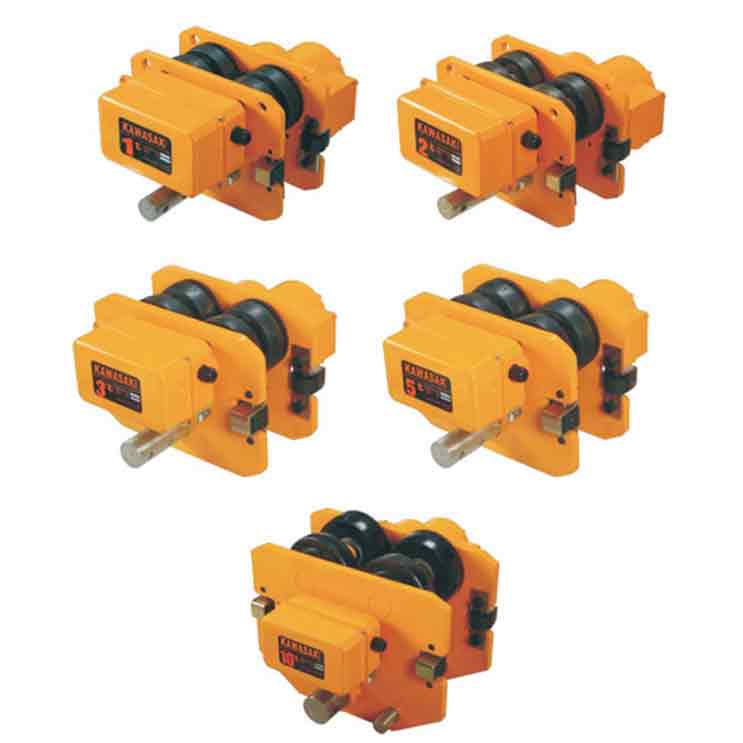
Precision Trolley Design: Our electric trolleys for electric chain hoist and electric wire rope hoist manufacturers standards are engineered with forged, heat-treated wheels. We utilize a unique gearbox mounting system that minimizes driveline deflection, ensuring that the power from the motor reaches both wheels simultaneously—a critical feature lacking in many generic chain hoist manufacturer designs.
-
Custom Solutions for Severe Duty: For electric hoist for mining operations or dusty foundry environments, we offer custom trolley enclosures and hardened wheel materials specifically formulated to resist slippage caused by contamination.
-
Global Parts and Support: We act not just as hoist suppliers but as technical consultants. Our engineering team can review your runway beam specs and crane usage data to recommend the optimal wheel material—be it hardened steel for heavy loads or polyamide for noise reduction in cleanroom warehouse crane applications.
Part 7: Future Trends in Trolley Tracking
The industry is moving toward proactive maintenance rather than reactive repair. As a leader among top hoist manufacturers, we see several emerging trends addressing the slip-and-skew challenge:
-
Condition Monitoring Sensors: New generation industrial crane systems now feature vibration sensors mounted on trolley frames. These sensors can detect the characteristic frequency of a flat wheel or the lateral “sway” of a skewing trolley long before the operator notices.
-
Synthetic Guide Rollers: To combat flange wear on beams, many loader crane manufacturers and large crane manufacturers are shifting toward horizontal guide rollers instead of rigid side plates. These rollers maintain alignment without the high friction that causes wheel slip.
-
Variable Frequency Drives (VFD) for Cross Travel: By using VFDs on crane hoist trolley motors, we can eliminate the high-torque “jerk” start. Smooth acceleration significantly increases the threshold before traction loss occurs, effectively masking minor track imperfections.
Conclusion: Trust the Experts, Preserve the Asset
Returning to the original question: Is it the track or the wheel?
It is the relationship between the two. While a contaminated track is the most frequent cause of slippage, and wheel taper mismatch the most frequent cause of skewing, the only way to ensure a permanent fix is to view the trolley and runway as a single, integrated system.
At Hangzhou Apollo Lifting Equipment Co., Ltd. , we don’t just manufacture electric hoists or act as industrial lifting clamps and lifting clamp manufacturers. We engineer motion solutions. Whether you need a single replacement trolley wheel set from crane parts suppliers or a fully integrated warehouse overhead crane system, our team is equipped to diagnose the hidden misalignments that drain productivity and compromise safety.
By applying rigorous engineering discipline to the humble trolley wheel, we ensure that when you press the button, the load moves straight, smooth, and safe—every time. For complex troubleshooting or to discuss a custom trolley solution for a challenging runway environment, contact our engineering support team. We are here to elevate your operational performance.