In the demanding world of heavy construction and industrial fabrication, the challenge of lifting long, heavy, or flexible loads is a daily reality. Consider a 30-meter concrete bridge girder, a massive industrial pressure vessel, or a lengthy section of large-diameter pipeline. A single hoist, regardless of its capacity, is entirely unsuitable for such a task due to the inevitability of dangerous tilting, uncontrolled stress points, and catastrophic load failure. The solution lies in a synchronized, multi-hoist lifting system. This article, brought to you by Hangzhou Apollo Lifting Equipment Co., Ltd. , serves as a definitive technical guide to understanding how multiple electric hoists can work in concert, the technology that enables this, and the critical factors that ensure a safe and precise lift.
Our decades of experience as a leading hoist manufacturer and integrator have placed us at the forefront of such complex Heavy lifting solutions. We understand that moving from a single-point lift to a synchronized tandem lift is not merely about buying more hoists; it’s about building an intelligent system.
1. The Core Challenge: Why Standards Hoists Fall Short
A standard electric chain hoist or wire rope hoist is a self-contained unit designed for vertical lifting from a single point. When you connect two, four, or more of these to a long load, several critical problems arise immediately:
-
Load Distribution Imbalance: The load is rarely perfectly uniform, and the hoists’ lifting speeds are not mathematically identical due to manufacturing tolerances, motor slip, and drum winding differences. One hoist will invariably take more than its share, leading to overload.
-
Positional Skew and Drift: As hoists run, minor speed variances accumulate. This causes the load to tilt, potentially bending the load itself, overloading lifting lugs, or causing it to slide out of its rigging.
-
Structural Integrity of the Load: A long, flexible load like a pipe or a steel truss is not a rigid body. Uncontrolled lifting can introduce bending moments it was never designed to withstand.
Therefore, the question is not just can they be synchronized, but how to achieve a level of synchronization that is safe, reliable, and precise enough for the specific application. This is where the expertise of specialized electric hoist suppliers becomes invaluable.
2. The Technological Enablers: Hardware and Control Systems
To create a functional tandem lifting system, you need more than just the hoists themselves. The following additional equipment is typically essential, specifically when deploying multiple chain hoists or wire rope hoists from a gantry or as part of an engineered system provided by overhead crane manufacturers.
A. The Foundation: Suitable Hoist Types
The choice between an electric chain hoist and a wire rope electric hoist is the first decision. For many precision tandem lifts under 10 tonnes per unit, electric chain hoists are preferred due to their mechanical synchronization capabilities. For heavier, long-travel lifts, wire rope hoists from specialist wire rope hoist suppliers are standard, though they demand more sophisticated electronic control.
B. The Control Architecture (The Brain)
This is the most critical component. Three tiers of sophistication are commonly employed:
-
Basic Master-Slave Control: One hoist (the master) sends a reference speed signal to one or more slaves. This is open-loop control. If a slave hoist is mechanically dragging or has a different load, it will lag. This is suitable only for non-critical lifts where some skew is acceptable.
-
Closed-Loop Synchronization with Encoders: This is the industry standard for reliable tandem lifting. Each hoist is fitted with an incremental or absolute encoder on its motor or drum. A central PLC (Programmable Logic Controller) constantly reads the precise position of each hoist. It then adjusts the motor speed of each unit via Variable Frequency Drives (VFDs) in real-time to maintain a defined position relationship. This closed-loop feedback effectively compensates for load differences and mechanical variations.
-
Closed-Loop with Load Cell Integration: For the highest precision and safety, load cells are integrated into each lifting point or the hoist’s suspension. The PLC not only synchronizes position but also the load weight on each hoist. This is the gold standard for lifting extremely sensitive, high-value, or flexible loads where load distribution is as critical as positional accuracy. It is a core offering for any advanced crane hoist manufacturer specializing in engineered Heavy lifting solutions.
C. Critical Supporting Components
-
Communication Network: A robust, real-time industrial protocol (like Profinet, EtherCAT, or a secure wireless link) connecting all drives and the central PLC is non-negotiable. Latency is the enemy of synchronization.
-
Human-Machine Interface (HMI): A touch-panel controller gives the operator a clear view of the position, load, and status of each hoist, along with smart alerts for skew limits and overloads. This single-point control replaces the impossible task of coordinating multiple independent pendants.
-
Skew Detection System: Beyond the encoders, a redundant laser or magnetic tape-based skew sensor system can provide a direct measurement of the load’s tilt, offering an ultimate safety trip if synchronization is lost.
3. Achieving Precision: What Synchronization Accuracy Can You Expect?
“Accuracy” in synchronized lifting is defined by the positional difference between the hoists during motion and at standstill. When you engage with top-tier hoist manufacturers, you are essentially buying a guaranteed performance envelope.
-
Standard Closed-Loop Encoder-Based Systems: A well-engineered system from reputable electric hoist suppliers can consistently achieve a synchronization accuracy of ±3 to ±5 millimeters. This is entirely sufficient for the vast majority of structural steel, pipeline, and general fabrication tasks.
-
High-Precision, Load-Compensated Systems: For critical applications—such as installing turbine rotors, placing precision machinery, or handling composite aircraft components—motor-mounted encoders are not enough. The rope stretch or chain elastic elongation must be compensated for. By integrating load cells and using advanced control algorithms, it’s possible to achieve a relative positional accuracy of ±1 millimeter or better.
-
The Theoretical Limit and Reality: The ultimate precision is limited by the mechanical backlash in the gearbox and chain/sprocket engagement. No control system can correct for 2mm of mechanical slack that hasn’t been taken up. This is why Hangzhou Apollo, as a dedicated chain hoist manufacturers, focuses heavily on precision manufacturing and the use of high-grade, calibrated load chains to minimize this inherent mechanical hysteresis.
4. Best Practice: Engineering the Complete Lifting Solution
A synchronized lift is a system, not a product. Here are the golden rules we advise our clients as a global lifting partner:
-
Start with the Load, Not the Hoists: A rigorous load analysis is paramount. Define the object’s weight, center of gravity (which may shift during lifting), structural rigidity, and the allowable stress limits at lifting points. This defines how many hoists are needed and where they must be placed.
-
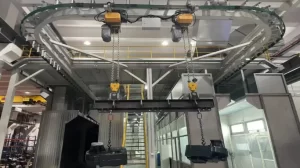
Consider the Overhead Structure: The hoists, whether riding on a custom-built lifting gantry or an existing crane, are often provided by overhead crane manufacturers. Misaligned runways or a flexible support structure will destroy even the best hoist synchronization by inducing uncontrolled forces.
-
Rigging is Part of the System: Industrial manual hoists or chain blocks are often used as fine-trimming side pulls, but in powered systems, the primary rigging must be geometrically perfect. Use precisely matched sling lengths and consider below-the-hook lifting beams designed by lifting clamp manufacturers to convert a multi-point lift into a statically determinate two-hook lift wherever possible, drastically simplifying synchronization.
-
Total System Commissioning and Proof Testing: The entire assembled system—hoists, controls, power supply, and rigging—must be commissioned and proof-tested at up to 125% of the Safe Working Load (SWL). This is not just a regulatory requirement but an essential validation of the control system’s stability under real-world conditions.
5. Future Trends: The Smart, Interconnected Liftsite
The future of synchronized lifting is digital. As a forward-looking company among leading crane hoist manufacturers, Hangzhou Apollo is actively integrating Industry 4.0 principles. We are moving towards systems with:
-
Wireless Mesh Networks: Eliminating control cables for faster, more flexible setup on construction sites.
-
Digital Twin Integration: Simulating the entire lift before execution, using the actual control parameters to predict system behavior and identify risks.
-
Autonomous Load Leveling: Systems that use AI-driven predictive algorithms, not just reactive PID loops, to compensate for disturbances before they happen, achieving a new level of “float-like” precision in material handling.
Conclusion: Partnering for Your Critical Lift
Synchronizing multiple electric hoists to lift a long, heavy load is a distinct engineering discipline that transcends the simple sale of hardware. It demands a partner who understands the complexities of mechanical design, electrical control theory, and real-world operational safety. Whether the solution requires a fleet of robust electric chain hoist units from our extensive range, a custom-engineered wire rope system, or a fully integrated overhead crane with AI-powered synchronization, Hangzhou Apollo Lifting Equipment Co., Ltd. possesses the vertical integration and engineering expertise to deliver a complete, certified solution.
We are more than just electric hoist suppliers; we are your partners in resolving the most demanding Heavy lifting solutions. From the initial load calculation to the final on-site commissioning, our focus is on providing a system that lifts safely, precisely, and reliably, every time. When the success of your project hangs in the balance, the choice of your lifting partner is the most critical decision you will make.