1. Introduction: The Core Challenge of Construction Material Handling
For contractors, project managers, and site supervisors, the efficient and safe movement of materials is not just a task—it’s a critical path activity that dictates project timelines and profitability. The question, “I frequently lift construction materials; which electric hoist should I choose?” is therefore fundamental. A mismatched choice leads to bottlenecks, increased wear, safety risks, and ultimately, higher total cost of ownership.
This guide, drawing on the extensive engineering expertise of Hangzhou Apollo Lifting Equipment Co., Ltd., moves beyond simple product comparisons. As leading hoist manufacturers specializing in heavy lifting solutions for the global construction sector, we provide a systematic decision-making framework. We will dissect the key operational factors, objectively compare the two primary technologies—electric chain hoist versus wire rope hoists—and deliver actionable recommendations to ensure your investment drives productivity and safety on your site.
2. The Pre-Selection Audit: Defining Your Operational Profile
A precise understanding of your specific needs is the essential first step. “Frequent lifting” must be quantified and contextualized.
2.1 Load Analysis: The “What” and “How Much”
Determine the single heaviest load you handle regularly. Always include the weight of all rigging hardware—industrial lifting clamps, slings, spreader beams—in your calculation. Industry best practice dictates selecting a hoist with a rated capacity at least 25% above this total weight to account for dynamic forces (shock load from starting/stopping) and ensure a long service life.
2.2 Duty Cycle Analysis: Quantifying “Frequent”
Frequency interacts with intensity. The international FEM/ISO duty class standard is the definitive metric for matching hoist robustness to your usage pattern. For active construction sites & prefabrication shops where hoists may operate for several hours daily with regular loading, a FEM 3m (Class 4 – Heavy Duty) rating is typically the minimum requirement. For very intensive use in pre-cast concrete yards or steel fabrication plants, FEM 4m (Class 5 – Very Heavy Duty) is recommended.
2.3 Environmental & Site Analysis: The “Where” Matters
The worksite environment dramatically impacts hoist selection and required specifications. Outdoor use mandates hoists with robust weatherproofing (e.g., IP54/55 or higher), corrosion-resistant finishes, and components tolerant of temperature fluctuations. For indoor workshops or warehouses, standard industrial protection may suffice.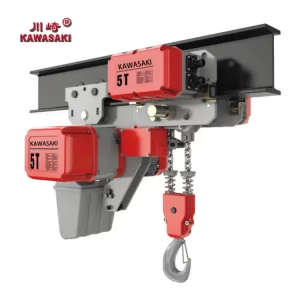
3. Technology Comparison: Electric Chain Hoist vs. Wire Rope Hoist
With a clear operational profile, we can meaningfully compare the two dominant electric hoist technologies for construction applications.
| Comparison Factor | Electric Chain Hoist | Wire Rope Hoist |
| Optimal Capacity Range | Excellent for low to medium capacities (up to 10-15 tons). Ideal for general construction materials. | Superior for medium to high capacities (5 tons and above). The choice for heavy lifting solutions. |
| Headroom Requirement | Minimal hook approach. Maximizes usable lift height in confined spaces like prefab buildings or under low ceilings. | Requires more headroom due to the drum assembly for rope storage. |
| Durability in Harsh Conditions | Welded alloy steel chain resists impact, abrasion, and crushing. Galvanized/stainless options excel outdoors. | Wire rope can be vulnerable to kinking and severe abrasion if not properly maintained with correct sheaves. |
| Duty Cycle Capability | Suitable for heavy duty (FEM 3m) and very heavy duty (FEM 4m) in appropriate models. | Engineered for intensive, high-frequency operation (FEM 4m+). Ideal for pre-cast yards and steel service centers. |
| Lift Speed & Control | Generally offers moderate lift speeds. Well-suited for precise positioning tasks. | Typically provides faster line speeds. Often compatible with VFDs for smooth acceleration and precise control. |
| Primary Construction Applications | General building construction, interior fit-out, outdoor infrastructure projects, modular construction. | Structural steel erection, precast concrete handling, heavy industrial material movement, large-scale projects. |
Key Insight: There is no universal “best” hoist type. The optimal choice depends entirely on your specific operational profile—capacity needs, duty cycle, environmental conditions, and headroom constraints.
4. Application-Specific Recommendations
4.1 General Building Construction & Interior Fit-Out
Typical Loads: Drywall bundles, lumber, MEP equipment, modular components (0.5 – 3 tons).
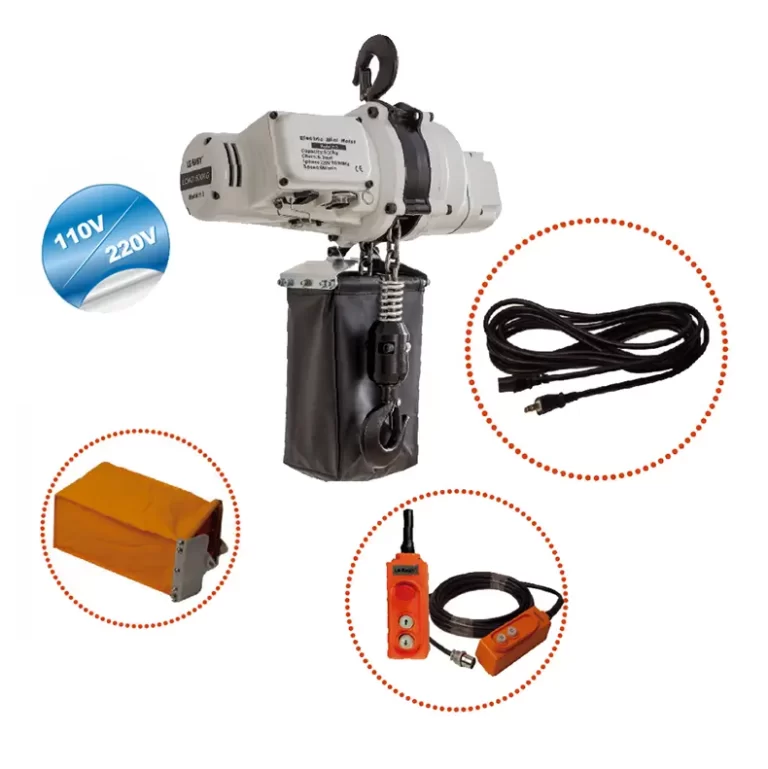
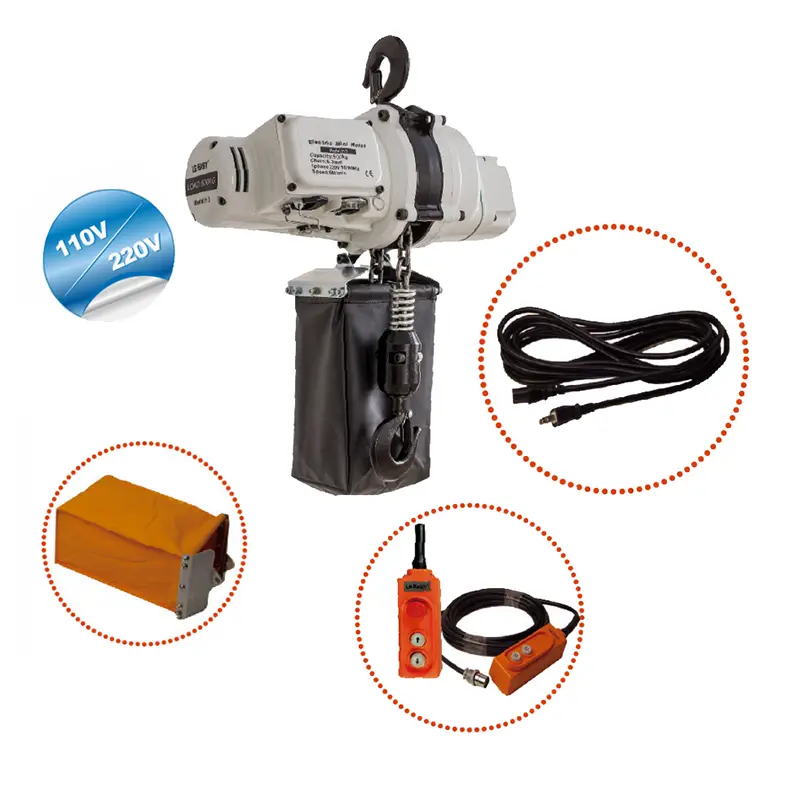
Recommended Solution: A robust electric chain hoist (FEM 3m). Its compactness, durability against incidental impacts, and favorable economics make it an excellent all-rounder for on-site material handling and positioning.
Case Study – Underground Power Station Construction: A significant challenge in constructing the underground main and auxiliary halls of a pumped-storage power station was limited space and a single vertical transport channel, which severely hampered the progress of moving materials. The solution implemented was the strategic installation of electric chain hoists at the crown of the auxiliary hall rock ceiling, with corresponding lift holes预留 on each floor. This created an efficient, temporary vertical transport network. The compact and lightweight nature of the chain hoists was critical in the confined underground space. This system successfully handled the frequent transport of formwork, scaffolding during civil works, and later, heavy equipment like air compressor tanks and electrical switchgear cabinets during the fit-out phase. This application highlights the chain hoist’s core strengths: enabling efficient material flow in space-constrained, multi-phase building projects where setup flexibility and reliability for frequent, varied lifts are paramount.
4.2 Structural Steel Erection & Fabrication
Typical Loads: Steel beams, columns, trusses, plate (2 – 25+ tons).
Recommended Solution: This is the core domain of professional wire rope hoist suppliers. The combination of higher speed, superior duty cycle capability, and precision control is critical for productivity and safety in steel handling. These are the engines of dedicated industrial lifting cranes.
Case Study – High-Rise Steel Frame Assembly: On a major urban high-rise project, the steel contractor faced a tight schedule requiring the precise placement of hundreds of heavy beams and columns. The critical need was not just lifting capacity, but speed per cycle and the durability to operate continuously throughout long shifts. Here, wire rope hoists equipped with Variable Frequency Drives (VFDs) were selected for the primary gantry cranes. The VFDs allowed for smooth, controlled acceleration and deceleration, enabling millimetre-perfect positioning of structural members into their connections, significantly reducing fitting time. The hoists’ FEM 4m (Very Heavy Duty) rating ensured they could withstand the intense, repetitive lifting schedule without excessive wear or downtime. This case underscores why wire rope hoists are the industry standard for steel: they provide the robust performance and precise control necessary to meet the demanding pace and accuracy of modern steel erection.
4.3 Precast Concrete Production & Handling
Typical Loads: Concrete panels, double-tees, structural elements (5 – 50+ tons).
Recommended Solution: Almost exclusively requires heavy-duty wire rope hoists (FEM 4m or higher). The demand for reliability, speed, and control under extreme cyclic loading is paramount. These hoists are integral to the systems provided by specialized crane hoist manufacturers for the pre-cast industry.
Case Study – Prefabricated Viaduct Project: In the construction of the Quanli-Dongfeng Viaduct, a key challenge was the hoisting, precise positioning, and control of massive, non-standard prefabricated pier columns and bridge abutments. The success of the entire prefabricated, integrated construction approach relied on heavy-duty wire rope hoisting systems. These hoists needed to provide exceptional reliability to maintain a fast production pace in the casting yard, and then offer fine control capabilities to ensure the giant concrete components were lowered into their final positions with absolute accuracy during installation. Any failure in control could lead to catastrophic damage to the multi-ton component itself or the foundation. This project exemplifies the non-negotiable requirements in precast concrete handling: extreme reliability to prevent costly production stoppages and superior control to guarantee safe, perfect placement, which are the hallmark strengths of high-performance wire rope hoists.
4.4 Specialized Application: Facade and Climbing Formwork
Typical Loads: Climbing formwork systems, modular facade panels (5 – 20 tons, often lifted synchronously by multiple hoists).Recommended Solution: Specialized climbing electric hoists (a type of electric chain hoist), also known as group-lifting hoists. These are designed for slow-speed, high-precision synchronous lifting of heavy, distributed loads.
Case Study – Synchronized Climbing Formwork Lift: For the core construction of a super-tall building, the team utilized a self-climbing formwork system. To lift the entire multi-ton formwork module for each new floor, a battery of climbing electric hoists was employed. These hoists are specifically engineered with features critical for this task: slow, controlled lifting speeds for safety and stability, high mechanical durability to withstand continuous cycling, and most importantly, precise electronic synchronization via a central control box. This ensures all lifting points rise in unison, preventing dangerous tilting or binding of the formwork. The hoists’ rated loads, which can range from 5 to 20 tons, are matched precisely to the distributed weight of the system. This application highlights a niche where specialized electric chain hoists are indispensable, providing the synchronized, heavy-duty, and reliable lifting power required for advanced construction techniques.
5. Best Practices for Safety and Maintenance
Selecting the right hoist is only the first step. Proper operation and maintenance are essential for safety and longevity:
- Daily Pre-Use Inspection:Check hooks, chains/ropes, controls, and limit switches for any visible damage or malfunction before each shift.
2. Regular Professional Maintenance:Adhere to the manufacturer’s scheduled maintenance for lubrication, gearbox inspection, and brake testing.
3. Operator Training: Ensure all personnel are trained in safe hoisting practices, load rigging, and understanding the equipment’s load chart.
4. Genuine Parts & Professional Service: Use only OEM-approved replacement parts from reputable crane parts suppliers to maintain safety certifications and performance.
6. The Apollo Value Proposition: Engineering Reliability for Your Project
At Hangzhou Apollo Lifting Equipment Co., Ltd., our role extends beyond being just electric chain hoist or wire rope hoist suppliers. We are your engineering partner in productivity. We understand that downtime is the enemy of project schedules and budgets.
6.1 Application-First Engineering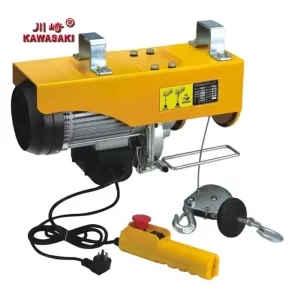
Our team collaborates with you to analyze your specific profile—duty cycle, environment, load dynamics—ensuring the recommended hoist isn’t just a catalog item, but an optimized heavy lifting solution tailored to your construction needs.
6.2 Quality Built for the Job Site
Every Apollo hoist embodies rigorous manufacturing standards (FEM, ISO), premium components, and comprehensive testing. We build durability and reliability into our products from the ground up, because we know they must perform in demanding construction environments.
7. Conclusion: Making an Informed Decision
The optimal electric hoist for your frequent construction material handling is the one that aligns precisely with your defined operational profile. For frequent, lower-to-medium capacity lifting where compactness, corrosion resistance, and cost-efficiency are priorities, the electric chain hoist stands as a versatile and robust champion.
For high-frequency, high-capacity, high-speed lifting demanding maximum durability, intensive duty cycle capability, and precise control, partnering with experienced wire rope hoist suppliers for a suitably rated wire rope hoist is the proven path to peak productivity and long-term value.
Final Recommendation: By applying this structured decision framework and partnering with a knowledgeable, quality-focused hoist manufacturer like Hangzhou Apollo, you secure more than equipment. You invest in a reliable, efficient, and safe heavy lifting solution engineered to keep your project moving forward, lift after critical lift.