Picking the proper load chain goes beyond a simple technical choice. In lifting gear, the chain grade influences safety, longevity, and everyday efficiency. T80 and T100 chains stand out as popular picks in industrial hoisting, particularly when picking electric or manual hoists for various load situations.
Apollo Hoist offers a broad selection of KAWASAKI hoisting options with adaptable T80 and T100 chains, so users can align the chain grade with actual job needs rather than relying on estimates. Grasping the distinctions between these two chain grades simplifies equipment choices and makes them more effective in practice.
What Are T80 And T100 Chains And Why Do They Matter?
Prior to examining their performance, it pays to know what T80 and T100 chains truly mean and why their differences count in actual lifting work.
Definition And Material Properties Of T80 Chains
T80 chains, known also as Grade 80 chains, consist of sturdy alloy steel and get heat-treated to achieve at least 800 MPa in tensile strength. This grade has served industrial lifting reliably for years and continues as a dependable option for typical hoisting jobs.
People value T80 chains for their steady operation, solid resistance to wear, and consistent response under ongoing loads. They appear often in shops, storage areas, building sites, and routine production spots where loads stay even and under control.
KAWASAKI manual and electric chain hoists from Apollo typically feature T80 chains in regular-duty setups, where dependability outweighs the need for top-tier strength reserves.
Definition And Material Properties Of T100 Chains
T100 chains, or Grade 100 chains, come from superior alloy steel and receive advanced heat processing. They reach a minimum tensile strength of roughly 1,000 MPa, which gives them greater load-handling ability at the same chain thickness as T80.
Such elevated strength enables either lifting heavier weights or employing slimmer, lighter chains for equivalent tasks. In spots with tight space or where cutting weight helps, T100 chains provide a distinct edge.
Apollo enables T100 chain tailoring for numerous KAWASAKI hoists, particularly for those in tough industrial conditions.
Importance Of Chain Grade In Hoist Performance
The chain grade shapes how a hoist operates across its lifespan. A superior-grade chain cuts down on wear, manages sudden loads more effectively, and delivers a wider safety buffer. Yet, selecting a grade that surpasses actual requirements can boost expenses without meaningful gains.
Aligning the chain grade with the hoist model, load habits, and site conditions draws on practical know-how. Here, Apollo’s varied products and tailoring features prove quite helpful.
How Do T80 And T100 Chains Compare In Strength And Durability?
With the fundamentals in place, the key matchup focuses on how these chains hold up under pressure and during extended service.
Tensile Strength And Wear Resistance Comparison
The clearest variance lies in tensile strength. T100 chains deliver about 25% more power than T80 chains of matching size, so they support higher working loads or permit lighter chains for identical duties.
Regarding wear, both types hold up nicely with routine care. Still, T100 chains exhibit less stretching under frequent heavy pulls, particularly in fast-paced lifting like assembly lines or automated systems. And for electric hoists in daily runs, this gap shows up gradually.
Fatigue Life And Maintenance Demands
Fatigue endurance is an area where T100 chains frequently excel. They better withstand tiny cracks and bending when facing ongoing strain, abrupt movements, or irregular weights.
Even so, T80 chains prove simpler to check and swap out, and replacement parts abound. For operators with average lifting rhythms, this ease often fits well.
Apollo provides various coatings for both types, such as blackened, galvanized, and nickel-plated options, which aid in prolonging usability across diverse settings.
Suitability For Heavy Duty Applications
Intense lifting, regular operation, or work close to peak loads suits T100 chains best. They build greater assurance and extend time between swaps.
For modest or sporadic lifts, T80 chains offer a sensible and budget-wise pick. The main point is to steer clear of choosing too low a spec, which invites hazards, or too high, which adds expense without true upside.
Which Chain Grade Is Best For Different Hoist Types?
Selecting the chain grade must account for the hoist design itself, since various hoist styles impose unique stresses on the load chain.
Optimal Chain For Kawasaki Electric Wire Rope Hoist LES
The KAWASAKI Electric Wire Rope Hoist LES suits steady lifts over greater distances and with bigger capacities. While wire rope bears the main burden, the chain grade still counts for supporting parts and elective setups.
In cases with substantial weights or repeated starts and halts, T100 chains gain favor. They cope with shifting forces more adeptly and align with the hoist’s robust industrial role. For everyday lifting needs, T80 chains work fully and save on costs.
Recommended Chain For Kawasaki Normal Operation Electric Chain Hoist KKBB
The KKBB electric chain hoist sees common use in plants, depots, and production lines. It often operates around the clock, at times through several shifts.
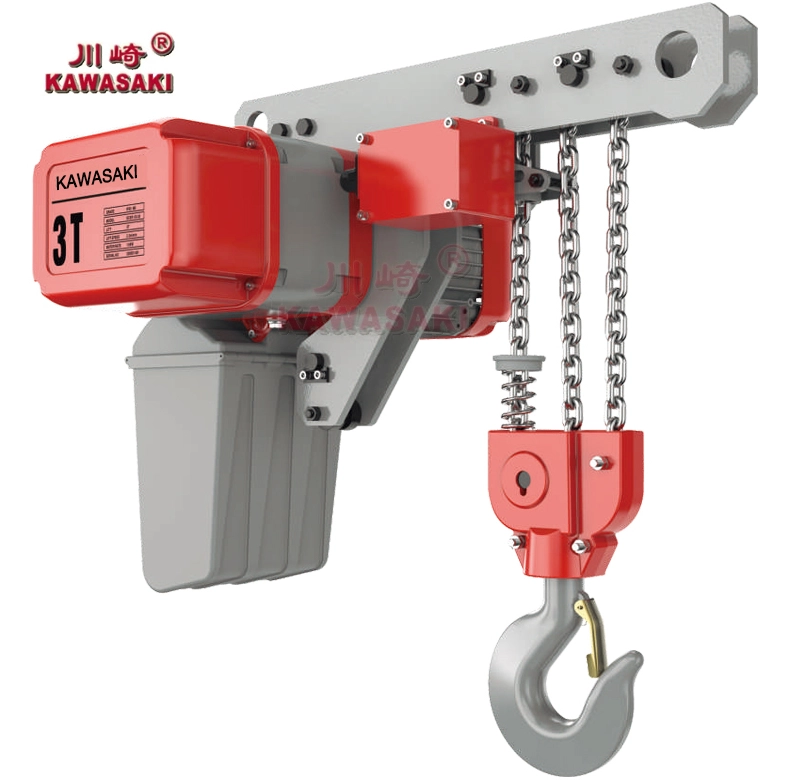
With routine loads and standard cycles, T80 chains deliver trustworthy results alongside straightforward upkeep. But for intensified cycles or lifts near full capacity, T100 chains yield stronger ongoing worth by lessening wear and interruptions. Apollo backs both choices, letting users decide per their specific conditions.
Chain Selection For Kawasaki Ultra Low Fixed Electric Chain Hoist DCEK
The DCEK hoist’s ultra-low headroom layout typically involves cramped fitting areas. Here, T100 chains enable greater lift power without enlarging the chain dimensions.
This renders T100 a frequent selection for snug arrangements, metal frameworks, or facilities where space precision matters. T80 chains suit lighter duties too, yet T100 brings added adaptability in confined zones.
How Does Chain Grade Affect Safety And Compliance?
Past mere operation, the chain grade impacts safety and rule adherence directly.
Load Rating And Safety Factor Standards
T80 and T100 chains both adhere to firm safety factor norms, usually four times the operational load. Nevertheless, T100’s stronger foundation widens the buffer against excess weight and jolts. This proves vital in areas where loads fluctuate or control proves uneven.
Inspection Frequency And Risk Mitigation
Stronger chains keep their form and measurements longer, which lowers issues spotted in checks like stretching or warping.
However, no chain skips upkeep entirely. Apollo stresses regular check routines, no matter the grade, and supplies swap parts plus advice to curb dangers.
Regulatory And Certification Considerations
KAWASAKI hoists from Apollo meet ISO, CE, and GS guidelines. Chain grade picks should match local laws and venue safety protocols.
Across numerous areas, T80 serves as the baseline for lifting, whereas T100 gains ground in risky or critical tasks.
What Practical Tips Should You Use When Choosing Between T80 And T100?
Now that the specs stand out, ultimate choices ought to center on hands-on application over abstract ideas.
Assessing Application Load Profiles
Weigh the usual load, top load, and lift frequency. Steady work near limits suggests T100. Sporadic average lifts match T80 nicely. Overlooking load trends ranks among top errors in picking chains.
Considering Environmental And Usage Conditions
Grime, dampness, corrosives, and climate changes all influence chain durability. Coatings and tougher materials assist, but apt pairing counts most. Apollo supplies diverse chain treatments to fit rough spots without complicating choices.
Balancing Cost With Long-Term Operational Value
T100 chains carry higher initial prices, but extended durability and rarer swaps can balance that out. T80 chains appeal where funds limit and loads stay steady. Opting by full lifespan over single-unit cost generally yields superior outcomes.
FAQs
Q1: Can T80 and T100 chains be used interchangeably on the same hoist?
A: Only when the hoist suits and rates for both grades. Stick to the maker’s guidelines and load limits prior to altering chain grades.
Q2: Does upgrading to a T100 chain increase a hoist’s rated capacity?
A: Not on its own. Hoist capacity hinges on the whole setup, like motor, drive, and frame. A tougher chain boosts safety buffer but won’t raise rated capacity without maker approval.
Q3: Which chain grade is better for long-term industrial use?
A: In frequent or demanding operations, T100 chains typically endure better in the long run. For ordinary industrial tasks, T80 chains stay a solid and accepted option.