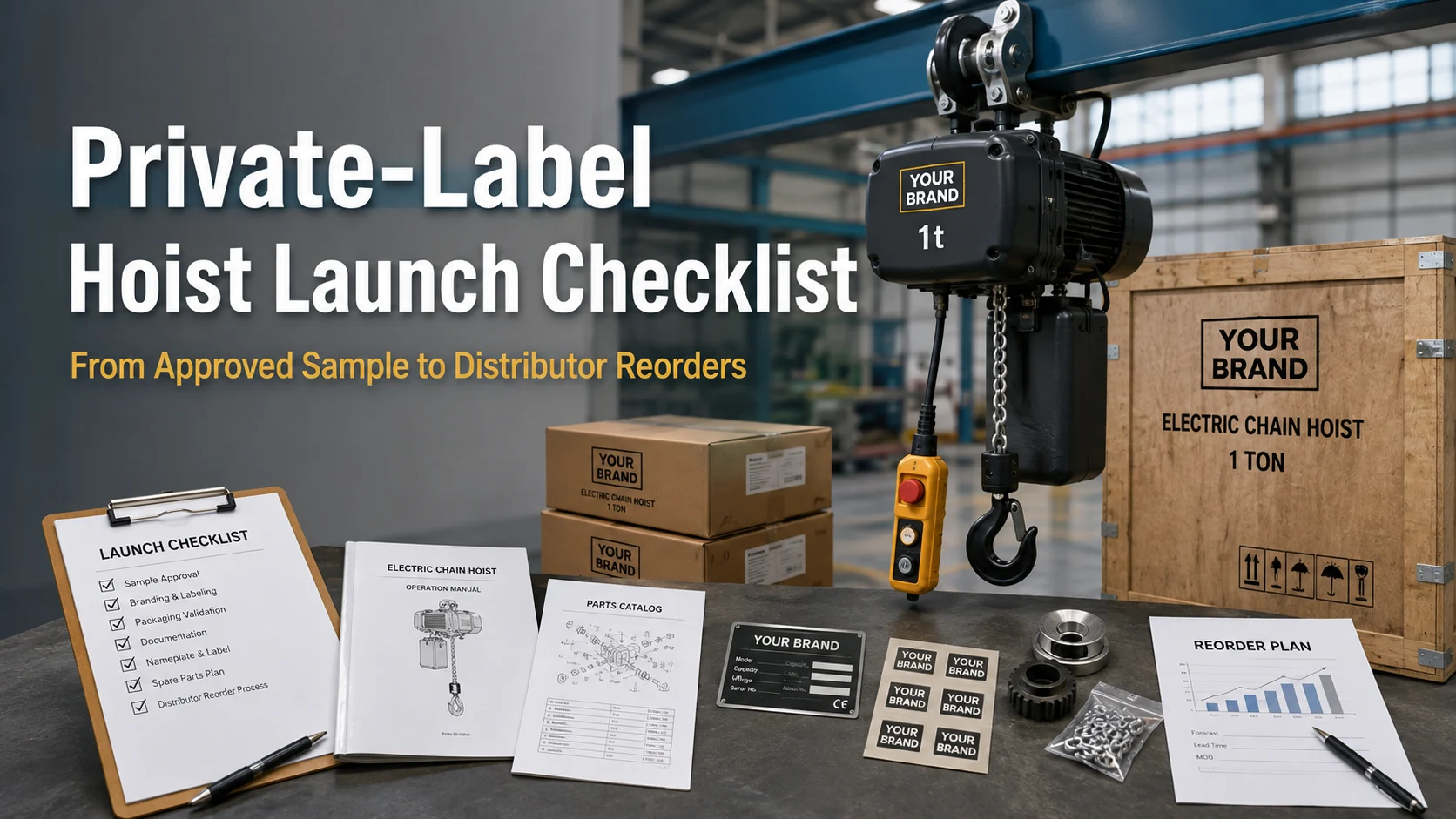
A private-label hoist program succeeds when the approved sample becomes a repeatable product system. The logo is only one part of that system. Distributors also need a frozen specification, accurate manuals and labels, consistent packaging, a usable spare-parts structure, and a reorder process that prevents small changes from becoming customer complaints.
This checklist takes a buyer from sample approval to the first replenishment order. It is written for lifting-equipment distributors, importers, rental suppliers, and equipment integrators buying electric chain hoists, wire-rope hoists, winches, or related products. Custom options, documentation, quantities, and commercial terms must be confirmed for each project; do not assume a standard model includes private-label deliverables.
Define the private-label product brief
Before requesting artwork or a sample, define what the distributor is actually launching. A clear brief prevents the common mistake of approving a visually attractive unit before the technical and service requirements are known. Start with the target market, application, product family, expected order pattern, and customer support model.
- Product scope: electric chain hoist, wire-rope hoist, winch, trolley, accessories, or a defined family of models.
- Application: capacity range, lift, speed, power supply, control method, environment, and installation interface.
- Brand assets: logo files, colors, model naming, data-plate layout, warning language, and ownership of artwork.
- Commercial rules: target quantity, minimum order assumptions, territory, forecast, lead time, and approval contacts.
- Service promise: warranty route, technical contact, spare-parts availability, and the information distributors will provide to end users.
Approve the sample against a controlled specification
The sample is the reference unit for production, but only if the approval record is detailed. Create a sample approval sheet with photographs, drawings, configuration data, and a numbered list of deviations. Approval should cover the product customers will receive, not only the finish shown in a showroom photograph.
- Record model, rated capacity, lift, speed, voltage, phase, control arrangement, chain or rope details, hook, trolley, and options.
- Inspect dimensions, nameplate content, labels, controls, guards, fasteners, finish, noise, operation, and visible workmanship.
- List every approved change from the supplier’s standard model, including parts, color, logo placement, packaging, and documents.
- Assign a revision and approval date; require written approval for any later change to the sample baseline.
Freeze branding, manuals, and labels
Treat brand information as controlled technical content. The manual, data plate, warning labels, carton markings, and online product page should describe the same configuration and operating limits. Translate and review safety language for the target market, and keep the approved source files with the product revision.
- Logo and artwork: vector file, color references, minimum size, placement, and approval owner.
- Manual: correct model, ratings, installation, operation, inspection, maintenance, warnings, troubleshooting, and spare-parts references.
- Labels and nameplate: model, serial number, capacity, power, warnings, manufacturer or responsible-party information, and required market fields.
- Digital content: product photographs, specification tables, declarations, and downloadable documents tied to the same revision.
Do not allow a generic manual to remain in the carton when the private-label product has different controls or limits. A document mismatch can create installation questions, warranty disputes, and compliance risk even when the hoist itself is mechanically sound.
Validate packaging and shipment presentation
Packaging is part of the distributor’s product experience and part of the protection plan. Approve the packaging specification against the shipping route, handling equipment, storage time, order quantity, and destination requirements. Confirm how the hoist, accessories, manuals, labels, and loose parts will be identified at receiving.
- Approve carton, pallet, or wooden-case dimensions, materials, markings, moisture protection, lifting points, and stacking limits where applicable.
- Match outer marks to the model, quantity, purchase order, destination, and handling instructions.
- Separate and identify pendant controls, hooks, trolleys, chains, ropes, fasteners, manuals, and other loose items.
Build the spare-parts and service structure
A private-label hoist is not launched when the first unit ships; it is launched when the distributor can support the installed base. Build a spare-parts list from the approved assembly and link each part to compatible models and revisions. Keep the commercial brand visible while preserving the manufacturer’s technical identifiers for accurate replenishment.
- Create SKUs for safety-relevant parts, wear items, electrical controls, brakes, hooks, chains, wire ropes, pendants, limits, seals, and fasteners as applicable.
- Record official part number, description, assembly position, revision, compatibility, packaging unit, and storage conditions.
- Define which parts are stocked locally, ordered on demand, supplied as kits, or restricted to qualified service personnel.
- Publish a service contact and escalation route for fit questions, substitutions, warranty, and technical documentation.
Do not promise interchangeability from appearance alone. Require written confirmation for substitutes and retain the approval with the spare-parts master and affected product revisions.
Control the first production batch
The first batch is the bridge between sample approval and a repeatable reorder. Use a pre-production meeting and a first-article or batch-release checklist. The supplier should show that the approved configuration, artwork, packaging, inspection plan, and document set have reached the production floor.
- Compare production units with the approved sample and record serial numbers or batch identifiers.
- Check branding, labels, manuals, packaging, accessories, and spare-parts references before dispatch.
- Review factory inspection and test evidence for the ordered configuration; define any buyer witness or pre-shipment document review in advance.
- Keep a signed release record with photos, deviations, corrective actions, and the final document index.
Set up the distributor reorder process
Reorders should be easier than the launch, but only if the baseline is controlled. Create a reorder form that references the approved product revision and asks for forecast, quantity, delivery date, packaging, and any requested change. Use the same model names and SKUs in the distributor’s ERP, catalog, service system, and supplier purchase order.
- Require the supplier to confirm revision, lead time, quantity, and any changed component, artwork, manual, or packaging before order acceptance.
- Separate a true reorder from a change order; new voltage, capacity, control, or environment can require a new technical review.
- Sample incoming units and documents against the baseline, especially after a long gap or supplier engineering change.
- Track complaints, warranty returns, spare-parts demand, and field feedback into the next product review.
Common launch failures to prevent
- Logo approved, but nameplate or manual still shows the factory model and conflicting ratings.
- Packaging artwork changes between batches, making warehouse identification and customer unboxing inconsistent.
- The approved sample has one control voltage or chain option, while production uses another without documented approval.
- Spare parts are sold under vague descriptions, so the distributor cannot identify the correct revision or compatible model.
How Apollo fits a private-label launch
Apollo’s published electric hoist product categories include electric chain hoists, electric wire-rope hoists, electric winches, and explosion-proof hoists. Use the relevant product family as the starting point for a private-label brief, then confirm the exact model, configuration, artwork, documents, packaging, and spare-parts scope for the project. Apollo also presents
R&D capabilities and service and customization capabilities. Ask which options can be repeated across batches and which require a new review. Send the approved sample record, brand files, document list, and reorder assumptions through Apollo’s contact channel before production. Website information establishes product relevance; the private-label baseline must be agreed in writing.
Conclusion
A private-label hoist program becomes scalable when the approved sample is converted into controlled data. Freeze the technical configuration, brand assets, manuals, labels, packaging, spare-parts SKUs, and reorder revision. Release the first batch with evidence, then use the same identifiers and change controls for every replenishment. This protects the distributor’s brand while giving the manufacturer a clear, repeatable production target.
FAQs
How many samples should a distributor approve?
Approve every model or configuration that will be sold, or define a documented common platform and list the differences. One sample should not silently cover different capacities, voltages, controls, or frame sizes.
Should the private-label manual show the distributor or the factory?
Follow the target market and contractual responsibility requirements. The manual must identify the responsible parties, describe the actual configuration, and retain controlled revision information; branding alone does not determine legal responsibility.
When should spare-parts SKUs be created?
Create them during sample and first-batch approval, before the product is promoted widely. Link each SKU to compatible models, revisions, packaging units, and the service documentation used by the distributor.
What makes a reorder a new approval?
Any change that can affect fit, safety, performance, installation, documentation, or customer presentation should be screened. Voltage, capacity, control system, load chain or rope, labels, manuals, and packaging may each require a revised approval.