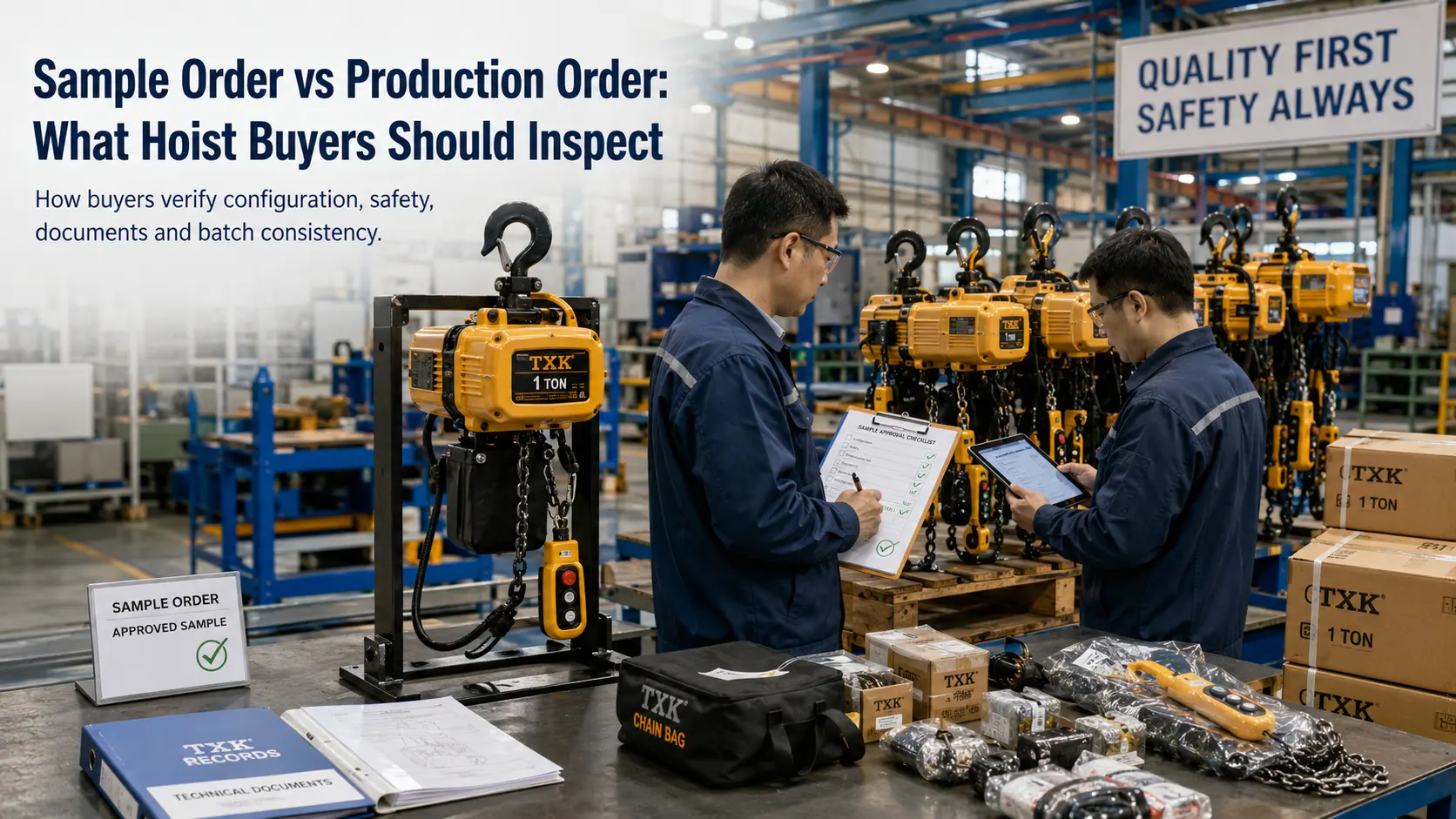
A sample hoist can look excellent and still fail to predict the production order. Sample units are often assembled with extra attention, while batch production depends on released drawings, incoming controls, work instructions, inspection records, and repeatable supplier processes. Buyers need a deliberate bridge between sample approval and production release.
This guide explains what to inspect at both stages for electric chain hoists, wire-rope hoists, winches, and related lifting equipment. The goal is not to demand that every production unit be identical in cosmetic detail; it is to verify that the approved technical, safety, documentation, and customer-facing requirements are controlled and repeatable.
Why sample approval is not production approval
A sample answers a limited question: does this proposed configuration appear suitable for the intended application? A production inspection answers a broader question: did the supplier build each ordered unit to the approved configuration, and is there evidence that the process stayed in control? Treat the sample as a baseline with a revision, not as a permanent substitute for batch inspection.
- Samples may use temporary parts, hand-finished surfaces, or engineering changes that are not yet released for production.
- Production may involve different operators, suppliers, fixtures, packaging, or document revisions.
- A sample may be tested once; a batch needs defined inspection frequency, traceability, and reaction plans for failures.
- A customer-facing label or manual can change between orders even when the hoist hardware appears unchanged.
Lock the approved sample baseline
Before placing the production order, create a sample approval record that another reviewer can use. Include photographs, drawings, specifications, test observations, and a numbered deviation list. Identify the exact model and configuration instead of relying on a family name or capacity alone.
- Record rated capacity, lift, speed, voltage, phase, control method, hook or trolley arrangement, chain or rope details, and options.
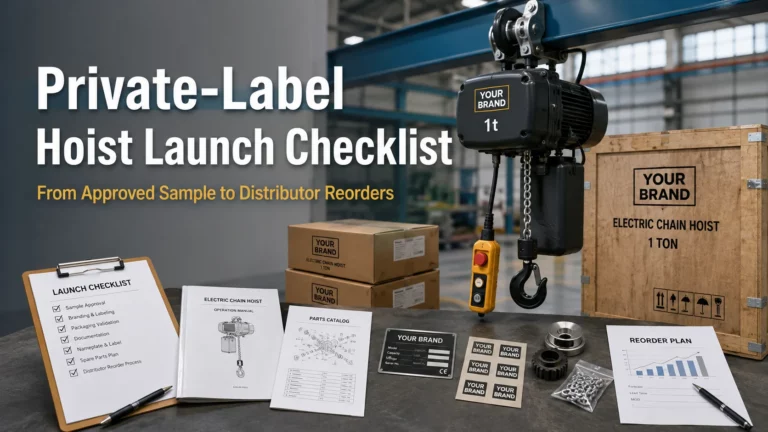
- Capture nameplate, warning labels, logo placement, color or finish, accessories, packaging, manuals, and spare-parts references.
- Assign a sample revision and approval date; identify who can approve a change.
- State which features are mandatory, which are cosmetic, and which remain subject to project or market confirmation.
If the sample was built for demonstration only, ask the supplier to identify temporary components or settings. A buyer should not discover at receiving that the approved reference was not a production-intent unit.
Inspect the production order before assembly is complete
Use a first-article or pre-production review for the first batch and after significant changes. Inspect a production-intent unit against the approved sample and released documents while correction is still inexpensive. For larger orders, define how many units or lots will be sampled and what triggers expanded inspection.
- Compare frame, motor, brake, gearbox, hook, chain or rope, trolley, controls, limits, guards, and fasteners with the approved bill of materials.
- Check dimensions, mounting interfaces, electrical connections, labels, finish, and accessory fit against the released drawing.
- Confirm that safety-relevant substitutions have written engineering approval and documented equivalence.
- Record serial numbers or batch identifiers for inspected units and link findings to the production order.
Compare functional and safety performance
The test method should match the ordered configuration and the applicable project requirement. A production unit should not be accepted because it powers on if critical functions have not been verified. Record the method, starting condition, instrument or test setup, result, and disposition of any failure.
- Operate hoist-up and hoist-down, speed selection, travel direction, pendant or radio controls, and indicators where supplied.
- Test upper and lower limits, emergency stop, brake holding, overload or load-limiting functions, interlocks, and other specified safety features.
- Observe abnormal noise, vibration, heating, leakage, chain or rope tracking, hook movement, and control response.
- Review factory routine, proof, or load-test evidence when required; do not generalize one test percentage to every design or jurisdiction.
For the sample, focus on suitability and acceptance of the proposed design. For production, focus on repeatability and evidence that every released unit received the required checks.
Verify documents, labels, and packaging
Documentation is a common point of divergence between a sample and a production shipment. Match the manual, nameplate, certificate, packing list, and packaging marks to the actual model, serial number, rating, voltage, options, and revision. The product and its information should tell the same story.
- Confirm the manual describes the delivered controls, limits, installation, operation, inspection, maintenance, and spare-parts references.
- Check serial number, capacity, power, warnings, responsible-party information, and required market fields on the nameplate and labels.
- Inspect carton, pallet, or case markings, accessory identification, moisture protection, and transport restraints.
- Require a document index and retain corrected or superseded versions in the order record.
Check traceability and nonconformance control
A production order needs a traceable history that a sample order may not. Select one finished serial number and ask the supplier to retrieve its traveler, incoming records for critical components, in-process checks, final inspection, test results, release approval, and packing record. If the chain breaks, the buyer cannot tell whether an apparent match is reliable.
- Unique serial or batch identifiers appear consistently on the unit, inspection record, test certificate, and packing documents.
- Critical component lots, revisions, and approved suppliers can be retrieved without relying on personal memory.
- Nonconformances show containment, root cause, correction, retest where needed, and authorized closure.
- Rework, repair, engineering changes, and customer deviations are linked to affected units and documents.
Confirm spare-parts and reorder consistency
Production inspection should include the service ecosystem, especially when the buyer will support a fleet. Check that the spare-parts list, part numbers, compatibility notes, and service manuals match the production revision. A batch that ships with an unannounced component change can create future wrong-part orders and warranty friction.
- Compare safety-relevant parts, wear items, electrical controls, brakes, hooks, chains, ropes, pendants, limits, seals, and fasteners with the approved parts list.
- Verify packaging units, labels, revision status, and storage requirements for the parts supplied with the order.
- Request written fit confirmation for substitutes and keep it with the affected model and serial range.
- Use field complaints, returns, and repair consumption to update the next production inspection and reorder review.
A practical release gate for buyers
Use separate sign-offs for sample approval and production release. The sample sign-off confirms design and application suitability. The production sign-off confirms batch conformity, test evidence, documentation, packaging, and closure of deviations. Shipment or payment should pause when a mismatch could affect safety, installation, legal acceptance, or customer support.
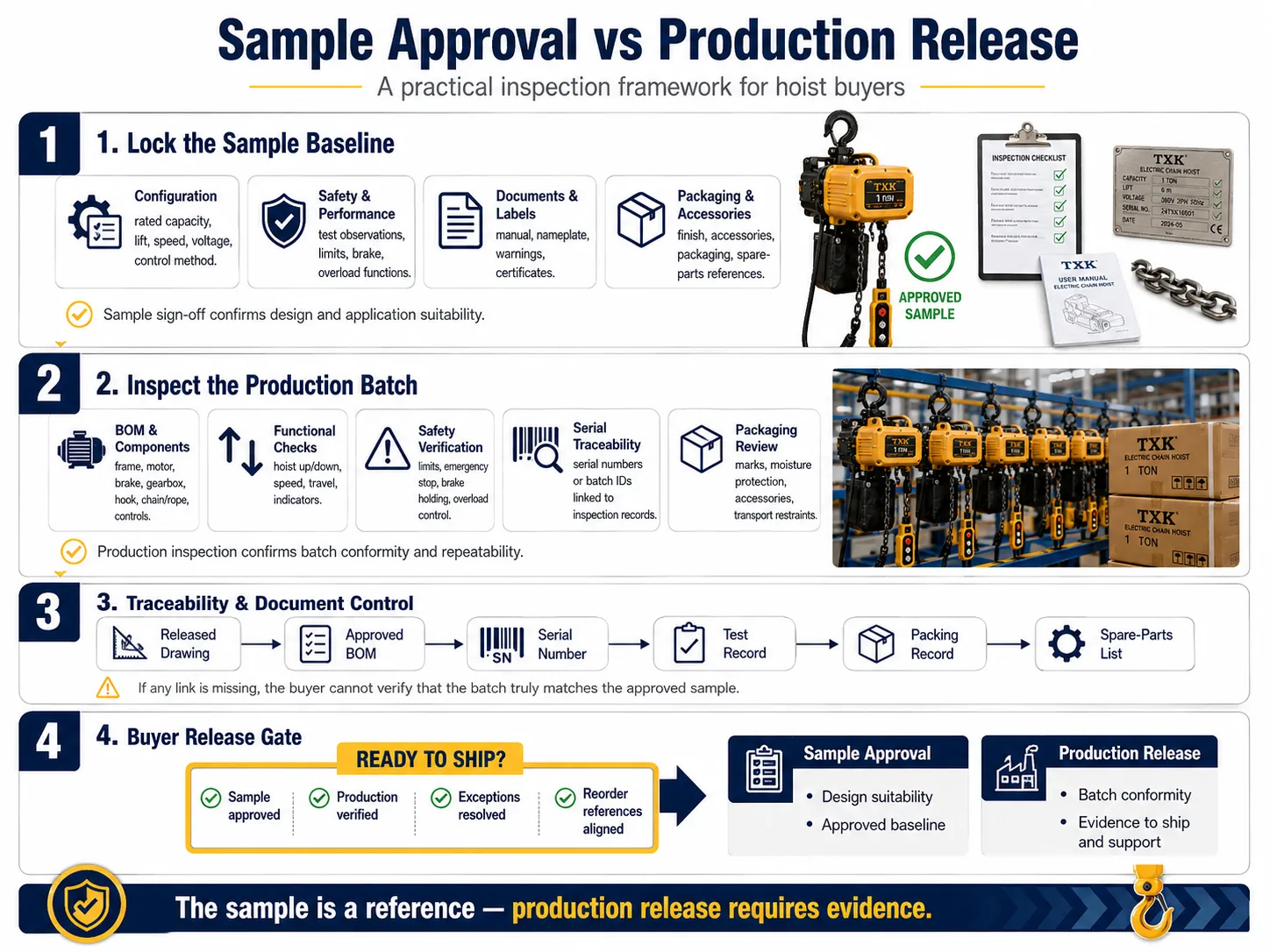
- Sample approved: baseline, revision, deviations, and acceptance owner recorded.
- Production verified: inspected units, serial mapping, test results, and document package complete.
- Exceptions resolved: corrective action, retest, and authorized disposition recorded.
- Reorder ready: ERP, catalog, spare-parts list, manual, and purchase-order references use the same revision.
How Apollo fits the inspection plan
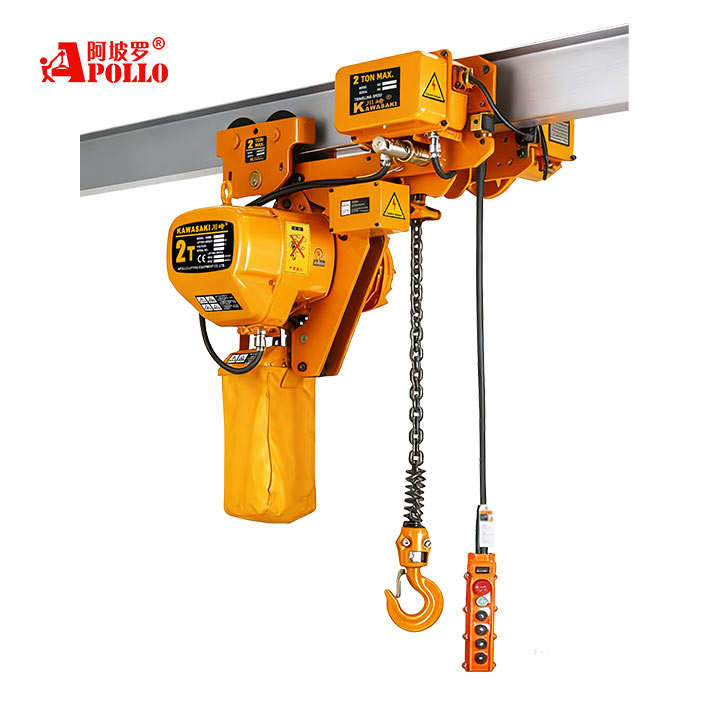
Apollo’s electric hoist product categories include electric chain hoists, electric wire-rope hoists, electric winches, and explosion-proof hoists. Buyers can use the relevant product family to define the sample scope, then request model- and configuration-specific production checks. Apollo also presents
R&D capabilities and service and customization capabilities. For a sample-to-production program, confirm which drawings, options, manuals, packaging, spare-parts lists, and testing records apply to the ordered units. Send the approved sample record and batch inspection requirements through Apollo’s contact channel before production release.
Conclusion
The sample is a reference, not a guarantee. Lock its technical and customer-facing baseline, inspect production-intent units, compare functional and safety performance, verify documents and packaging, follow serial-number traceability, and confirm spare-parts consistency. A separate production release gate turns sample approval into evidence that the batch is ready to ship and support.
FAQs
Is a production inspection needed if the sample passed?
Yes. The sample demonstrates the approved reference unit; production inspection checks whether the batch matches that reference and whether the manufacturing process remained controlled.
How many production units should a buyer inspect?
The quantity depends on risk, batch size, history, configuration changes, and the purchase agreement. Define the sampling plan and escalation triggers before production starts.
What is the most important sample-to-production check?
Match the released configuration and safety-relevant components, then confirm that the production unit’s serial-numbered test and inspection records support the result.
Should packaging be inspected at both stages?
Yes. Approve the intended packaging with the sample or trial pack, then verify production marks, protection, accessories, and documents on the shipment being released.