When you compare hoist supplier quotations, a low hoist price is meaningful only when the quotations describe the same lifting job. If one supplier prices a bare electric chain hoist while another includes controls, testing, freight, and commissioning, the figures are not comparable. A sound comparison normalizes the technical baseline first, then exposes total delivered cost, operating risk, and support obligations. This method helps purchasing teams choose a quote that can be defended technically and financially.
Make every quotation technically equivalent
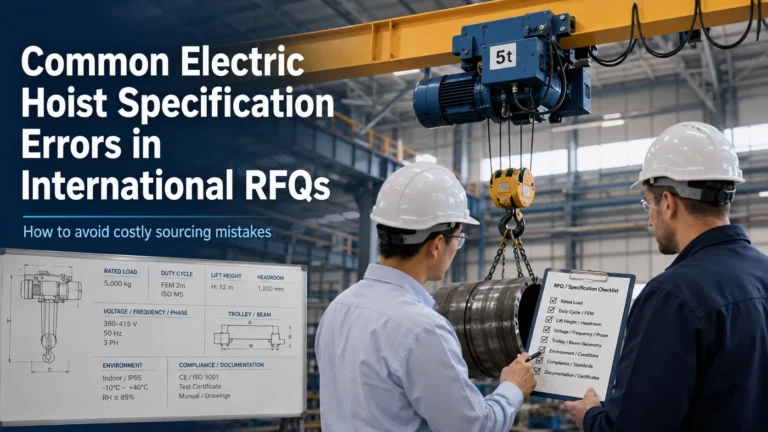
Start with a one-page request for quotation (RFQ) that every supplier receives. State the rated load, lift height, lifting speed, duty cycle or expected lifts per hour, available voltage and phase, control method, headroom, beam or trolley interface, environment, and quantity. Ask bidders to identify assumptions instead of silently selecting a standard configuration.
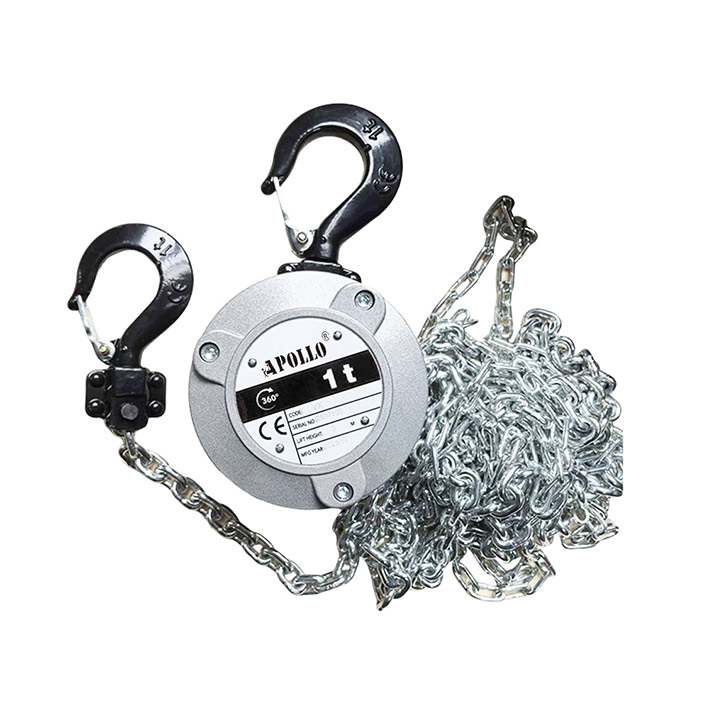
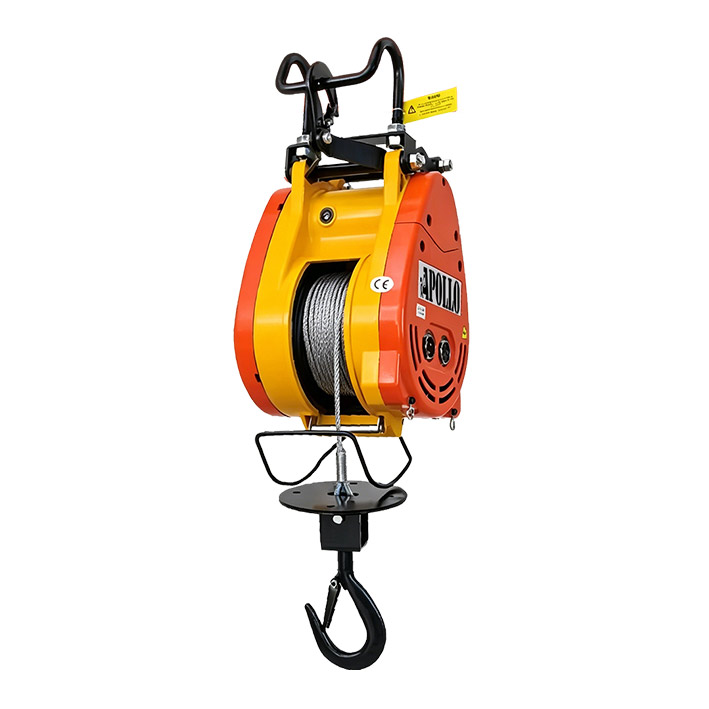
Check that the offered hoist type matches the job: manual hoist category, electric chain hoist, wire-rope hoist, winch, or a more specialized arrangement. Capacity alone does not establish equivalence. A unit selected for occasional maintenance work may be unsuitable for repetitive production lifting, even if both quotes show the same nominal load. Require each supplier to state the applicable duty classification, load spectrum assumptions, and any derating for temperature, dust, moisture, or outdoor exposure.
Then compare the line-item specification: lifting height, chain or rope length, speed, motor and brake arrangement, trolley travel, hook style, controls, power cable, overload protection, and limit devices. Where a value is absent, mark it as an open item rather than assuming it is included. Apollo’s electric hoist product range should be used as a reference point for the product family being requested, while final suitability remains dependent on the application specification.
Rebuild the price into a total delivered cost
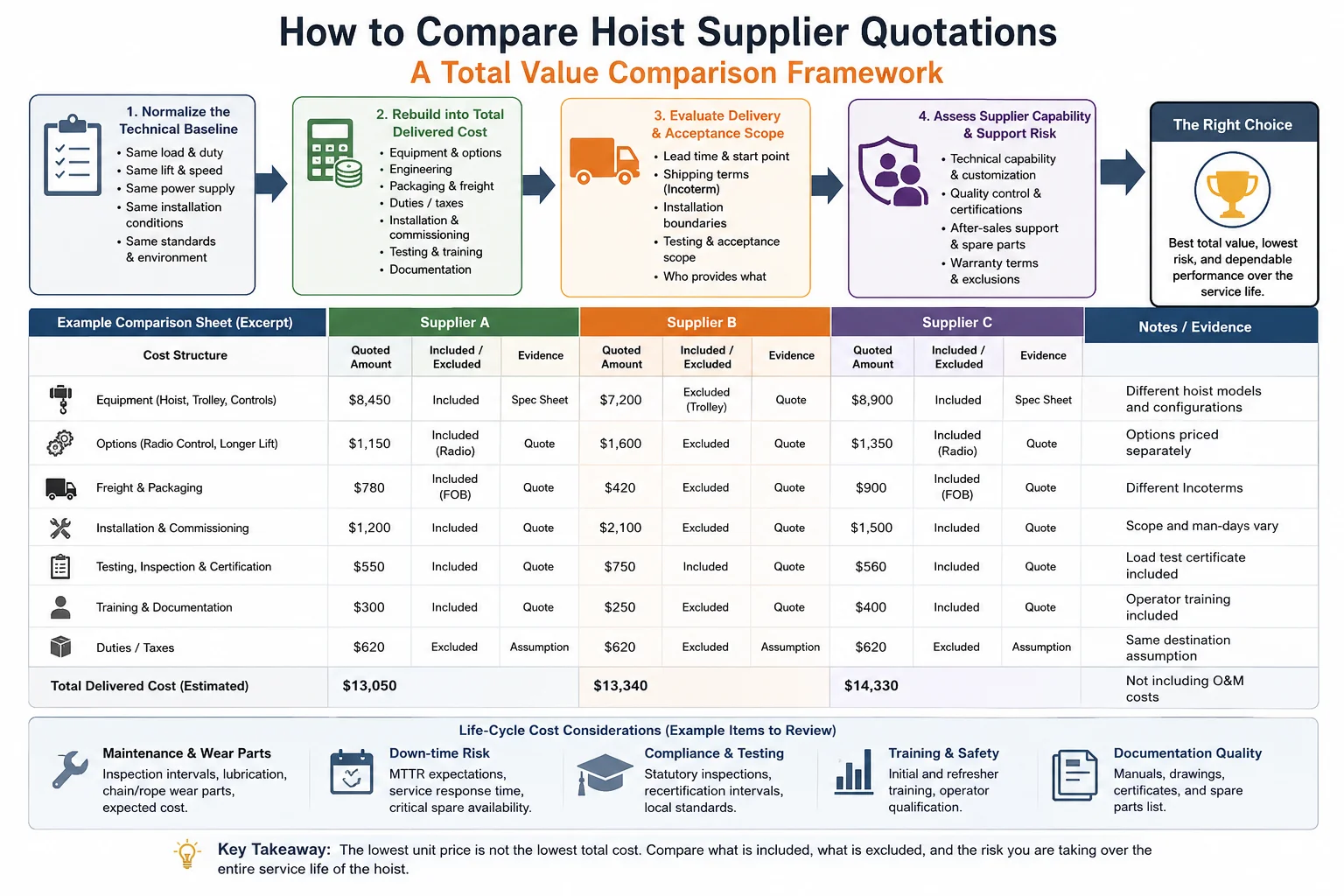
Convert each quotation into the same cost structure. Separate equipment, options, engineering, packaging, freight, duties or taxes, installation, commissioning, load testing, inspection, training, and documentation. Record whether prices are firm, what currency and Incoterm apply, and when the quote expires. A quote that excludes site work is not cheaper; it is incomplete.
Use a simple comparison sheet with columns for quoted amount, included, excluded, allowance, and evidence. Ask suppliers to price common options separately, such as a longer lift, pendant versus radio control, trolley, spare chain or rope, replacement hooks, and special packaging. This keeps the base comparison clean and shows which design choice is driving the difference.
Model cost over the intended service period. Include scheduled inspections, lubrication and wear parts, statutory or customer-required testing, operator training refreshers, and likely downtime during service. Do not invent a failure rate or savings estimate; use your own maintenance records or request a transparent assumptions sheet. A supplier willing to show what is and is not in the total is easier to manage after the purchase order.
Compare delivery, installation, and acceptance scope
Lead time is useful only when its starting point is clear. Ask whether it begins at purchase order, drawing approval, deposit, or receipt of final technical data. Confirm what happens if an approval changes the design, and whether partial shipments create extra handling or storage costs.
Define installation boundaries in writing. Who supplies lifting access, supports, electrical connections, runway checks, anchorage, and disposal of an old unit? Who performs no-load and load tests, records results, and provides the acceptance package? Clarify the person authorized to sign completion and the documents needed for release of payment. These details prevent a low equipment quote from becoming a high project invoice.
Evaluate supplier capability and support risk
A quotation is also a signal about the supplier’s process. Review whether the company can answer application questions, issue a controlled drawing or datasheet, identify configuration limits, and maintain revision history. Apollo describes research and development, production workshops, quality-control personnel, and OEM/ODM services; those capabilities are relevant when a project needs customization, but the exact deliverables should still be listed in the RFQ response.
Check the after-sales model: named technical contact, spare-parts channel, troubleshooting response, service coverage, and escalation route. Ask which parts are considered wear items, how they are identified, and whether manuals and exploded diagrams are supplied. A warranty comparison should state coverage, exclusions, labor responsibility, start date, and the evidence required for a claim. Treat broad phrases such as ‘long warranty’ as unpriced assumptions until the terms are attached.
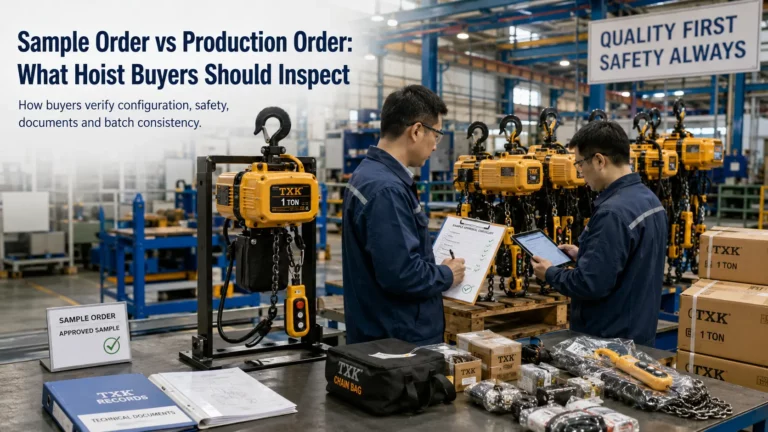
For a new or modified installation, request quality records that are actually applicable to the configuration: material or component traceability where required, inspection and test records, operating instructions, and declarations or certificates promised in the quotation. Do not award points for a logo or certificate that does not match the supplied model, market, or operating conditions.
Use a weighted decision matrix, not a lowest-price rule
Once all bids are normalized, score them against criteria agreed by engineering, operations, maintenance, and procurement. A practical matrix can include technical fit, scope completeness, delivered cost, schedule confidence, serviceability, documentation, supplier responsiveness, and commercial terms. Weight the criteria according to consequence: a production-critical hoist may give technical fit and support more weight than a small price difference.
- Reject non-compliant bids first. Do not compensate for a missing duty rating or excluded safety-critical component with a favorable price score.
- Request clarifications in one shared list and issue the same questions to every bidder. Record revised prices and assumptions as a new revision.
- Run a sensitivity check. Identify which exclusions, freight changes, or service assumptions could move the ranking, then obtain written allowances for them.
- Document the award rationale, including why the selected quotation is technically comparable and what conditions remain open before release.
Turn the winning quote into a controlled purchase
Before issuing a purchase order, attach the final datasheet, drawing, option list, delivery term, inspection plan, warranty terms, and acceptance criteria. Make the supplier’s quotation revision part of the contract record. If a requirement is conditional on material, load, size, environment, or configuration, state who must verify it and when.
Apollo’s services and customization information can help buyers frame an OEM, ODM, or application-support discussion, but the RFQ should name the exact output expected: drawing, sample, configuration review, spare-parts list, test record, or training package. For unresolved technical questions, contact the technical team with the model or product family, dimensions, load, operating conditions, quantity, and any drawing. This gives the supplier enough context to validate fit without turning the request into a generic price exercise.
Conclusion
Comparing hoist supplier quotations beyond the unit price is a disciplined normalization exercise. Match the technical baseline, expose every included and excluded cost, define delivery and acceptance scope, test support commitments, and use a weighted decision matrix. The result is a quote comparison that protects uptime and budget while leaving a clear record of why the selected hoist is fit for the job.
FAQs
What should be identical across hoist quotations?
At minimum, compare rated load, duty cycle, lift height, speed, power supply, control method, mounting or trolley interface, environment, testing scope, and delivery basis. Any difference should be priced or clearly marked as an assumption.
How do I compare warranty terms fairly?
Compare coverage by component and responsibility: parts, labor, structural items, electronics, travel, exclusions, claim evidence, and start date. Ask for the complete written terms rather than relying on a headline duration.
Should the cheapest compliant quote win?
Not automatically. If two quotes are technically compliant, compare total delivered cost, service risk, documentation, schedule confidence, and the cost of unresolved exclusions. Use the weighting agreed before reviewing the final prices.
What information should accompany an RFQ?
Provide load and duty information, lift height, speed, voltage and phase, controls, mounting details, environment, quantity, delivery location, testing needs, drawings, and the required documentation. Complete inputs reduce clarification cycles and improve comparability.