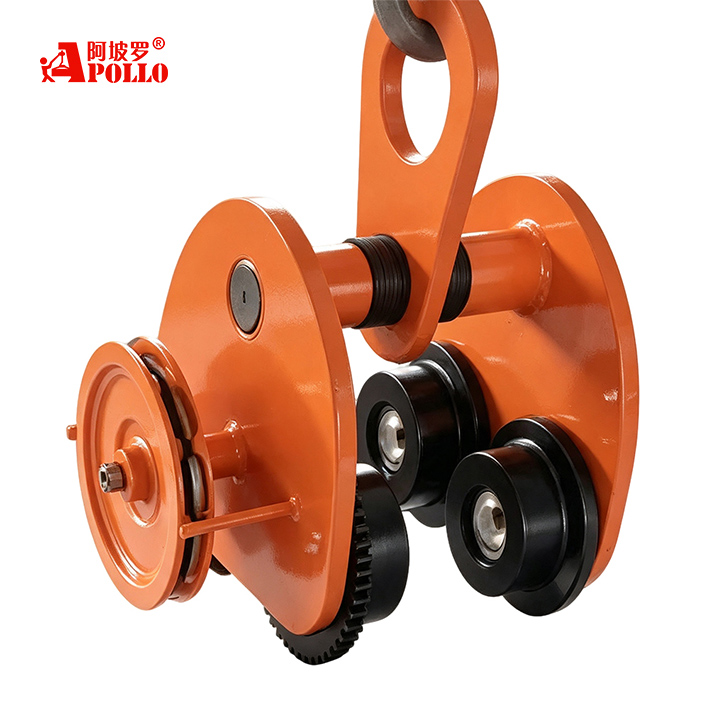
Every so often a maintenance manager measures a beam with a tape measure, writes down 100 mm, and orders a geared beam trolley to match. The trolley arrives, the crew lifts it onto the rail, and the wheels will not clear the flanges. The measurement was accurate, but it was taken at the wrong end of the beam. The number that matters is the flange width where the wheels actually sit, not the flat reading across the top.
The order goes back, return freight gets paid, and the bay sits waiting another two weeks. It is one of the most avoidable mistakes in overhead lifting, and the bill keeps growing before the trolley ever moves a load: return freight and restocking on a unit that was never used; two to four weeks of schedule slip while the correct unit is built and shipped; improvised installation, where crews shim or grind parts to force a wrong trolley to fit, which hurts both the trolley and the beam; and the same mistake repeated on the next bay, because nobody recorded what went wrong the first time.
This guide is aimed at the people who measure, order, and install this equipment — plant engineers, maintenance supervisors, and procurement teams buying trolleys for production bays, warehouses, and fabrication shops. It walks through the four measurements that decide fit, where the usual errors come from, and what belongs on the purchase order so the unit arrives ready to hang.
Before you order, you can get a second opinion. Send your beam dimensions, load weight, and bay layout to sales@apollohoist.com, and you will have a matched trolley recommendation within one business day.
What You Actually Need to Measure
Four numbers decide whether a trolley fits and how it behaves on the rail. Measuring all four takes about fifteen minutes on site and rules out most of the problems described above.
- Beam flange width
Measure the flange — the horizontal plate the wheels roll on — edge to edge, at the point where the trolley will sit in service. Do not measure at the end of the beam, where the profile often differs. On a 100 mm flange, a trolley built for a 68 to 146 mm range covers it; a trolley built for a different range does not, no matter how close the nominal figure looks. Work in millimetres and measure at two different points along the beam to catch a rolled or damaged section.
- Beam type and flange taper
Beams are not one profile. A rolled I-beam has tapered inner flange faces, while a welded or wide-flange beam has parallel faces. Trolley wheels are shaped for one or the other, and a mismatched wheel rides on a narrow contact line, wearing both the wheel and the beam. Note the beam type on the order; it is the second most common cause of a trolley that fits but will not roll properly.
- Minimum curve radius
If the trolley travels around a curve, that radius sets the smallest one the trolley can negotiate. Compact units handle tight bends, and heavy units need generous ones: a 0.5-ton trolley turns in a 0.8 m radius, while a 20-ton unit needs 3.5 m. Forced around a tighter curve than it is rated for, a trolley binds and the load swings out of control exactly where the operator has the least room to react. Measure from the inside of the curve to the centre line of the rail.
- Overhead clearance and wheel geometry
Headroom decides whether the trolley and the hoist below it fit above the load. Every trolley has a frame height, and heavier units are taller: a compact unit adds roughly 95 mm of frame height, while a 20-ton unit adds around 315 mm before the hoist is even considered. Add the trolley frame height to the hoist body height and the hook reach, then compare the total against the clear space between the beam and the highest point of the load. If the total does not clear, change the trolley model — do not trim the safety margin.
| What to measure | How to do it right | The mistake and what it costs |
| Flange width | Edge to edge, in millimetres, at two points where the trolley works | Measuring at the beam end or across the top; unit does not fit on arrival |
| Beam type | Note rolled I-beam (tapered) or wide flange (parallel) | Wrong wheel profile; rapid wheel and flange wear |
| Curve radius | Inside of curve to rail centre line | Trolley binds in curves; load swings out of control |
| Clearance | Frame height plus hoist body plus hook reach against available space | Hoist fouls the load or the structure; no lifting height left |
The full Apollo beam trolley range, with a and b axle length options for different flange widths, is on the beam trolley category page (https://www.apollohoist.com/product-category/manual-hoist/beam-trolley/).
Trolley Capacity Is Not Hoist Capacity
These are two separate ratings, and buyers mix them up constantly. The hoist rating tells you what the hoist can lift. The trolley rating tells you what the trolley can carry while rolling along the beam — and that includes the load, the hoist, the chain, and any rigging hanging below it. A two-ton hoist hanging from a two-ton trolley is already at the trolley limit before a load is attached, and it exceeds the limit the moment a two-ton part is lifted.
The working rule is to size the trolley for the heaviest combination it will ever carry, then leave a margin above it. If your heaviest lift is two tons and the hoist and rigging add 120 kg, the trolley needs to be rated above 2.12 tons — a three-ton unit is the sensible choice. Ask for the rating to be confirmed against the total carried weight, not the load weight alone.
Capacity coverage also matters when you maintain several bays. A single product family that runs from 0.5 to 20 tons means one set of installation procedures, one spare parts list, and one set of operator instructions across the whole plant — instead of a different supplier handbook for every size.
Send your heaviest load, hoist weight, and beam details through the inquiry page, and Apollo’s engineers will confirm the right trolley rating and axle length, then email the certification documents at no cost.
What Separates a Quality Geared Trolley from a Cheap One
Nearly every heavy duty lifting equipment maker can show certification documents. Certificates are the entry ticket, not the real difference. On a geared trolley, the differences that matter show up in four places, and all four can be checked before you buy:
- Enclosed gear housing keeps dust and debris out of the drive, so the gear train keeps its engagement over years instead of grinding itself loose.
- Hardened wheel treads resist flange wear on the contact surface, stretching the interval between wheel replacements and protecting the beam.
- Four-wheel chassis with two wheels per side gives inherent anti-tilt stability, without relying on auxiliary guides.
- Axle length variants, where one model covers two flange width ranges, so one stock item serves more beams and you carry less inventory.
- Gear ratio scaled to capacity, so moving a 20-ton load stays manageable rather than turning into a two-person job.
The trolley is only half of the lifting system. Most geared trolleys carry a manual hoist below them, and the two work as one assembly: the trolley positions the load along the beam and the hoist raises it. Matching both from the same supplier keeps ratings, documentation, and service intervals consistent. The Apollo hand chain hoist range is built to pair with these trolleys across the full capacity range (https://www.apollohoist.com/product-category/manual-hoist/chain-hoist/).
Ask These Three Before You Order
Any beam trolley supplier should answer these three before you commit:
- Which flange width range does this axle length cover? A model number alone is not an answer. Apollo quotes the a and b axle length options with their flange width ranges, so you match the trolley to the measured beam before the order is placed.
- Is the trolley rating quoted for the carried weight or the load weight? This confirms whether the rating accounts for the hoist and rigging hanging below it. Apollo sizes the trolley against the total carried weight and states the margin.
- What is the minimum curve radius, and what documentation ships with the unit? Curve radius decides whether a curved monorail is usable, and the certification documents keep the installation file complete for inspection. Apollo supplies both with the order.
Apollo has manufactured lifting equipment for over twenty years, exports to more than fifty countries, and runs factory-direct production with OEM support. The complete range is on the product overview page (https://www.apollohoist.com/product/).
How to Buy from Apollo: Choose Your Channel
- Plant and project procurement: Get a free load assessment — send the beam flange width, beam type, curve radius, and the heaviest carried weight. Within one business day you will receive a matched trolley recommendation with the correct axle length, a formal quotation, and the certification documents your inspection team needs.
- Distributors and dealers: Stock the full 0.5 to 20-ton range with a and b axle length options that cover two flange widths per model, keeping inventory depth low while covering most beams in your market. Multi-product quotes that combine trolleys with Apollo hand chain hoists and lever hoists protect margin and simplify ordering.
- OEM and private label: Custom branding, packaging, and documentation are available from the Apollo factory, built to the compliance requirements of your market.