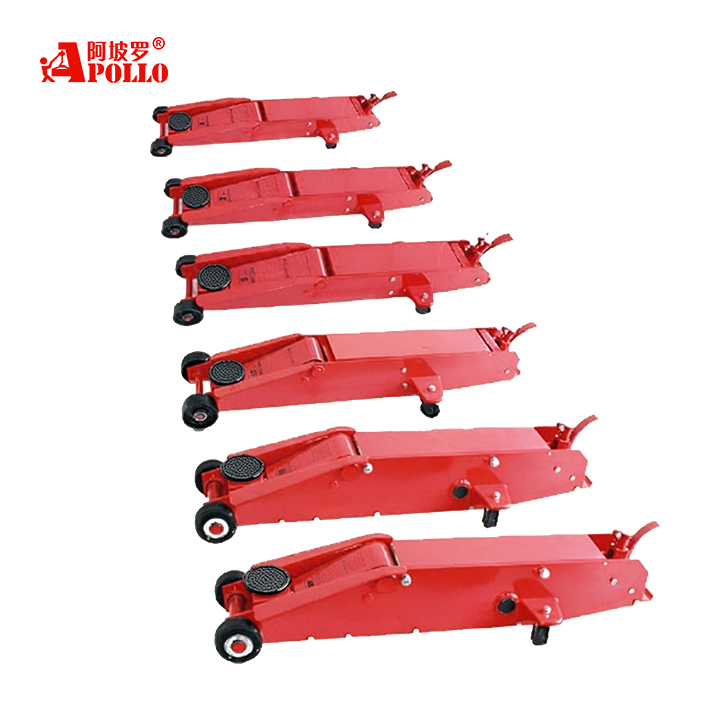
A workshop picks a bottle jack because it is cheap, lifts high, and fits in a small toolbox. Then a technician rolls a lowered car onto the bay, tries to place the jack under the subframe, and finds the body is too tall for the gap. The workaround is a wooden block under the jack, which turns a stable lifting point into a loose stack of timber. Everyone in the bay understands the risk, even if nobody says it out loud.
The wrong type of lifting tool rarely fails in one dramatic moment. It fails as a slow accumulation of workarounds, ruined panels, and near misses that eventually cost more than buying the right equipment in the first place: workarounds become habit, and blocks, shims, and improvised props become permanent fixtures in a shop that should not need them; panels and underbodies get damaged when a jack that is too tall or too unstable contacts the vehicle where it should not; productivity drops when a job needs two people to position a tool one person should handle; and safety margins disappear, because an unstable setup is a setup that can shift under load.
This guide is written for workshop owners, fleet maintenance managers, and procurement teams equipping service bays. It explains what each type of lifting equipment actually does well, how to match the tool to the vehicle and the work, and what to check on a quotation before money changes hands.
Send your vehicle weights, floor clearances, and service mix to sales@apollohoist.com, and get a matched jacking recommendation within one business day.
The Three Options in Plain Terms
You can get a vehicle off the ground with three broad categories of equipment, and they are not interchangeable. Each has a different job.
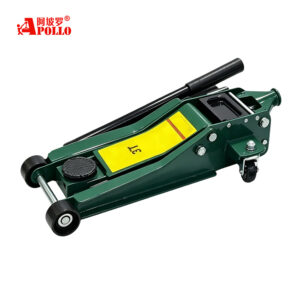
A floor jack — also called a trolley jack — is a horizontal hydraulic unit that rolls under the vehicle on four wheels. It lifts through an arm, and its height is measured at the lowest point of the saddle when fully lowered. Because it rolls, you can position it precisely under a lifting point and move it as the work progresses.
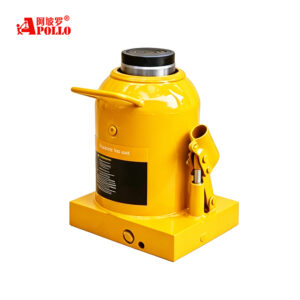
A bottle jack is a vertical hydraulic unit that stands on its base and pushes straight up. It is compact, reaches a high lift for its size, and is stable when it stands on level ground under a solid point. What it cannot do is roll, and its minimum height is set by the height of its own body.
A lift raises the entire vehicle on a platform or posts, leaving the wheels free and the underside fully accessible. It is a fixed installation with the highest capital cost, and it wins on throughput wherever the volume justifies it.
| Compare | Floor jack (trolley) | Bottle jack | Lift |
| Minimum height | As low as 80 mm on 3-ton models | Limited by body height | Not applicable, full access |
| Mobility | Rolls under and around the vehicle | Carried by hand to one point | Fixed bay installation |
| Stability at height | High, wide four-wheel base | Good on level ground only | Highest, vehicle supported on structure |
| Best suited to | Wheel and brake work, low-clearance vehicles | Trucks, plant, structural lifting points | High-volume service bays |
In practice, most well-equipped workshops keep more than one type. A floor jack handles routine vehicle lifting, a bottle jack covers high-lift or heavy industrial points, and a lift handles volume. The decision is less about picking a favourite and more about covering the jobs that actually arrive in the bay.
How to Match the Tool to Your Operation
Three questions about the work settle most of the decision: what is the lowest vehicle you service, what is the heaviest, and how often does a vehicle occupy a bay?
Low-clearance cars and modified vehicles
Sports cars, lowered suspensions, and low-floor vans are the jobs that expose a jack’s minimum height. On a three-ton floor jack that number can be as low as 80 mm — about 3.1 inches — and it clears most lowered vehicles without blocks. The check is simple: measure the lowest point of the underbody, subtract the jack’s minimum height, and the remainder is your working clearance. An 80 mm jack under a 110 mm gap leaves 30 mm to position the saddle; a 135 mm jack will not enter at all.
Trucks, plant, and heavy equipment
Heavier loads and higher lifting points favour the bottle jack, which is built to push vertically and reach high without a long arm. It is the practical choice for trucks, trailers, excavators, and structural lifting where the application point is solid and the ground is level. Stability comes from the setup, so a bottle jack always works with rated stands and a firm base — never on soft ground or loose material.
High-volume service bays
If a bay turns over vehicles all day, a lift earns its cost through time saved per job, and the floor jack becomes the secondary tool for wheel, brake, and suspension work. The arithmetic is straightforward: multiply the minutes saved per vehicle by the number of vehicles per day and the working days per year, then compare that against the difference in capital cost. A bay that saves four minutes per vehicle across twelve vehicles a day recovers close to two hundred hours of technician time a year — 48 minutes a day over roughly 250 working days.
Apollo hydraulic floor jacks and lifting jacks cover 2 to 5 tons with minimum heights from 80 mm, listed on the lifting jack category page (https://www.apollohoist.com/product-category/lifting-jack/).
What Separates a Quality Floor Jack from a Cheap One
Nearly every heavy duty lifting equipment maker can show certification documents. Certificates are the entry ticket, not the real difference. What separates a jack that still holds pressure in year five from one that weeps fluid within a year comes down to four build decisions, and all four are checkable:
- Thickened steel frame with a stamped one-piece construction instead of thin welded plate, keeping the structure rigid under repeated load cycles.
- Dual-seal hydraulic cylinder, with a dust seal protecting a pressure seal, so dirt stops at the first barrier instead of grinding the seal that holds the load.
- Built-in overload valve that vents excess pressure, protecting the jack and the operator when a load comes in heavier than expected.
- Per-unit load testing, with each jack tested above its rated capacity and the overload valve calibrated individually rather than set by batch.
Stability is the other half of the picture. A wide four-wheel base and a box-section lifting arm keep the load centred as the jack rises, and a controlled release valve lowers the vehicle smoothly instead of dropping it. Those features do not show up in a price comparison, but they decide whether the jack can be trusted on a busy day.
Buyers comparing jacks on total running cost rather than purchase price will find the arithmetic in our guide to hydraulic jack total cost of ownership (https://www.apollohoist.com/product-news/apollo-hydraulic-jack-tco-guide-why-cheap-jacks-cost-more/), which works through seals, service intervals, and replacement cycles.
Five Rules That Keep Any Jacking Job Safe
Equipment choice is only part of the job. Whatever tool you use, the same rules apply on every lift, and they are worth repeating to every new technician.
- Use rated stands under any vehicle that will be worked on, and never rely on the hydraulic jack alone to hold a load.
- Keep a capacity margin of at least 1.5 times the heaviest corner or end load, and include the weight of the lifting fixture in the total.
- Lift on designated points and keep the load centred on the saddle, because off-centre loading reduces usable capacity.
- Work on level, firm ground with the vehicle’s wheels blocked, and never lift on soft ground or on an improvised base.
- Inspect before use for leaks, a bent arm, or a valve that will not hold, and take the jack out of service at the first sign of trouble.
Ask These Three Before You Order
Any hydraulic jack supplier should answer these three before you commit:
- What is the minimum height of this model, and what capacity does it lift? Minimum height decides whether the jack reaches the lifting point, and capacity decides whether it can hold the load. Apollo quotes both for every model in the range.
- Is the overload valve calibrated per unit, and what test documentation ships with the jack? This confirms whether the safety device is individually set and verifiable. Apollo calibrates the valve per unit and supplies test documentation with the order.
- What service parts are available, and how often should seals be inspected? Seal life decides the long-term cost. Apollo stocks replacement seals for the full range and publishes inspection intervals for workshop and fleet duty.
Apollo has manufactured lifting equipment for over twenty years, exports to more than fifty countries, and runs factory-direct production with OEM support. The complete range is on the product overview page (https://www.apollohoist.com/product/).
How to Buy from Apollo: Choose Your Channel
- Workshop and fleet procurement: Get a free load assessment — tell us the vehicles you service, their weights, and the lowest clearance you work with. Within one business day you will receive a matched jacking recommendation, a formal quotation, and the test documentation your safety officer needs.
- Distributors and dealers: Stock the 2 to 5-ton range with low-profile options that cover lowered vehicles, plus multi-product quotes that combine floor jacks with chain hoists, lever hoists, and trolleys. Factory-direct pricing protects your margin across the whole order.
- OEM and private label: Custom branding, packaging, and documentation are available from the Apollo factory, built to the compliance requirements of your market.