The thirty millimetre problem
A machining cell hangs a compact hoist over the load port to place fixture plates onto dowel pins. The plate weighs 420 kg, the hoist is rated 500 kg, and on paper the job is solved. Then the operator tries to land it. The hook runs at one speed, so the operator cannot feather the last few millimetres. The plate overshoots the pins, the operator corrects, it overshoots the other way, and a two-minute placement turns into ten.
Fixed speed is not a motor fault. It is a control decision, and Apollo answers it with two speed settings rather than one. A hoist with a single speed has to be geared for throughput, because throughput is the number a buyer can compare between quotations, and the fine positioning falls to the operator’s timing and patience.
This guide is written for workshop supervisors, maintenance planners and plant buyers specifying a compact hoist between 100 kg and 750 kg, and for the distributors who quote them. It explains what an inverter motor changes, what it leaves alone, and what to verify before the unit is accepted on site.
What an Apollo inverter motor changes
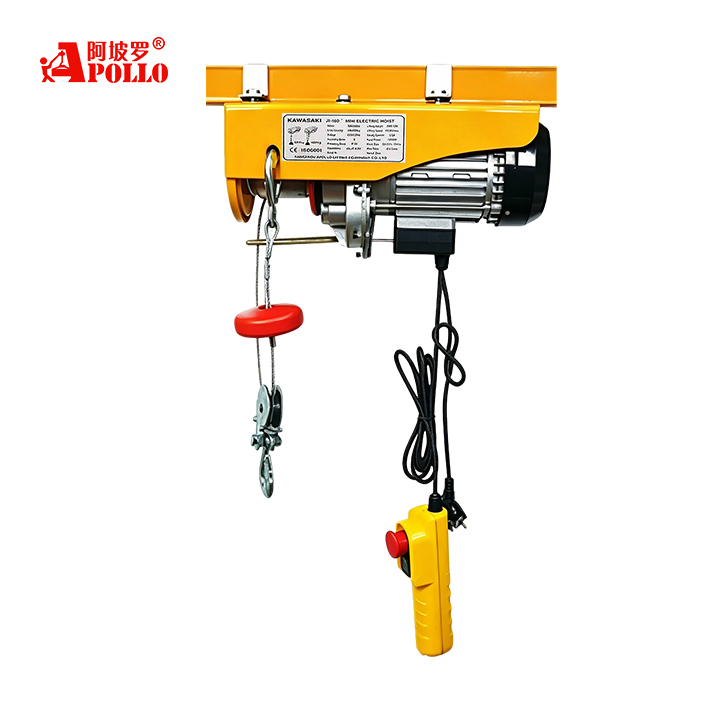
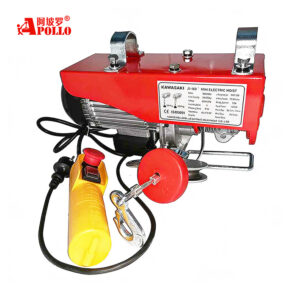
The permanent magnet inverter motor in the Apollo compact hoist drives the drum through an electronic speed setting rather than a fixed gear ratio tied to the supply frequency. On the compact range the low mode runs at 5 to 12 metres per minute and the high mode at 14 to 34 metres per minute, from a 1.5 kW or a 2.5 kW motor.
Three things follow from that, and only the first is obvious:
- The load can be set down precisely instead of hitting the surface, because the slow mode moves the hook at a speed one operator can watch and stop.
- One unit covers two habits of work, the placement job that needs patience at the end and the transport job that needs the part to come off the bench quickly.
- The speed setting lives in the control box, so there is no separate frequency converter to mount, wire, cool and keep dry beside the hoist.
What the motor does not change is just as important to state. It does not raise the capacity: a 500 kg unit still lifts 500 kg in the mode the rating describes. It does not replace the brake, the rope or the limit switch, and it does not remove the duty cycle. Variable speed improves where the load stops, not what the load can be.
Two settings or true stepless control
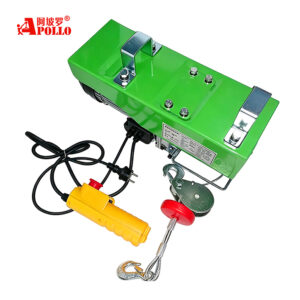
Catalogues use the words variable speed loosely, so it is worth separating two designs before the order is placed. The Apollo compact hoist is the two-setting type, with a slow range for placement and a fast range for transport.
A two-setting hoist gives a low figure and a high figure, and the operator picks one. That is enough for most mixed work, because the placement problem is solved as soon as the slow setting exists. True stepless control lets the operator hold any speed between the limits, usually through a pressure-sensitive pendant, which suits operators who feather the load through a machine opening or past an obstruction.
| Setting | Speed on the compact range | Where it earns its place |
| Low | 5 to 12 metres per minute | Final placement, dowel pins, machined faces, anything that must not be bumped |
| High | 14 to 34 metres per minute | Transport between bench and machine, or between floor and mezzanine, where cycle time is the cost |
| Stepless option | Between the two limits | Loads threaded past obstacles, where the operator needs to feel the move rather than pick a setting |
Neither design is better in the abstract. The question is whether the crew needs to choose a speed or to feel one, and that question is answered by the shape of the work rather than by the price of the option.
One habit is worth correcting early. Crews that leave the unit on the low setting for transport, because the last lift of the shift needed patience, lose the throughput the high setting was bought for. Apollo recommends a rule rather than a procedure: slow for the last 100 mm, fast for everything before it.
What to verify before you accept the unit
A quotation gives two speed figures and stops there. Acceptance is where those figures either hold up or quietly turn out to describe an empty hook.
- Ask whether the speed figures were measured empty or with the rated load.A hoist that runs at 34 metres per minute with nothing on the hook will run slower with 750 kg on it, and the difference is what the crew will actually live with.
- Run the low setting through the real lift, not an empty one.Order an inching cycle or a variable pendant only after watching the operator try to stop a representative part in the position it has to reach.
- Check the brake sequence on every stop.The electric brake handles normal stops and the mechanical brake holds the load when the supply is lost; both should be demonstrated rather than described.
- Confirm the control voltage at the pendant.The standard pendant on the Apollo range runs on a 4 volt safe control voltage, which is what limits the electrical exposure at the operator’s hand.
- Watch the protection set work.Overload, overheat, the limit switch and anti-reverse are standard on every Apollo unit, and each one should be tripped once during handover instead of being left to the first fault.
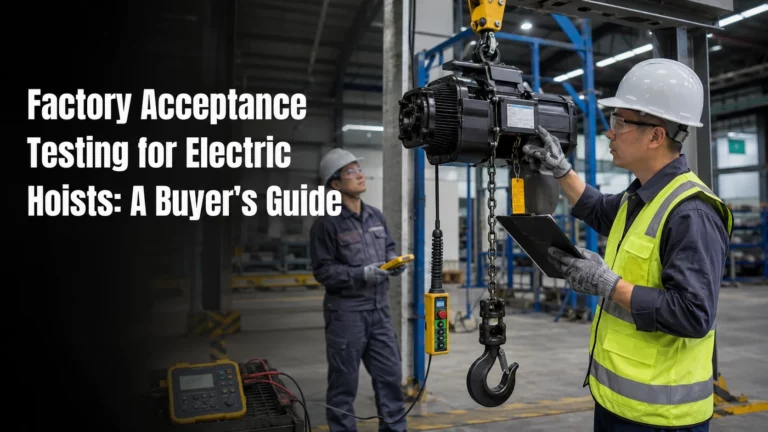
Apollo’s factory acceptance guide sets out how to structure those checks so the result is a recorded pass rather than a conversation at the loading bay (https://www.apollohoist.com/product-news/factory-acceptance-testing-for-electric-hoists-a-buyers-guide/).
Where the variable speed design pays for itself
The savings are not in the motor. They are in the operations the fixed-speed hoist cannot do at all, and in the damage it does on the way.
- Fewer scrapped parts: a plate that is bumped against a machined face is either reworked or written off, and the cost of one scrapped part often exceeds the difference between the two hoist designs.
- Shorter cycles on light work: the same unit that creeps for placement runs fast for transport, so the crew does not trade throughput for control.
- Less reliance on the operator’s timing: when the hoist can be slowed, the stop depends on the setting rather than on reflexes, which matters on shifts where the operator changes every eight hours.
The Apollo compact range is built from 100 kg to 750 kg with body weights of 16 kg and 24 kg, so the same design that carries the inverter also hangs on a beam without a lifting frame. Rope sizes run from 5 mm to 8 mm with standard lifting heights of 20 m, 29 m and 49 m, the standard supply is 220 volts, and each Apollo unit ships with CE documentation and a one year warranty. The full range, including rope and control configurations, is listed on the Apollo mini wire rope hoist category page (https://www.apollohoist.com/product-category/electric-hoist/electric-wire-rope-hoist-mini/).
The questions that decide the order
Most specification errors on this product class come from describing the hoist instead of the job. Five answers settle it:
- What is the heaviest single lift, including the rigging?The part plus the spreader plus the slings, not the part alone.
- What does the operator have to do at the end of the lift?Landing on pins, threading past an obstruction and dropping onto a pallet are three different control problems.
- How many lifts per shift, and how long is each one?Duty cycle is what decides motor heating, and it is the figure buyers most often leave out.
- What is the mounting height and the headroom above the hook?The rope length and the lifting height are chosen together with the beam, not after it.
- Which control arrangement suits the crew?A two button cable pendant, a cable pendant with a remote, or a wireless remote, each of which changes how the operator stands relative to the load.
Apollo is a mini wire rope hoist manufacturer that builds the compact range in its own factory, so those five answers come back as one quotation rather than a negotiation between a trading desk and an unseen supplier.
Who builds the unit, and what that changes
The control electronics are the part of a variable speed hoist that is hardest to service from a distance. A speed setting that drifts, a pendant that does not return, or a brake that holds late are all faults that get resolved by whoever can read the wiring diagram and supply the board.
Apollo is an electric hoist supplier to distributors in more than 50 countries, and the compact range is produced in the Apollo factory from 100 kg to 750 kg, which means one control design, one rope specification and one documentation set across the sizes a workshop is likely to buy. As a lifting equipment manufacturer with more than 20 years of production, Apollo also builds the electric chain hoists and manual hoists that share the same beams and the same inspection paperwork, so a site can keep one approval file instead of three.
The wider Apollo powered range, from electric chain hoists to winches and explosion-proof units, sits on the electric hoist category page (https://www.apollohoist.com/product-category/electric-hoist/).
Placing an order with Apollo
Plant and project buyers normally start from the lift, and so does Apollo: the part weight, the height, the number of cycles per shift and the supply on site. Distributors start from the stock range and the documentation they need to resell. Both routes end in the same place, which is a unit configured for one job rather than a category description.
Send the heaviest lift, the rigging weight, the height the hook has to reach and the cycles per shift, and Apollo’s engineers will confirm the capacity margin, the speed setting and the control arrangement in writing, with the CE documents attached. Custom branding, packaging and market-specific documentation are produced at the Apollo factory for OEM and private label orders.
Request conformity document samples now
Get a lift assessment via WhatsApp or phone: +86 18989488615 | Email: sales@apollohoist.com | Online inquiry: https://www.apollohoist.com/contact-us/ | Full range: https://www.apollohoist.com