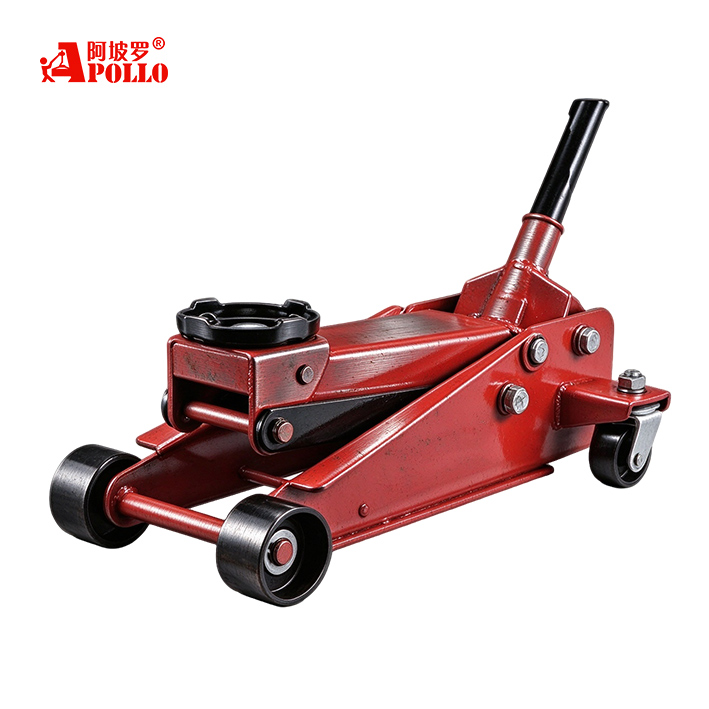
The jack that sinks overnight
A workshop lifts a van to change a wheel bearing, leaves the vehicle on the jack overnight with stands under the chassis, and comes back to find the saddle 15 mm lower than it was left. Nothing has failed visibly. No oil on the floor, no noise, no warning. The jack is simply not holding where it used to.
That slow sink is the most common hydraulic complaint in a workshop, and it is also the most misdiagnosed, because three different faults produce almost the same symptom. A release valve that has not closed fully, air trapped in the cylinder and a worn seal all let the load down slowly, and the only way to separate them is to check them in order.
This guide is written for workshop supervisors, fleet maintenance planners and the distributors who support them. It covers the three checks that find the fault, the things that must never be done to a hydraulic jack, and the point at which replacement is cheaper than repair.
Three places the height goes
A hydraulic jack holds a load on a column of oil trapped between two seals. Anything that lets that oil past the release valve, compresses the column, or escapes past a seal shows up as the same slow descent.
| Symptom | Most likely cause | First check |
| Sinks only under load, holds when unloaded | Release valve not seating fully, or a seal passing under pressure | Close the valve firmly by hand and re-test before touching anything else |
| Saddle rises then drops a few millimetres on the first pump | Air trapped in the cylinder | Bleed the cylinder with the release valve open and the reservoir full |
| Oil film on the ram or under the body | Worn pressure seal or a damaged dust seal | Wipe the ram, run one lift, and look for where the film reappears |
| Handle feels spongy across the whole stroke | Low oil level or air in the circuit | Check the level at the fill point and bleed before topping up |
The order matters, and it is the order Apollo’s maintenance guidance follows. Checking the valve takes a minute, bleeding takes five, and stripping the cylinder takes an afternoon, so the cheap checks run first and rule themselves out before any tool comes out of the box.
Check one: the release valve and the handle position
The release valve is the part the operator touches every cycle, and it is the part most likely to be left just short of closed. A valve that is one fraction of a turn open will hold a light load and creep under a heavy one, which is exactly the pattern that makes crews blame the seals.
Close it by hand until it stops, then test with the load that produced the complaint rather than an empty saddle. If the jack holds, the fault was the valve position and the maintenance answer is a note in the shift routine: never leave the valve part way, and never use the handle as a lever against the stop. If it still creeps with the valve closed, move to the next check.
Check two: air in the cylinder
Air gets into the circuit when the reservoir runs low, when the jack has been stored on its side, or after a repair that was not bled. Air compresses, so the first pump of the handle moves the saddle less than it should, and the load settles as the bubble migrates.
The bleed procedure is short and does not need the jack apart:
- Open the release valve and pump the handle through several full strokes.The aim is to move oil through the circuit with no load, which carries the air back to the reservoir.
- Close the valve and run the saddle to full height with no load.Repeat twice, then lower it fully.
- Check the oil level at the fill point and top up to the specified mark.Use the oil grade named in the Apollo manual for the unit; mixing grades is what turns a bleeding job into a seal job.
- Re-test with the load that caused the complaint.If the saddle now rises evenly from the first stroke and holds, the air is out.
If air returns within a week, stop bleeding and look for where it enters. A reservoir that keeps dropping is losing oil past a seal, and the bubble is a symptom rather than the fault.
Check three: oil level and seal condition
On an Apollo hydraulic floor jack, oil is only visible in two places: on the ram and on the floor. A film on the ram that reappears after it has been wiped is the pressure seal passing. A film under the body, near the fill point, is usually the fill plug or the release valve stem rather than the cylinder itself.
The seal arrangement on the Apollo hydraulic floor jack is a dual-seal cylinder: a dust seal that keeps grit off the ram, and a primary pressure seal behind it that holds the oil. That order is deliberate. The dust seal is the cheap part and the pressure seal is the one that ends a lift, so a jack that is wiped down and kept out of grit will outlast one that is stored on a workshop floor next to a grinder.
Apollo’s view is that three habits decide how long the pair lasts:
- Wipe the ram before every use, because grit carried past the dust seal is what scores the pressure seal.
- Store with the ram fully retracted, so the exposed chrome is inside the cylinder instead of in the air.
- Keep the fill point clean, and never open it with a dirty funnel or in a dusty bay.
When the pressure seal does go, the repair is a seal kit and an hour of work on most Apollo units in the 2 tonne to 5 tonne class, which is why the decision to repair or replace is an economic one rather than a technical one.
What never to do to a hydraulic jack
Most of the jacks that arrive for scrap did not wear out. They were damaged by a shortcut, and the shortcuts are consistent enough to list.
- Never top up with brake fluid or engine oil, because both attack the seals and turn a top-up into a rebuild.
- Never adjust or plug the overload valve, because it is set and verified per unit and it is the only protection against a load that is heavier than the rating.
- Never weld, drill or bend the frame or the lifting arm, because heat and holes remove the margin the plate was designed with.
- Never use the release valve as a lowering brake, because the valve is designed to open and close, not to meter a load down a slope.
- Never work under a load held only by the jack, because a jack is a lifting device and stands are what make a raised vehicle safe to work beneath.
Repair or replace: the arithmetic
A seal kit and an oil change are cheap against a new unit, so the decision turns on what else the jack needs at the same time. Three conditions argue for replacement rather than repair:
- The ram is scored or pitted.A new seal against a damaged ram will pass again within weeks, and re-chroming costs more than the jack is worth at the small end of the range.
- The frame or the lifting arm is deformed.Structural damage is not a seal problem, and a bent arm changes the geometry the rating was calculated on.
- The unit is at the small end of the range and the labour is not free.A 6.5 kg jack that needs a kit, an oil change and an hour of a technician’s time can cost more to keep than to replace.
For a fleet, the arithmetic usually lands the other way, because a standard seal kit held in stock and one procedure across twenty identical jacks is cheaper than twenty replacements arriving at different times.
Questions for the next purchase
The maintenance history of the last Apollo jack is the best specification document for the next one. Four answers decide whether the replacement will behave differently:
- Is the minimum height low enough for the lowest vehicle in the fleet?The Apollo hydraulic floor jack range runs from a 140 mm entry height down to 80 mm on the 3 tonne low-profile model, and the difference decides whether a sports car or a lowered van can be lifted at all.
- How is the cylinder sealed?Ask for the seal arrangement in writing, because a dual-seal design with a replaceable dust seal is what makes routine cleaning effective.
- Does Apollo stock a seal kit as a spare part?A jack that cannot be resealed is a consumable, and the buyer should price it that way.
- What does the documentation include?The test record, the capacity marking and the manual with the oil specification are what an inspection depends on.
The document pack that should arrive with industrial lifting equipment is set out in more detail in Apollo’s documentation guide (https://www.apollohoist.com/product-news/industrial-lifting-equipment-documentation-checklist/), and the questions that separate a factory from a trader are listed in the manufacturer audit checklist (https://www.apollohoist.com/product-news/how-to-audit-a-hoist-manufacturer-factory-qc-and-traceability-checklist/).
Who builds the jack, and why it matters here
A hydraulic jack is a small machine with three failure points that decide its life: the seal arrangement, the release valve and the frame. None of them are visible in a product photograph, and all of them are decided before the unit is packed.
Apollo is a hydraulic floor jack manufacturer that builds the range from 2 tonnes to 5 tonnes in its own factory, with a thickened steel plate frame stamped as one piece, a dual-seal cylinder, and an overload valve set and verified per unit. Apollo is also a floor jack supplier to distributors in more than 50 countries, and the range covers 2 tonne, 2.5 tonne, 3 tonne and 5 tonne models with net weights from 6.5 kg to 45 kg, so a dealer can cover passenger cars through light trucks from one stock line.
As a workshop lifting equipment supplier, Apollo builds the hoists, trolleys and jacks that share the same bays and the same inspection paperwork, which means one approval file and one contact for the whole workshop rather than a separate relationship for every category. The full jack range is listed on the Apollo lifting jack category page (https://www.apollohoist.com/product-category/lifting-jack/).
Booking the service with Apollo
A jack that sinks overnight is a maintenance job, not a reason to replace a fleet. The three checks in this guide take an afternoon in total and settle the cause before anything is stripped, and the result is either a seal kit and an oil change or a clear case for a new unit.
Send the model, the capacity, the symptom and the age of the unit, and Apollo’s engineers will confirm whether a seal kit is the right answer and what the replacement unit would be. Custom branding, packaging and documentation are produced at the Apollo factory for OEM and private label orders.
Request conformity document samples now
Get a maintenance opinion via WhatsApp or phone: +86 18989488615 | Email: sales@apollohoist.com | Online inquiry: https://www.apollohoist.com/contact-us/ | Full range: https://www.apollohoist.com