Introduction
Imagine you need to lift a 30-meter-long bridge girder, a massive industrial pressure vessel, or an oversized pipeline section that weighs dozens of tons. A single hoist, no matter how robust, cannot keep such a long and slender workpiece stable. The load would tilt, twist, or—worse—suffer structural damage from uneven pulling. The natural engineering answer is to use two, four, or even more electric hoists, connected to a common load-bearing beam or directly to the load itself, and make them lift and travel as one. But can multiple standard hoists truly be synchronized to move a long, heavy object as if lifted by a single super-intelligent machine? What extra equipment does it take, and how precisely can they hold position relative to one another?
As one of the established electric hoist manufacturers and providers of heavy lifting solutions, Hangzhou Apollo Lifting Equipment Co., Ltd. regularly helps project engineers, plant managers, and crane builders answer exactly these questions. This guide unpacks the technology, the hardware, and the practical know-how that transforms individual hoists into a perfectly orchestrated lifting team.
1. Understanding the Need: Why Synchronization Matters for Long Loads
Single-point lifting of a long, slender load is inherently unstable. If the center of gravity shifts slightly or the hook is not precisely centered, the load tilts, dynamic shock loads appear, and the hoist can be side-loaded beyond its design limits. In industries such as bridge construction, shipbuilding, power generation, and large-scale HVAC or pipeline installation, loads are not only heavy but also dimensionally long and sometimes flexible. A 20-meter pipe lifted from one end would bend permanently. A pre-cast concrete beam hoisted by a single rope would crack under its own bending moment.
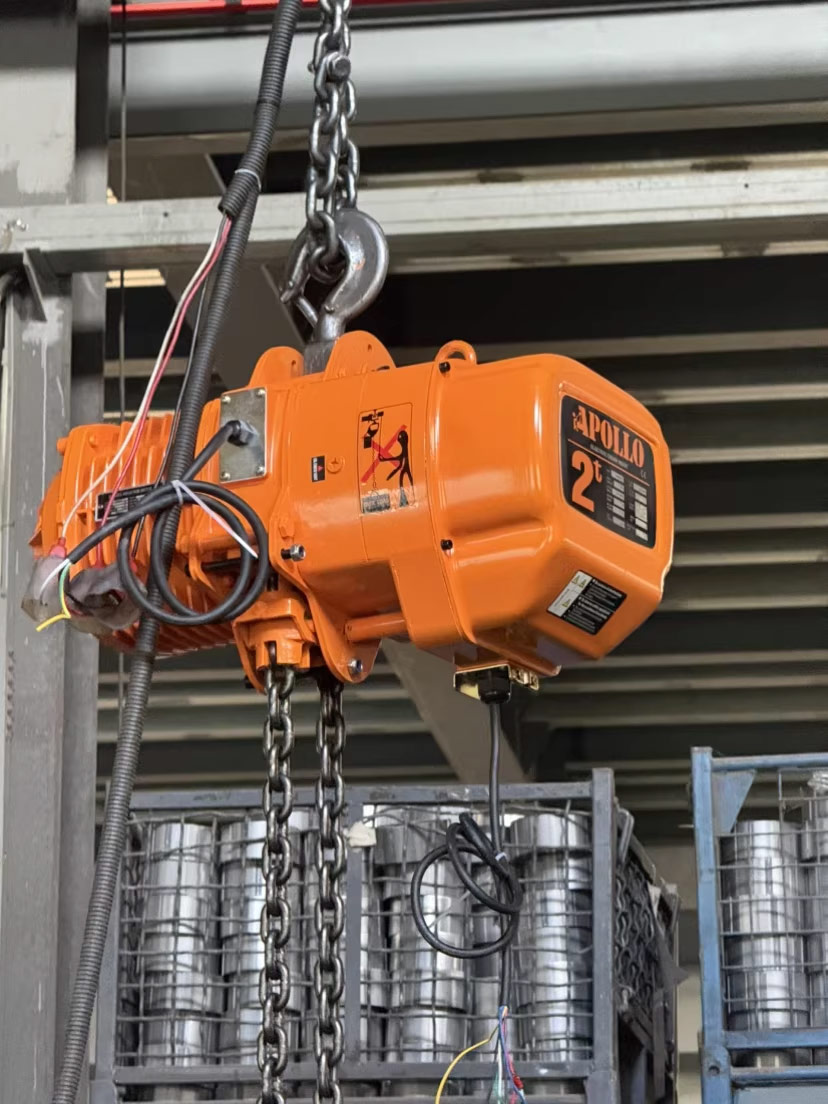
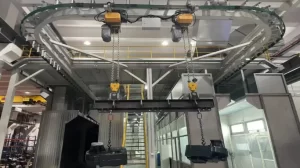
The solution is multi-point lifting, and in modern material handling, this usually means deploying multiple electric chain hoist or wire rope hoist units under a common spreader beam or attached to lifting lugs distributed along the load. These hoists, often supplied by specialist electric wire rope hoist manufacturers, must act in perfect concert—raising, lowering, and often traversing a workshop or yard without creating a dangerous height misalignment between the lifting points. The technical term for this is synchronized lifting or master-slave control, and it lies at the heart of many heavy lifting solutions engineered by advanced hoist manufacturers.
2. Key Factors When Configuring Multi-Hoist Synchronized Systems
Before selecting specific hardware, engineers must analyze several critical factors that determine the synchronization strategy.
2.1 Load Nature: Rigid vs. Flexible
A stiff, torsion-resistant load like a thick-walled concrete bridge girder can tolerate small positional differences between hoists as long as the load distribution stays within safe limits. A flexible load, such as a thin-walled stainless steel pipe or an aircraft wing jig, is far less forgiving—millimeters of vertical mismatch can cause permanent deformation. This distinction directly influences whether the control priority should be position synchronization or force/load equalization.
2.2 Number of Hoists and Mechanical Coupling
Two hoists under a single stiff spreader beam form a somewhat self-correcting mechanical system; the beam helps distribute forces. However, when four hoists lift a large, slightly flexible truss frame without a rigid lifting beam, each lifting point must be electronically synchronized, as there is no mechanical cross-coupling. Experienced crane hoist manufacturers analyze the entire lifting geometry to determine the degree of redundancy and the required control architecture.
2.3 Lifting Height and Travel Distance
The taller the lift and the longer the horizontal travel, the more opportunity there is for small speed differences to accumulate into large positional errors. For a lift of 15 meters, a mere 0.5% speed deviation between two hoists can result in a 75 mm vertical gap—unacceptable for precision installations. This is why overhead crane manufacturers and hoist manufacturers carefully match drive characteristics and employ closed-loop feedback for any synchronized travel application.
2.4 Environmental and Operational Factors
Temperature variations affect hoist motors and ropes differently; wind on outdoor construction sites can push a suspended load and load one hoist far more than another. The synchronized control system must be able to detect and correct for such external disturbances in real time. In heavy-duty sectors, the expertise of electric hoist manufacturers in building robust, IP65-rated sensor systems becomes invaluable.
3. The Equipment That Makes Synchronization Possible
Turning individual hoists into a synchronous lifting group requires more than just strapping two controllers together. It demands a carefully composed chain of sensors, drives, and logic.
3.1 Position Feedback Sensors
Absolute or incremental encoders mounted directly on the hoist drum or chain sprocket are the minimum requirement. To achieve tight synchronization, leading electric wire rope hoist manufacturers integrate dual-encoder systems: one on the motor shaft for speed feedback and one on the drum for direct load position measurement, eliminating gear backlash errors. Additionally, draw-wire sensors or laser rangefinders can be fitted directly to the hook blocks to measure the true height of each lifting point, compensating for wire rope stretch or chain link wear.
3.2 Load Monitoring
Each hoist must be equipped with a load pin or tension-type load cell to constantly measure the actual force at its lifting point. Not only does this prevent overloads, but it also provides the input for force-based synchronization schemes. When lifting a flexible load, it is often safer to keep the tension in each chain or rope equal than to chase an absolute position that the load’s flexibility distorts.
3.3 Variable Frequency Drives (VFDs) with Closed-Loop Control
Standard single-speed contactor-controlled hoists are unsuitable for precise multi-point synchronization—they cannot smoothly adjust speed to correct micro-deviations. A dedicated VFD for each hoist motion, operating in closed-loop vector control, is the usual backbone. These VFDs receive commands from a master controller and rapidly fine-tune motor torque and speed. Many crane hoist manufacturers factory-integrate such drives with pre-tuned loops specifically for synchronized lifting cycles.
3.4 Master Synchronization Controller
The “brain” of the system is typically an industrial PLC or a dedicated motion controller. It continuously reads the position and load data from all hoists, compares them, and issues corrective speed adjustments. The communication bus—Profinet, EtherCAT, or CANopen—must guarantee real-time data transfer with millisecond-level determinism. This controller also manages safety functions: if the positional difference between any two hoists exceeds a preset “error window” (e.g., 15 mm for a rigid load), it immediately initiates a controlled stop to prevent damage.
3.5 Human-Machine Interface (HMI) and Remote Pendants
Operators require clear visualization of the relative positions and loads of all hoists. A color touch-screen HMI can show each hook height to the millimeter and each load in kg, together with alarm histories. Radio remote controls with multiple joysticks allow a single operator to jog the entire system while watching the load from the safest vantage point.
4. Synchronization Accuracy: What Numbers Can You Expect?
This is the million-dollar question for any project director. The achievable synchronization accuracy is not a single fixed digit; it depends on the control method, the hoist mechanics, and the load rigidity.
-
Open-loop frequency control with identical speed references: Accuracy typically falls in the range of ±0.5% to ±1% of the travel distance. For a 10-meter lift, this could mean a 50–100 mm height difference—entirely unsuitable for most long load applications and considered unsafe by leading crane manufacturers for anything other than non-synchronous tandem use with a mechanical spreader.
-
Closed-loop master-slave position control with encoder feedback: This is the mainstream solution for industrial lifting crane systems lifting rigid bridge segments or steel structures. Synchronization accuracy of ±5 mm to ±10 mm is routinely achieved and guaranteed by leading hoist lift manufacturers. Under steady-speed lifting with a well-tuned VFD setup, many electric chain hoist and wire rope systems maintain deviations well within a single chain link pitch or one rope revolution.
-
Advanced cross-coupled control with dynamic load compensation: When both position and load data are used in an adaptive control algorithm, deviations can be held to ±2 mm to ±3 mm even during acceleration and deceleration. This level of precision, often delivered by specialized heavy lifting solutions providers, is necessary for turbine rotor insertion, glass panel lifting, and sensitive prefabricated modules. Some electric wire rope hoist manufacturers offer pre-assembled synchronized packages that achieve ±1.5 mm absolute hook position accuracy under controlled conditions.
It is critical to understand that the synchronization accuracy at the hook does not directly equal the load end accuracy. Wire rope stretch and structural deflection in spreader beams introduce additional relative movement. Hangzhou Apollo always factors these mechanical realities into the control system’s error budget when designing synchronized lifting crane hoist manufacturers systems.
5. Solution Architectures Compared
There is no single correct way to synchronize hoists. The right architecture depends on the rigidity of the load, the number of hoists, and the safety integrity level required.
5.1 Simple Paralleled Motors (Not Recommended for Precision)
Connecting two hoist motors to a single VFD or running them from independent open-loop drives is a low-cost trick used in some non-critical conveyor systems. But for long heavy loads, this approach has no positional correction ability and is fundamentally unsafe without a strong mechanical coupling.
5.2 Master-Slave Position Control
One hoist is designated the master, and the others are slaves. The slaves continuously read the master’s encoder position and adjust their own speed to match it within a narrow deadband. This is easy to implement and works extremely well for rigid loads lifted by two hoists. Many electric hoist manufacturers offer factory-configured master-slave kits for their electric chain hoist series up to 10 tonnes.
5.3 Electronic Gearing / Parallel Positioning
Each hoist receives the same position command from a central controller, but each runs its own independent closed-loop position loop. The controller monitors the actual positions and cross-compensates—if hoist A runs slightly ahead, the controller can slightly reduce its speed and slightly increase hoist B’s speed, rather than forcing B to blindly follow A. This method is superior for multiple hoists (3, 4, or more) and is favored by leading overhead crane manufacturers for large-span crane installations.
5.4 Force-Priority Synchronization
For highly flexible loads, the control system prioritizes load equalization. Each hoist maintains a target load share (e.g., 25% of total weight for a 4-hoist system). If a position deviation starts to transfer load to one hoist, the controller allows a small position offset to balance forces, preventing the load from bending. This sophisticated scheme requires tight integration between the PLC and load cells, typically supplied by experienced hoist manufacturers working closely with structural engineers. In practice, a blended control using position as the primary cascade target and force as a limiting boundary is often the optimal heavy lifting solution.
6. Best Practices from the Field
Drawing on years of on-site experience as an integrated supplier of electric chain hoist and wire rope hoist systems, several best practices stand out:
-
Match the mechanics first. Before fine-tuning electronics, ensure all hoists have the same gearbox ratios, drum diameters, chain pitches, and rope constructions. Identical components from the same hoist lift manufacturers minimize inherent speed differences. Never mix an old hoist with a new one in a synchronized set without re-engineering.
-
Pre-stretch and condition the ropes. When using wire rope hoists from electric wire rope hoist manufacturers, new ropes exhibit significant initial stretch. The ropes must be pre-cycled under load conditions and re-calibrated before synchronization is commissioned. Similarly, new load chains should be properly lubricated and bedded in.
-
Define safe limits rigorously. Set a tight electronic synchronization error window (e.g., 10 mm differential above which an alarm sounds) and a wider “tripping” window that stops all motions safely. These thresholds should be verified through load tests with eccentric weights designed to intentionally pull the hoists out of sync, ensuring the safety chain functions reliably.
-
Install independent overload and slack rope detection for each hoist. In any synchronized lifting system, a single hoist could theoretically be subject to overloading if the load tilts; independent protection is a must for crane parts suppliers specifying components for these systems.
-
Work with a single responsible engineering partner. Synchronized lifting is a system, not an assortment of parts. Hangzhou Apollo Lifting Equipment Co., Ltd. designs, assembles, and pre-commissions the complete synchronized system—from hoists and VFD panels to PLC logic and radio control—at its factory before shipping. Customers witness a full load test with real-time synchronization readouts on their future equipment, ensuring that commissioning at the final site is a rapid, low-risk process.
7. Future Trends in Synchronized Lifting
Borrowing intelligence from industrial automation and IoT, the next generation of synchronized hoists is becoming a reality. Wireless synchronization protocols now allow two hoists on separate, unconnected monorails—perhaps supplied by different overhead crane manufacturers—to operate as a coordinated tandem through secure radio frequency communication, greatly expanding the flexibility of existing factory layouts. Meanwhile, digital twin technology allows engineers to run dozens of simulated lifts with different speed combinations and load eccentricities before the hardware is even installed. Hangzhou Apollo integrates such simulation capabilities for complex heavy lifting solutions, minimizing surprises on site.
Real-time condition monitoring, gathering data from crane parts suppliers and on-board sensors, will soon feed cloud-based algorithms that automatically adjust synchronization parameters as ropes wear and brakes age—shifting maintenance from reactive to predictive and keeping the multi-hoist system in optimum harmony across its entire service life.
Conclusion
Can multiple electric hoists be synchronously connected to lift a long, heavy load? Absolutely—and with a level of precision and safety that allows bridge segments, large pipes, and massive industrial modules to be handled as easily as a single compact pallet. The key lies not in any one magic component, but in the systematic integration of closed-loop drives, precise feedback sensors, intelligent controllers, and mechanically matched hoists. Whether you choose rugged electric chain hoist units or heavy-duty wire rope hoists from proven electric wire rope hoist manufacturers, the success of the operation depends on the engineering rigor behind the synchronization logic.
For operations managers, procurement directors, and construction engineers, the most strategic decision is to engage a partner who understands both the lifting hardware and the control software deeply. Hangzhou Apollo Lifting Equipment Co., Ltd. brings together the capabilities of an electric hoist manufacturer, an overhead crane manufacturer, and a crane hoist manufacturer under one quality-controlled roof. With customized synchronized lifting heavy lifting solutions, backed by global service and genuine commitment to project partnership, Apollo helps you lift longer, heavier, and smarter—one perfectly synchronized move at a time.