An OEM electric hoist warranty is more than a number of months. For a distributor, it defines which complaints can be passed to the manufacturer, what evidence is required, who pays for diagnosis and freight, and how a replacement affects the downstream sale. If those points remain in a quotation footnote, a field failure can become a margin dispute.
This guide gives distributors a review framework before placing an OEM hoist order. Use it to turn a general promise into a written, model-specific schedule that matches the destination market and customer commitments.
Why warranty wording matters in an OEM transaction
The distributor sits between the hoist manufacturer and end user. The manufacturer may warrant the equipment, while the distributor separately promises delivery, commissioning support, spare parts, or a private-label product. These are different obligations. Never assume the manufacturer warranty mirrors a downstream sales contract.
A clear warranty schedule also protects both sides when a failure has several possible causes. A motor, brake, control panel, trolley, installation method, power quality issue, or operating practice may each affect the diagnosis. The purchase agreement should identify the governing warranty document, the covered product configuration, and the process for deciding whether a claim is valid.
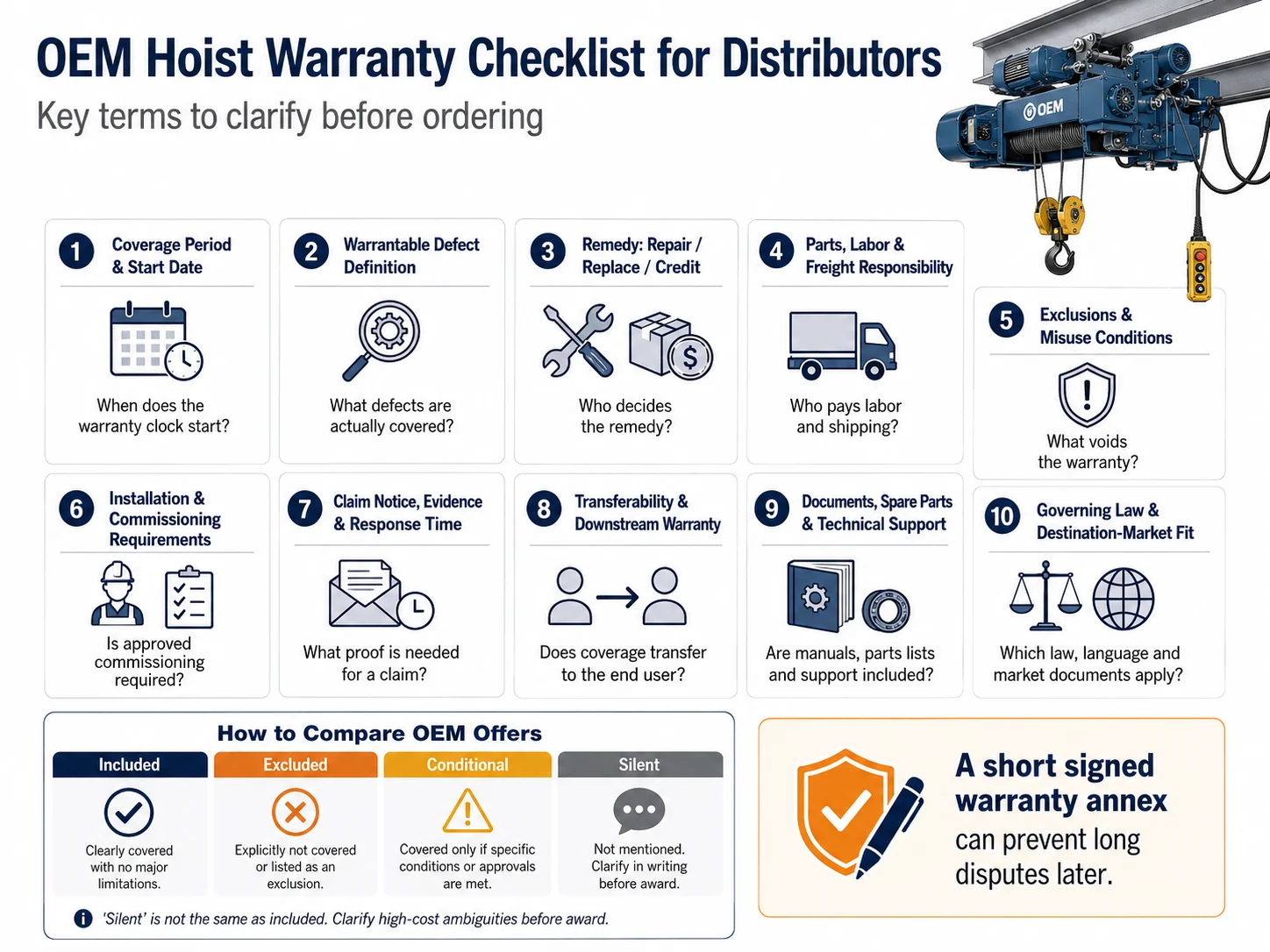
Ten warranty terms to clarify before ordering
Coverage period and start date
Ask whether the period starts on shipment, delivery, commissioning, site acceptance, or the end user sale. Confirm whether different periods apply to the hoist, motor, electrical components, controls, trolley, hooks, and accessories. If the supplier states “one-year warranty,” verify the trigger date and whether an approved extension or replacement part receives a new period. Apollo identifies one-year after-sale warranty service, but the signed warranty document should control the period, start date, and configuration.
Meaning of a warrantable defect
Define whether coverage applies to defects in materials and workmanship under normal use, and how “normal use” is measured. Tie the warranty to the approved load, duty class, lift, voltage, ambient conditions, and installation instructions. Clarify whether a design nonconformity found during commissioning is a warranty claim, manufacturing correction, or separate engineering change.
Remedy: repair, replacement, credit, or refund
A warranty should state the manufacturer’s remedy and who chooses among alternatives. It should cover replacement units, components, rework, technical instructions, or commercial credit. Do not infer a refund right from the word “warranty.” Ask whether the remedy is limited to the defective part and whether the replacement is new, refurbished, or equivalent.
Parts, labor, inspection, and freight
Separate the cost buckets. Confirm who pays for parts, factory inspection, remote troubleshooting, local technician labor, removal and reinstallation, packaging, inland transport, international freight, duties, and return shipment. These costs are often excluded or handled only with prior written approval. Record the approval contact and the spending limit so a distributor is not forced to authorize urgent work without reimbursement clarity.
Exclusions and misuse tests
Request a complete exclusions list, not only a reference to “improper use.” Ask about overload, shock loading, side pulling, unauthorized modification, incorrect voltage or phase, poor grounding, unsuitable duty cycle, corrosion, water or dust beyond the declared rating, skipped maintenance, and consumable wear. Hooks, chains, ropes, brake linings, contactors, batteries, and seals may have separate treatment. Have the supplier identify which exclusions can be tested from records, photographs, inspection, or operating data.
Installation and commissioning responsibility
State who approves the installation, alignment, beam or trolley fit, wiring, limit-switch setup, brake adjustment, and initial test. A manufacturer may require an authorized installer or a signed commissioning report before coverage begins. The distributor should obtain the required checklist and know whether a missed commissioning step voids the entire warranty or only affects the related component.
Claim notice, evidence, and response
Write the claim route in operational terms: email or portal, required photos and serial numbers, operating hours, fault codes, inspection records, and the time allowed to notify the supplier. Confirm who performs the first diagnosis and whether the hoist must be stopped pending instructions. A response target, parts dispatch target, and escalation contact should be stated if the distributor has customer service obligations; never assume a service-level agreement exists because a warranty exists.
Transferability and downstream warranty
Ask whether coverage follows the serial-numbered equipment, the original purchaser, the distributor, or a named end user. Clarify what happens after resale, project handover, replacement shipment, or site change. The distributor’s customer warranty should not promise broader coverage, longer duration, or more generous remedies than the OEM agreement unless that risk is priced and accepted.
Documentation, spare parts, and technical support
Warranty performance depends on documents that can be used in the field. Confirm the delivery of manuals, wiring diagrams, parts lists, inspection forms, certificates, serial-number records, and recommended maintenance intervals. Ask how long equivalent spare parts and technical assistance will be available after the warranty period. Apollo describes after-sale accessories services and OEM/ODM customization; the order should convert those capabilities into a documented parts and support commitment for the specific model.
Governing law, language, and destination-market fit
Check the governing law, dispute venue, contract language, currency, tax treatment, and export-control responsibilities. For US transactions, Federal Trade Commission warranty guidance is not a substitute for legal review of a commercial industrial-equipment contract. The FTC explains federal warranty concepts for consumer products; distributors should have counsel confirm which rules, disclaimers, safety duties, and import requirements apply to their actual sale.
A distributor’s pre-order warranty checklist
Before releasing a purchase order, place the following items in a signed annex or referenced warranty document:
- Model, serial-number scope, approved drawing revision, and included accessories.
- Coverage period, start event, remedy hierarchy, and treatment of replaced parts.
- Installation, commissioning, maintenance, and operating conditions required for coverage.
- Exclusions, wear-part rules, inspection rights, and evidence required for a claim.
- Parts, labor, freight, duties, technician travel, and approval rules for exceptional costs.
- Claim contacts, notice timing, response expectations, escalation route, and records retention.
- Transferability, downstream customer wording, governing law, language, and destination-market documents.
How to compare OEM offers
Build a side-by-side matrix with one row per warranty term and one column per supplier. Mark each response as included, excluded, conditional, or silent. “Silent” is not equivalent to included. Price exposure for local labor, emergency stock, inspection delays, and customer downtime, then ask the supplier to close the highest-cost ambiguities before award.
For a product-family review, visit Apollo’s electric hoist category and match the candidate model to the approved duty, environment, electrical supply, and warranty annex. Apollo’s ODM and OEM service page describes function, voltage, surface-treatment, packaging, and appearance customization. Those options should be tied to the exact serial-numbered configuration and acceptance documents.
When a standard warranty does not fit the project risk, review Apollo’s R&D capabilities with a written list of required changes, validation evidence, and ownership of the resulting design. For a formal fit-check, contact Apollo with the model, quantity, destination, operating profile, installation details, and your proposed warranty schedule.
Conclusion
The strongest OEM hoist warranty is specific enough to operate during a real failure. Distributors should confirm the clock, covered defect, remedy, cost allocation, exclusions, claim evidence, transferability, support documents, and governing terms before ordering. A short signed annex can prevent a long argument later, protect downstream commitments, and make supplier offers genuinely comparable.
FAQs
Does a one-year OEM warranty cover the distributor’s end customer automatically?
Not necessarily. Confirm who is the original purchaser, whether coverage transfers, and whether the downstream warranty uses the same duration, exclusions, and claim route.
Who normally pays international freight for a warranty replacement?
There is no universal answer. The purchase agreement should state responsibility for packing, inland transport, ocean or air freight, duties, and return shipment, including any prior-approval rule.
Can wear parts be included in an electric hoist warranty?
They may be excluded, limited, or covered only for a manufacturing defect. Ask for a component-level schedule covering chains, ropes, hooks, brake parts, contactors, seals, and batteries where applicable.
What evidence should a distributor collect before filing a claim?
Keep the serial number, approved configuration, installation and commissioning records, maintenance history, operating hours, fault codes, photographs, and a concise failure timeline. Follow the supplier’s written notice procedure.
To clarify an OEM warranty schedule for an upcoming project, contact the Apollo team and include the application, destination market, customer warranty wording, and the terms you need confirmed in writing.