1. The Hidden Cost of Choosing the Wrong Jack
Step into any active auto garage or vehicle maintenance workshop, and there is one particular industrial equipment that sees more usage than most others in such a workplace: the hydraulic floor jack. It rolls from garage bay to garage bay, works its mechanism hundreds of times per day, and is expected to function without fail in the tough environment, often being forgotten about entirely.
Until it fails.
When a jack does not have the capacity to lift the vehicle because of the low lift point or if it fails to operate after only six months due to seal failure, then the cost will not simply be that of a new jack. The cost is the vehicle waiting on the lift, the technician just standing around, and the shop owner losing precious billable time.
For industries, no matter if you are a procurement officer purchasing for an entire country-wide distribution center or a shop owner setting up just one facility, the purchase of proper heavy-duty lifting equipment is far more than just a simple transaction. It is a direct investment in uptime, safety, and the reputation of your operation.
This guide walks you through a practical, six-factor selection framework for horizontal hydraulic floor jacks. At the end, we will also explain why who you buy from matters just as much as what you buy, and how Apollo, as an established lifting equipment supplier, helps industrial buyers make confident, low-risk decisions.
2. Six Factors That Determine Whether Your Jack Delivers or Disappoints
The datasheet of a floor jack can look the same across a dozen suppliers. The difference between a unit that lasts five years and one that leaks in six months rarely shows up in a spec table. Here are the six evaluation dimensions that experienced buyers use to separate genuine industrial-grade equipment from disposable alternatives.
Factor 1: Capacity: Not Just the Number on the Label
The tonnage rating printed on the jack is probably the most obvious and most commonly misinterpreted figure. In the case of a 3-ton jack, for instance, the manufacturer is not claiming that the jack can safely lift a 3-ton vehicle; it is rather claiming that the jack can support 3 tons when the lifting point is at its lowest.
Loading conditions do not happen to be perfect. In the process of lifting one side of a truck, the technician will not be supporting the total weight of the vehicle, but he will have to contend with an uneven weight distribution, which tends to vary. In the automotive industry, the recommended ratio is a capacity of at least 1.5 times the part of the vehicle weight that the technician intends to lift. It goes without saying that this safety factor is compulsory in commercial fleet vehicles and loaded vans.
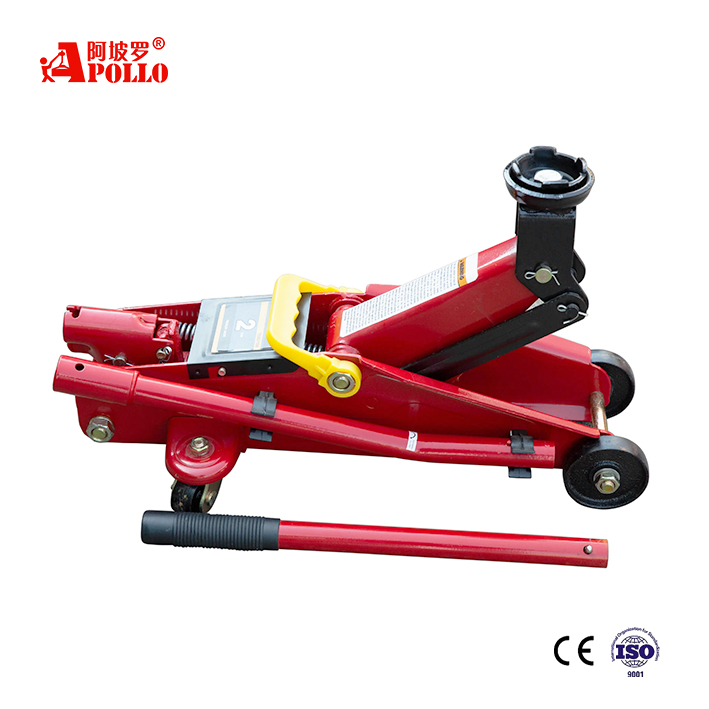
Apollo horizontal floor jacks span 2-ton, 2.5-ton, 3-ton, and 5-ton models. This range covers everything from passenger cars to light-duty commercial trucks from a single supplier, reducing the procurement complexity of managing multiple vendor relationships for different tonnage needs.
Factor 2: Minimum Height: The Number That Makes or Breaks Access
Any jack which cannot be physically placed under a car does not serve its purpose despite being strong enough. This is because of the minimum saddle height which becomes an absolute gate for the vehicle if it is larger than the ground clearance of the vehicle.
For standard passenger vehicles, a minimum height of 130-140 mm is usually sufficient. But a growing share of the fleet market, which includes sports cars, modified vehicles, low-floor delivery vans, and specialty trailers, requires substantially lower clearance. Apollo addresses this with 3-ton models featuring a minimum height as low as 80 mm, enabling access to vehicles that many competing jacks in the same capacity class cannot reach. For distributors serving body shops and performance garages, this specification alone can be the reason a customer chooses your catalog over another.
Factor 3: Maximum Lift Height: Enough Room to Actually Work
After the vehicle is raised off the ground, room is needed for movement, inspection, and tool work. The jack which raises up to 330 mm means the mechanic doing the repair is in an awkward position with restricted vision. Jack which rises to 460-550 mm creates the workspace for making a difficult task a regular one.
The Apollo 5-ton model achieves a maximum lift height of 550 mm, and the 3-ton range extends from 460 mm to 500 mm depending on the variant. When evaluating lift height, consider not just the static number but the total adjusted height, which is the sum of minimum height plus the lifting stroke, and which better reflects real-world usability.
Factor 4: Build Quality: Where Cheap Steel Hides Future Failures
Though two jacks may have the same capacity and specifications on paper, one might last longer than the other for many years. It all depends on the material and the manufacturing process used.
Floor jacks experience bending and torsion every time they lift something. Thin-gauge steel frame gets small cracks at the welding points. Smaller lift arms bend due to the weight, leading to pressure imbalance on the cylinder. Substandard seal materials harden with heat cycles and begin bypassing fluid. None of these failures announce themselves. They accumulate until the jack collapses or refuses to hold pressure.
Apollo floor jacks are built with thickened steel plate frames, reinforced box-section lifting arms, and dual-seal hydraulic cylinder systems (dust seal plus primary pressure seal). Each unit is assembled and tested in an ISO 9001-certified facility, and all models carry CE and GS certification. For an industrial buyer, these details translate into lower warranty return rates and fewer callbacks from angry end-users, which are the metrics that procurement managers actually track.
Factor 5: Safety Systems: The Feature You Hope You Never Need
Hydraulic floor jacks run under thousands of PSI of pressure. In case a seal breaks or if the user tries to lift a weight beyond the maximum rated capacity of the jack, the consequence may be devastating. The consequences will include collapse, fall of the vehicle, and potential injuries.
The only component that needs to be included in a hydraulic lifting device is an overload valve, which serves as the ultimate safety mechanism. Once the pressure reaches above the rated level, the valve allows for the bypassing of the fluid into the reservoir, thus preventing the cylinder from pressurizing further. This provides a predictable, controlled limit rather than a sudden failure.
Every Apollo horizontal floor jack is equipped with a calibrated safety overload valve, factory-set and verified per unit. This is not an optional add-on. It is a standard feature that reflects a design philosophy built around the reality that end-users will occasionally push equipment beyond its intended limits.
For distributors, the commercial advantage is straightforward: safety features reduce liability exposure and after-sale disputes. A customer who buys a jack without an overload valve and has an accident will not blame themselves. They will blame the supplier who sold it to them.
Factor 6: Maneuverability: Because the Jack Moves More Than the Vehicle Does
A floor jack is not stationary equipment. It gets rolled across uneven concrete, positioned under tight wheel wells, and stored in cramped tool corners between jobs. The rolling chassis (including the wheel configuration, caster quality, and handle ergonomics) determines how easily it integrates into a technician’s workflow.
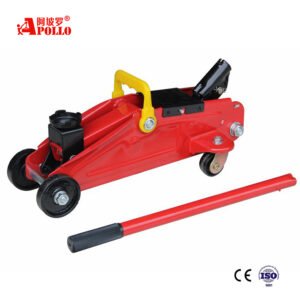
Apollo floor jacks use a four-wheel chassis design with rear swivel casters and front fixed rollers. This configuration provides straight-line stability during positioning with the maneuverability to pivot in tight spaces. The long pump handle doubles as a steering and transport lever, allowing a single operator to roll and position the jack without bending or straining. For workshops where technicians cycle through multiple bays per shift, this ergonomic consideration directly affects productivity.
3. Why the Right Supplier Matters as Much as the Right Jack
Even the best-designed floor jack loses its value proposition when it arrives late, ships without documentation, or cannot be serviced because the supplier has disappeared. In the industrial lifting equipment market, the supplier relationship is a risk management decision, not a transactional one.
The Three Costs of Choosing the Wrong Lifting Equipment Supplier
- Inconsistent quality across batches. A supplier that sources from multiple unvetted factories, or changes factories between orders without disclosure, delivers a product that looks the same but performs differently. One batch passes your customer’s inspection; the next generates a wave of warranty claims.
- Missing or fraudulent certifications. CE marks are easy to print and hard to verify. A supplier that cannot produce valid certification documentation exposes your business to customs clearance delays, rejected shipments, and liability in markets with strict workplace safety regulations.
- No continuity of supply. When a supplier drops a product line or raises prices mid-contract, the distributor who built a catalog and customer base around that product is left scrambling. Continuity matters more than a marginally lower unit price.
Apollo has manufactured lifting equipment for over 20 years, exporting to more than 50 countries. The factory operates under an ISO 9001-certified quality management system, and products carry CE and GS certification. These are not marketing claims; they are verifiable credentials that buyers can confirm before placing an order.
Because Apollo manufactures directly rather than trading through intermediaries, three things are true that are not always the case with resellers: the engineering team can customize specifications (adjusting stroke length, saddle design, or color to meet regional market requirements), the quality control chain is short enough to be real rather than theoretical, and the factory-direct pricing leaves room for healthy distributor margins without compromising on materials.
For OEM buyers, Apollo supports private-label production with custom branding, packaging, and documentation tailored to your market’s compliance requirements. This is not a bolt-on service. It is a core part of how the factory operates.
4. Your Next Step: From Selection Guide to a Tailored Solution
The six factors above (capacity, minimum height, maximum lift height, build quality, safety systems, and maneuverability) give you a repeatable framework for evaluating hydraulic floor jacks. Use them to audit your current supplier’s offering or to brief a new one.
But a guide can only take you so far. Every industrial operation has constraints that a generic article cannot anticipate: local voltage standards if you are bundling electric equipment, specific packaging requirements for container optimization, regional certification nuances, or lead-time windows driven by seasonal demand.
This is where a conversation with the manufacturer pays for itself. A 20-minute call or email exchange can surface cost-saving adjustments, such as consolidating multiple tonnages into a single container to reduce freight per unit, or specifying saddle adapters for a niche vehicle type that your competitors are not serving. These are insights that a product catalog alone will never reveal.
Apollo’s engineering and sales team works directly with industrial buyers and distributors to configure lifting equipment solutions that match the real conditions of their market, not a generic specification sheet.
Get in Touch with Apollo
- WhatsApp / Phone: +86 18989488615
- Email: sales@apollohoist.com
- Online Inquiry: https://www.apollohoist.com/contact-us/
- Website: https://www.apollohoist.com
Tell us your tonnage requirements, target markets, and any customization needs. We will respond with a tailored proposal and pricing within one business day, so you can make a confident sourcing decision without the guesswork.