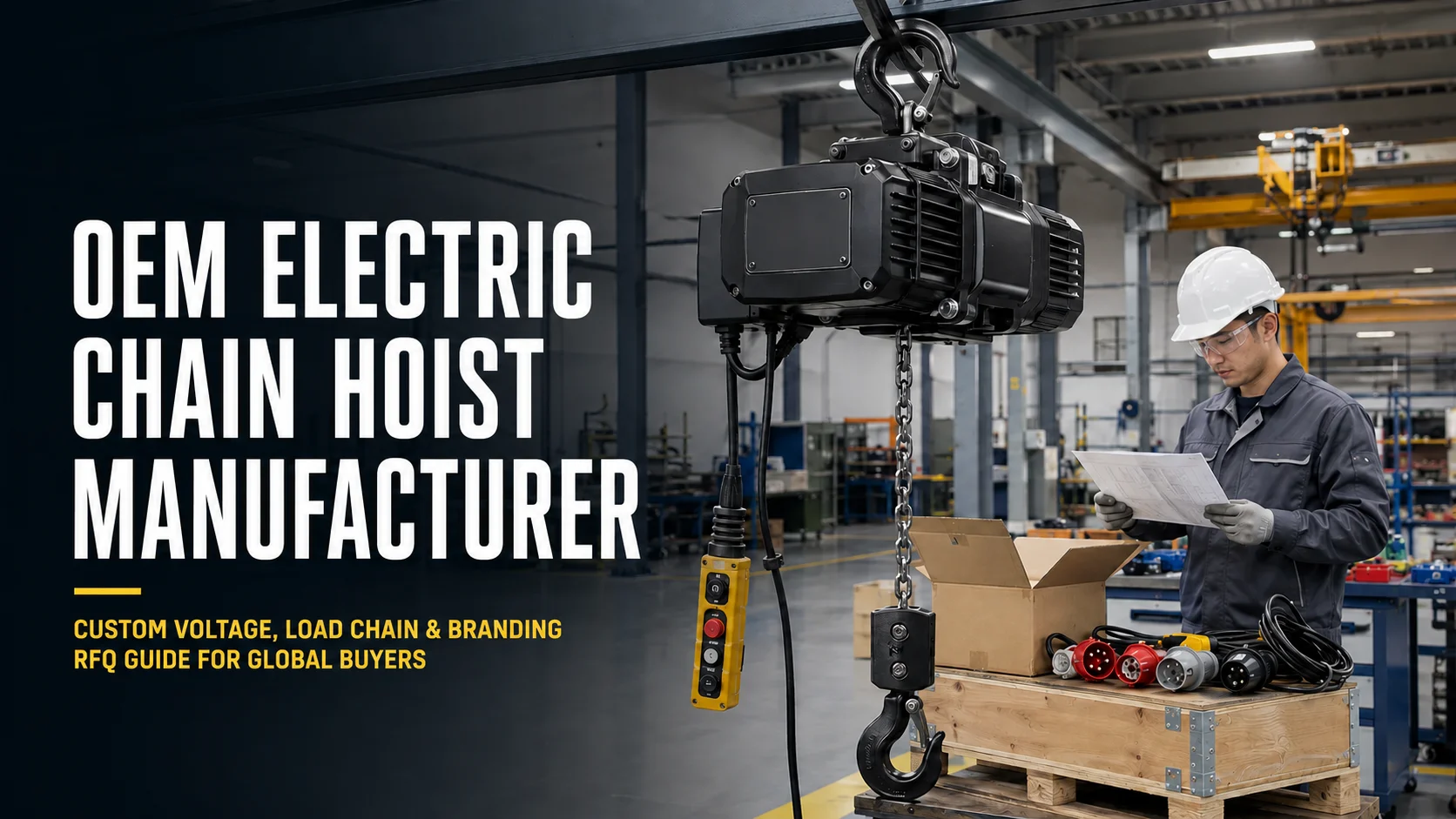
Finding the right OEM electric chain hoist manufacturer is not only about choosing a lifting capacity or asking for a lower unit price. For global buyers, the real problem is compatibility: voltage, phase, load chain grade, surface treatment, control method, branding, packaging, documentation, and after-sales support must match the end market and the working environment. A standard hoist may work for a simple warehouse job, but distributors, equipment manufacturers, maintenance contractors, and industrial buyers often need a custom electric chain hoist that can be specified, branded, packed, and supported for repeated orders.
Why Global Buyers Need OEM Electric Chain Hoists
OEM demand usually appears when a buyer is serving more than one market or when a standard catalog model does not fully match the site condition. A distributor may need private label electric chain hoists with its own logo and packaging. An equipment manufacturer may need a hoist that fits a specific lifting system. A maintenance team may need a replacement electric chain hoist that matches the existing power supply, lifting height, control style, and installation space.
The most common risk is assuming that “same capacity” means “same product.” Two electric chain hoists with the same rated load may differ in voltage, chain material, duty requirements, surface treatment, hook type, trolley compatibility, control voltage, protection needs, and packaging documentation. For B2B purchasing, these details affect installation time, user acceptance, spare parts planning, and long-term service cost.
When Standard Electric Chain Hoists Are Not Enough
A standard electric chain hoist may be suitable for general indoor lifting where the local power supply, lifting height, control method, and operating environment are already compatible. It becomes less suitable when the buyer needs custom voltage electric chain hoists for different countries, branded labels for resale, special chain surface treatment for corrosion concerns, or packaging that meets distributor and export requirements.
The first sign that OEM support is needed is a mismatch between the product page and the project reality. If the buyer must change the plug, adapt the voltage, relabel the unit, modify packaging, confirm T80 or T100 load chain, or provide market-specific instruction manuals, the purchase should be treated as an OEM electric chain hoist supplier selection rather than a simple product order.
Which Buyers Benefit Most from OEM Customization
OEM customization is most useful for importers, lifting equipment distributors, crane system builders, machinery integrators, rental fleet operators, and industrial maintenance suppliers. These buyers need repeatable specifications and consistent presentation across batches. The goal is not only to receive a working hoist, but to reduce complaints, simplify sales documentation, and make future reorders easier.
For one-time replacement orders, OEM customization may not be necessary unless the application has unusual voltage, chain, branding, or installation requirements. For wholesale electric chain hoist orders, however, custom branding, packaging, chain options, and documentation can directly affect resale value and customer confidence.
Key Specifications to Confirm Before OEM Production
Before requesting a quote, buyers should define the working condition as clearly as possible. Capacity alone is not enough. A useful RFQ should include load, lifting height, power supply, phase, frequency if required, control method, operating environment, duty expectations, installation type, branding needs, packaging method, and target quantity.
A clear specification helps the manufacturer judge whether a standard electric chain hoist, a modified model, or a fully customized configuration is appropriate.
Voltage, Phase and Local Market Compatibility
Voltage customization is one of the most important reasons buyers search for a custom electric chain hoist manufacturer. Industrial power conditions vary by market, and a hoist that works in one country may not be suitable in another. Buyers should confirm whether the application needs single-phase or three-phase power and verify the available voltage range against the product specification before production.
Incorrect voltage selection can cause installation delays, motor problems, control failures, or rejected deliveries. For importers and distributors, it can also create after-sales disputes when end users discover that the hoist does not match local site power. When preparing an OEM electric chain hoist RFQ, voltage and phase should be confirmed before logo, color, or packaging discussions.
Load Chain Grade, Surface Treatment and Working Environment
The load chain is a core safety and durability component. Buyers often ask about T80 T100 load chain electric hoist options because chain grade and treatment may affect suitability for different working environments. The correct choice depends on the load, lifting frequency, operating conditions, corrosion exposure, and manufacturer specification.
Surface treatment also matters. Galvanized, nickel-plated, blackened, or other chain treatments may be considered depending on moisture, dust, handling conditions, and appearance requirements. These options should not be selected only for cost or appearance. The buyer should explain the operating environment and confirm whether the chain material and surface treatment are suitable for the application.
Capacity, Lifting Height, Speed and Control Method
Capacity is the starting point, not the full selection standard. Lifting height affects chain length, storage, handling, and cost. Lifting speed affects productivity and load control. Control method affects operator distance, safety habits, and installation layout. If the hoist will be used with a beam trolley, crane system, workstation, or fixed hook point, the installation method should also be stated.
A common purchasing mistake is asking for “1 ton electric chain hoist” or “2 ton electric chain hoist” without explaining how it will be used. A better RFQ includes the load range, maximum lifting height, operating frequency, power supply, whether horizontal travel is needed, and whether special functions such as two-speed operation, dust-proof configuration, rain-proof configuration, explosion-proof requirements, or frequency conversion should be evaluated.
Branding, Packaging and Documentation for Distributors
For distributors and importers, private label electric chain hoist customization is part of the commercial product, not a decoration. The end user sees the logo, label, manual, carton, wooden box, and product information before judging the factory behind the equipment. Poor labeling or inconsistent packaging can make a technically acceptable hoist harder to sell.
Apollo’s electric hoist customization options include appearance color, logo, packaging, label, instruction manual, voltage, chain options, surface treatment, and function-related configurations depending on project requirements. Buyers comparing an electric chain hoist OEM supplier should check whether these items can be handled consistently across repeated orders.
Logo, Label and Instruction Manual Customization
Logo and label customization should support product identification, resale, and after-sales communication. Labels may need to reflect model, capacity, voltage, warnings, and market-specific information. The instruction manual should match the ordered configuration rather than describe a different model or generic product family.
The risk is not only visual inconsistency. If the manual, label, and actual product specification do not match, distributors may face installation questions, warranty disputes, or compliance concerns in the target market. Before production, buyers should confirm artwork files, label content, manual language, and whether the packaging layout will be approved before batch manufacturing.
Packaging Options for Wholesale and Export Orders
Packaging should be selected based on shipping route, product weight, order quantity, storage environment, and resale method. For wholesale and export electric hoist orders, buyers may need cartons, wooden cases, or other packaging methods depending on handling risk and destination requirements.
Packaging should protect the product and also support efficient warehouse identification. For distributors, this means clear model marking, quantity control, and packaging consistency. For project buyers, it means the hoist and accessories should arrive in a condition that supports fast installation and inspection.
Quality Control and Factory Testing Before Shipment
Supplier evaluation should include how the manufacturer controls assembly, performance testing, and shipment documentation. A low purchase price has limited value if the hoist creates installation delays, repeat complaints, or uncertain spare parts support.
For lifting equipment, quality control should be treated as a purchasing requirement. Buyers should ask what inspections are performed, what product information is recorded, and what support is available if the end user needs replacement parts or operation guidance.
Assembly Inspection and Performance Testing
A qualified manufacturer should inspect assembly quality and test the product before shipment. For electric hoists, this may include checking lifting capacity, operational stability, safety-related functions, and whether the finished unit matches the confirmed specification. The exact test process should be verified with the supplier and should match the ordered model and configuration.
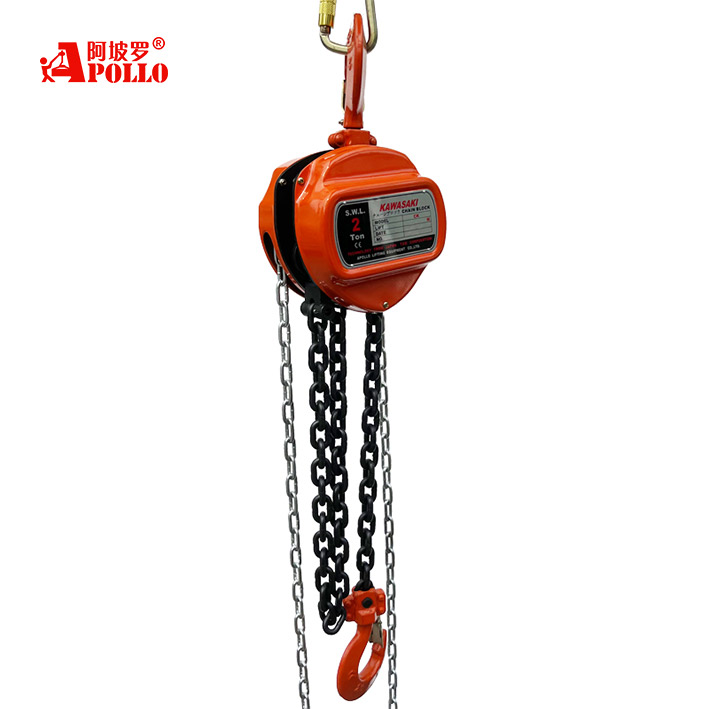
Hangzhou Apollo Lifting Equipment Co., Ltd. states that Kawasaki brand lifting machinery undergoes whole-machine assembly inspection and factory performance testing before leaving the factory. For buyers comparing an OEM electric chain hoist manufacturer, this type of inspection information is useful because it connects supplier capability with real procurement risk.
Certificates, Spare Parts and After-Sales Support
Certifications and after-sales support should be checked early, especially when the product will be resold or installed in regulated industrial environments. Apollo’s website states that the company has passed ISO9001, CE, GS and other quality system certificates. Buyers should still confirm which certificate applies to the exact product, market, and order configuration.
Spare parts and guidance also matter. If the buyer is building a distributor program or servicing multiple end users, it should confirm accessory support, warranty terms, video guidance availability, and documentation before placing the order. These details can reduce after-sales friction after shipment.
How to Choose an OEM Electric Chain Hoist Manufacturer
Choosing a manufacturer is a risk control process. A buyer should look for product range, customization capability, specification communication, testing process, documentation support, and response quality. The manufacturer should be able to discuss voltage, chain grade, surface treatment, packaging, labeling, and application conditions in practical terms.
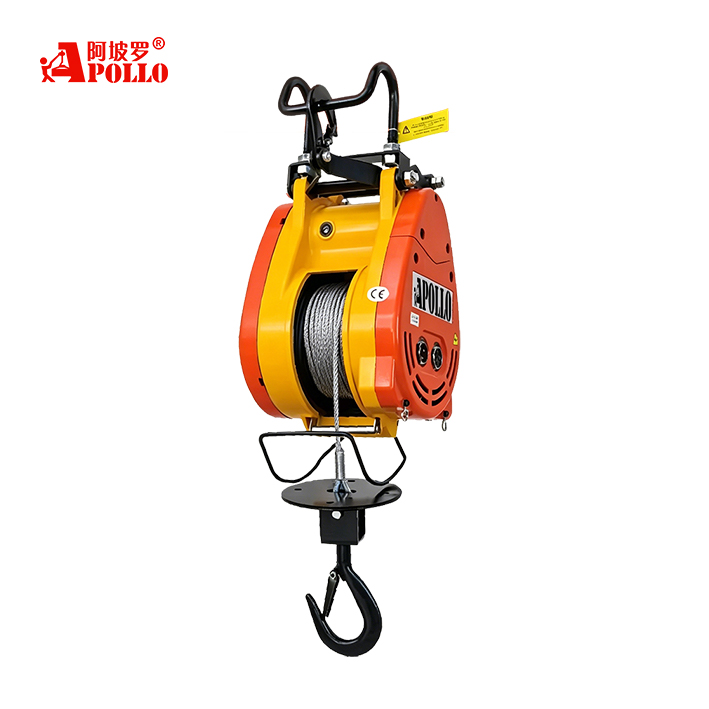
Hangzhou Apollo Lifting Equipment Co., Ltd. focuses on lifting equipment and offers electric hoists, chain blocks, lever hoists, lifting clamps, beam trolleys, winches, jacks, and related lifting products. Buyers who need a broader lifting equipment source can review Hangzhou Apollo Lifting Equipment Co., Ltd. as part of supplier screening.
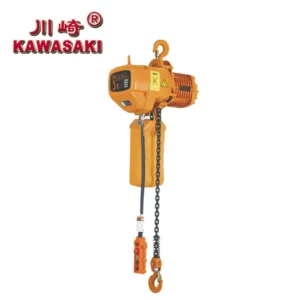
A specific model page can also help buyers check how customization information is presented. For example, KAWASAKI electric chain hoist KKBB is listed under the electric chain hoist category and includes OEM-related customization items such as branding, function options, appearance, chain, voltage, surface treatment, and packaging. Exact suitability should still be verified against the final application and product specification.
RFQ Checklist for Custom Electric Chain Hoist Orders
A useful electric chain hoist RFQ should reduce assumptions. Buyers should provide enough information for the supplier to judge configuration, cost, and feasibility.
Include the following before requesting a quote:
- Product type: electric chain hoist, hook type, fixed type, running type, or trolley-related requirement
- Rated load and lifting height
- Power supply, phase, voltage, and target market
- Operating environment: indoor, outdoor, dust, humidity, rain exposure, or special conditions
- Chain grade or surface treatment preference, if required
- Control method and speed requirement
- Branding needs: logo, color, label, manual, packaging
- Target quantity and expected order pattern
- Required certificates or documentation for the target market
- Photos, drawings, or existing model information for replacement projects
The most common RFQ mistake is asking only for the lowest price. A better approach is to request a quotation based on confirmed specifications, then compare total procurement risk: product fit, customization support, inspection, packaging, spare parts, communication, and long-term repeatability.
Conclusion
An OEM electric chain hoist order should be built around application fit, not only capacity and price. Buyers should confirm voltage, phase, chain grade, surface treatment, lifting height, control method, packaging, documentation, and supplier testing before production. This is especially important for distributors, importers, equipment manufacturers, and maintenance teams that need repeatable specifications across multiple orders.
To move from selection to quotation, prepare the confirmed load, lifting height, voltage, phase, chain requirement, operating environment, branding files, packaging preference, target quantity, drawings or photos if available, and any certificate or documentation requirements. Buyers can request an electric chain hoist quote with these details to reduce back-and-forth and receive a more accurate response.
FAQs
How do I know which electric chain hoist voltage is right for my application?
Confirm the site power supply first, including voltage, phase, and any local electrical requirements. Then verify the requested configuration against the product specification before production. Custom voltage electric chain hoist options may be available, but the final choice should match the target market and installation site.
Can electric chain hoists be customized with a private label?
Yes, private label electric chain hoist customization may include logo, appearance color, label, instruction manual, and packaging depending on the order requirement and supplier capability. Buyers should approve artwork, label content, and packaging details before batch production.
What is the difference between T80 and T100 load chain for electric chain hoists?
T80 and T100 refer to different load chain grades. The right option depends on the hoist specification, load, working environment, and manufacturer recommendation. Buyers should not choose chain grade by name alone; it should be verified against the application and product configuration.
What information is needed for an OEM electric chain hoist RFQ?
A complete RFQ should include rated load, lifting height, voltage, phase, operating environment, control method, chain requirement, branding needs, packaging preference, quantity, target market, and any photos or drawings for replacement or system integration.
Is an OEM electric chain hoist manufacturer better than a trading company?
For custom voltage, chain grade, branding, packaging, and repeated wholesale orders, working with a manufacturer can make specification control and communication more direct. The final choice should depend on customization capability, quality control, documentation, after-sales support, and whether the supplier can match the buyer’s application requirements.