1. When a Trolley Sits on the Shelf Because It Does Not Fit the Beam
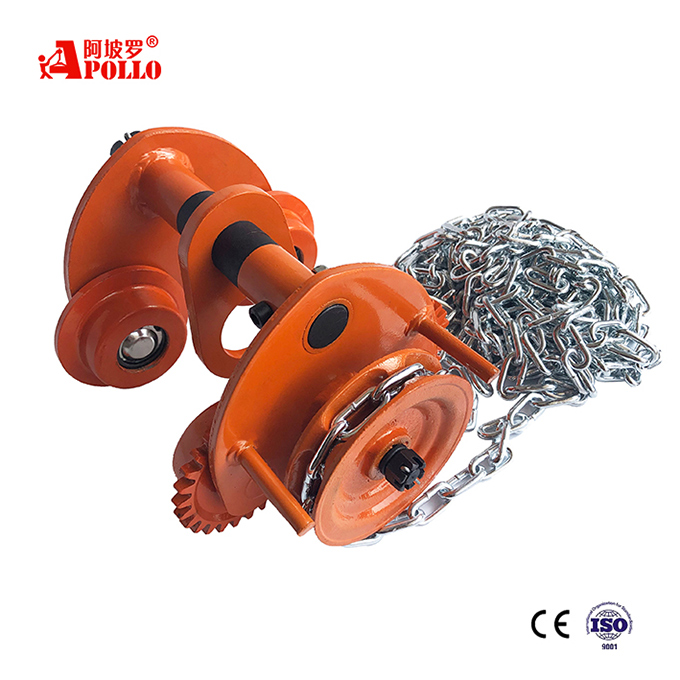
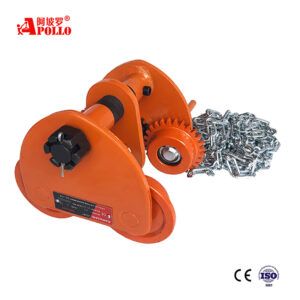
A geared beam trolley is deceptively simple. Four wheels. A hand chain. A gearbox. A suspension point for the hoist. It looks like it should just work.
And yet, the single most common procurement mistake in overhead lifting systems has nothing to do with the trolley at all. It comes before the box has even been opened; the axle length does not match the size of the beam, capacity was calculated based on the hoist and not the application, and no one bothered to see if the curve radius matched the real world monorail installation.
The end result is a trolley that cannot be mounted, an expensive re-shipping of said trolley that will cost more than the trolley itself, and the project schedule being pushed back while waiting for the correct trolley to arrive.
For engineers designing heavy duty lifters, and procurement officers relying on said designs, gear driven beam trolley selection is far from choosing the closest tonnage in a catalog. It is a multi-variable engineering decision with hard constraints. Constraints that, when ignored, do not produce a warning light. They simply prevent the equipment from fitting.
This guide walks through the four non-negotiable parameters for selecting a geared beam trolley from the Apollo product line, and explains why the decisions made at the specification stage ripple through installation safety, operator productivity, and long-term maintenance costs.
2. The Four Parameters That Determine Whether Your Trolley Fits or Fails
Parameter 1: Capacity: What the Trolley Carries, Not What the Hoist Lifts
The most persistent confusion in overhead lifting specification is the assumption that trolley capacity should equal hoist capacity. This is incorrect, and it is the root cause of a significant share of underspecification.
A chain hoist’s rated capacity describes the vertical load it can lift. But a geared beam trolley bears not only that vertical load, but also the lateral forces generated by load swing, acceleration, and uneven weight distribution. A 3-ton hoist suspended from a 3-ton trolley leaves zero safety margin for these additional forces. A margin that any competent mechanical engineer would consider unacceptable.
The industry-accepted rule of thumb is to select a trolley with a capacity rated at least 25% above the hoist capacity when the application involves frequent starts, stops, or load swinging. For applications with side-pull loading or angled lift paths, the margin should be higher still.
Apollo series beam trolleys range from 0.5 tons to 20 tons within a single family of architectural systems. The point being that if an engineer has to specify for a light assembly system (0.5 ton or 1 ton) and also for a heavy duty steel coil conveyor system (10 ton or 20 ton), he or she uses the same dimension table, the same mounting process, and the same maintenance manual. A consistency that matters when you are managing a fleet of overhead lifting equipment across multiple facilities.
Parameter 2: Beam Flange Width: The Measurement That Cannot Be Approximated
If there is one parameter that causes more failed installations than any other, it is beam flange width. The trolley wheels must roll on the inside edge of the I-beam flange. If the axle length does not match the beam width, the trolley either will not fit between the flanges, or will sit too loosely and risk derailment.
The correct measurement is the width of the beam flange at the point where the wheels will ride. Not the overall beam width, not the web thickness, and not a catalog number taken from a building plan drawn five years ago. Beam dimensions vary by manufacturing standard (European IPE beams differ from American S-shapes, which differ from Asian JIS sections), and even within a single standard, flange width changes with beam depth.
Apollo geared beam trolleys address this with dual beam-width options on the 0.5-ton through 3-ton models. The ‘a’ variant covers a narrower flange range (e.g., 68-146 mm on the 0.5-ton), while the ‘b’ variant extends to a wider range (68-203 mm). For 5-ton through 20-ton models, a single axle covers the most common industrial beam profiles (114-203 mm for the 5-ton, 122-203 mm for the 10-ton and 20-ton).
For distributors, the a/b dual option means one product line covers two beam scenarios without doubling the SKU count. A meaningful inventory optimization for regional distributors stocking for mixed customer bases.
Parameter 3: Minimum Curve Radius: The Overlooked Constraint on Curved Monorails
Straight I-beam runs are forgiving. Curved monorail systems are not. When an overhead rail curves, the trolley wheels must navigate a changing contact angle against the beam flange. A trolley that operates perfectly on a straight section can bind, skip, or derail on a tight-radius curve.
The minimum curve radius, defined as the tightest bend the trolley can negotiate without mechanical interference, is specified for every model. It is not a suggestion. Exceeding the minimum radius is safe (wider curves are easier); going tighter than the rated minimum is not.
Minimum curve radii: 0.5t model: 0.8 m | 1t: 0.9 m | 2t: 1.0 m | 3t: 1.2 m | 5t: 1.3 m | 10t: 1.7 m | 20t: 3.5 m.
For heavy industrial applications such as steel mills, shipyards, and heavy fabrication, where monorails often include curved sections to route around existing structure, this parameter must be checked before the trolley is ordered, not after it arrives.
Parameter 4: Headroom: The Dimension That Determines Whether You Can Actually Lift
The headroom of a geared beam trolley is the vertical distance from the bottom of the I-beam to the suspension eye where the hoist attaches. This dimension, labeled ‘H’ in the product drawings, directly subtracts from the available lift height of the entire system.
In a facility with a 4-meter ceiling, a trolley with 500 mm of headroom paired with a hoist that has 600 mm of body height leaves approximately 2.9 meters of usable lift. That may be adequate, or it may mean the load never reaches the height required for the operation. And no one discovers this until commissioning day.
Headroom values range from 95 mm on the 0.5-ton model to 315 mm on the 20-ton model, scaling predictably with capacity. The key takeaway for engineers: calculate total system lift height as [ceiling clearance] minus [trolley headroom + hoist body height + load height + safety margin], and verify that the result exceeds the required lift for every task on the production schedule.
3. Why the Supplier’s Engineering Matters as Much as the Trolley’s Spec Sheet
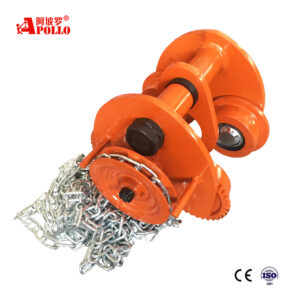
A geared beam trolley is not a commodity. Two trolleys with identical capacity ratings, identical flange-width ranges, and identical curve-radius specifications can differ dramatically in how they perform after two years of daily service. Because the specifications only describe the envelope. They do not describe the gear material, the housing seal quality, the wheel tread hardness, or the consistency of the machining tolerances.
The Three Risks of Specifying from a Catalog Alone
- Gear train quality is invisible on a datasheet. Hardened steel pinions with precision-cut tooth profiles deliver consistent engagement and minimal backlash over thousands of cycles. Soft cast-iron gears, which are common in budget alternatives, wear into slop within a year. This makes precise positioning impossible and creates a safety hazard as the trolley drifts under load.
- Gear housing sealing determines maintenance intervals. An open-gear design, where the drive mechanism is exposed to whatever dust, moisture, and debris the factory environment throws at it, requires frequent cleaning and lubrication. An enclosed housing, standard on Apollo geared beam trolleys, protects the gear train and extends service intervals by a factor that compounds across a fleet.
- Wheel tread metallurgy is a lifecycle cost multiplier. Machined steel wheels with hardened tread surfaces distribute load evenly and resist flange wear. Soft cast-iron wheels, the default in entry-level trolleys, deform over time. This creates uneven contact that accelerates beam wear and eventually requires wheel replacement. For a trolley that cycles dozens of times per day, the difference in wheel life between hardened steel and cast iron can be measured in years.
Apollo has manufactured lifting equipment for over 20 years, and the geared beam trolley product line reflects the engineering discipline that comes from two decades of feedback from distributors and end-users in more than 50 countries. The factory operates under ISO 9001-certified quality management, and all Apollo geared trolleys carry CE and GS certification: verifiable credentials that matter when your customer’s safety inspector walks the floor.
Because Apollo manufactures directly, not through intermediaries, the production team can customize geared trolley specifications for regional requirements. This includes adjusting axle lengths for non-standard beam profiles, modifying the suspension eye to mate with specific hoist brands, or applying private-label branding and documentation for OEM distributors.
4. From Spec Sheet to Installed System: Your Next Step
The four parameters above, capacity with safety margin, measured beam flange width, curve radius compliance, and total system headroom, form a repeatable engineering checklist for specifying geared beam trolleys. Use them to validate your next overhead lifting equipment order before it is placed, not after it arrives.
But a checklist can only take you so far. Real installations involve beams that were welded before the current engineering team was hired, monorail layouts that exist only in a maintenance supervisor’s memory, and load scenarios that no standard safety factor fully captures.
This is where a direct conversation with the manufacturer earns its value. Apollo’s engineering team works with specifiers to validate trolley selection against the actual conditions of the installation, not the idealized conditions of a catalog page.
Specify Your Geared Beam Trolley with Apollo
- WhatsApp / Phone: +86 18989488615
- Email: sales@apollohoist.com
- Online Inquiry: https://www.apollohoist.com/contact-us/
- Website: https://www.apollohoist.com
Share your beam specifications, required capacity, and any curve-radius constraints. We will confirm the correct model, provide a tailored quotation within one business day, and ship with full documentation. So your installation team can get to work, not get on the phone.