1. The Specification Gap: When a Catalog-Rated Hoist Fails on the Shop Floor
An electric chain hoist looks simple on a datasheet. Capacity. Lifting speed. Motor power. Three numbers that suggest the selection decision is straightforward. But every production engineer who has managed overhead lifting equipment for more than a few years has encountered the same painful lesson: a hoist that matches on paper can fail catastrophically in practice.
The failure is rarely sudden. It begins as a thermal overload trip during the third shift, when ambient temperature peaks and the motor has been cycling for seven hours straight. It continues as chain elongation that accelerates beyond the maintenance schedule. It ends as unplanned downtime during peak production, with the root cause traced back to a single missing specification: the FEM duty classification.
The selection of electric chain hoists for a manufacturing setting does not consist merely of picking the appropriate three figures. The choice process involves engineering decisions according to multiple standards including FEM/ISO Duty Ratings, EN lifting codes, chain material strength ratings, safety factor considerations, and balancing lifting height, headroom, and ceiling clearance. This guide builds a practical selection framework that addresses each of these parameters, and explains how to make the right trade-offs when they conflict.
2. The Eight-Parameter Selection Framework
2.1 FEM/ISO Duty Classification: The Parameter That Determines Whether Your Hoist Survives the First Year
Every electric chain hoist carries a rated capacity in tons. Far fewer buyers check the duty classification, and yet this single parameter determines whether the hoist is engineered for production or for occasional use.
FEM 9.511 and ISO 4301-1 define hoist duty ratings from 1Dm (light intermittent) to 4m (heavy continuous). A 1Dm or 1Cm rated hoist is intended for infrequent lifting with long intervals between cycles: repair bays, tool room, infrequent rigging. A hoist that is 2m or 3m rated is designed for production duty with predictable lift rates per hour and balanced loading spectra. A hoist that is 4m rated is intended for continuous process application, in which the motor operates for long periods under full load.
It is important to note that two hoists with similar 3-ton capacities can be in different FEM classes. Selecting a 1Dm hoist for a production line that operates at a rate of 40 lifts per hour does not constitute a performance trade-off; rather, it is an incorrect engineering selection, which will lead to motor overheating and destruction of windings within months.
Rule of thumb: If your operation exceeds 20 lifts per hour or two hours of cumulative lifting time per shift, you need a minimum FEM 2m classification. For automated or process-dependent applications, 3m or higher is non-negotiable.
2.2 Chain Grade and Safety Factor: The Metallurgy Behind EN 818-7 Compliance
Load chain for electric hoists is governed by EN 818-7, which specifies Grade 80 (G80) alloy steel chain with minimum breaking force requirements proportional to chain diameter. A 7.1 mm Grade 80 chain link carries a minimum breaking force of approximately 50 kN; a 11.2 mm link exceeds 125 kN. These are not design targets. They are regulatory minimums.
The practical meaning for a buyer: a hoist using Grade 80 chain at a 4:1 or 5:1 safety factor (per EN 14492-2 for powered hoists) has several thousand cycles of chain life before elongation reaches the 5% replacement threshold. A hoist using ungraded or lower-grade chain may reach that threshold in hundreds of cycles. Chain replacement cost is the single largest line item in electric hoist lifecycle maintenance.
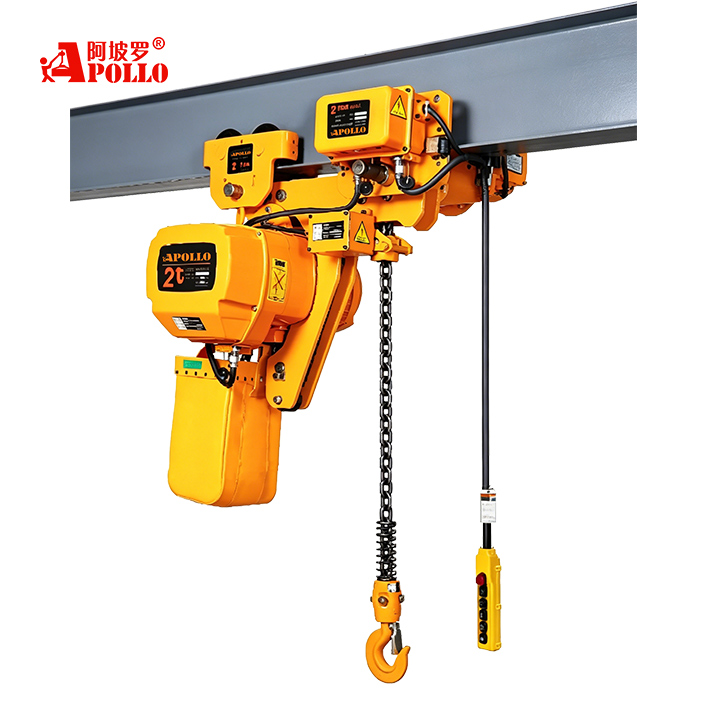
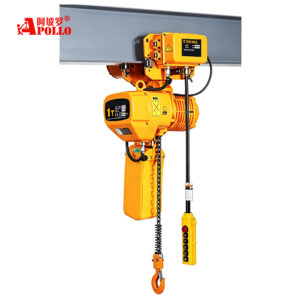
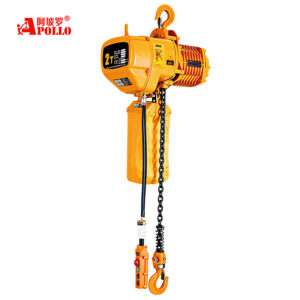
Apollo electric chain hoists use calibrated Grade 80 alloy steel load chain with diameters ranging from 6.1 mm to 11.2 mm depending on capacity. The safety factor is maintained at 4:1 minimum per EN 14492-2, with test loads verified at 125% of rated capacity on every unit before shipment.
2.3 Lifting Height and Headroom: The Two Dimensions That Define Your Working Envelope
Lifting height and headroom are separate parameters but inseparable in practice. Lifting height is the vertical distance the load hook travels from its lowest to highest position. Headroom is the distance from the bottom of the I-beam to the hook in its fully raised position. Together, they determine whether a load can be lifted to the height required by the operation.
Example: A facility has a 5-meter ceiling. The I-beam runs at 4.5 meters. A hoist with 600 mm of headroom and 3 meters of lifting height means the hook reaches from approximately 3.9 meters down to 0.9 meters above the floor. If the operator needs to lift a 2-meter-tall assembly, the maximum hook height of 3.9 meters provides only 1.9 meters of clearance above the load; the assembly cannot be lifted high enough to clear a 2-meter workstation.
- Measure the actual distance from beam bottom to the highest point the load must reach.
- Add 200 mm as a minimum safety buffer to prevent the hook body from contacting the hoist frame at full lift.
- Confirm that the required lifting height plus the hoist headroom does not exceed the available ceiling clearance.
Apollo electric chain hoists offer headroom values as low as 630 mm on light-capacity models, competitive with manual trolley setups. This means powered automation is feasible even in older facilities with constrained ceiling heights.
2.4 Lifting Speed and Dual-Speed Travel: Matching the Hoist Cycle to the Production Line Cadence
While lifting speed seems to be the most obvious parameter of performance, the combination of travel speed and chain-fall configuration actually dictates actual cycle time. In case of a hoist which lifts 6.6 meters per minute and travels at only one speed of 11 meters per minute, a bottleneck appears in the horizontal transfer stage, if the beam span exceeds 10 meters.
The Apollo series of electric chain hoists combines dual speed travel: 11 meters per minute on the approach and positioning stages and 21 meters per minute on the transfer stage on the beam. Such an approach allows the operator to move fast when needed and slow down in order to set the load precisely. Lifting speed varies depending on the capacity and chain fall configuration: it ranges between 8.8 meters per minute for light 1.5-ton hoists and 1.8 meters per minute for heavy 7.5-ton hoists. More capacity is traded for more torque. For example, a 3-ton hoist with 3 chain falls reduces speed but increases life-time.
2.5 Voltage Compatibility: The Global Power Specification That Prevents a Container of Unusable Hoists
Industrial power standards divide the world into three major regions: 200-240V/60Hz (Japan, parts of North America), 380-415V/50Hz (Europe, much of Asia, Africa), and 460-480V/60Hz (North America, parts of South America). A hoist specified for 400V/50Hz will not operate on a 460V/60Hz supply without a transformer, and in many jurisdictions, adding a transformer to a permanent installation triggers additional electrical code requirements, inspections, and certifications.
The Apollo electric chain hoist is designed with a 3-phase input range of 200V to 460V at 50Hz or 60Hz, compatible with all three major global power standards from a single specification. For a distributor importing lifting equipment to multiple countries, this eliminates the need to stock voltage-specific sub-models. For a production buyer, it removes the most common reason a hoist fails pre-commissioning inspection.
2.6 Chain-Fall Configuration: How Load Distribution Affects Speed and Chain Life
The number of chain falls determines the mechanical advantage between the motor and the load hook. A 1-fall configuration provides maximum speed but places the entire load on a single chain leg. A 2-fall configuration halves the speed but splits the load across two legs, reducing per-link stress. A 4-fall configuration at 10 tons distributes the load across four chain legs.
Selection logic: for a production line running 30 lifts per hour, prioritize the minimum chain falls that achieve your required cycle time. Chain stress per link decreases linearly with additional falls, directly extending chain replacement intervals. The speed penalty is real: 3.3 meters per minute at 2 falls versus 6.6 meters per minute at 1 fall. But for a lift height of 2 meters, the difference is roughly 18 seconds per lift. Over 30 lifts per hour across three shifts, the chain life extension from 2-fall configuration will pay for itself in reduced replacement parts within the first year.
2.7 I-Beam Compatibility and Travel Integration
The hoist lifts. Moving the load horizontally requires a trolley. The I-beam flange width must match the trolley wheel spacing, and the beam profile (IPE, HEA, W-shape) affects flange geometry. A trolley specified for a 100 mm flange will not fit a 130 mm European IPE beam, and the mis-match is often discovered on installation day.
Apollo electric chain hoists integrate directly with a motorized trolley designed for flange widths from 60 mm to 294 mm, covering the most common industrial beam profiles across all regions. The hoist and trolley ship as a single pre-wired unit, eliminating the field-integration coordination that comes with buying them from separate suppliers.
2.8 Scenario Decision Matrix: When Parameters Conflict
Real selection decisions involve trade-offs between competing requirements. Below are three common scenarios and the priority logic for resolving conflicts.
Scenario A: Automotive Assembly Line
- Requirements:high cycle count (30+ lifts/hr), moderate loads (0.5T-2T), fixed cadence.
- Priority:FEM 2m+ classification first, then lifting speed (6.6 m/min minimum), then dual-speed travel.
- Trade-off:choose 1-fall configuration despite higher chain wear; the speed gain justifies the maintenance cost in a high-throughput environment.
Scenario B: Steel Fabrication Shop
- Requirements:heavy loads (3T-10T), moderate cycles, beam spans exceeding 15 meters.
- Priority:2-fall or 4-fall configuration for chain life, then FEM 3m classification, then headroom (older facilities with lower ceilings).
- Trade-off:accept slower lifting speed in exchange for reduced chain stress; the speed penalty is offset by the time saved on fewer chain replacements.
Scenario C: Multi-Country Distribution
- Requirements:diverse end-user environments, unknown power standards, unknown beam profiles.
- Priority:wide voltage input (200-460V), broad beam flange range, full certification package (CE, EN compliance).
- Trade-off:standardize on 2-fall configurations for 1T-5T models to minimize chain-related warranty claims across unknown duty cycles.
3. Why the Manufacturer Behind the Hoist Determines Its Real-World Performance
An electric chain hoist specification sheet describes dimensions, speeds, and ratings. It does not describe the motor winding insulation class, the contactor duty cycle rating, the chain link heat-treatment protocol, or whether the factory tests every unit at 125% load or samples one per batch.
The Three Verification Questions Every Production Buyer Should Ask
- Can the supplier provide FEM classification documentation for every model in the range?A manufacturer that sells heavy-duty hoists without FEM-rated documentation is asking you to trust a marketing term over an engineering standard. Apollo electric chain hoists are FEM-classified, with documentation available on request.
- Is the load chain certified to Grade 80 per EN 818-7 with traceable material certificates?Chain metallurgy is invisible to the naked eye. Without traceability, there is no way to distinguish G80 chain from lower-grade alloy that will elongate prematurely. Apollo uses calibrated G80 chain with full material traceability.
- Does the manufacturer operate under ISO 9001 with third-party CE/GS certification, or are the marks self-declared?Self-declared CE marks are insufficient for buyers in regulated markets (EU, UK, Australia, GCC). Apollo holds third-party-verified CE and GS certification from an ISO 9001-certified facility with over 20 years of export history to more than 50 countries.
4. From Specification to Commissioning: Your Next Step
The eight parameters and three scenario templates above give you a production-grade selection framework. But every real installation involves constraints that a guide cannot anticipate: power quality fluctuations, beams installed before current electrical codes existed, or lifting points designed for equipment replaced a decade ago.
Apollo’s engineering and sales team works directly with production buyers to validate hoist specifications against actual site conditions, not idealized catalog assumptions.
Specify Your Electric Chain Hoist with Apollo
- WhatsApp / Phone: +86 18989488615
- Email: sales@apollohoist.com
- Online Inquiry: https://www.apollohoist.com/contact-us/
- Website: https://www.apollohoist.com
Share your capacity, lifting height, duty cycle, voltage, and beam specifications. We will confirm the correct configuration, deliver a tailored quotation within one business day, and help you commission a hoist that meets the demands of your production line on day one.