What a Failed Jack Actually Costs Your Workshop
A technician is about to change a truck’s brake drum. The jack is rated for the axle, the lift points are correct, the floor is level. What nobody checked is that the overload valve on this jack was never calibrated, and a seal has been weeping for weeks. Halfway up, the pressure climbs past what the system can hold, the load settles hard, and the technician is under the truck when it happens.
The bill for that day is never just the repair:
- Damaged equipment and tooling,replaced out of pocket.
- Downtime and missed jobs,billed at a rate far above the price of any jack.
- An insurance claim denied,because the equipment documentation cannot be produced.
- A safety record,that follows the workshop for years.
Every one of those costs traces back to a decision made at a purchase desk months earlier. This guide is for the people who buy and manage jacks: workshop owners, fleet managers, and safety officers. It covers how overload protection works, what to verify before you buy, and the maintenance that keeps a jack safe for its full service life.
Get a free load assessment: send your tonnage needs and the vehicles or equipment you lift to sales@apollohoist.com, and receive a matched configuration recommendation within one business day.
How Does an Overload Valve Work? The Pressure Has to Go Somewhere
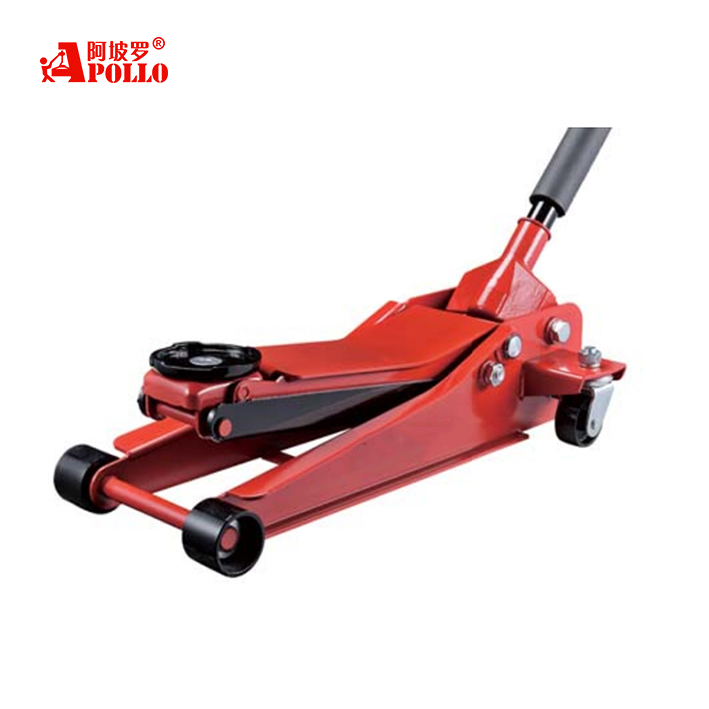
A hydraulic floor jack pumps fluid from a reservoir into a cylinder. Each handle stroke raises the pressure, and the lifting arm rises with it. Under normal operation the operator controls the pressure. The problem starts when the load is heavier than it looks, the load jams and will not rise, or an off-center load makes one jack carry far more than its share.
On a jack with overload protection, excess pressure vents back to the reservoir and the load settles in a controlled way. On a jack without it, pressure builds until a component yields: a seal blows, a cylinder wall gives, or a lifting arm bends.
A controlled settle is an incident you write up. An uncontrolled drop is an accident you report.
Economy or Industrial Grade: Which Valve Tier Do You Actually Need?
Not every jack with a price difference has a safety difference, so it is worth being straight about where the line sits. Economy jacks typically use a simple pressure relief arrangement: the opening pressure is fixed at component level with limited per-unit setting, test documentation is often unavailable on request, and the valve is generally not user-serviceable.
Industrial-grade jacks use a spring-loaded overload valve calibrated per unit, with the opening point set and verified against the rated capacity of each jack. Load test and calibration records are available with the order, and the valve is accessible for re-inspection and re-calibration.
The honest selection rule: match verification depth to duty. A well-made economy jack is adequate for light, occasional use within its rating. Industrial or fleet duty, frequent use, and heavy loads belong to the calibrated tier. If a failure means a technician underneath the load, buy the tier whose protection is documented and re-verifiable.
What Does EN 1494 Compliance Actually Require?
In Europe, mobile jacks are covered by EN 1494, which sets the safety requirements and test loads, and by the Machinery Directive 2006/42/EC for CE marking. A compliant jack is load-tested at defined multiples of its rated capacity. EN 1494 compliance is the entry ticket for industrial supply, and the test documentation is how a buyer verifies it.
Apollo floor jacks carry CE and GS certification, are load-tested at 125 percent of rated capacity before shipment, and the overload valve is spring-calibrated per unit. That is what any industrial buyer should expect and confirm in writing, not a claim unique to one brand.
The Buyer’s Five-Point Checklist
Run through these five before you order, whether the jack is for vehicles or industrial equipment:
- Capacity:at least 1.5 times your heaviest corner or end load. Apollo offers 2, 2.5, 3, and 5-ton models.
- Minimum height:must fit under the lift point without blocks. Apollo 3-ton models go down to 80 mm for low-clearance vehicles.
- Lift height:enough working clearance for the task. Apollo’s 3-ton range reaches 460 to 500 mm; the 5-ton reaches 550 mm.
- Protection verification:a calibrated valve with per-unit records. Apollo load-tests every jack at 125 percent with per-unit valve calibration.
- Service path:seals and valve service available. Apollo dual-seal cylinders have replacement seals stocked.
Unit conversion note: 1 metric ton equals about 1,000 kg. 80 mm is roughly 3.1 inches; 500 mm is about 19.7 inches.
Get a free load assessment: send your tonnage needs, the vehicles or equipment you lift, and your site conditions via the inquiry page, and Apollo’s engineers will confirm the right configuration and email EN 1494 test samples at no cost.
For Vehicle Lifting
Match the capacity to the heaviest axle corner you actually service, with the 1.5-times margin. Check the minimum height against your lowest vehicle: sports cars, modified vehicles, and low-floor vans are where an 80 mm minimum height earns its keep.
For Industrial Equipment Lifting
Plants use floor jacks for machine-base leveling, pump and motor repositioning, bearing and coupling changes, and skid alignment. Industrial loads are often rigid and eccentric, the floor may be uneven or oily, and a dropped load destroys expensive equipment, not just a bumper. For this duty, buy the verification tier: calibrated valve, documented test, accessible service.
What Actually Separates a Quality Jack from a Generic One
Nearly every heavy duty lifting equipment manufacturer can show EN certification and a CE mark. That documentation is the entry ticket, not the differentiator. What separates a jack that still holds pressure in year five from one that weeps fluid in month three is how the design is built, and the specifics are checkable:
| Feature | What it means on the shop floor | How Apollo builds it |
| Frame construction | A jack bends and twists on every lift; thin frames crack at welds | Thickened steel plate frame, stamped one-piece construction |
| Lifting arm | Undersized arms deflect under load and stress the cylinder | Reinforced box-section lifting arm, rated to 5 tons |
| Cylinder sealing | The #1 after-sale complaint is leaks; dust kills seals fast | Dual-seal cylinder: dust seal keeps contamination out, pressure seal holds fluid in |
| Chassis | Workshop jacks roll constantly over dirty floors | Four-wheel chassis with swivel casters for loaded positioning |
| Verification | A safety feature is only as good as its proof | 125% load test plus per-unit valve calibration, documented per order |
What dual-seal means in plain language: on most jacks, one seal does the holding. On Apollo jacks, a second seal in front keeps grinding dirt from reaching the pressure seal in the first place. Less contamination, longer intervals between leaks, fewer visits from the service tech.
Use It Right: The Workshop Rules That Prevent the Incident
Jack incidents are rarely a single cause. They happen when an undersized tool, an unstable surface, missing safety stands, and a skipped inspection line up at once. Selection of a compliant jack is one control; the rules below close the rest.
- NEVERwork under a load supported only by a hydraulic jack. Use rated safety stands.
- NEVERexceed rated capacity.
- NEVERuse the jack as a press, a spreader, or a permanent support.
- NEVERdump the release valve with a load on the jack.
- Lift on designated lift points, on level firm ground, with wheels blocked.
- Position the load centrally on the saddle; off-center loading reduces effective capacity.
- Lower with the release valve, controlling the descent speed.
- Take the jack out of service at the first sign of leakage, a bent arm, or a valve that will not hold.
Maintain It: The 12-Month Check That Keeps It Safe
An overload valve is calibrated at the factory, and calibration drifts. Springs relax, seals wear, contaminated fluid changes system behavior. The valve is not a fit-and-forget component.
- Every use: visual check for leaks, frame cracks, bent components, and valve function.
- Every 12 months (or per manufacturer and local rules; more often under intensive use): competent-person inspection, hydraulic fluid level and condition check, seal inspection.
- Annually for industrial duty: re-verification and recalibration of the overload valve by a competent service provider.
- After any overload or incident: full inspection before returning to service.
A jack that fails a check comes out of service until repaired. The cost of a service interval is small compared to the cost of an uncontrolled drop.
Three Questions to Ask Any Supplier
Any hydraulic floor jack manufacturer and supplier should answer these three before you order:
- Can you send the load-test and calibration records before I order?Apollo’s jacks are tested at 125 percent of rated capacity with per-unit valve calibration, and the records are available with each order.
- Is the valve serviceable, and do you stock seals?Replacement seals and valve service guidance are available for the full Apollo floor jack range.
- What certification documents ship with the unit?CE and GS certification from an ISO 9001-certified facility, with over 20 years of exports to more than 50 countries.
Apollo has manufactured lifting equipment for over 20 years, exporting to more than 50 countries, with factory-direct production and OEM support.
Get the Free Hydraulic Jack Selection Kit
Two free resources, no sign-up wall. Email sales@apollohoist.com with the subject line “Free Jack Selection Kit” and receive both files the same business day:
- Free Jack Capacity and Clearance Worksheet: a one-page worksheet with the 1.5x capacity margin, minimum-height checks, and unit conversions from this guide, formatted for your next fleet or workshop decision.
- Full Hydraulic Jack Selection PDF: the complete selection guide with the valve-tier comparison, EN 1494 acceptance checks, and inspection checklists, ready to share with your safety officer.
How to Buy from Apollo: Choose Your Channel
Workshop and fleet procurement
Get a free load assessment: tell us your tonnage needs, the vehicles or equipment you lift, and your site conditions. Within one business day you will receive a matched configuration recommendation, a formal quotation, and the EN 1494 test documents your safety officer needs.
Distributors and dealers
Stock the full 2 to 5-ton range under one certification package, with multi-product quotes that combine floor jacks with chain hoists and trolleys. Factory-direct pricing protects your margin.
OEM and private label
Custom branding, packaging, and documentation are available from the Apollo factory, built to your market’s compliance requirements.
Request EN Certificate Samples Now
- Get a free load assessment via WhatsApp / Phone: +86 18989488615
- Request EN certificate samples by email: sales@apollohoist.com
- Submit an online inquiry: https://www.apollohoist.com/contact-us/
- Browse the full product range: https://www.apollohoist.com