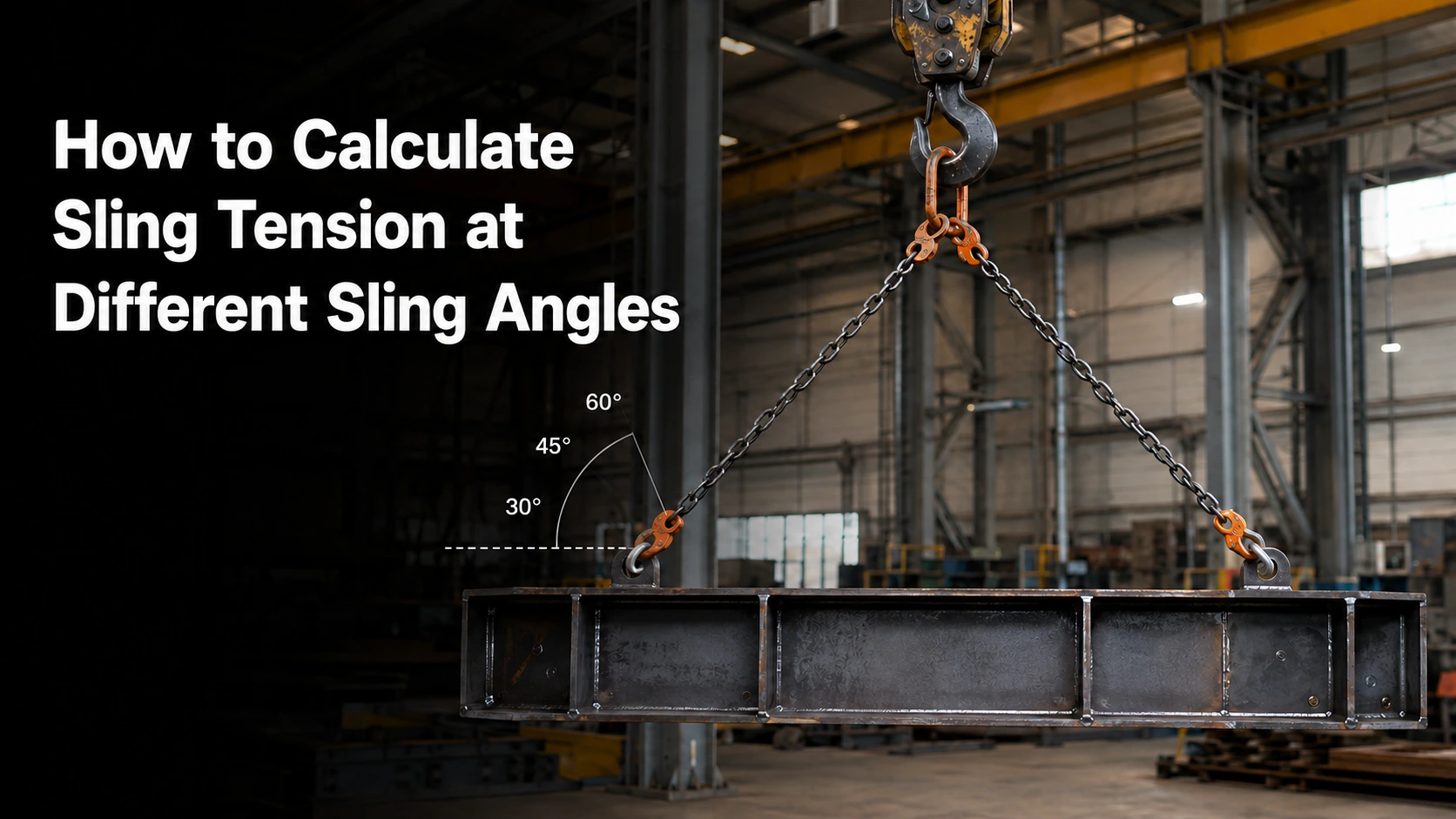
Sling angle changes the force carried by every leg. As legs move closer to horizontal, each sling must carry more tension to support the same load, while the horizontal force at the lifting points rises. The arithmetic is simple, but a safe result depends on defining the angle correctly, identifying the legs that actually share load, and checking the complete load path. Use the equations below for planning, then verify the result against rated-capacity information and a competent person’s lift review.
The core sling-tension formula
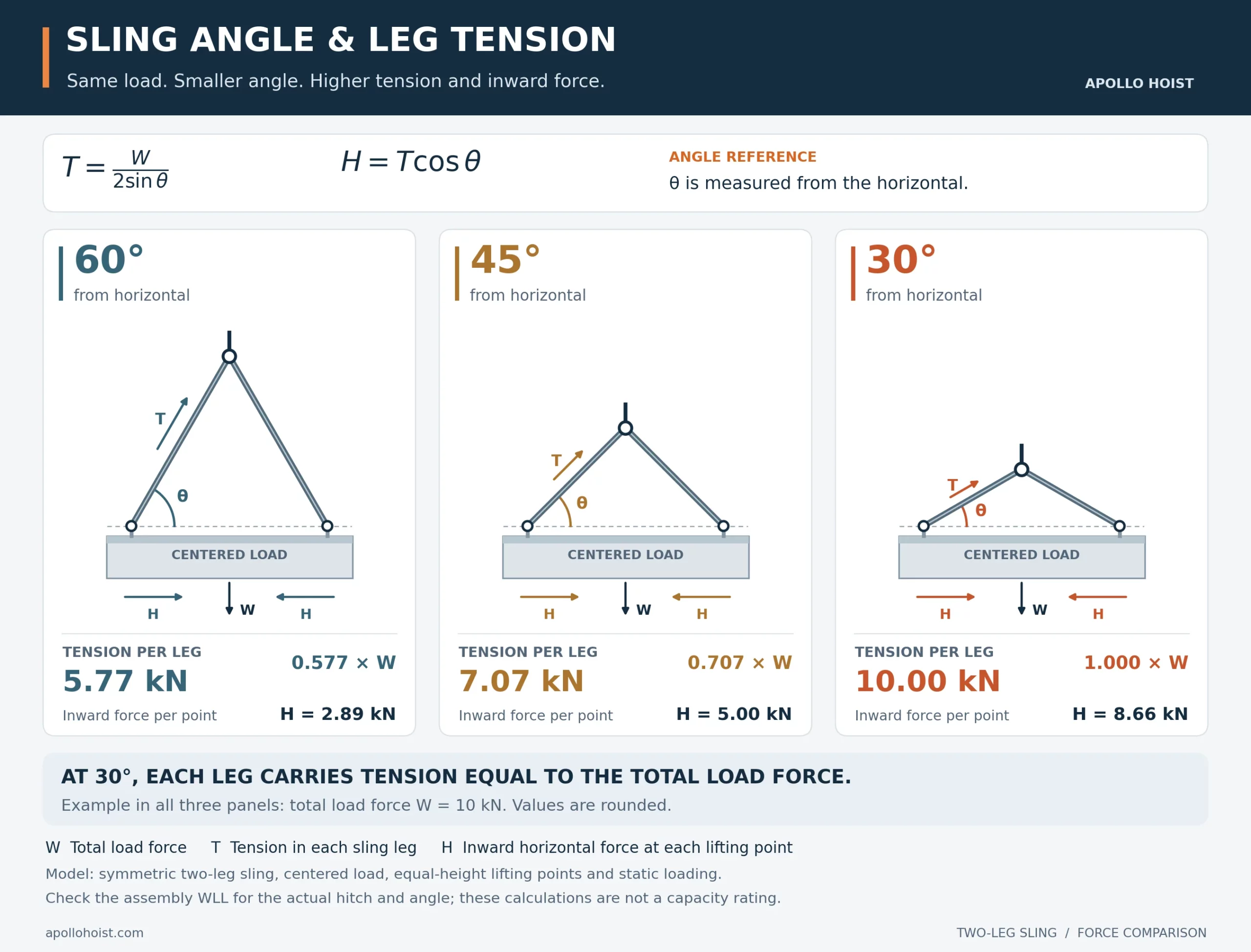
For a balanced two-leg bridle or basket arrangement, calculate tension per leg as:
• T = W / (n x sin A) when A is measured from horizontal.
• T = W / (n x cos B) when B is measured from vertical.
• W is lifted load weight; n is the number of effectively sharing legs; T is tension in one leg.
The two forms are equivalent because A + B = 90 degrees. The common field error is using a horizontal-angle table with a vertical angle, or vice versa. Write the reference line beside the angle before substituting numbers. If a sling manufacturer defines the angle differently, follow that definition and do not mix factors from another convention.
Angle factors at a glance
| Angle from horizontal | Sine factor | Tension per leg for two legs |
| 90 degrees | 1.000 | W / 2 |
| 60 degrees | 0.866 | 1.155 x W / 2 |
| 45 degrees | 0.707 | 1.414 x W / 2 |
| 30 degrees | 0.500 | 2.000 x W / 2 |
| 15 degrees | 0.259 | 3.864 x W / 2 |
These factors show why a shallow sling angle deserves attention. At 30 degrees from horizontal, each leg carries the full load divided by two, not simply half the load. At 15 degrees, the tension is nearly twice the 30-degree value. The table is a calculation aid, not a rated-capacity chart; sling material, hitch type, edge contact, fittings, and manufacturer limits still govern selection.
Worked example: a two-leg sling
Assume a 4,000 lb load is lifted symmetrically by two legs at 60 degrees from horizontal. T = 4,000 / (2 x 0.866) = approximately 2,310 lb per leg. At 30 degrees, T = 4,000 / (2 x 0.5) = 4,000 lb per leg. The load did not change; geometry doubled the force carried by each leg.
A real lift may not be perfectly balanced. The center of gravity can shift, one leg may be shorter, or connection points may not lie in one plane. Treat equal sharing as an assumption to verify, not a guarantee. When unequal loading is possible, use the engineered load distribution or design for the most heavily loaded leg.
Three-leg and four-leg arrangements
The formula can include more legs, but the number of physical legs is not automatically the number of sharing legs. In a four-leg bridle, tolerances and load geometry may leave only two or three legs carrying most of the force. Use the capacity method required by the applicable standard, sling manufacturer, and lift plan. For preliminary planning, a balanced three-leg value is W / (3 x sin A), and a balanced four-leg value is W / (4 x sin A). These idealized equations do not account for unequal leg length, torsion, friction, or a load that cannot rotate freely.
Connection, hitch, and horizontal-force checks
Sling tension is only one part of the force path. Check shackles, master links, hooks, lifting lugs, padeyes, clamps, beams, and edge protection. A choker hitch can reduce rated capacity depending on choke position and angle. A basket hitch may require restraint against slipping. Sharp edges can damage web slings or bend wire rope, while small radii can reduce effective strength. Use each component’s marked working load limit and configuration guidance.
For a symmetric two-leg lift, the horizontal component at each attachment is approximately T x cos A when A is measured from horizontal. As A decreases, the outward force rises. Confirm that the lifting lugs and load structure can resist it; a sling strong enough in direct tension can still overload a weak attachment.
Practical calculation workflow
• Weigh the load, including below-the-hook equipment supported by the slings.
• Locate the center of gravity and identify the legs expected to share load.
• Measure each leg angle from a clearly stated horizontal or vertical reference.
• Calculate per-leg tension and horizontal force at each connection.
• Apply hitch, edge, temperature, wear, chemical, and environmental limitations.
• Compare results with sling, hardware, and attachment ratings and document assumptions.
Apollo’s navigation includes lifting clamp and rigging-related categories alongside load chains and other lifting equipment. Its load-chain category can help identify compatible lifting components. Identify the actual connection hardware and sling type rather than treating a generic tension result as approval to substitute components.
Common mistakes to avoid
Do not assume a two-leg sling carries exactly half the load when the angle is shallow. Do not calculate with the sling’s angle to the floor if the chart expects the angle to the vertical. Do not use breaking strength in place of working load limit. Do not ignore spreader beams, shackles, hooks, or clamps. Do not rely on a calculator when the load is unstable, the geometry is three-dimensional, or lifting points are not rated for horizontal force.
Supplier and documentation checks
Ask for leg construction, rated-capacity tables by hitch and angle, inspection criteria, identification requirements, and derating for temperature, chemicals, abrasion, or edge contact. Apollo presents OEM and ODM service support for lifting-equipment projects; a fit check can help when a lift requires specific clamps, chains, or custom handling arrangements. The lift plan should still be reviewed by the responsible engineer or qualified lifting professional.
Conclusion
To calculate sling tension, divide the load by the number of effectively sharing legs and by the sine of the sling angle from horizontal, or by the cosine of the angle from vertical. Lower angles produce higher leg tension and greater horizontal force, so angle definition and connection capacity matter as much as arithmetic. Use the calculation to screen a lift, then verify the complete load path, rated capacities, equipment condition, and site controls before work proceeds.
FAQs
What is the safest sling angle?
There is no universal angle for every lift. A steeper angle generally reduces tension, but load, headroom, connection geometry, and rated capacity determine what is acceptable.
Should I use the horizontal or vertical angle?
Either is valid if the formula matches it. Use sine for the angle from horizontal and cosine for the angle from vertical.
Does a four-leg sling always share the load equally?
No. Tolerances, center of gravity, and geometry can leave fewer legs carrying most of the force. Follow the governing manufacturer or engineered method.
Is sling tension the same as sling capacity?
No. Tension is the calculated force in a leg. Capacity is the allowable working load for a specific sling, hitch, angle, material, and condition.
For a project-specific rigging or equipment fit check, contact Apollo’s technical team with the load weight, center of gravity, sling type, angles, connection details, lift plan, and operating environment.