The Trolley Decision Nobody Prices Properly
Picture this: a production line installs a two-tonne electric chain hoist on a manual push trolley, because the hoist was the expensive bit and the trolley looked like a bracket. Six months in, the line supervisor watches an operator walk a load forty metres down the rail by hand, stop, reposition, walk all the way back, and start again. The hoist does exactly what the spec said. The travel system is the bottleneck, and nobody priced it as one.
The trolley is almost always decided last, once the hoist has eaten the budget and the attention. That ordering buries four costs that surface later:
- Operator time per move, which grows with distance and repeats with every cycle of the shift.
- Positioning errors, because a load pushed by hand rolls in with momentum and stops roughly.
- The single-person limit, because heavy loads on a manual trolley often need two people just to get them moving.
- Safety exposure, because standing beside a swinging load is the normal posture of manual travel.
This guide is for the people who spec overhead lifting systems for production, whether they are plant engineers, maintenance managers or purchasing teams weighing up configurations. It covers what actually changes when travel is powered, how to tell whether the extra spend earns its keep, and which specifications to lock down before the order goes out.
Want a straight answer on sizing? Send your load weight, rail length and moves per shift to sales@apollohoist.com, and you will get a matched Apollo hoist-and-trolley recommendation within one business day.
What Changes When the Trolley Is Powered
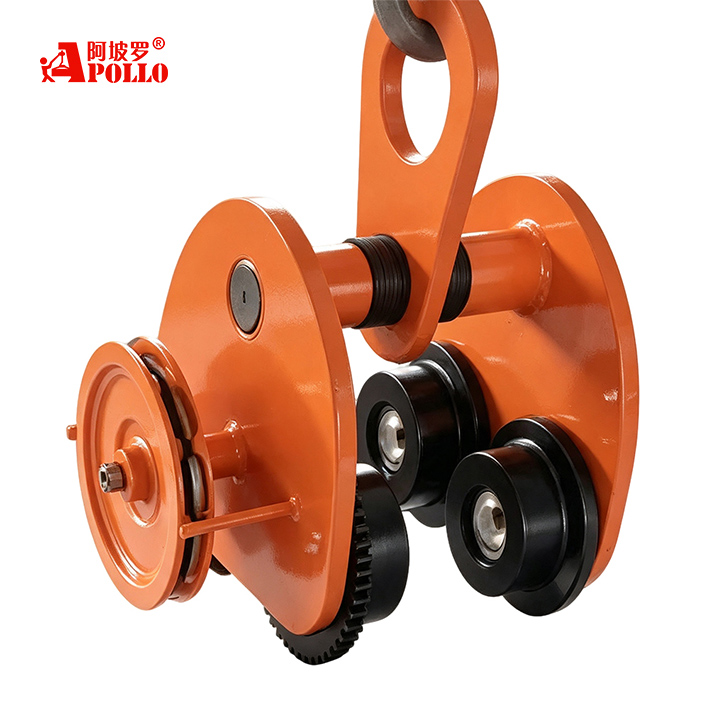
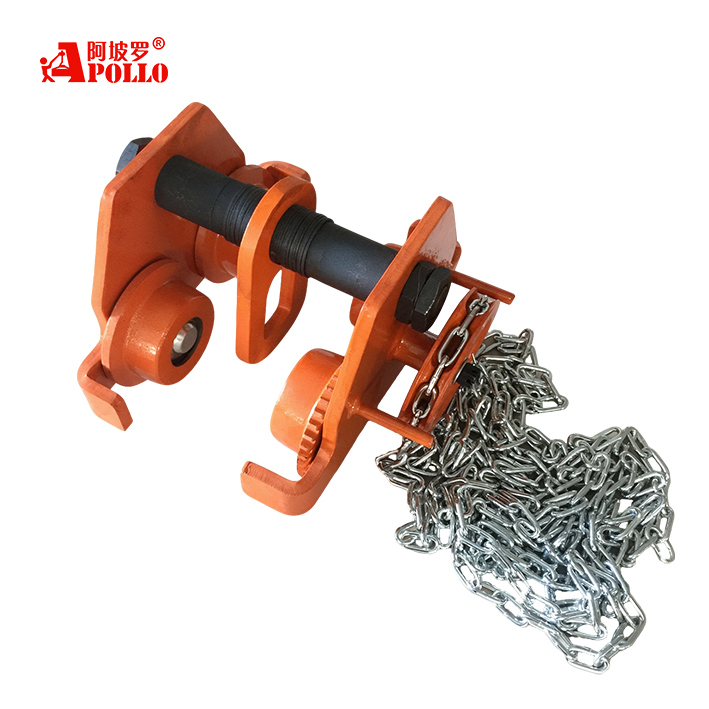
A manual trolley only moves when somebody pushes it. The operator walks alongside, pushes to get it going, pushes again to stop it, and does that all over again for every move down the rail. An Apollo motorized trolley drives the load with a travel motor, run from the same pendant or remote that already works the hoist, so the operator stays put and drives the load into position.
The travel motor on Apollo electric chain hoists runs two speeds, roughly 11 and 21 metres per minute. The slow one is for final positioning, where centimetres count and a bumping load costs you a fixture or a panel. The fast one is for the long stretches between workstations, where the load is just in transit. Getting both in one unit means the operator never has to choose between speed and control.
| Factor | Manual push trolley | Motorized trolley |
| How it moves | Operator pushes the load along the rail | Travel motor drives the load, controlled from the pendant |
| Travel speed | Depends on load weight and operator effort | About 11 m/min slow and 21 m/min fast |
| Positioning | Momentum stops the load, precision depends on the operator | Controlled creep speed for fine placement |
| Operator position | Walking beside a moving load | Standing clear, operating the pendant |
| Best for | Occasional moves, short rails, light loads | Frequent moves, long rails, repetitive cycles |
The Arithmetic of a Manual Trolley
Whether a motorized trolley pays off is really a timing question, and you can answer it with numbers from your own operation instead of a brochure. Measure three things: how long a manual move takes, how long a powered one takes, and how many moves you make per shift.
On a long rail, a move that takes an operator about 60 seconds by hand usually takes around 20 under power, once the load is attached. On a line doing 40 moves a shift, that is 40 minutes saved every shift. Multiply 40 minutes by two shifts and 240 working days and you get roughly 320 hours of operator time back per year on a single workstation, and that is the number the purchase really hinges on.
The same arithmetic cuts the other way on low-frequency rails. A maintenance bay that only moves a load four times a week will not claw back a motorized trolley through time savings, so there a manual trolley is the honest answer.
When a manual trolley is the right choice
Manual travel makes sense when moves are infrequent, the rails are short, the loads are light enough for one person to start, and the trolley mainly serves occasional maintenance rather than production. In that pattern, the extra controller, travel motor and power feed are cost with no return.
When a motorized trolley earns its place
Powered travel pays off in four situations: repetitive cycles where the same move happens dozens of times a shift; long rails where manual travel time runs into tens of seconds; precise placement where a creeping speed keeps you from damaging something; and heavy loads a single operator cannot start by hand. Most production lines hit at least two of these.
Matching travel speed to the line
Travel speed has to fit the work, not the other way around. A line that cycles every ninety seconds needs travel fast enough to finish the move inside the cycle, with time left for the lift. When the cycle is tight, high speed covers the distance and low speed does the final placement, which is why a dual-speed travel motor is standard on Apollo electric chain hoists, not an option.
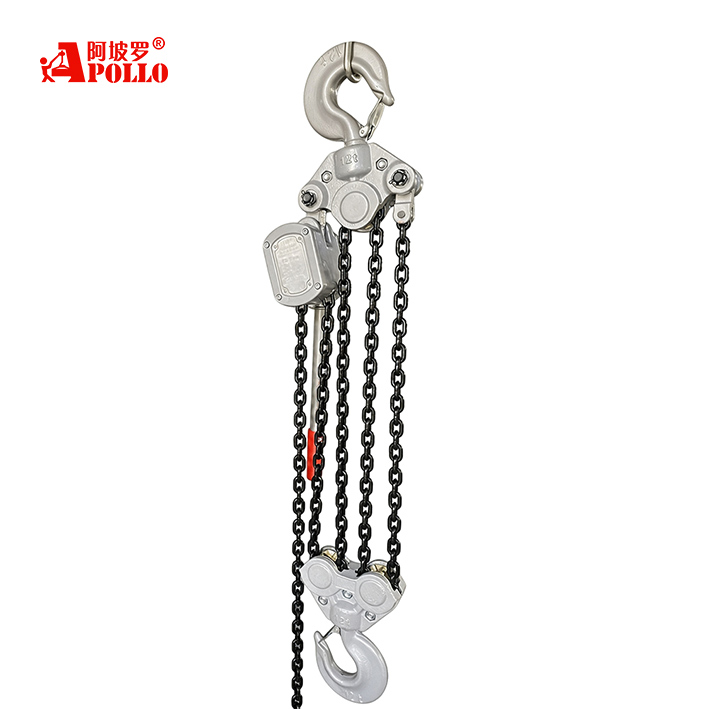
The Apollo electric chain hoist range covers 0.3 to 10 tonnes with integrated motorized trolleys, listed on the electric chain hoist category page (https://www.apollohoist.com/product-category/electric-hoist/electric-chain-hoist/).
Send your rail length, cycle time and moves per shift through the inquiry page, and Apollo’s engineers will tell you whether powered travel pays off and which configuration fits, at no cost.
What Else to Check Before You Order
Travel is one spec among several that decide whether a powered overhead system goes in clean and runs for years. Four more are worth pinning down before you order.
Voltage and frequency compatibility
Industrial power standards vary by region. North American plants commonly run 460 volts at 60 hertz, European plants 400 volts at 50 hertz, and Asian plants 380 or 220 volts at 50 hertz. Apollo electric chain hoists take three-phase input from 200 to 460 volts at either 50 or 60 hertz, with the lift motor rated at 1440 RPM, so a single specification serves all three regions without a transformer. If you want the detail on how speed and motor behaviour differ between 50 and 60 hertz, this guide to 50Hz and 60Hz electric hoists (https://www.apollohoist.com/product-news/50hz-vs-60hz-electric-hoists-speed-and-voltage-guide/) covers it.
Headroom
Headroom is a hard constraint, not a preference. An Apollo powered trolley stacks extra structure above the load, and on the light models the total hoist height can drop to about 630 mm, which is what lets powered units into older buildings built around manual chain hoists. Measure from the underside of the beam to the highest point of the load, then compare it against the hoist height plus the hook reach.
Beam flange width
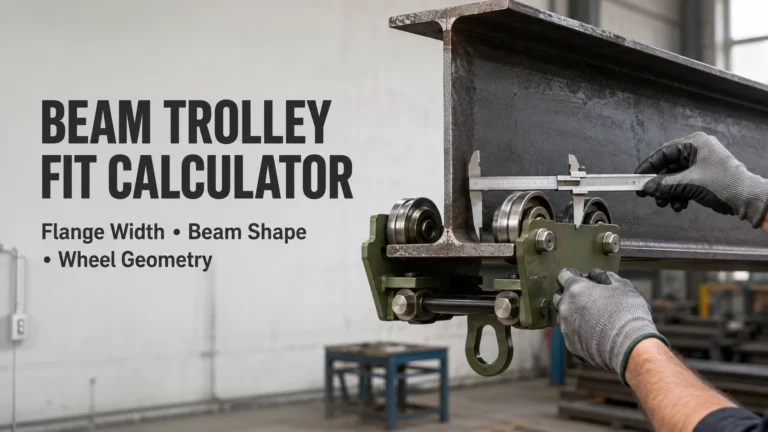
Flange width decides whether the trolley wheels sit properly on the rail. Across the Apollo range it runs from about 60 to 190 mm on light models, up to 100 to 294 mm on heavy ones. Measure the flange edge to edge where the trolley will actually work, in millimetres, and not at the end of the beam.
Chain fall configuration and capacity
Apollo models up to three tonnes are usually built with a single chain fall for faster lifting; the heavier ones use two or four falls to split the load and reach higher capacities with the same chain diameter. Let the configuration follow the load, not the other way around, and keeping the same series architecture across falls means spares and service procedures stay consistent.
What Separates a Quality Electric Hoist from a Cheap One
Almost any heavy-duty lifting equipment maker can show you certification documents. That is the entry ticket, not the differentiator. On a powered overhead system, five differences decide whether the unit is still running the line in year five.
- Fully integrated powered travel, where the lift and travel motors are designed as one unit rather than a hoist and a trolley from different suppliers bolted together on site.
- Dual-speed travel at roughly 11 and 21 metres per minute, so one unit covers fast transit and fine placement.
- Per-unit load testing, with every Apollo hoist run to 125 percent of rated capacity before it ships and the test documentation issued with the order.
- Wide voltage input from 200 to 460 volts at 50 or 60 hertz, which drops regional variants and transformers out of the spec.
- Compact headroom that rivals manual trolley installations, so powered systems fit facilities that were never designed for them.
Three Questions to Ask Any Supplier
Before you order from any electric chain hoist supplier, get these three answered:
- What is the travel speed in both directions, and does it fit my cycle time? A single-speed trolley either crawls slower than the line or arrives too fast to position. Apollo quotes both travel speeds and checks them against cycle times.
- Will the hoist run on my plant voltage without a transformer? That is the difference between an installation and a project. Apollo hoists accept 200 to 460 volts at 50 or 60 hertz.
- What test documentation ships with the unit, and what spares are stocked? Both answers decide how fast the line comes back from wear. Apollo tests every unit at 125 percent of rated capacity and stocks spares across the range.
Apollo has built lifting equipment for more than 20 years, exports to over 50 countries, and runs factory-direct production with OEM support. The full range is on the product overview page (https://www.apollohoist.com/product/).
How to Buy from Apollo: Choose Your Channel
Production and project procurement
Get a free load assessment: send your rail length, cycle time, load weight and plant voltage. Within one business day you will get a matched Apollo hoist-and-trolley configuration, a formal quotation, and the test documentation your engineering team needs.
Distributors and dealers
Stock a single voltage range that serves plants across regions, with models from 0.3 to 10 tonnes, and combine Apollo electric chain hoists, manual hoists and trolleys in one multi-product quote. Factory-direct pricing protects your margin across the order.
OEM and private label
From the Apollo factory you can get custom branding, packaging and documentation, built to the compliance requirements of your market.
Request EN Certificate Samples Now
- Get a free load assessment via WhatsApp / Phone: +86 18989488615
- Request EN certificate samples by email: sales@apollohoist.com
- Submit an online inquiry: https://www.apollohoist.com/contact-us/
- Browse the full product range: https://www.apollohoist.com