Two numbers buyers assume are the same
A pipe fitter needs to close a stubborn gap between two flange faces on a large line. The lever hoist is a 1.5 tonne unit, the pull feels easy, and the flange closes. The anchor is an eye bolt that was selected because the spool weighs under a tonne. Nobody notices the problem that day. It appears months later, when the same eye bolt is found bent and the pull geometry is finally drawn on paper: the line ran at a wide angle, and the eye bolt was carrying more than the weight it was chosen for.
That story repeats because of one assumption: that the lifting rating and the pulling capacity of a lever hoist are the same number read in two directions. They are not, and the difference is not hidden in the tool. It is hidden in the geometry of the pull.
Pulling jobs get under-planned for four reasons:
- The lifting rating is read as a pulling rating, without checking what the tool is being asked to do in that direction.
- The anchor is chosen for the weight being moved, not for the tension the line will actually carry.
- The geometry is never drawn, so nobody calculates the load the angle creates.
- Progress is judged by feel, and a pull that feels easy is assumed to be a pull that is within limits.
This guide is written for riggers, pipe fitters, maintenance supervisors, and the buyers who specify manual lifting equipment for their crews. It separates lifting capacity from pulling capacity in plain language, shows how a pull multiplies the load on an anchor, and gives a five step method that keeps a horizontal pull inside its rating.
Get a free load assessment: send the pull direction, the anchor points, and the load you are moving to sales@apollohoist.com, and receive a rigging plan review within one business day.
What lifting capacity actually means
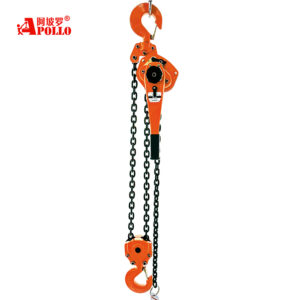
On a lever hoist, the capacity on the badge is a lifting rating. It describes a vertical lift, with the unit hanging from a hook above the load, and it is the figure a site inspection looks for on the plate. The supporting parts are sized around that figure: an Apollo lever hoist at 0.75 tonnes is proof loaded at 1.125 tonnes before it leaves the factory, which is 1.5 times the rated load, and the range is built to a 4:1 safety factor, which means the chain and the load plates are sized to withstand four times the load they are sold to lift.
That vertical rating rests on four design decisions that stay the same whichever direction the load moves:
- A double-pawl brake, so two independent locking elements share the holding function rather than one.
- Heat-treated load plates and gear train, so tooth engagement stays precise under the repeated shock loading that lever operation produces.
- Forged hooks with integrated steel safety latches, meeting the latch requirements of EN 13157.
- A high-tensile alloy load chain from 6 mm to 10 mm, built for the combined tensile and bending stress of lever-driven work.
What changes when the load is pulled sideways
The line tension is not the weight
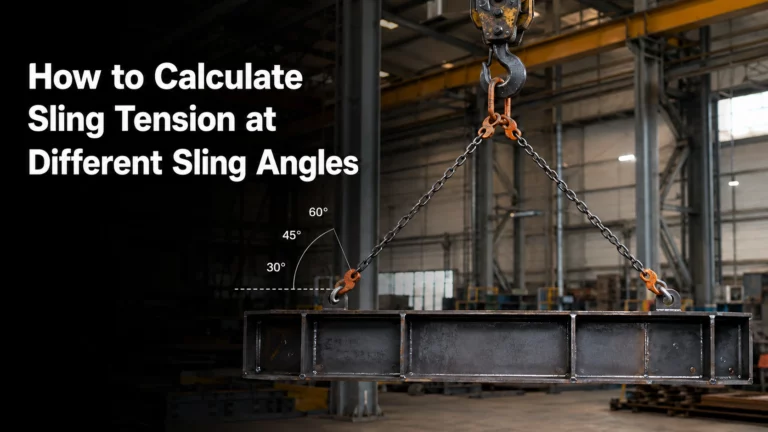
This is the part that catches experienced crews. When a line runs between two points at an angle, the tension inside the line is higher than the weight being moved, and the geometry decides how much higher. The arithmetic is easy once it is written out. Two legs at an included angle of 120 degrees put the full load on each leg: a 1,000 kg load means 1,000 kg of tension in each leg. At an included angle of 90 degrees, each leg carries about 707 kg. At 60 degrees, each leg carries about 577 kg. The load never changed. Only the angle did, and the angle was never measured.
In practice this means a lever hoist used for pulling should be chosen from the tension you calculate for the pull, not from the weight printed on the load. If the arithmetic puts more than the rated capacity on the line, the answer is a different rigging arrangement or a larger unit, not a harder pull on the lever.
The anchor takes the same tension or more
Whatever tension is in the line is also in the anchors at both ends, and an eye bolt, a beam clamp, or a strap is rated for a direction as well as a load. A vertical pull on an eye bolt and a sideways pull on the same bolt are not the same job, and an anchor that was selected for the weight of a spool will not necessarily carry the tension of a pull. Check the anchor against the calculated tension, check the direction it was rated for, and check the structure it is fixed to. In most incident write-ups the tool was inside its rating and the anchor was not.
The mechanism works differently when it pulls
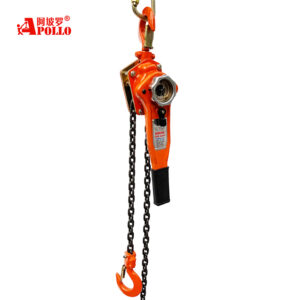
A lever hoist is the one manual tool that is designed for lifting and pulling work in the same unit, with a working range that runs from a vertical lift through to a near-horizontal pull rather than at any angle the operator can imagine. Two features make that practical. The free-wheeling mechanism lets the chain be adjusted to length without ratcheting it through the drive, so setting up a pull takes seconds instead of minutes. The 360 degree rotating lever handle lets the operator find a usable pulling position in a space where the body cannot be repositioned freely, which is often the real constraint in a pump room or a shaft.
How to plan a pull in five steps
- Write down what is being moved and in which direction.A pull that is described as sideways is not a direction; it is a start of a conversation.
- Draw the geometry and calculate the line tension.Two anchor points, one included angle, and the arithmetic from the section above. If the angle is wide, expect the tension to exceed the weight.
- Check the anchor for the tension, not the weight.Include the direction it was rated for, the fixing into the structure, and any sling or shackle in the path.
- Choose the capacity from the calculated tension.Keep a margin rather than working on the rating, and step up a size if the total lands on a limit.
- Apply the force in stages and watch the load.A pull that stops responding to the lever is usually a load that has caught on something, not a tool that needs more force.
Choosing the size: capacity, hand force, and the person at the lever
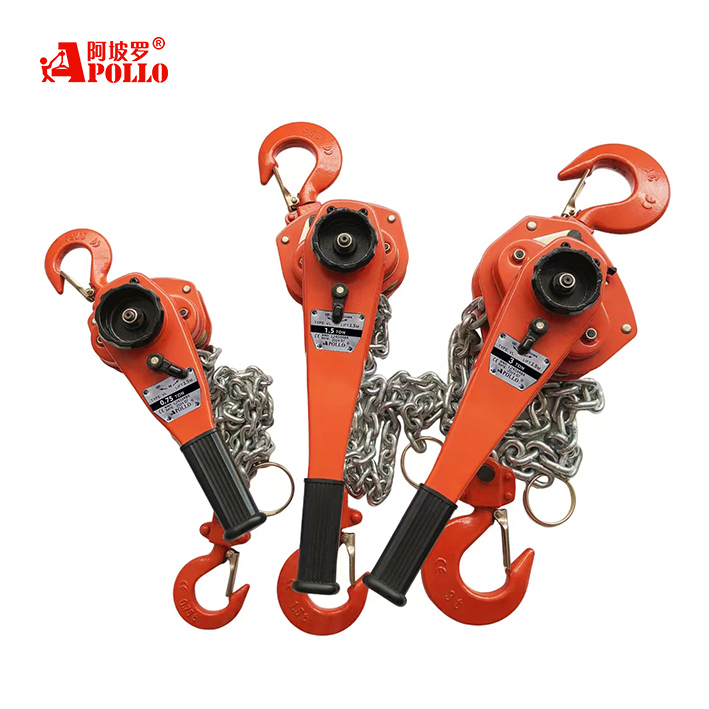
The lever hoist range covers five capacities, and the number that decides which one a crew can actually use is not the capacity but the force needed at the handle.
| Capacity | Test load | Maximum hand force | Net weight |
| 0.75 t | 1.125 t | 140 N | 7.5 kg |
| 1.5 t | 2.25 t | 220 N | 11.5 kg |
| 3 t | 4.5 t | 320 N | 21 kg |
| 6 t | 9 t | 340 N | 31.5 kg |
| 9 t | 13.5 t | 360 N | 47 kg |
Read the third column as the real selection tool. A person working in a comfortable standing position can hold a steady pull of roughly 200 newtons, and the figure falls quickly when the handle has to be worked at chest height or in a confined space. A 6 tonne unit that needs 340 newtons at its rating is a two-person tool in practice, whatever the badge says, and the same is true of the 3 tonne unit at 320 newtons. If your crew is one person in a shaft, choose the capacity from the force column and accept a larger unit working below its rating. The weight column matters for the same reason: a 47 kg unit has to be carried to the job by someone.
Using one tool for lifting and pulling
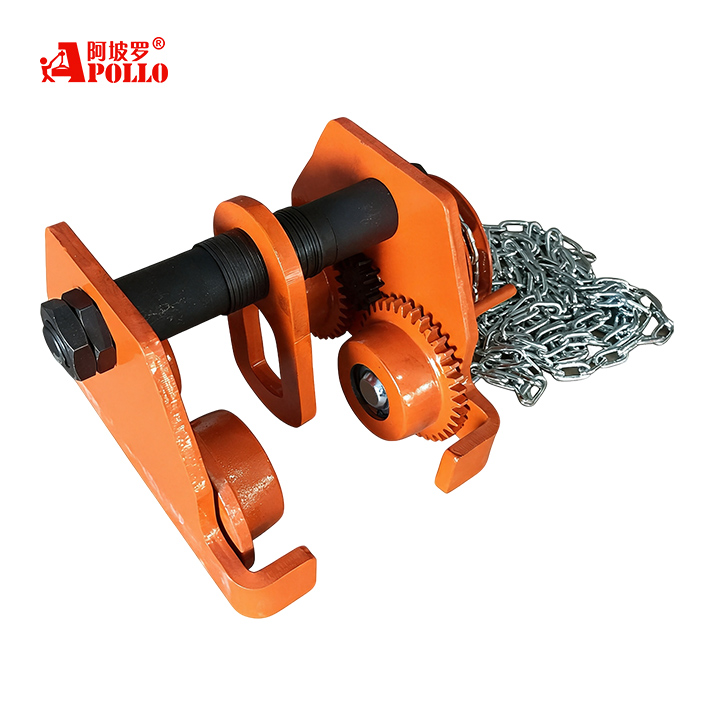
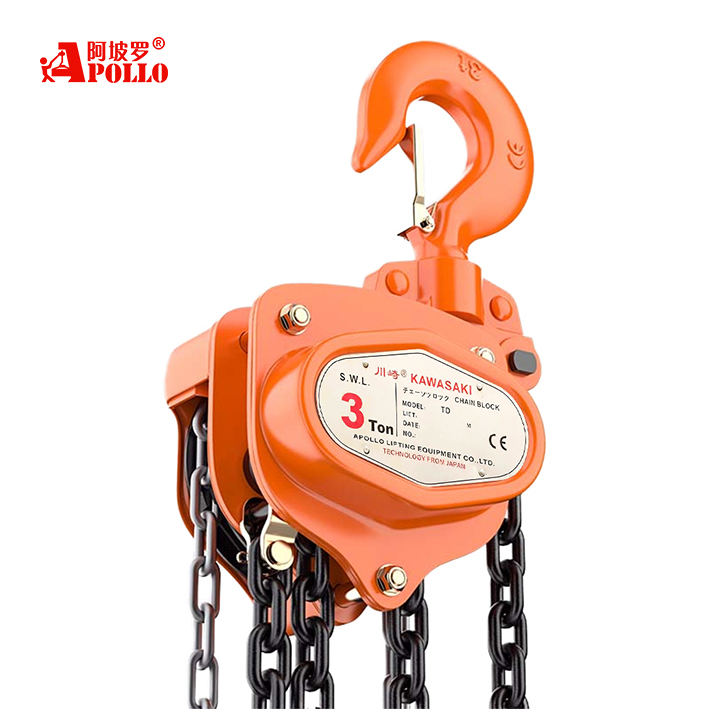
Most sites need both directions on the same job, which is why the lever hoist and the chain hoist are usually bought together. A hand chain hoist lifts vertically, holds the load on its brake while the crew works, and does it with a pull that stays manageable at high capacities. A lever hoist does the pulling, aligning, and tensioning that a chain hoist cannot do, and it does it without power. Stocking both from one supplier keeps one inspection procedure, one spare parts list, and one documentation set for the whole manual lifting fleet. If your work includes spaces where a chain hoist cannot even be hung, the rigging notes in the confined space guide (https://www.apollohoist.com/product-news/confined-space-rigging-how-apollo-lever-hoists-solve-it-apollo-lifting-equipment-manufacturer/) cover the setups that work, and the vertical side of the same fleet is covered on the chain hoist category page (https://www.apollohoist.com/product-category/manual-hoist/chain-hoist/).
Why the supplier matters as much as the rating
Two lever hoists with the same badge can behave very differently after a year of pulling work, because pulling loads the tool in a way that shows up the quality of the internal parts. Every heavy duty lifting equipment manufacturer can quote a tonnage, so the specification has to be read further down the page. Ask any lever hoist supplier three questions before you order: whether the brake is a double-pawl design or a single pawl, what the proof load is for the size you are quoting, and whether the free-wheeling mechanism is fitted as standard. The answers separate a tool that will still hold a load in five years from one that is rebuilt every season.
Apollo is a manual lifting equipment manufacturer that has built lifting equipment for more than 20 years, exports to over 50 countries, and holds ISO9001, CE, and GS. The lever hoist range is produced in the Apollo factory from 0.75 tonnes to 9 tonnes, with a double-pawl brake, a 4:1 safety factor, and EN 13157 compliance across the series, which means one safety documentation package covers a fleet rather than one unit. Crews that also work with chain hoists, wire rope hoists, and beam trolleys get the same documents and the same spare parts list from the same factory. As an established industrial lifting equipment supplier working with distributors, contractors, and OEM brands, Apollo prices factory direct and supports private label programmes without an extra layer between the factory and the customer. The full range, with hand force and weight figures for every capacity, is listed on the lever hoist category page (https://www.apollohoist.com/product-category/manual-hoist/lever-hoist/).
How to buy from Apollo: choose your channel
Plant, shutdown, and project procurement
Get a free load assessment: send the pull or lift direction, the anchor points, the load, and how many operators will work the lever. Within one business day you receive a matched lever hoist recommendation, a rigging review, and the conformity documents your inspection team needs.
Distributors and dealers
The 0.75 tonne to 9 tonne range covers the tonnages contractors actually ask for, and combining lever hoists with hand chain hoists in one order keeps one documentation set for the customer. Hand force and net weight figures are published for every size, which makes the range easier to quote without a technical call.
OEM and private label
Custom branding, packaging, and documentation are produced at the Apollo factory, built to the compliance requirements of your market.
Request EN certificate samples now
- Get a free load assessment via WhatsApp / Phone: +86 18989488615
- Request EN certificate samples by email: sales@apollohoist.com
- Submit an online inquiry: https://www.apollohoist.com/contact-us/
- Browse the full product range: https://www.apollohoist.com