Three parts that stop a lift without a bang
A maintenance technician services a compact electric hoist on a mezzanine. It lifts cleanly all week, then on Monday the hook rises, stops 40 mm short of the limit, and will not go higher. Nothing is smoking, nothing is loud, and the load is still on the hook. He lowers it, tries again, and the same thing happens at a slightly different height.
Wire rope hoists rarely announce themselves. A rope degrades wire by wire, a brake holds a little less each month, and a limit switch drifts out of adjustment by the width of a washer. All three show up as a lift that behaves differently rather than as a machine that has failed, which is why they get found late.
This guide is written for the people who keep compact hoists working: maintenance planners, workshop supervisors, site safety officers, and the distributors who support them. It covers the three checks that matter most on a 100 kg to 750 kg wire rope unit, how to run each one, and what to write down.
What the rope tells you first
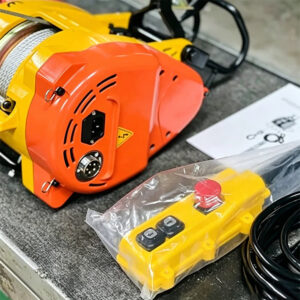
The rope is the part that carries everything, and it is also the part most often judged by eye. A visual pass catches the obvious defects: broken wires standing proud of the strand, a crushed or flattened section where the rope has been pulled over an edge, a kink that will never straighten, and rust blooming between the strands. Those are stop signs. None of them improves with another week of service.
Three measurements sit behind the visual pass, and all three need a datum taken when the unit is new:
- Diameter, measured with a calliper at three points along a working section. The rope thins as the core settles and as outer wires wear on the sheave, and the rope standard your market works to sets the discard figure as a percentage of nominal.
- Broken wire count, counted over a defined length rather than over the whole rope. The count that triggers replacement depends on the rope construction, which is why the number belongs in the manual rather than in a rule of thumb.
- Termination, checked at the drum end and at the hook end, where a thimble, a wedge socket or a ferrule sits. A termination that has slipped shows as a change in the tail length, and it is the failure mode that gives no warning at all.
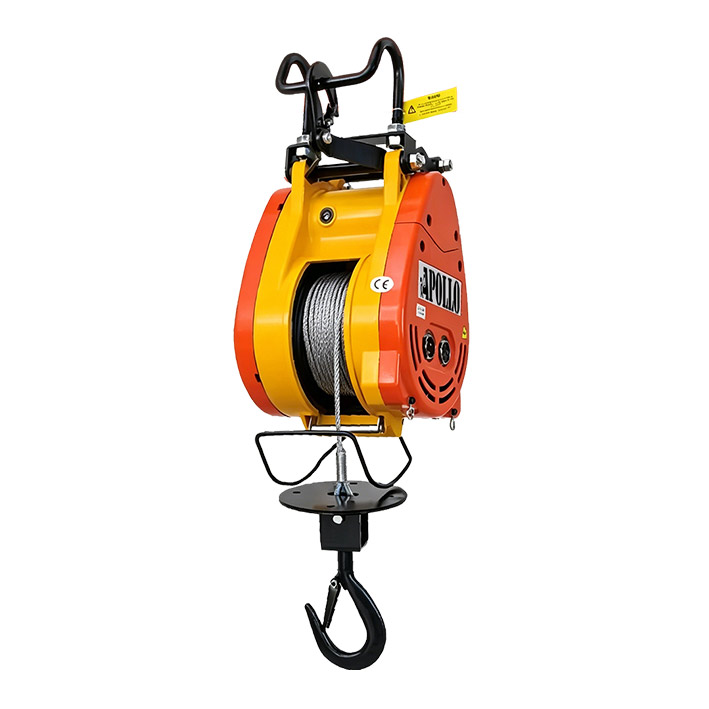
The Apollo compact range carries 5 mm, 6 mm and 8 mm rope in standard lengths from 21 m to 50 m, with rated lifting heights of 20 m, 29 m and 49 m. The longer configurations are where rope condition matters most, because more rope means more sheave passes and more drum wraps, and the same defect that is harmless on a 20 m unit becomes a repeated stress point on a 49 m one.
The dual brake, and the two minute test
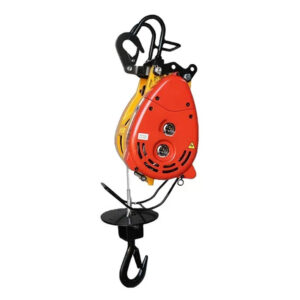
Apollo compact hoists carry two brakes rather than one: an electric brake that stops the load on a normal command, and a mechanical brake that holds it when power is lost. The arrangement means a single component cannot drop a load, and it also means a brake test has to check two behaviours instead of one.
The quick test needs a light load rather than a rated one. Lift it a metre, release the button, and watch. A load that holds position passes. A load that settles by a few millimetres once and then stops is normal take-up. A load that keeps moving, even slowly, is a unit to take out of service rather than to schedule.
The second behaviour is the one crews skip: what happens when the supply goes. Test it deliberately, with a light load at low height and nobody underneath. The command should stop the lift and the mechanical brake should take the load without a drop. A unit that passes the first test and fails the second is holding on the electric brake alone, and that is the condition the second brake exists to prevent.
Limit switch and anti-reverse: test both directions
On an Apollo unit, the upper limit switch stops the hook before it reaches the drum, and the lower switch stops it before the rope runs out of wraps. Both drift, because both are set against a moving part that wears, and both are only noticed when they are reached.
Test them weekly, at no load, in this order. Raise the hook slowly until the switch trips, then confirm the hoist refuses to raise further and will still lower. Repeat at the bottom. A switch that stops the movement but leaves the button unresponsive in both directions is a different problem from a switch that never trips, and the two point at different parts.
The anti-reverse function that Apollo fits belongs in the same weekly pass. What it blocks depends on how the control is built, so the manual is the place to confirm the expected behaviour before testing it, and a function that behaves differently after a power cut deserves a written note even if the unit still lifts.
A schedule that survives a busy week
| What to check | Interval | What tells you it is due |
| Rope, visual pass | Before each shift | Broken wires, crushed section, kink, or rust between strands |
| Rope diameter and termination | Quarterly | Diameter below the figure in the manual, or a changed tail length at either end |
| Brake holding, light load | Monthly | The load keeps moving after the button is released |
| Brake with supply cut | Quarterly | A drop instead of a hold when power is removed |
| Upper and lower limit | Weekly | A switch that does not trip, or one that traps the control in both directions |
| Drum spooling | Monthly | Rope crossing itself on the drum, or fewer dead wraps than the manual requires |
Two notes make the table usable. The checks are cumulative rather than alternatives: a rope that passes the diameter check still comes off if a section is crushed. And the drum needs attention of its own on the long-lift versions, because spooling is where a rope that measures perfectly still gets damaged, by wrapping over itself under tension.
Apollo’s guidance for this range runs on the same logic: rope and limits are checked often because they change slowly, and the brake is checked monthly because it is the one part whose condition is invisible between tests. The intervals are a floor rather than a target, and a unit working outdoors or in a dusty plant earns a shorter one.
What to write down
- Record the datum, not just the reading.A diameter figure means nothing without the number taken when the rope was new, and nobody remembers that number two years later.
- Note the height at which a limit switch trips.A switch that trips 40 mm lower this quarter than last quarter is telling you something before it stops the lift.
- Keep the brake test result as a pass or fail, with the load used.A brake test at an unrecorded load cannot be compared with the next one.
- File the record with the beam and the slings.The hoist is part of a lifting system, and the inspection history is only useful where the auditor looks.
Apollo supplies each unit with the rope specification and the manual that sets the discard figures, which is what makes a written record comparable between units. Two hoists of the same model should produce the same datum diameter, and a difference between them is worth a question before it turns into a rope replacement.
Why Apollo publishes the rope specification
Apollo is a wire rope hoist manufacturer, and the rope specification is the part of a compact hoist that a buyer cannot judge from a photograph. The diameter, the construction and the termination are decided at the factory, and they are what the inspection routine above depends on.
Apollo is also a compact electric hoist supplier with its own production, more than 20 years of experience and exports to over 50 countries, so the same rope specification and the same inspection logic apply whether the unit is a 100 kg model on a workstation or a 750 kg model on a 49 m lift.
As an overhead lifting equipment supplier, Apollo fits overload and overheat protection, the dual brake, the limit switch and the anti-reverse function as standard rather than as options, and supplies the unit with CE documentation and a one year warranty. The full range, with rope sizes and lifting heights, is listed on the Apollo mini wire rope hoist category page (https://www.apollohoist.com/product-category/electric-hoist/electric-wire-rope-hoist-mini/).
The document pack that should arrive with a hoist, and the records an inspection team will ask for, are set out in the Apollo documentation checklist (https://www.apollohoist.com/product-news/industrial-lifting-equipment-documentation-checklist/). For the tests a buyer can ask to see before accepting a unit, the factory acceptance guide on this site covers what each test proves (https://www.apollohoist.com/product-news/factory-acceptance-testing-for-electric-hoists-a-buyers-guide/).
Ordering the replacement parts
On an Apollo unit, rope, brake parts and limit switches are wear items, and the question that decides whether a unit stays serviceable is whether they can be bought separately. Apollo quotes the rope by diameter and length against the model, so the replacement matches the drum and the sheave rather than being cut from a generic reel.
Apollo keeps a rope specification per model rather than a generic reel, so a replacement ordered by diameter and length arrives matched to the drum, the sheave and the termination already on the unit, and the inspection routine keeps measuring the same rope.
Get a rope and wear-part assessment: send the model, the rope diameter, the lifting height and the inspection interval your site works to, and Apollo’s engineers will return the matching rope, the wear-part list and the check intervals in writing within one business day, at no cost.
Request conformity document samples now
Get a free rope and wear-part assessment via WhatsApp / Phone: +86 18989488615
Request conformity document samples by email: sales@apollohoist.com
Submit an online inquiry: https://www.apollohoist.com/contact-us/
Browse the full product range: https://www.apollohoist.com