The order that came back
A workshop buys a hand winch to raise a 400 kg motor onto a plinth. The drum pulls, the motor rises a little, and then the load hangs while the operator changes grip. On the second pull the rope lays over itself on the drum, the crank kicks back, and the motor comes down faster than it went up.
The winch was not faulty and it was not overloaded. It was doing what a winch does, which is pull along a line, and it was being asked to do what a hoist does, which is hold a load in the air while a person stops and starts.
Traction and lifting are different machines
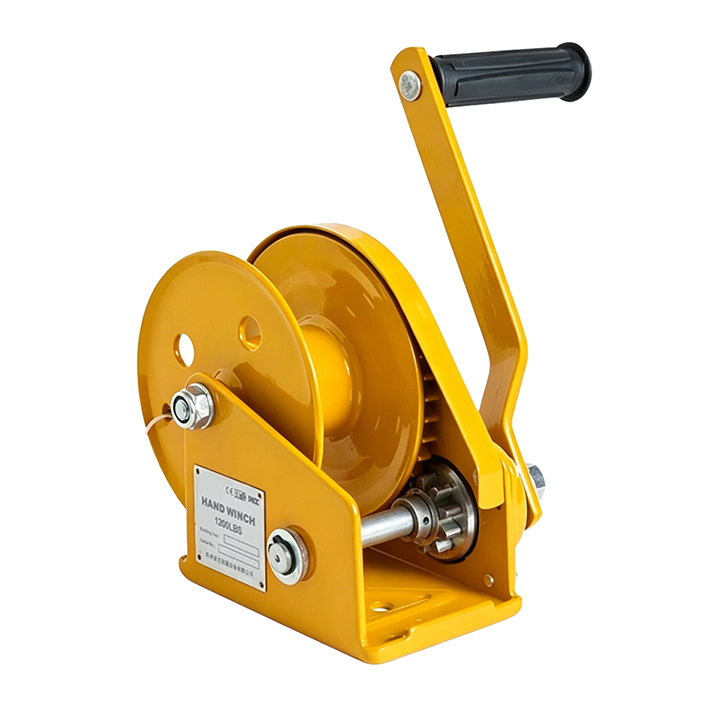
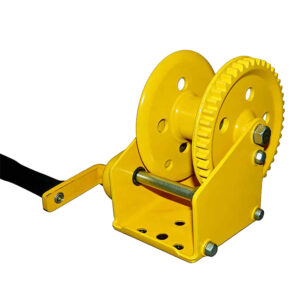
A hand winch is rated to pull. The drum winds rope, the gearing multiplies the operator’s effort, and the load moves along the line of the rope, usually horizontally, sometimes up a slope. A friction brake holds the drum when the operator lets go, which is what keeps a boat on a trailer or a log on a slope from running back.
A hoist is rated to suspend. Its brake is built to hold a load in the air for as long as the job takes, its drum and frame are built around a vertical load path, and its chain or rope is sized for a suspended load rather than for a pull along the ground.
The two overlap in appearance and not in duty. Using a winch to lift is not a capacity question, so answering it with a bigger winch does not solve it. The load has to be raised by a device rated for suspension, and the winch is the wrong device whatever its tonnage.
Apollo builds both, which is why this distinction is stated before the specification rather than after. Apollo hand winches are traction tools, and the lifting range starts with the manual hoists.
Apollo keeps the two families separate for exactly this reason: the winch range and the hoist range carry their own ratings, their own documentation and their own spare parts, and a buyer who describes the job rather than the product gets routed to the right family the first time.
The transmission ratio is not a safety factor
The specification carries a figure of 4.2 to 1, 5 to 1 and 10 to 1 across the three models, and it is the single most misread number on the sheet. It is the gearing between the crank and the drum: how many turns of the handle produce one turn of the drum.
A higher ratio means the drum turns more slowly and the operator works less hard for each unit of pull. It does not mean the winch is ten times stronger. A buyer who reads 10 to 1 as a tenfold margin will size a winch from the wrong number and be surprised by what the load does.
The figure that does describe effort is the hand force, and it sits at 180 N on the smallest model and 190 N on the two larger ones. That near-flat line is the useful part of the specification: the operator does not pull harder for more capacity, they crank for longer.
How the rope is routed changes the job
A pull in a straight line along the ground loads the drum evenly and spools the rope in neat wraps. A pull that turns a corner, or that rises to a snatch block, loads the drum from an angle, and the wraps cross rather than lay.
Crossed wraps are the normal cause of a rope that will not pay out on the next job, and they are usually created in the last two metres of a pull rather than at the start. Fair-leads and a straight run from the drum to the first block are what prevent it, and both belong in the plan before the winch is bolted down rather than after the first jammed drum.
Apollo quotes the rope by diameter and length against the model, so the drum and the rope are matched at the order rather than at the first replacement.
Three models, in pounds and in kilograms
| Model capacity | In kilograms | Test load | Net weight |
| 1,200 lb | 544 kg | 8 kN | 3.7 kg |
| 1,800 lb | 816 kg | 12 kN | 8.1 kg |
| 2,600 lb | 1,179 kg | 17.5 kN | 10.3 kg |
The capacity is printed in pounds because that is how the range is catalogued, and most international enquiries arrive in kilograms. Converting is not optional, and it has to be done once, correctly, and written down rather than left to the reader.
The conversion is 0.4536 kilograms per pound. The rule that keeps a listing clean is to keep the two units apart: a phrase carries one unit, and a specification table carries both in separate columns. Stacking a pound figure and a kilogram figure into one phrase is how a listing reads as keyword padding rather than as a specification.
The test load, and a figure that had to be corrected
Test loads run at 8 kN, 12 kN and 17.5 kN across the three models. Checked against the capacities, each one sits at about 1.5 times the rated load: 5.34 kN of rated load against 8 kN, 8.01 against 12, and 11.57 against 17.5.
That consistency is worth stating because the printed sheet for the largest model carries a figure of 175 kN, which is ten times the value the pattern predicts and roughly seventeen tonnes on a winch rated for one. A typographical slip of that kind is not a small matter: a buyer comparing the sheet with a quotation sees two different numbers and starts questioning the rest of the document. Apollo publishes 17.5 kN for that model, and the sheet is being corrected.
Stainless steel, and when it earns its cost
The range can be supplied in stainless steel, which is the option that matters in three situations: a boat, a dock, and anything that lives outdoors in salt air or in a wash-down area.
It is an option rather than a standard finish, so it belongs in the quotation as a stated choice with its own lead time. Apollo supplies the range in the standard finish with stainless available against the order, and the specification should say which finish was bought rather than leaving it to the invoice.
What to ask before the order
- Is this pull or lift?If the load leaves the ground and stays there, this is the wrong product family.
- What is the pull distance?Drawn rope length and drum capacity decide whether the job needs one pull or a reset.
- What is the surface and the environment?Standard finish or stainless, decided at order rather than after the first winter.
- Is the mounting fixed or portable?A 1,200 lb model at 3.7 kg can be carried; the 2,600 lb model at 10.3 kg usually gets bolted down.
- What is the rope being used for?A pull along a line and a pull around a corner load the rope differently, and the routing belongs in the plan.
Why Apollo builds winches and hoists separately
Apollo is a hand winch manufacturer, and the range is built for traction: three capacities, a friction brake, and gearing that keeps hand force flat as capacity rises. The lifting products are a separate family with their own ratings, because the two duties are not interchangeable.
Apollo is also a manual winch supplier with more than 20 years of production, its own factory and exports to over 50 countries, so a distributor can quote a winch and a manual hoist against the same enquiry without splitting the order across two suppliers.
As a traction equipment supplier, Apollo publishes the transmission ratio and the hand force together, states the test load in kilonewtons rather than leaving it to be inferred, and supplies the range with the stainless option against the order. The three models are listed on the Apollo hand winch category page (https://www.apollohoist.com/product-category/hand-winch/), and the wider range sits under the Apollo product index (https://www.apollohoist.com/product/).
For the documents a buyer should expect with any pulling or lifting equipment, the Apollo documentation checklist sets out what belongs in the file (https://www.apollohoist.com/product-news/industrial-lifting-equipment-documentation-checklist/).
Apollo supplies the range with stainless against the order rather than as a stock variant, so the finish is a stated line on the quotation and not an assumption made at the packing bench.
Deciding in one pass
Ask whether the load is going to hang. If it is, the answer is a hoist and the winch is out of the conversation. If the load is going to slide, tow or be tensioned along a line, the winch is the right tool and the three questions that matter are the pull force, the distance and the environment.
Apollo quotes the winch range against the pull force in kilonewtons and the rope length, and quotes the hoist range separately, so a buyer who describes the job rather than the product gets the right family the first time.
Apollo answers a winch enquiry with a pull force and a rope length rather than with a model number, because the same winch covers a truck trailer and a mooring line and only the duty tells them apart.
Get a pull force check: send the load, the surface, the distance and the environment, and Apollo’s engineers will confirm the model, the rope and the finish in writing within one business day, at no cost.
Request conformity document samples now
Get a pull force check via WhatsApp / Phone: +86 18989488615
Request conformity document samples by email: sales@apollohoist.com
Submit an online inquiry: https://www.apollohoist.com/contact-us/
Browse the full product range: https://www.apollohoist.com