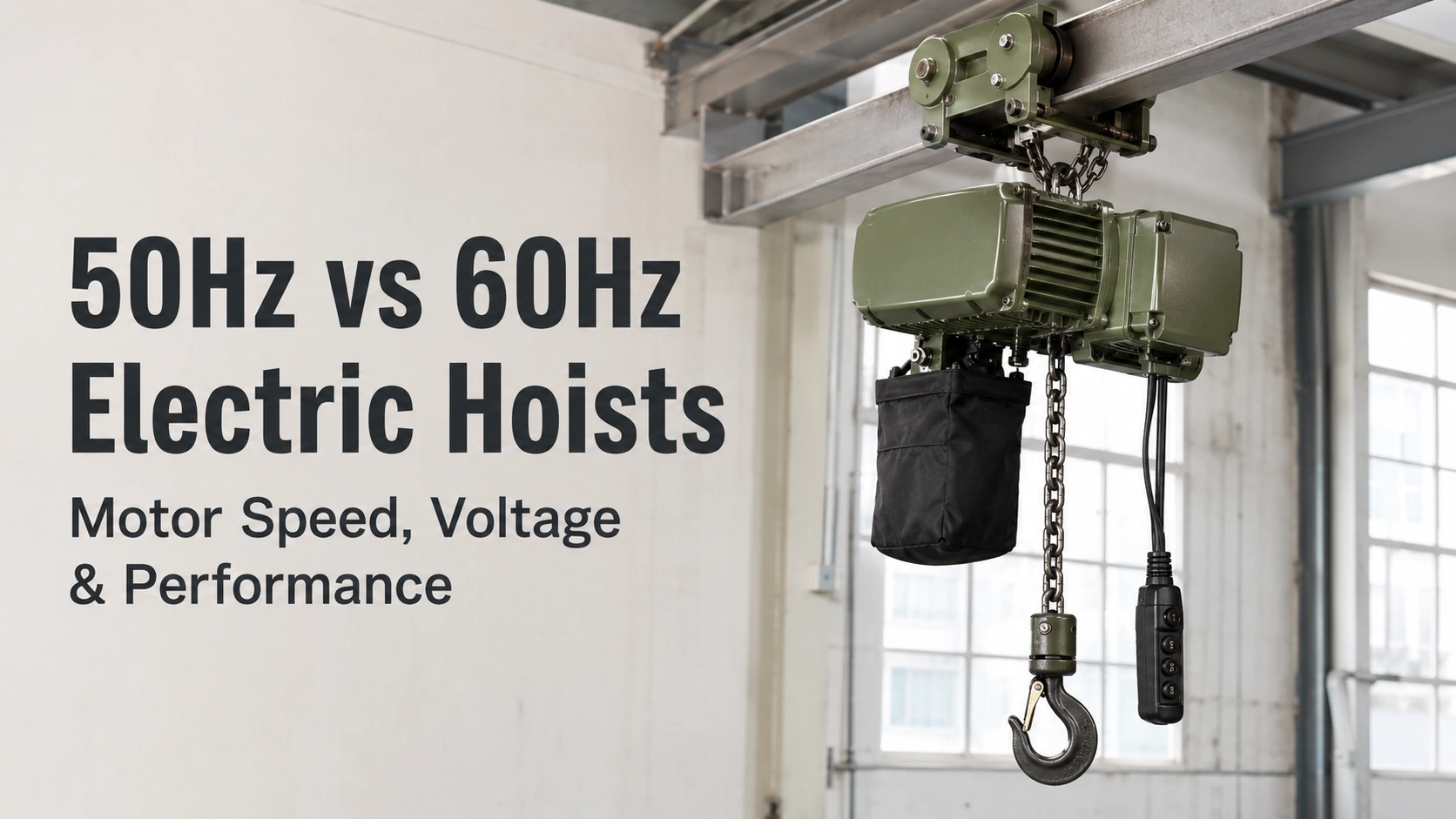
When specifying an electric hoist for a new plant, a replacement project, or an export order, frequency is not a minor nameplate detail. A 50Hz and a 60Hz hoist can use the same lifting mechanism yet deliver different motor speed, current, heat, brake behavior, and control performance. The practical answer is to match the hoist motor, voltage, phase, control components, and duty rating to the site supply as a complete system. A frequency mismatch should never be corrected by changing only a plug or overload setting.
What 50Hz and 60Hz mean for an electric hoist
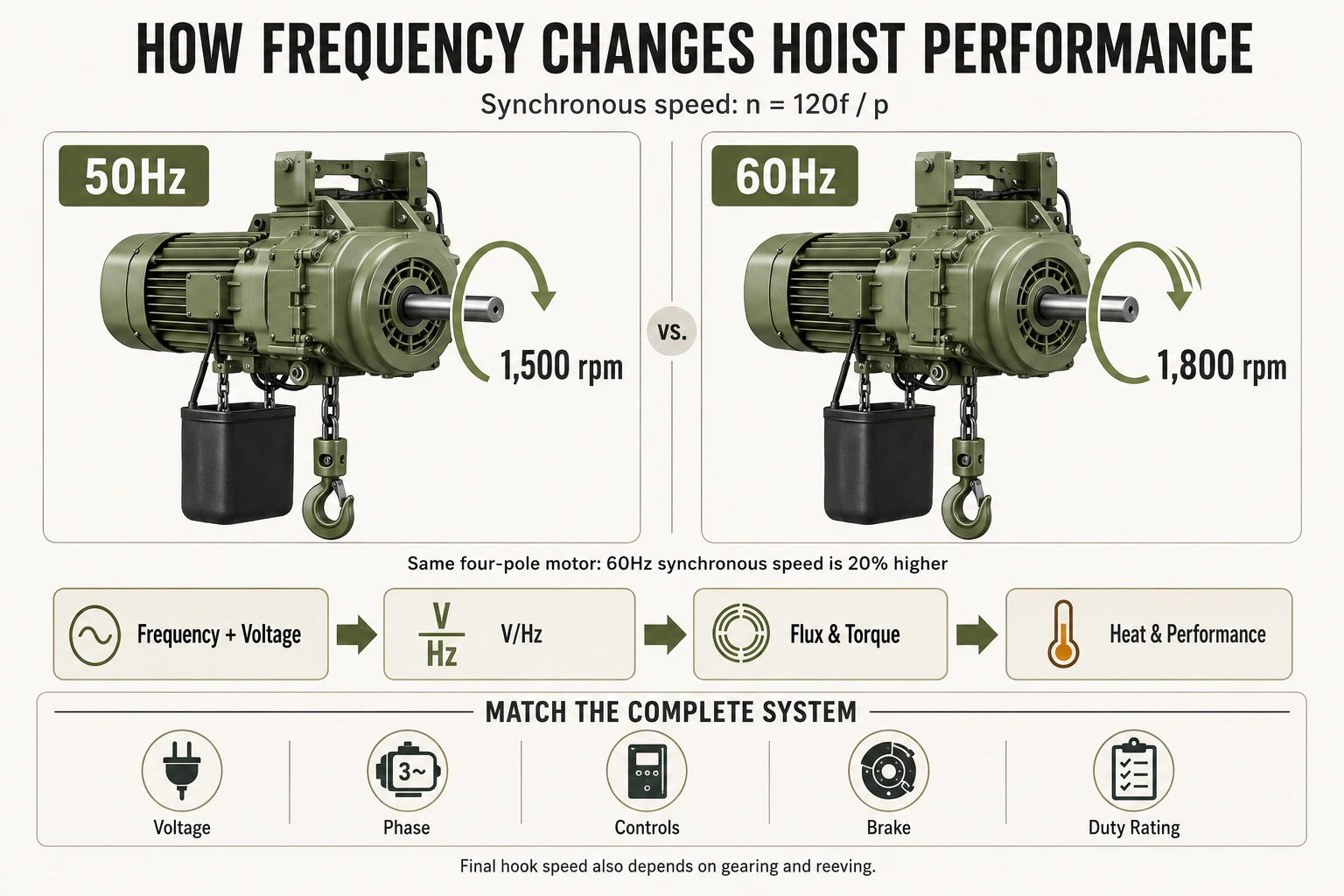
Frequency is the number of AC cycles per second. In a conventional induction motor, synchronous speed is approximately proportional to frequency: n = 120f/p, where f is hertz and p is the number of poles. With the same pole count, a 60Hz motor has a theoretical synchronous speed 20% higher than a 50Hz motor. Actual rotor speed is slightly lower because of slip, but the relationship remains useful for estimating how a hoist will behave.
That speed change reaches the gearbox, drum, or chain sprocket. If the reduction ratio is unchanged, a 60Hz motor can produce faster lifting or travel. A 50Hz version may move more slowly but can provide a different torque and thermal margin depending on the motor design and rated voltage. Hoist speed is therefore a system result, not a frequency-only promise.
How frequency changes hoist motor speed
For a simple four-pole motor, the synchronous-speed estimate is 1,500 rpm at 50Hz and 1,800 rpm at 60Hz. Slip reduces both figures under load. The resulting 20% difference is large enough to affect lift time, trolley travel, positioning, and production takt time. It does not mean that every 60Hz hoist will lift 20% faster: gearing, reeving, drum diameter, inverter settings, and rated duty can limit the final hook speed.
If a variable-frequency drive is used, the drive can command a controlled speed range, but its base frequency, motor data, acceleration limits, brake timing, and overload protection still need to match the hoist. A drive is not a blanket license to run a single-frequency motor on any supply. Ask for the permitted frequency range and the parameter sheet before commissioning.
Voltage and V/Hz: the compatibility check that matters
Frequency and voltage must be evaluated together. Motor magnetic flux is broadly related to volts per hertz (V/Hz). If frequency falls while voltage stays high, flux and magnetizing current can rise, increasing heating and saturation risk. If frequency rises without a corresponding voltage increase, available torque can fall because the motor is effectively operating below its intended V/Hz ratio. The safe operating point depends on the motor nameplate and the manufacturer’s instructions.
A dual-frequency nameplate such as 50/60Hz may list different voltages, currents, speeds, or output ratings for each condition. A common example is a motor designed for 220-240V at 50Hz and 220-240V at 60Hz, but that is not universal. Some systems use 380-415V or 440-480V three-phase supplies, while controls may use a separate lower voltage. Verify line-to-line voltage, phase count, frequency, control voltage, and earthing arrangement from the actual site measurement and hoist documentation.
Performance differences you may see in service
| Factor | 50Hz condition | 60Hz condition |
| Motor speed | About 17% lower than the same motor at 60Hz; final hook speed depends on gearing. | About 20% higher synchronous speed; actual lifting speed remains application-specific. |
| Torque and power | Can maintain rated torque when voltage and V/Hz are correct; thermal limits still apply. | May provide higher speed, but torque can reduce if voltage cannot rise with frequency. |
| Cooling and heat | Lower fan speed can reduce cooling; check temperature rise and duty class. | Higher speed may improve self-cooling, yet friction and load-related losses can increase. |
| Controls and brake | Contactors, transformers, timers, and brake coils must be rated for the supply. | Control timing and brake release must be checked; a faster motor can change stopping behavior. |
Can a 50Hz hoist run on 60Hz, or vice versa?
Only when the nameplate, motor design, and control system permit it. Moving from 50Hz to 60Hz at the same voltage raises speed and lowers V/Hz by roughly 17%; available torque may change, and the hoist can exceed its rated lifting or travel speed. Moving from 60Hz to 50Hz at the same voltage raises V/Hz by about 20%; the motor may draw more current, run hotter, or trip protection. The brake, limit switches, gearbox lubrication, and mechanical stopping distance also need review.
For a frequency conversion, obtain written confirmation of allowable voltage-frequency combinations, rated current, duty class, thermal protection, brake coil data, and any required derating. If the supply is unstable or the application needs multiple speeds, specify a compatible inverter package rather than improvising with a general-purpose converter. A qualified electrician should verify phase rotation, protective devices, and commissioning measurements.
Selection checklist for procurement teams
Use this sequence when comparing offers from an electric hoist manufacturer or distributor:
• Record the measured site supply: nominal voltage, phase, frequency, allowable variation, and available fault current.
• Define the lifting task: rated load, lift height, reeving, lift and travel speeds, starts per hour, and expected duty cycle.
• Request a nameplate or datasheet showing motor frequency, voltage, full-load current, speed, insulation, brake data, and duty classification.
• Confirm that the hoist controls, pendant, transformer, limit switches, overload limiter, and emergency-stop circuit use compatible ratings.
• Check installation conditions such as ambient temperature, altitude, indoor or outdoor exposure, dust, moisture, and hazardous-area requirements.
• Ask how performance changes between 50Hz and 60Hz versions and what factory settings or derating apply to each.
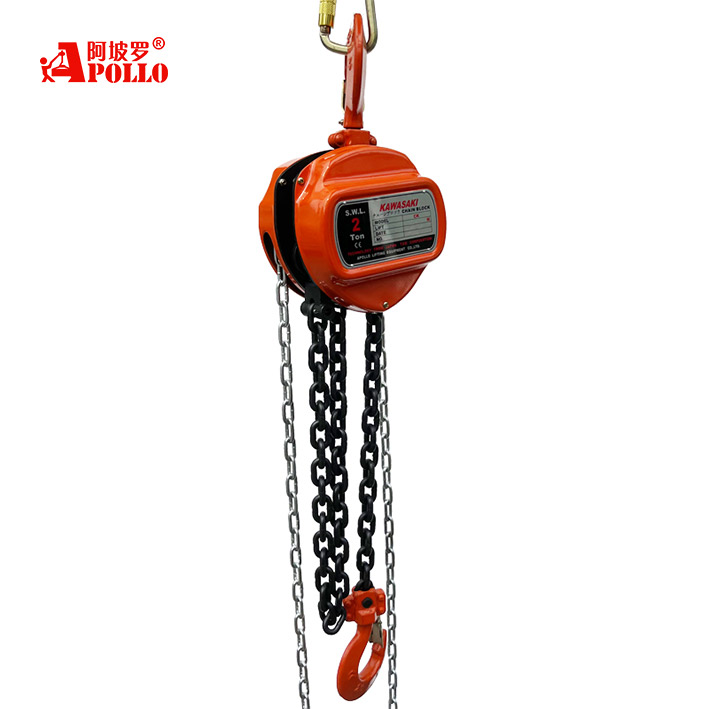
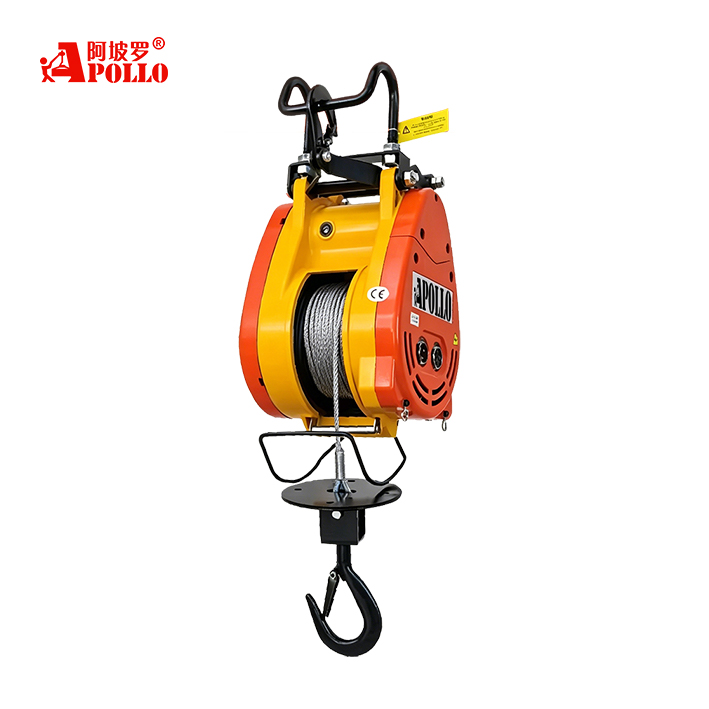
Apollo lists electric chain hoists, electric wire rope hoists, electric winches, and explosion-proof hoists within its electric hoist product range. Its dedicated electric chain hoist category illustrates why the correct comparison should start with the mechanism and application as well as the power supply. For a chain-driven, wire-rope, or specialty configuration, ask for the exact model data instead of assuming that a nearby product has the same motor package.
How to verify a supplier before ordering
A credible quotation should state the offered frequency and voltage, not just the lifting capacity. It should identify whether the quoted speed is at 50Hz, 60Hz, or a programmed inverter setting. Request drawings and wiring information when the hoist will integrate with a crane, monorail, or plant control system. Confirm spare-part availability for motors, brake components, contactors, and frequency-drive parameters.
Apollo describes OEM and ODM support and provides a services and customization page. Those capabilities can be useful when a project needs a nonstandard voltage, export-market frequency, special control voltage, or a documented fit check. The final configuration still needs approval against the project’s electrical and lifting requirements.
Conclusion
The central difference between 50Hz and 60Hz electric hoists is motor speed, but speed is only one part of performance. Voltage, V/Hz ratio, torque, heat, brake timing, controls, gearing, and duty rating determine whether a hoist is safe and productive on a particular supply. Treat frequency as a system specification, verify the nameplate and control package, and select the version that matches the measured site conditions. When the application is unusual, a written fit check is more valuable than a generic frequency converter.
FAQs
Is 60Hz always better than 50Hz for an electric hoist?
No. 60Hz can offer higher motor speed, while 50Hz may suit the local grid and the specified gearbox, torque, and duty. The correct choice is the one matched to the complete system.
Will a 60Hz hoist lift 20% more weight?
No. Frequency primarily changes motor speed. Rated load is set by the motor, gearbox, brake, rope or chain, structure, and duty rating.
Can a frequency converter make any hoist compatible?
No. Converter output, V/Hz control, braking, protection, and thermal limits must match the motor and hoist controls. Manufacturer approval is recommended.
What information should I send for a frequency fit check?
Provide the model, rated load, lift and travel speeds, voltage, phase, frequency, duty cycle, environment, control requirements, and any drawing or nameplate photo.
For a project-specific quotation, contact Apollo’s technical team with the model, site voltage and frequency, load, dimensions, duty cycle, operating environment, and quantity.