Introduction
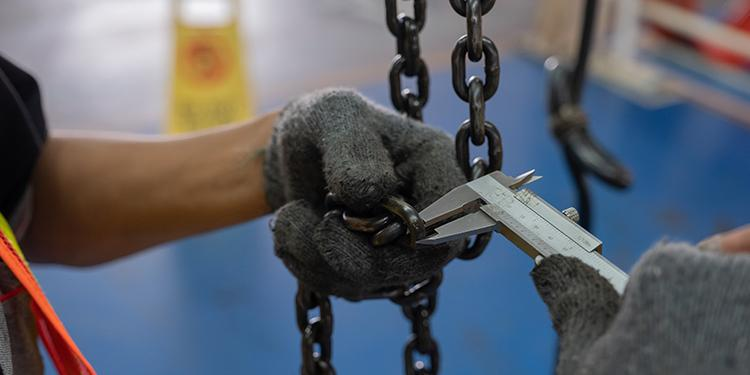
The load chain is the most important bearing element of every chain hoist. Although customers always check the lifting capacity, lifting height, and price, the quality of the load chain influences its strength, reliability, safety, and performance.
For distributors, wholesalers, industrial contractors, and OEM brand owners, the knowledge about chain grades is vital in terms of procuring chain hoists in different markets. Using an incorrect chain grade may cause problems including low lifespan, non-certification of the product, warranties claims, and more operating costs in the future.
This guide explains the differences between G80, G100, and other chain grades, helping international buyers choose the most suitable option based on application requirements, regulatory standards, and procurement objectives.
Why Load Chain Grade Matters
The load chain transfers the entire lifting force during operation. Its quality directly affects:
- Lifting safety
- Working load limit (WLL)
- Fatigue resistance
- Wear resistance
- Product lifespan
- Certification compliance
- Maintenance costs
Although two chain hoists may have the same rated capacity, differences in chain material and manufacturing quality can significantly impact performance.
For B2B buyers, chain grade should be considered alongside supplier quality control, testing procedures, and certification documentation.
Understanding Chain Grades
Chain grades indicate the mechanical properties and strength level of alloy steel lifting chains.
The most common grades used in lifting applications include:
| Chain Grade | Typical Strength Level | Common Applications |
| G43 | Medium strength | Transport and general utility |
| G70 | Transport chain | Cargo securing |
| G80 | High-strength lifting chain | Most manual chain hoists |
| G100 | Premium lifting chain | Heavy-duty lifting systems |
| G120 | Ultra-high-strength chain | Specialized lifting equipment |
Not all chain grades are suitable for overhead lifting applications.
For industrial chain hoists, G80 and G100 remain the most widely used options.
G80 Chain: The Industry Standard
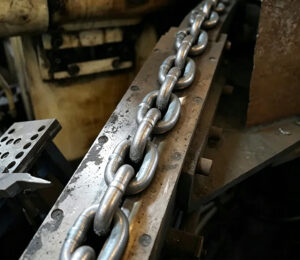
G80 chain is the most commonly used load chain for manual chain hoists and many electric chain hoists worldwide.
Key characteristics include:
- Heat-treated alloy steel construction
- High tensile strength
- Good fatigue resistance
- Proven lifting performance
- Broad international acceptance
Advantages:
- Cost-effective
- Widely available
- Suitable for most industrial lifting tasks
- Compatible with common international standards
Typical applications:
- Manufacturing plants
- Construction sites
- Warehouses
- Maintenance operations
- Equipment installation projects
For many distributors and importers, G80 chain hoists provide the best balance between performance and cost.
G100 Chain: Higher Strength, Lower Weight
G100 chain represents a newer generation of lifting chain technology.
Compared with G80 chain, G100 generally offers approximately 20–25% higher strength.
Advantages include:
- Higher working load capacity
- Improved strength-to-weight ratio
- Reduced chain weight
- Enhanced lifting efficiency
- Better performance in demanding applications
Typical applications:
- Heavy industrial environments
- Offshore projects
- Mining operations
- Steel fabrication facilities
- High-frequency lifting operations
However, G100 chain hoists typically carry a higher purchase price.
For buyers targeting premium industrial markets, the increased performance may justify the additional investment.
G120 Chain: Is It Necessary?
Some manufacturers now offer G120 lifting chain systems.
Benefits include:
- Higher strength levels
- Reduced chain size requirements
- Weight reduction opportunities
However, G120 remains relatively uncommon in standard chain hoists.
Challenges include:
- Higher cost
- Limited availability
- More specialized replacement requirements
For most distributors and industrial buyers, G80 and G100 remain the most practical choices.
Comparing G80 and G100 Chains
| Feature | G80 | G100 |
| Strength | High | Very High |
| Cost | Lower | Higher |
| Market Availability | Excellent | Good |
| Replacement Parts Availability | Excellent | Good |
| Industrial Applications | General | Heavy-duty |
| OEM Demand | High | Growing |
| Global Acceptance | Very High | High |
For most standard lifting applications, G80 provides excellent value.
For premium lifting equipment and specialized industrial sectors, G100 may offer competitive advantages.
How Certifications Affect Chain Selection
International buyers often require compliance with recognized standards.
Depending on the target market, chain hoists may require:
- CE compliance
- ISO 9001 manufacturing systems
- GS certification
- UKCA compliance
- Third-party testing reports
Certification requirements often influence the choice of load chain supplier and manufacturing process.
Buyers should request:
- Material certificates
- Mechanical property reports
- Load test records
- Quality inspection documentation
Reliable documentation simplifies customs clearance, market entry, and customer acceptance.
OEM and Private Label Considerations
For distributors and brand owners, chain grade selection also affects OEM projects.
Common OEM customization options include:
- Private logo branding
- Customized load chain specifications
- Branded packaging
- Instruction manual localization
- Product labeling
- Market-specific compliance markings
When evaluating OEM suppliers, buyers should confirm whether chain grades can be customized according to local market requirements.
Some regions may primarily demand G80 products, while others increasingly favor G100 lifting systems.
Quality Control: What Buyers Should Verify
Chain quality varies significantly among manufacturers.
Before placing bulk orders, buyers should assess:
Raw Material Traceability
Quality manufacturers maintain complete records for:
- Steel sourcing
- Heat treatment processes
- Batch identification
- Material testing
Load Testing Procedures
Every chain hoist should undergo appropriate testing before shipment.
Typical tests include:
- Proof load testing
- Functional testing
- Brake testing
- Visual inspection
Production Consistency
Consistent manufacturing reduces:
- Warranty claims
- Product recalls
- Customer complaints
- Unexpected failures
For long-term distributors, supplier quality consistency is often more important than achieving the lowest purchase price.
Lead Time and Supply Chain Considerations
Reliable supply is critical for distributors and project contractors.
When sourcing chain hoists, buyers should evaluate:
- Monthly production capacity
- Standard lead times
- Peak-season delivery performance
- Inventory management capabilities
- Emergency order support
Manufacturers with stable production systems are better positioned to support long-term partnerships.
After-Sales Support and Spare Parts Availability
The availability of replacement chains and spare parts directly impacts product lifecycle value.
Buyers should confirm:
- Replacement chain availability
- Spare part inventory
- Technical support response times
- Warranty policies
- Product documentation support
Strong after-sales support can significantly reduce downtime and maintenance costs.
How to Choose the Right Chain Grade
The optimal chain grade depends on application requirements.
Choose G80 If:
- Cost efficiency is important
- Applications are general industrial lifting
- Replacement parts availability is a priority
- Broad market acceptance is required
Choose G100 If:
- Higher lifting performance is needed
- Weight reduction is important
- Equipment operates under demanding conditions
- Target customers require premium specifications
Consider G120 Only If:
- Specialized applications justify the investment
- Engineering requirements demand maximum strength
- Long-term replacement support is available
Need Help Selecting the Right Chain Hoist for Your Market?
The selection of the right load chain grade is an exercise of compromise between safety considerations, certification standards, positioning strategy, and overall acquisition costs.
If you are looking for chain hoists for any industrial use, distribution channels, rent-a-warehouse or OEM branding programs, our team can help to select the best chain hoist for your business.
We offer:
- G80 and G100 chain hoists
- OEM and private label manufacturing
- Custom packaging and branding
- CE and ISO-compliant production
- Bulk order support
- Technical documentation and testing reports
- Flexible lead times
- Spare parts and after-sales support
Contact us today to discuss your requirements, request product specifications, or receive a customized quotation.
Website: Apollo Hoist Official Website
Inquiry Page: Contact Apollo Hoist Today
Email: sales@apollohoist.com
WhatsApp / Phone: +86 18989488615
Conclusion
Chain grade is among the critical considerations that affect the performance, safety, and longevity of a chain hoist. While the G80 grade chain continues to be the standard in many industrial settings, G100 chain has continued to win favor in more rigorous settings where higher efficiency is needed.
For international buyers, it is important that chain selection goes beyond just technical specifications and includes certification conformity, OEM customizing capability, manufacturing quality, reliable supply chain, and post-sales service. Through cooperation with a reputable manufacturer and choosing the right chain grade, buyers can gain more competitive products and minimize risks.