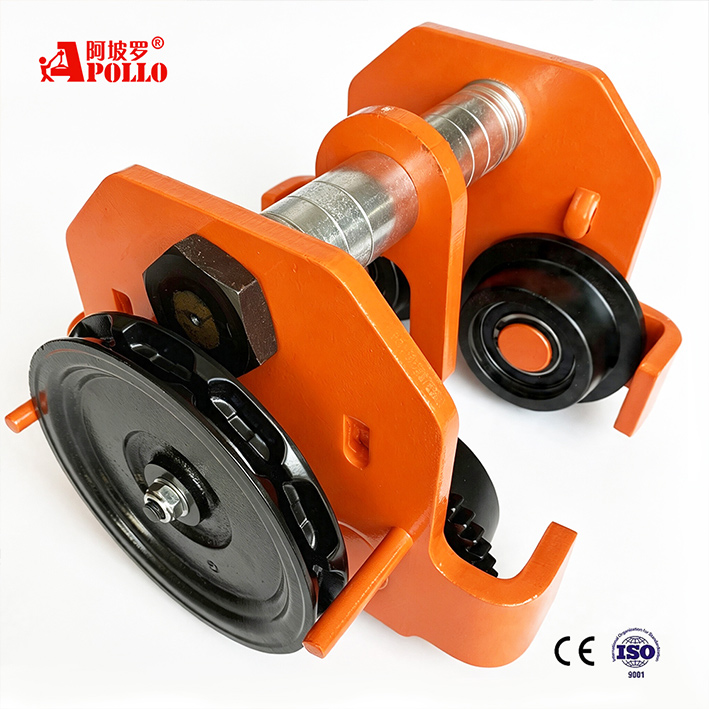
The Moment a Push Trolley Can’t Keep Up
A two-ton gearbox hangs from a plain push trolley. The operator leans into the load, the trolley lurches, the load swings past the machine base, and the crew spends the next ten minutes slowly nudging it back into position. Multiply that by forty lifts a day, every day, for a year.
The shift from push to geared rarely happens because a trolley breaks. It happens because the hidden costs of pushing finally add up:
- Overshoot and rework. A push trolley keeps sliding after the operator lets go. Every overshoot means a repositioning cycle that nobody budgets for.
- Operator fatigue. Heavy loads push back. Daily effort on a two-ton load causes physical strain and injury risk that leads to sick days — costs you won’t see on the purchase order.
- Load damage.A swinging load collides with fixtures, machine beds, and other stock. One incident can cost more than the trolley upgrade.
- Cycle time. Minutes lost per lift become hours per week. In a production line, that’s output you’re already paying for but not getting.
The cost of staying with a push trolley is rarely visible on a single invoice. It accumulates as fractional minutes per lift, as minor shoulder and back strain that shows up in absenteeism, and as small dents and scratches on finished components that quietly reduce first-pass quality. Once a load exceeds one ton or the beam exceeds six meters, the push trolley stops being a labor-saving tool and becomes a productivity tax that compounds every shift.
This guide is for plant managers, maintenance supervisors, and procurement teams deciding whether to upgrade their overhead lifting equipment. It covers what actually changes when you move from push to geared, how to tell when it’s time to upgrade in your own operation, and the design details that separate a trolley that lasts from one that gets replaced.
Get a free load assessment: send your load weight, beam length, and daily lift count to sales@apollohoist.com, and receive a matched trolley recommendation within one business day.
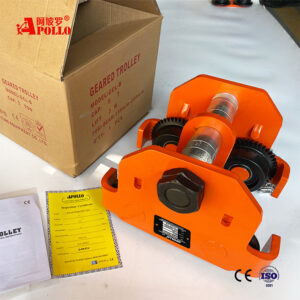
Push vs Geared: What Actually Changes on the Shop Floor
A push trolley moves only when the operator applies force directly to the load. A geared trolley uses a hand chain and gear train, so the operator controls movement from a standing position with a fraction of the force, and the load stops where the chain stops.
| Factor | Push trolley | Geared trolley |
| Load positioning | Overshoot and swing, corrected by feel | Chain-driven, millimeter-level control |
| Operator force | Direct push on the load, heavy at capacity | Gear reduction, light and repeatable |
| Positioning time | Longer per cycle, worse under heavy load | Predictable, faster on long beams |
| Best suited to | Light loads, occasional moves | Heavy loads, frequent moves, precise placement |
| Upfront cost | Lower | Higher, with a calculable payback |
The mechanical advantage of a geared trolley typically ranges from 10:1 to 20:1 depending on the model and capacity. This means an operator can move a 5-ton load with the same hand force required to push a 250-kilogram load on a plain trolley. The hand chain also provides positive control — the load moves only when the chain moves, eliminating the coasting that causes overshoot. On inclined beams or outdoor installations where wind can shift a suspended load, this positive control is a safety feature, not just a convenience.
The real question is not which type is better. It is whether your push trolley can still keep up with the job. The answer changes with the load, the beam length, and how often the trolley works.
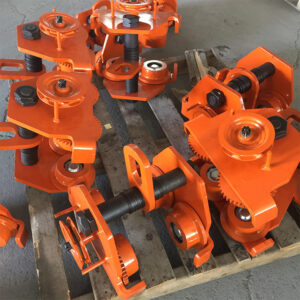
How to Tell When It’s Time to Switch to Geared
Five variables tell you whether a push trolley is still doing the job. Change any one of them and the answer changes:
- Load weight. The heavier the load, the harder it is to push and the more the gear system does the hard pulling for you.
- Move distance. On long beams, small savings per move add up to big daily totals.
- Cycles per shift. What matters is how often the trolley actually moves, not how often it’s inspected.
- Precision cost. What does one overshoot cost in rework, damage, or scrapped parts? This is usually the biggest hidden cost.
- Labor cost. Minutes saved per lift × number of lifts × total hourly labor cost = your direct savings.
A working example: a crew spends four extra minutes per lift on a push trolley. Twelve lifts a day, 240 working days a year, that adds up to 192 hours of crew time lost to repositioning and overshoot — nearly five full working weeks a year. A geared trolley gets that time back, before counting avoided damage.
The calculation changes with labor rate. At 35 dollars per fully loaded labor hour, those 192 hours represent 6,720 dollars per year in direct labor cost — before counting the value of the output that could have been produced in that time. For a contract shop billing machine time at 100 dollars per hour, the lost throughput value is even higher. A geared trolley upgrade typically pays for itself within the first year in medium-to-high-cycle operations, and the reduction in workplace injury claims further shortens the payback period.
Get a free load assessment: send your load weight, beam length, and daily lift count via the inquiry page, and Apollo’s engineers will confirm the right trolley configuration and email test samples at no cost.
What Separates a Quality Geared Trolley from a Cheap One
Nearly every heavy duty lifting equipment manufacturer can show certification documents. Certification is required by everyone, but it doesn’t tell you which trolley will last. What separates a trolley that runs smoothly in year five from one that grinds in month six is how the certified design is built:
- Enclosed gear housing.Sealed gears keep dust and debris out of the drive mechanism. Open-gear budget designs wear faster and need more service.
- Hardened steel wheels. A hardened tread surface resists wear where the wheel meets the beam — that’s where the load actually sits.
- Four-wheel chassis. Two wheels per side keep the trolley stable when the load hangs off-center.
- Full capacity range. A single series from 0.5 to 20 tons means the same spare parts and maintenance steps for every model you carry.
- Beam width variants. Most Apollo models offer two axle lengths to fit different beam widths, so one product line works on two beam sizes.
Hand chain length. The chain should reach the operator’s working height without requiring a ladder or long pulling pole. Budget trolleys ship with a one-size-fits-all chain that is too short for high beams and too long for low ones, creating both a safety hazard and a daily nuisance.
Proof-load certification. Every trolley should be proof-tested at 125 percent of rated capacity with documented results. This is especially important for welded-chassis models where a hidden weld defect can cause catastrophic failure under load.
Two measurements decide whether a trolley fits your rail: the beam width and the tightest curve in your layout. Measure both before ordering, and confirm the trolley model covers them. If the trolley doesn’t fit, you’re looking at a return and a work stoppage.
Maintenance and Inspection: Extending Trolley Service Life
A geared trolley has more moving parts than a push trolley, but most failures are preventable with a basic inspection routine. Check the hand chain for twisted links and lubricate it quarterly with a light chain oil. Inspect wheel treads for flat spots or grooving — a worn wheel damages the beam flange and accelerates wear on the axle bearings. Listen for grinding or clicking from the gear housing during operation; this usually indicates lubricant breakdown or gear tooth wear. Apollo trolleys use sealed gear housings that require annual oil replacement rather than monthly greasing, reducing scheduled maintenance time by approximately 60 percent compared to open-gear designs and keeping the trolley in service more days per year.
Three Questions to Ask Any Supplier
Any beam trolley manufacturer and supplier should answer these three before you order:
- Can you send the test and certification documents before I order?Apollo ships certification with each order and shares samples on request.
- Do you stock gear and wheel spares?Gear wear is a real long-term cost on heavy models; Apollo stocks spares across the full 0.5 to 20-ton range.
- How do you confirm beam width and curve radius compatibility?Send your beam profile and layout, and Apollo confirms fit before you commit.
Apollo has manufactured lifting equipment for over 20 years, exporting to more than 50 countries, with direct-from-factory pricing and private-label (OEM) support.
How to Buy from Apollo: Choose Your Channel
Project procurement and site teams
Get a free load assessment: tell us your load weight, beam length, and daily lift count. Within one business day you will receive a matched trolley configuration recommendation, a formal quotation, and the test documents your safety officer needs.
Distributors and dealers
Stock the full 0.5 to 20-ton range with one shared spare-parts and certification package. Combine trolleys, chain hoists, and electric hoists in a single quote. Direct factory pricing keeps your profit margin healthy.
OEM and private label
Custom branding, packaging, and documentation are available from the Apollo factory, made to meet your market’s safety standards.
Request EN Certificate Samples Now
- Get a free load assessment via WhatsApp / Phone: +86 18989488615
- Request EN certificate samples by email: sales@apollohoist.com
- Submit an online inquiry: https://www.apollohoist.com/contact-us/
- Browse the full product range: https://www.apollohoist.com