
Nailing the figures before a major lift goes beyond simply meeting regulations. It focuses on protecting your team and preventing equipment failure during the task. In heavy lifting scenarios, the chain serves as more than a mere device. It acts as the core support for the entire setup. Since 1986, the experts at Apollo, part of the HSY International Group, have crafted this essential component from our base in Kaohsiung, Taiwan. With a dedicated research and development team in Osaka, Japan, we have invested years in blending raw power with the exactness required for today’s hoisting needs.
Why Is Knowing the Chain Weight Essential for Safe Lifting?
You may believe that a small additional mass on a chain poses no issue, but in demanding lifting operations, each bit of weight impacts the overall capacity. Without including the chain’s own mass, you end up estimating the available space for the real payload. This approach creates hazards, and a firm grasp of your tools’ boundaries proves crucial.
Prevention of Equipment Overload
Each hoist comes with a defined limit, and exceeding it invites catastrophe. At Apollo, we construct our Kawasaki brand items to maintain a solid safety margin, typically four times the working load, yet this holds true only if you understand the precise burden on the hook. When the chain carries substantial weight, particularly in extended reaches, it reduces your lifting allowance and may strain the components past their designed tolerance.
Accuracy in Structural Load Planning
In vast warehouses or factory settings, the fixed mass of an extended chain can surprise you with its size. Our electric hoists handle elevations up to hundreds of meters, and at such spans, the chain contributes notably to the total burden. Skilled installers must account for this, ensuring that overhead supports or bridge cranes do not bear more than the facility’s design permits.
Compliance with International Safety Standards
Adhering to legal and inspection requirements involves proper records and calculations. Apollo’s production follows ISO9001 and ISO2000 standards, and our items feature CE and GS certifications. By computing weights precisely, you support the quality controls we implement to safeguard your operations and personnel.
How Do You Measure Different Chain Types Effectively?
Chains vary in construction, and applying a uniform method for weight assessment leads to errors. Whether dealing with basic links or tailored versions, the substance and assembly affect the figures. It pays to review the details briefly rather than discovering an overload when the unit begins to operate incorrectly.
Calculation Based on Material Density and Link Size
The simplest starting point involves examining the steel’s grade, like our T80 high-strength chains with a breaking strength of 800mpa. A G80 chain possesses a set density, and when you combine that with the wire’s thickness and links per unit length, you obtain a dependable mass estimate. We employ premium alloy steel here, so the chain remains durable while its weight stays consistent for your preparations.
Adjustments for Specialized Surface Treatments
The chain’s outer layer influences its mass as well. Untreated steel weighs lighter than one coated for corrosion protection. At Apollo, we provide options from basic lubrication and darkening to zinc coating, nickel application, and Dacromet finishes. Although these coverings are slim, they increase the total slightly over a 50-meter length, a detail that careful planners consider.
Consideration of Chain Length for High-Lift Hoists
Span emerges as the primary factor when shifting from compact workshop units to large-scale industrial work. In deep shaft tasks or extended pulls, the chain’s extent fluctuates greatly. You need to use the mass per meter from our specification guides and multiply by the full distance, while also factoring in the loose portion needed for the stopping system to function correctly.
Which Apollo Manual Hoists Offer the Best Weight-to-Strength Ratio?
For gear that delivers force without complicating transport across the job site, manual hoists frequently prove ideal. They function as reliable mainstays in building and maintenance fields. We have engineered our manual range to minimize pulling effort on the handle, all while ensuring the main unit withstands rough handling.
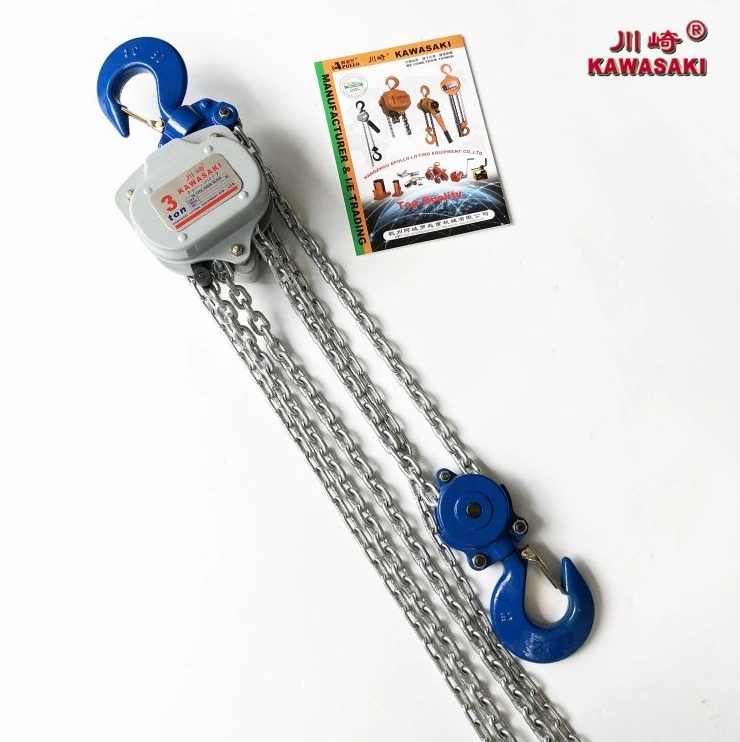
KAWASAKI Manual Hoist Chain Hoist TD
The TD line suits users seeking a dependable, no-fuss device that performs consistently. It incorporates the identical top-quality G80 lifting chains found in our elite series, providing ample safety without excess bulk. This model shows how we merge Taiwan’s production know-how with Japan’s development expertise to produce equipment that operates smoothly.
KAWASAKI Manual Hoist Chain Hoist VC
The VC version appeals to scenarios where control matches might in importance. It adapts well to diverse factory settings, or even home and farm applications. The inner mechanisms receive high-heat treatment to resist degradation, even at maximum capacity.
Customization Options for Manual Lifting Chains
We recognize that off-the-shelf items sometimes fall short, so we allow extensive adjustments. Options include various chain substances like stainless steel or aluminum blends, based on needs for reduced mass or rust resistance. Features such as 360-degree handling or embedded digital scales let you track burdens instantly, removing uncertainty from the process.
How Can Electric Hoists Simplify Heavy-Duty Weight Management?
As burdens climb into tens or hundreds of tons, human effort alone fails. Electric hoists step in here. They not only manage greater volumes but also incorporate monitoring and adjustments, ensuring safe handling without operators performing complex computations during use.
KAWASAKI Electric Chain Hoist KKBB
The KKBB excels in productivity for expansive industrial duties. Powered by an engine, it achieves quicker ascent rates and eases the physical demands on workers. We tailor the power supply from 110V up to 575V, matching your available electricity.
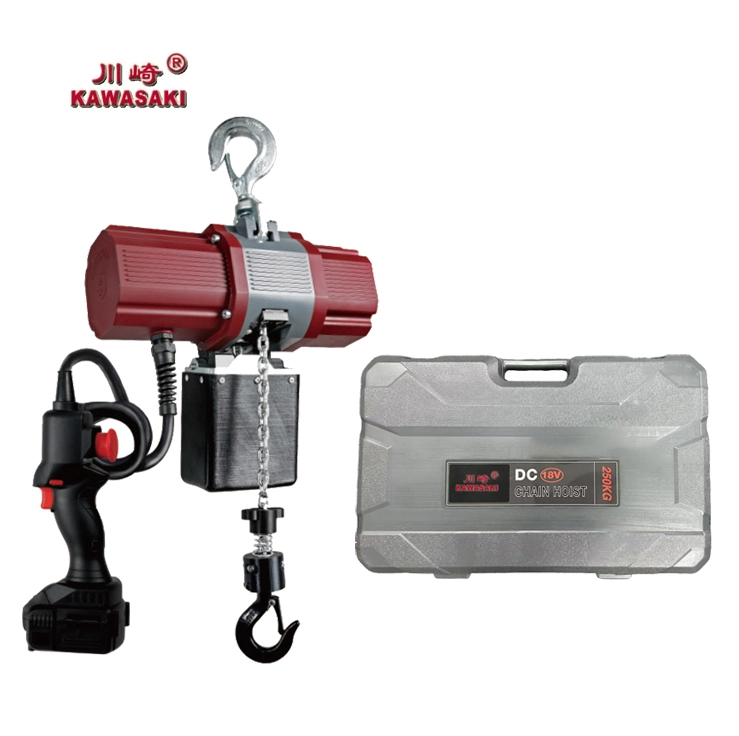
KAWASAKI Electric Wire Rope Hoist DC
For substantial loads, wire rope often outperforms chain. The DC range targets tough conditions with particles, moisture, or hazardous vapors. Given wire rope’s unique mass characteristics, these units include advanced automation to manage pull and distribution effectively.
Advantages of Integrated Safety and Control Systems
A key benefit of electric models lies in their built-in protection features. Our hoists support variable speed drives and programmable controllers for functions like sudden halts and excess load safeguards. Thus, if your mass estimate proves slightly inaccurate and you approach a risky threshold, the equipment halts automatically to avert damage.
Why Choose Apollo for Your Global Hoisting Requirements?
Selecting a provider means more than acquiring hardware. It involves partnering with a firm that supports you through repairs or bespoke needs. Apollo has operated in this sector for decades, earning trust through dependability and adaptability.
As a family-run enterprise with worldwide reach, we deliver individualized attention that larger firms often lack. Our representatives serve Singapore, Japan, Thailand, and South Korea, and we supply as an original equipment manufacturer for prominent labels. From a one-year guarantee and instructional videos to consistent accessory availability, we handle it all. Our aim centers on delivering superior quality at fair costs, alongside top-notch post-purchase assistance.
FAQ
Q1: Does the chain weight include the hooks and the bottom block?
A: Usually, the “weight of the chain” refers just to the links themselves per meter. However, when you’re looking at the total “dead weight” for a lift, you definitely need to add the weight of the hooks and the bottom block assembly, as these are made of heavy alloy steel forgings.
Q2: How often should I check my chain for weight-altering wear?
A: While the weight doesn’t change much as a chain wears down, the strength certainly does. We recommend a full inspection before any major project. Since our chains undergo strict factory performance testing for lifting capacity and safety, keeping them clean and oiled (or using our galvanized options) helps maintain their original specs for much longer.
Q3: Can I get a custom length chain for an existing Apollo hoist?
A: Yes, we are experts at customization. Whether you need a specific length of T80 or T100 chain, or a particular surface treatment like nickel-plating to handle a corrosive environment, we can pull that together for you. Just keep in mind that for custom orders, we usually have a minimum order quantity of about 50 to 100 units depending on the model.