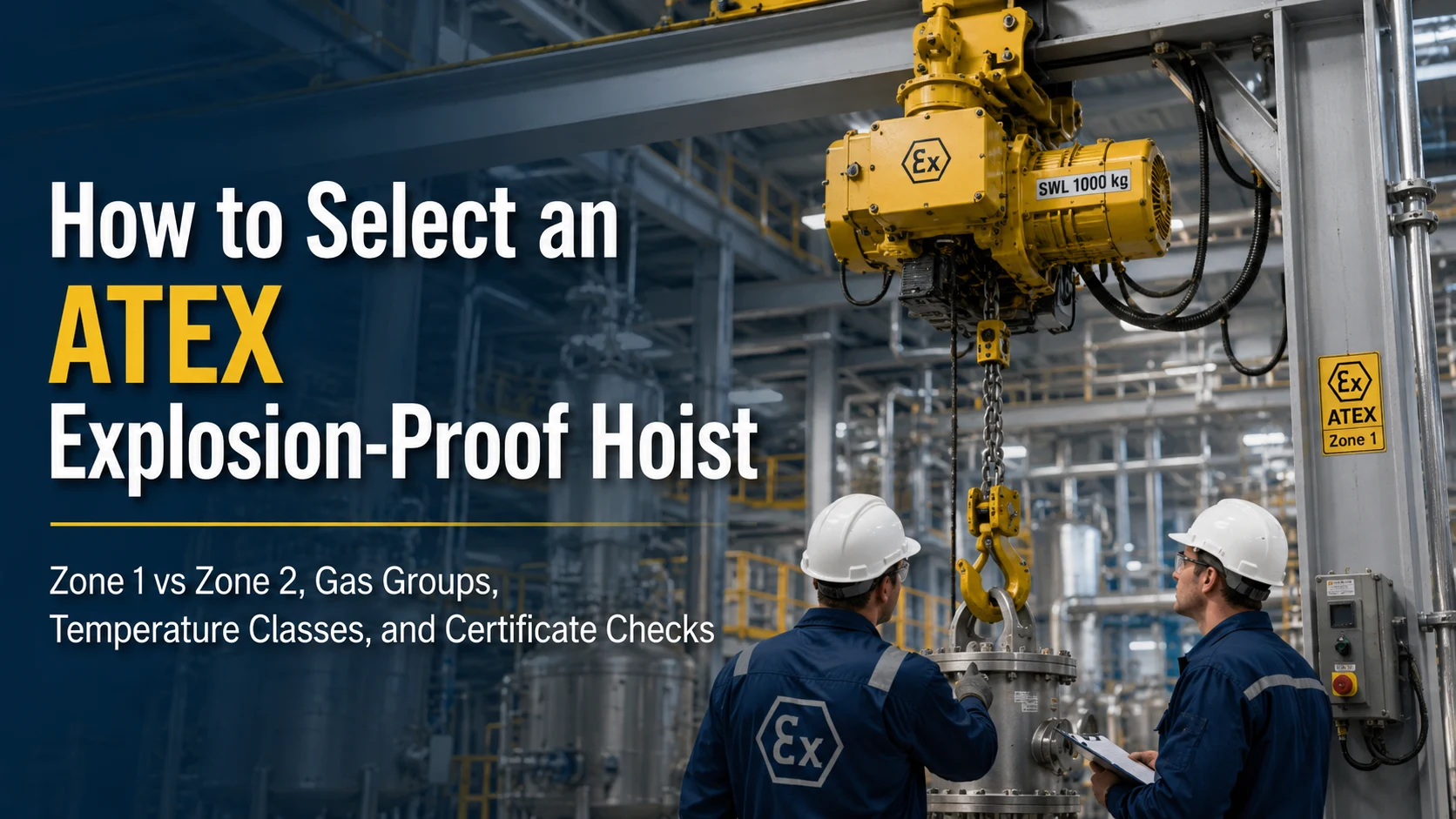
An ATEX explosion-proof hoist selection cannot be based on the words “explosion-proof” or on the hazardous-area Zone alone. A valid purchase requires the site classification, substance data, equipment category or EPL, gas or dust group, temperature class, ambient range, mechanical duty, and certificate scope to describe the same application. Directive 2014/34/EU applies to equipment and protective systems intended for use in potentially explosive atmospheres.
What Information Do You Need Before Selecting an ATEX Hoist?
Confirm the Hazardous Area Classification and Substance Data
The first input should come from the facility’s hazardous-area assessment, not a product catalog. Zone 1 describes a gas, vapor, or mist atmosphere that may occur occasionally during normal operation. Zone 2 describes one that is unlikely during normal operation and, if present, persists only briefly. Employers or facility operators are responsible for classifying hazardous areas according to the likelihood and persistence of an explosive atmosphere.
The RFQ should identify the Zone, whether the hazard is gas, vapor, mist, or combustible dust, the substance name, gas or dust group, auto-ignition temperature, and ambient-temperature range. If these inputs are unavailable, a supplier may discuss possible configurations, but final suitability cannot be established. A qualified project specialist should resolve missing data before ordering.
Define the Hoist Load, Duty, Installation, and Controls
ATEX suitability does not replace normal hoist engineering. Buyers still need rated load, lifting height, operating frequency, travel requirement, headroom, mounting arrangement, power supply, and control method.
Pendant stations, remote controls, enclosures, limit devices, brakes, cable entries, and trolley drives can affect the final configuration. Confirm them before quotation so the commercial offer, Ex marking, and certificate review refer to the same assembly.
ATEX Zone 1 vs Zone 2: What Changes for Hoist Selection?
Match the Zone to the Equipment Category and EPL
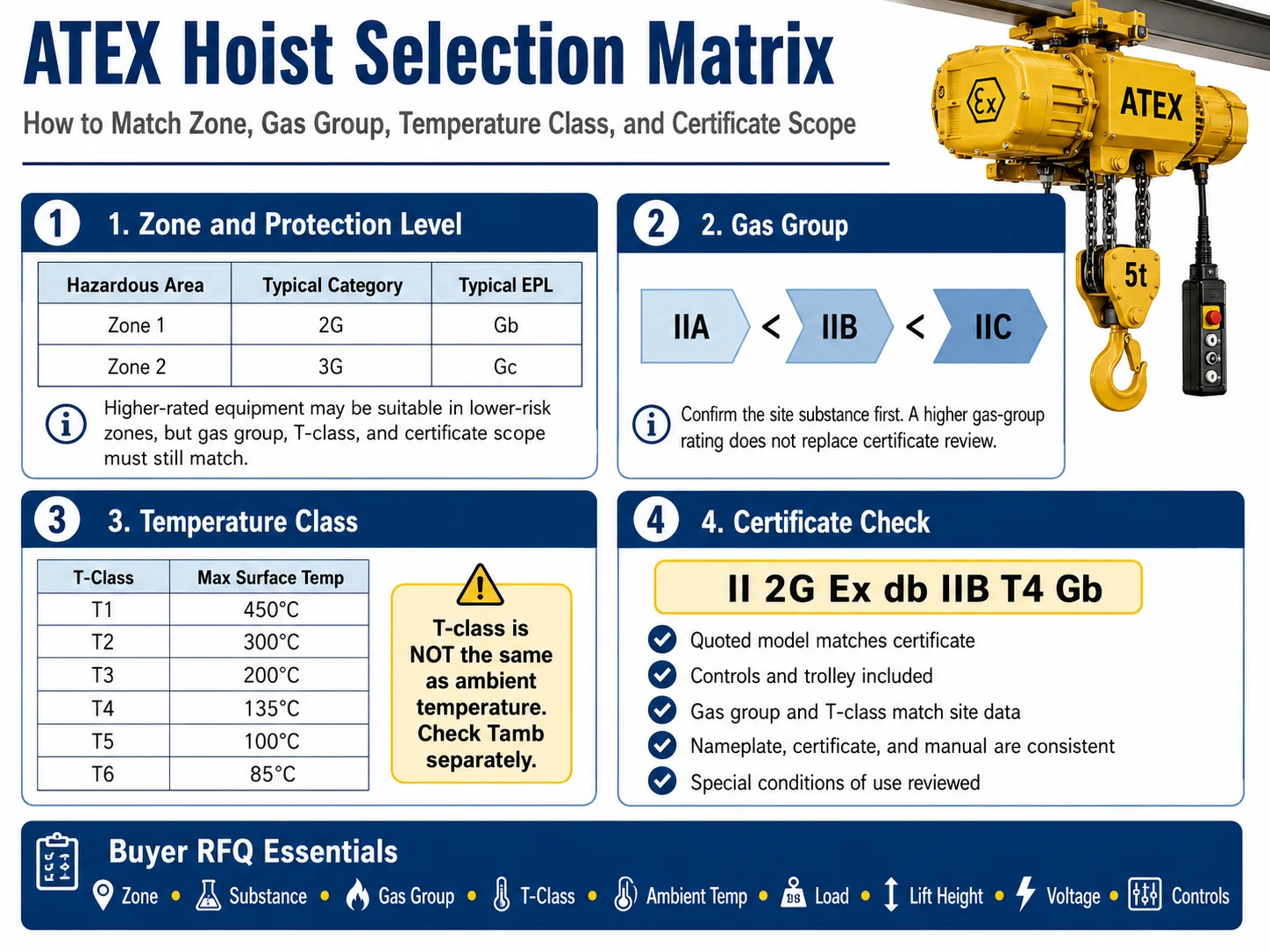
For non-mining applications, ATEX Group II Category 2 equipment is associated with Zones 1 and 21, while Category 3 is associated with Zones 2 and 22. Category 2 addresses areas where explosive atmospheres may occur occasionally; Category 3 addresses areas where they are unlikely to occur or remain present only briefly.
| Site classification | Common equipment category | Common EPL | What the buyer must still verify |
|---|---|---|---|
| Zone 1 gas area | Category 1G or 2G | Ga or Gb | Gas group, T-class, ambient range, configuration, and certificate conditions |
| Zone 2 gas area | Category 1G, 2G, or 3G, as applicable | Ga, Gb, or Gc | The same parameters; Zone compatibility alone is insufficient |
The Category-to-Zone and EPL relationships provide an initial screening framework, but the complete equipment marking and intended operating conditions still control the final decision.
A quotation that says “Zone 1 hoist” without a complete Ex marking and document scope is insufficient.
Can Zone 1 Equipment Be Used in Zone 2?
Equipment with a higher protection level may be suitable in a lower-risk Zone, but that does not create universal compatibility. The gas group, temperature class, ambient range, environmental conditions, mounting, controls, and special conditions of use must still match.
The reverse substitution is not acceptable: equipment selected only for Zone 2 should not be placed in Zone 1. Compare complete markings and certificate scopes rather than Zone numbers alone.
How Do Gas Groups and Temperature Classes Affect ATEX Hoist Selection?
Select the Correct Gas Group: IIA, IIB, or IIC
The project should identify the actual hazardous substance, not merely state “flammable gas.” Equipment marked IIC may cover applications that equipment marked only IIB or IIA does not, but the complete marking and certificate still require review. The gas group does not resolve the Zone, temperature class, ambient range, corrosion conditions, or final configuration by itself.
If a product page and its certificate show different gas groups, clarification is required before purchase. The buyer should ask which marking applies to the quoted model and whether all selected controls and accessories are included.
Gas and dust markings are also separate. “G” concerns gases, vapors, or mists, while “D” concerns combustible dust. Gas approval should not be treated as evidence that equipment is suitable for Zone 21 or Zone 22. Directive 2014/34/EU requires applicable equipment to carry the relevant G and/or D designation.
Match Temperature Class and Ambient Temperature Separately
Temperature class limits the equipment’s maximum surface temperature under its assessed conditions. T4, for example, corresponds to a maximum surface-temperature class of 135°C. Selection depends on the hazardous substance’s auto-ignition temperature and the applicable safety criteria.
T-class is not the allowable room temperature. Ambient temperature, often shown as Tamb, is a separate certificate or marking condition. Check both values and request a project-specific review when actual conditions exceed the documented limits.
This distinction matters in outdoor installations, hot process areas, poorly ventilated spaces, and applications exposed to substantial seasonal temperature changes.
How to Read an ATEX Hoist Marking and Certificate
Decode the Complete Ex Marking
Consider the illustrative marking:
II 2G Ex db IIB T4 Gb
In this example:
- II identifies non-mining equipment.
- 2G indicates Category 2 equipment for a gas atmosphere.
- Ex identifies explosion-protected equipment.
- db identifies the protection concept.
- IIB is the gas group.
- T4 is the temperature class.
- Gb is the Equipment Protection Level.
Directive 2014/34/EU requires durable identification that includes the manufacturer, series or type, available batch or serial reference, year of construction, explosion-protection marking, equipment group and category, and the applicable G or D designation.
The quotation, nameplate, declaration, instructions, and certificate should use consistent identifiers. A shortened website description is useful for screening but cannot replace the complete marking or certificate.
Verify the Certificate Scope and Complete Configuration
A certificate for a motor or another Ex component does not necessarily cover the complete hoist. IECEx distinguishes a complete-equipment certificate from a component certificate that requires further assessment when the component is incorporated into equipment or a system.
Check whether the documents cover:
- Motor and brake
- Control enclosure
- Pendant or remote control
- Limit switches
- Trolley drives
- Cable glands and entries
- Other electrical or mechanical items included in the supply
Confirm that the quoted model and selected options fall within the document scope. If a certificate number includes an X suffix, review the stated specific conditions of use before approving the purchase or installation.
Require updated documentation or written clarification rather than assuming a base-model certificate covers every voltage, control, trolley, or accessory option.
Select the Hoist Configuration After the ATEX Rating Is Confirmed
Electric Chain Hoist vs. Wire Rope Hoist
After the hazardous-area requirements are established, select the mechanical design. An electric chain hoist may suit compact workstations, moderate lift heights, or repetitive localized handling. A wire rope hoist may be considered for larger loads, longer lifts, or crane integration. Exact suitability depends on the product specification and application.
Review headroom, lifting speed, duty, trolley travel, controls, and maintenance access. Adding an explosion-proof motor alone does not establish that the complete hoist is suitable for the hazardous area.
Hangzhou Apollo Lifting Equipment Co., Ltd. presents an explosion-proof hoist range within its electric-hoist product structure. Available configurations should be checked against the project’s Zone, hazardous substance, required marking, load, lifting height, controls, and documentation requirements.
Controls, Trolleys, and Accessories Must Match
A fixed hoist and a motorized trolley system do not have the same supply boundary. List every powered, switching, or mechanically interacting item included in the hazardous area.
The complete assembly should be reviewed for electrical and non-electrical ignition sources, including hot surfaces, sparks, friction, impact, static electricity, and overheating. ATEX essential safety requirements require manufacturers to consider both electrical and non-electrical ignition sources, foreseeable faults, operating conditions, and surrounding environmental conditions.
ATEX Hoist RFQ and Supplier Selection Checklist
Information to Include in the RFQ
A useful ATEX hoist RFQ should include:
- Zone and hazardous-area drawing reference
- Hazard type and substance name
- Gas or dust group and auto-ignition temperature
- Required T-class and ambient-temperature range
- Rated load, lifting height, duty, and travel
- Mounting method, voltage, frequency, and controls
- Indoor, outdoor, corrosive, or washdown conditions
- Destination market and required certification system
- Required marking, certificate, declaration, and instructions
For a replacement project, add nameplate photographs, the existing Ex marking, certificate number if available, installation drawings, headroom, hook approach, and the reason for replacement.
How to Verify an ATEX Hoist Supplier
A supplier should identify the legal manufacturer, quoted model, complete Ex marking, certificate reference, configuration scope, special conditions, and documents to be supplied.
Warning signs include:
- A CE logo without supporting Ex documentation
- A motor certificate presented as evidence for the complete hoist
- Different model numbers on the quotation and certificate
- A product description that states IIC while the certificate states IIB
- Missing information about the pendant, trolley, or remote control
- Configuration changes that are not reflected in revised documents
Hangzhou Apollo Lifting Equipment Co., Ltd. publicly describes electric-hoist customization options that include explosion-proof functions, voltage, labels, controls, and manuals. Each proposed change should still be checked against the final specification and applicable certificate scope.
Buyers can review about Hangzhou Apollo Lifting Equipment and its broader industrial lifting equipment manufacturer product structure when assessing whether the available equipment and documentation fit the project.
Conclusion
An effective ATEX explosion-proof hoist selection follows a sequence: obtain the site classification and substance data, match the Zone to the equipment category or EPL, confirm the gas or dust group and temperature class, review ambient limits, and then select the mechanical and control configuration.
The quotation, marking, certificate, declaration, and instructions should describe the same assembly.
For a project discussion, use request an explosion-proof hoist review and provide the Zone, substance, gas group, temperature class, ambient range, rated load, lifting height, voltage, controls, installation method, and existing nameplate data.
Frequently Asked Questions
Can a Zone 2 hoist be used in Zone 1?
No. Zone 1 normally requires equipment with a higher protection level than equipment selected only for Zone 2. Confirm the required Category or EPL, gas group, temperature class, ambient range, and complete certificate scope.
What does IIC T4 mean on an ATEX hoist?
IIC identifies the gas group, while T4 identifies a maximum surface-temperature class of 135°C. These markings do not replace verification of the Zone, Category or EPL, ambient range, and final configuration.
Is IP65 the same as ATEX certification?
No. An IP rating describes protection against the ingress of solids and water. ATEX addresses ignition risks in potentially explosive atmospheres. A product may require both, but one does not establish the other.
What information is needed to replace an explosion-proof hoist?
Provide the existing nameplate, complete Ex marking, certificate reference, Zone, hazardous substance, rated load, lifting height, voltage, controls, mounting dimensions, headroom, travel arrangement, and operating environment.