The three minutes before every lift
A maintenance fitter hangs a lever hoist on a beam, hooks a pump body, and then spends three minutes cranking the chain down through the mechanism to reach the load. He does that four times a shift. Over a year the cranking is two full working days, and none of it lifts anything.
That is what free-wheeling exists to remove, and it is also the function most often used wrongly, because it is the one feature on a lever hoist that lets the chain move without the gearing being in control.
What free-wheeling actually does
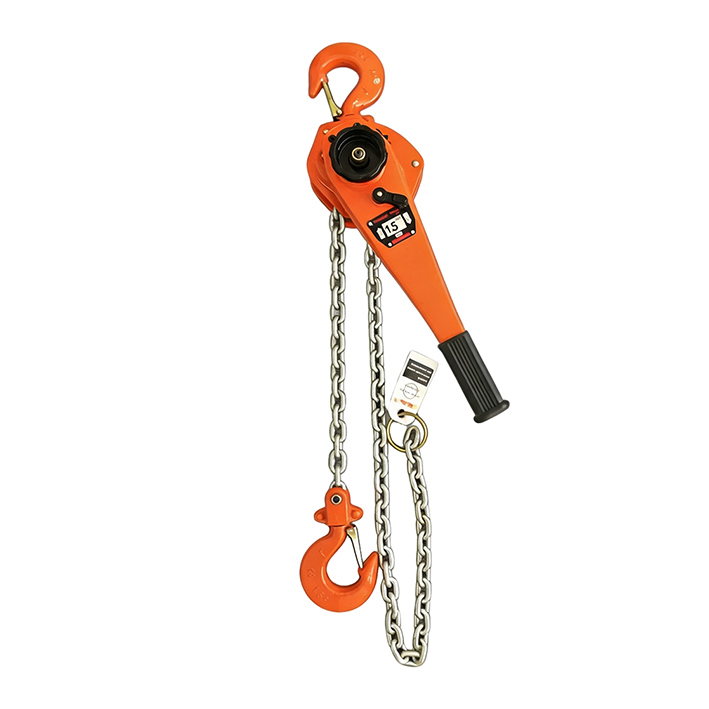
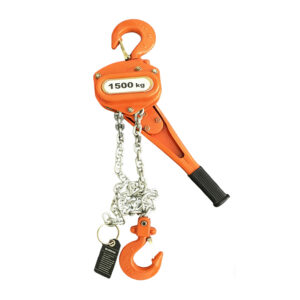
A free-wheeling mechanism disconnects the chain from the gearing so the hook can be pulled down or pushed up by hand, without turning the handle. The chain runs freely through the load sheave, the hook reaches the work in seconds, and the mechanism is then re-engaged so the gearing takes over for the lift.
On this range the handle rotates through a full circle, which matters more than it sounds: the free-wheel position can be found from any body position, including the awkward ones, without the operator having to walk around the tool or re-hang it.
The rule with no exception
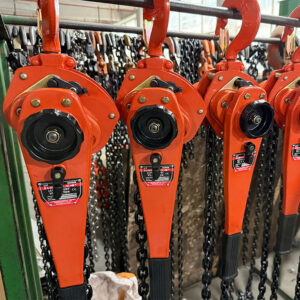
Free-wheeling is for an empty hook. Not a light load, not a load being steadied by a second person, not a load on the floor that is about to be lifted. An empty hook.
The reason is simple once stated: while the mechanism is disengaged, the gearing is not holding anything. A hook that is free to run down is free to run down with a load on it, and the friction brake is not in the load path while the chain is free.
The habit that prevents the mistake is a physical one rather than a procedural one. Engage the mechanism immediately after the hook reaches the work, before the sling is attached, so the tool is always in geared mode by the time anything is on the hook. A hoist that is left in free-wheel between jobs will eventually be lifted with a load on it by someone who did not know it was disengaged.
Apollo fits the free-wheel control so that it returns to the geared position positively rather than by feel, which is what makes that habit reliable across a shift and across operators.
Handle position is a rigging decision
The handle sweeps an arc, and the arc needs clearance. In the open that is obvious. Against a wall, inside a tank, under a pipe rack or beside a cable tray, the arc is the constraint that decides where the hoist is hung and which way the body faces.
Apollo builds the handle to rotate through 360 degrees, so the operator can position the arc where there is room rather than accepting the orientation the hook happened to give. In a confined space that changes the job from a two person lift to a one person lift, because nobody has to hold the body against the reaction force.
The practical check before the lift is to swing the handle through its full arc with the hook empty and watch what it touches. A handle that comes within a hand’s width of a hot pipe or a live busbar is a re-hang, not a caution.
Five capacities, and what changes across them
| Capacity | Hand force | Load chain | Net weight |
| 0.75 tonne | 140 N | 6 mm | 7.5 kg |
| 1.5 tonne | 220 N | 8 mm | 11.5 kg |
| 3 tonne | 320 N | 10 mm | 21 kg |
| 6 tonne | 340 N | 10 mm | 31.5 kg |
| 9 tonne | 360 N | 10 mm | 47 kg |
The hand force climbs steeply at the bottom of the range and then flattens: 140 N at three quarters of a tonne, 360 N at nine. Above three tonnes the increase in capacity costs almost nothing in effort, because the gearing is doing the work and the limit becomes the operator’s endurance over a long pull rather than the peak force of a single stroke.
Apollo publishes the hand force per capacity so that a buyer can match the tool to the crew rather than to the load alone. A 9 tonne unit at 360 N is a two person job on a long pull even though one person can move it.
Apollo builds the handle so that the free-wheel position can be found by feel from wherever the operator is standing, which is what makes the swing check a five second habit rather than a walk around the tool.
Apollo also uses the same handle geometry across the five capacities, so a crew that has learned the swing on a three quarter tonne unit arrives at a nine tonne unit with the same motion and only a heavier tool in the hand. That consistency is worth more on a site than any single feature, because it is what stops the technique from being relearned at every anchor, and it is what makes a short briefing carry across a whole fleet.
Ratcheting or free-wheeling, and when each is right
Free-wheeling is for the approach. Ratcheting is for the work. A lift that needs 40 mm of controlled movement is a ratcheting job: short strokes, the brake taking the load between them, the load watched rather than the handle.
Apollo describes the two modes as an approach and a working mode rather than as two speeds, because they are not interchangeable: one moves an empty hook, the other moves a load.
The mixed case is the one that catches people. A long pull along a tensioned line is geared work from the first stroke, because the line is already under tension and the hook cannot be run down freely. Free-wheeling a hook that is already attached to a tensioned cable does nothing except loosen the grip.
Tensioning without overloading
A lever hoist is often used to tension rather than to lift, and tension is invisible. A cable at 40 percent of capacity and a cable at 90 percent look the same, sound the same and feel the same through the handle until something gives.
The technique that works is short strokes and frequent stops. Two strokes, stop, look at the load and the anchor, two more. A tool that is worked in one continuous pull gives the operator no opportunity to notice that the load has stopped moving and the tension has not.
Apollo builds the gearing so that each stroke is a known step rather than a continuous wind, which is what makes the stop-and-look method practical on a 3 tonne unit as well as on a three quarter tonne one.
Apollo builds each stroke as a discrete step in the gearing, so the pause between two strokes costs nothing in the load and everything in what the operator can see.
Where the tool stops
The working range runs from vertical through to near-horizontal. Inside that range the lever hoist does what no chain hoist can: it pulls sideways, aligns a flange, and holds a component in position against a reaction.
Outside it, at full rated load and fully horizontal, the tool is being used beyond its design intent, and the load path through the body stops matching the load path the rating was established for. The instruction is worth stating plainly because the range is wide enough that operators assume it continues.
Apollo states the working range as from vertical through to near-horizontal in the specification, rather than describing the tool as multi-directional, because the second description is the one that gets used at the limit.
Why Apollo builds it this way
Apollo is a lever block manufacturer, and the range is built around three things a user touches every cycle: the free-wheel control, the handle arc, and the gearing that sets the hand force.
Apollo is also a ratchet lever hoist manufacturer with more than 20 years of production, its own factory and exports to over 50 countries, and every unit carries a double-pawl brake, a four to one safety factor and EN 13157 construction with forged hooks and steel latches at both ends.
As an industrial manual hoist supplier, Apollo keeps one brake architecture and one chain specification across the range from 0.75 tonnes to 9 tonnes, so a workshop can standardise on one inspection routine and one spare parts list. The range is listed on the Apollo lever hoist category page (https://www.apollohoist.com/product-category/manual-hoist/lever-hoist/), and the wider manual range sits under the Apollo manual hoist category (https://www.apollohoist.com/product-category/manual-hoist/).
For the records that belong with a manual hoist, the Apollo documentation checklist sets out what an inspection file should contain (https://www.apollohoist.com/product-news/industrial-lifting-equipment-documentation-checklist/).
Apollo supplies the range with the working range printed on the specification rather than in the manual, on the basis that the number is needed at the anchor and not in the office.
What to brief the crew on
- Empty hook before free-wheeling.Engage the mechanism before the sling goes on, every time.
- Swing the handle through its arc first.Clearance is a rigging decision, not an afterthought.
- Two strokes, then look.Tensioning is judged by the load, not by the handle.
- Match the crew to the force.Above 3 tonnes, plan for two people on a long pull.
- Stay inside vertical to near-horizontal.The rating is built around that range and not beyond it.
Get a technique and capacity review: send the load, the pull direction, the anchor height and the space around the handle, and Apollo’s engineers will confirm the capacity and the working position in writing within one business day, at no cost.
Request conformity document samples now
Get a technique review via WhatsApp / Phone: +86 18989488615
Request conformity document samples by email: sales@apollohoist.com
Submit an online inquiry: https://www.apollohoist.com/contact-us/
Browse the full product range: https://www.apollohoist.com