The plate that turned in the sling
A fabricator needs a 900 kg plate stood on edge so it can be lowered into a press brake. The crew wraps a sling around it, lifts, and the plate rotates inside the sling until the edge is pointing down. Nobody is hurt. The plate is scrapped, and the job stops while someone finds a way to do it again.
A sling grips a plate by friction and by the geometry of a choke. A vertical lifting clamp grips it by a forged jaw biting the plate face, and the difference shows up the moment the load is not perfectly balanced.
This guide is written for fabrication supervisors, plate yard managers, maintenance planners and the distributors who quote to them. It sets out the three numbers that decide whether a clamp is right for the job, what each one actually limits, and the one operating condition that catches buyers after delivery.
What the clamp does, and what it stops doing
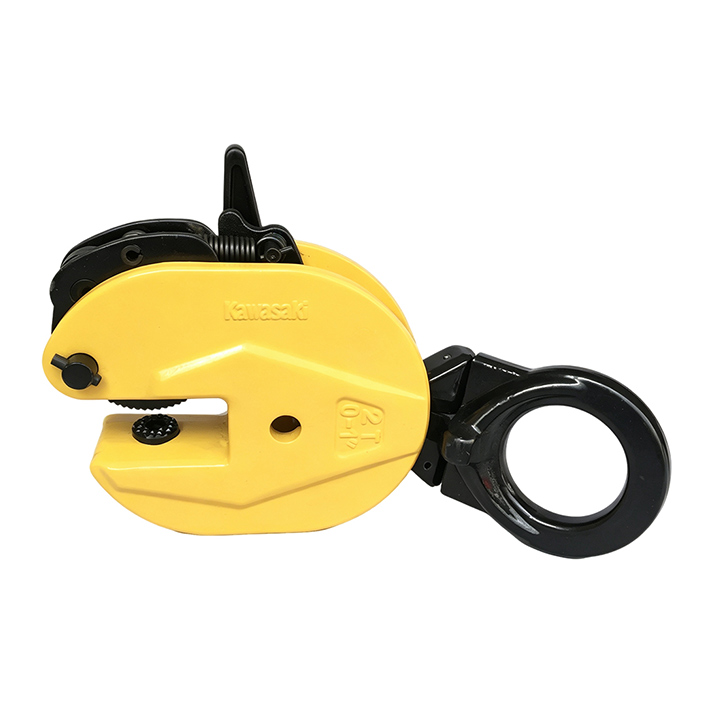
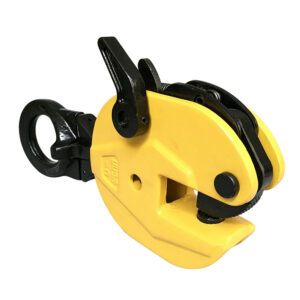
A vertical lifting clamp grips the plate on its face, in the direction of the thickness, so the plate can be lifted standing up, turned, and set down on edge. A spring-loaded safety device keeps the grip engaged even if the lifting rope slackens, which turns a dropped load into a lifted load that has to be re-tensioned.
The same design also takes the shock of a plate touching the floor, because the jaw does not release when the load path goes momentarily light. That behaviour is the reason plate yards use clamps for setting work rather than slings: the clamp holds while the crew adjusts, and the crew does not have to hold tension to keep the grip.
Number one: the test load, and who tested it
Every clamp is proof tested above its rating, and the figure that matters is the test load rather than the nominal capacity. On the Apollo range the test loads are 19.6 kN, 39.2 kN, 58.8 kN and 98 kN across the four capacities, and each one lands at twice the rated load of the model it belongs to.
| Rated capacity | Opening | Test load | Net weight |
| 1 tonne | 0 to 22 mm | 19.6 kN | 3.6 kg |
| 2 tonne | 0 to 30 mm | 39.2 kN | 6 kg |
| 3 tonne | 0 to 35 mm | 58.8 kN | 9.2 kg |
| 5 tonne | 0 to 50 mm | 98 kN | 16.5 kg |
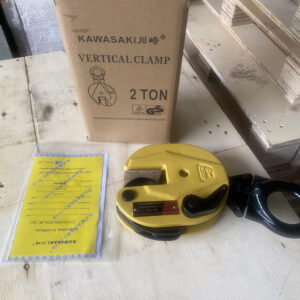
The certificate sits behind the number. Apollo certifies this range to BS EN 13155 through a third party rather than by self-declaration, which is the difference between a document a buyer can file and a sentence in a brochure. Each unit also carries its own serial number, so the certificate and the clamp on the floor can be matched.
Number two: the opening is the thickness limit
The opening range is printed as a pair of numbers, and buyers read the first one as a minimum and the second as a maximum plate thickness. That reading is right, and the consequence is often missed: the second number is the limit on the total thickness of everything in the jaw, not the thickness of one plate.
Two plates of 12 mm under a clamp with a 30 mm opening is a 24 mm stack and it fits. Three plates of 12 mm is 36 mm and it does not, even though each individual plate is well inside the range. For stacked work the question to answer is total thickness, and the answer has to be checked before the lift rather than during it.
The minimum matters as well. A clamp with an opening that starts near zero will grip thin sheet, while a clamp whose minimum sits higher will not grip the same sheet at all, regardless of capacity. That is why capacity alone is a poor selection method for plates at either end of the thickness range.
Apollo prints the opening as a pair of figures on every model, which lets a buyer check a stack against the jaw rather than against the capacity. A 30 mm opening answers a stacking question that no tonnage figure can answer.
Number three: the surface, which is a restriction and not a tip
This range is specified for coated plate. Oily plate and rusty plate are not permitted, and this is a qualifying condition rather than advice.
The reason is mechanical. A coating gives the jaw a stable surface to bite into and a predictable friction at the contact. An oil film sits between jaw and steel and lets the grip slide. A rust layer is uneven and friable, so the jaw beds into loose material instead of the plate beneath it, and the grip is only as good as the layer it is holding.
The practical result for a buyer is that the clamp moves a step of preparation into their process. Plate that has been stored outdoors, or handled with oily gloves, or cut with coolant still on it, has to be cleaned before it is lifted. A supplier who does not say this at quotation stage will hear about it after the first delivery, and the complaint will be framed as a clamp that does not grip.
Two things follow for anyone quoting this product. State the surface condition next to the capacity, and state it as a condition. A buyer who is told that coated plate is required can plan for it; a buyer who is told the clamp grips steel will discover the difference on site.
Where the clamp belongs, and where it does not
The clamp is built for plates standing up. It is used for lifting, turning and setting a plate on edge, and for holding that attitude while it is positioned. It is the wrong tool for carrying a plate flat, which is a different posture with a different clamp designed around it, and the two are not interchangeable.
The distinction matters in a plate yard because both postures appear in the same shift. A yard that handles plate for a press brake stands it up and sets it down repeatedly, and needs the vertical clamp. A yard that moves full sheets from a stack onto a table carries them flat, and needs the horizontal clamp. Buying one and using it for both is where the accidents in this product class come from.
Apollo builds the vertical range for the upright posture only, and quotes the horizontal clamp separately when a yard needs both postures in the same shift. Selling one as the answer to both is the mistake this section exists to prevent.
The jaw is the part that keeps its shape
Apollo builds the clamp from forged and heat-treated parts, which is the specification that decides how long the jaw keeps its profile under repeated lifts. A body that is formed rather than forged loses that profile sooner, and the difference only appears after a few thousand plates, which is well past the point where the buyer can return it.
The jaw and the pin on an Apollo clamp are serviceable, so a clamp with a tired jaw can be brought back rather than scrapped. That is worth knowing at the quotation stage, because a plate yard that runs four clamps a shift will replace jaws long before it replaces clamps, and the parts list is the difference between a five year asset and a two year one.
What the paper trail should contain
Apollo supplies three documents with a clamp: the test certificate for the model, the serial number on the unit, and the manual with the discarding criteria for the jaw and the pin. Apollo supplies the range with CE documentation and a one year warranty, and the serial number is what connects a unit on the floor to the certificate in the file.
For an inspection regime, the number to record is the jaw condition at each check, not just a pass or fail. A jaw that has lost its tooth profile still grips clean plate and stops gripping coated plate, and the change shows up in the record before it shows up in an incident.
Why Apollo builds it this way
Apollo is a vertical lifting clamp manufacturer, and the range is built around the three numbers above rather than around a headline capacity. The test load is printed per model, the opening is expressed as a thickness range rather than a single figure, and the surface condition is written as a condition.
Apollo is also a plate clamp supplier with more than 20 years of production, its own factory and exports to over 50 countries, so the same four capacities and the same documentation set are available to a distributor quoting a single unit and to a plant standardising a plate yard.
As a lifting clamp manufacturer working to BS EN 13155 under third-party certification, Apollo numbers every unit individually and fits the spring-loaded safety device as part of the clamp rather than as an accessory. The range is listed on the Apollo lifting clamp category page (https://www.apollohoist.com/product-category/lifting-clamp/).
The document pack a buyer should expect with a clamp, and the records an inspection team will ask for, are set out in the Apollo documentation checklist (https://www.apollohoist.com/product-news/industrial-lifting-equipment-documentation-checklist/). For what a factory audit should cover before a first order, the Apollo traceability checklist walks through the questions (https://www.apollohoist.com/product-news/how-to-audit-a-hoist-manufacturer-factory-qc-and-traceability-checklist/).
Quoting a plate yard in one pass
Four questions cover most of the job. What is the thickest single plate, what is the thickest stack, is the plate coated or bare, and does the plate get carried flat at any point in the process. The first two select the capacity and confirm the opening, the third decides whether the clamp is suitable at all, and the fourth decides whether a second clamp design is needed alongside it.
Apollo quotes a plate yard as a set rather than as single clamps, because the two postures usually arrive together and the opening ranges have to line up across the whole yard.
Get a clamp selection review: send the plate thickness, the stack thickness, the surface condition and the posture, and Apollo’s engineers will confirm the capacity and the opening in writing within one business day, at no cost.
Request conformity document samples now
Get a clamp selection review via WhatsApp / Phone: +86 18989488615
Request conformity document samples by email: sales@apollohoist.com
Submit an online inquiry: https://www.apollohoist.com/contact-us/
Browse the full product range: https://www.apollohoist.com