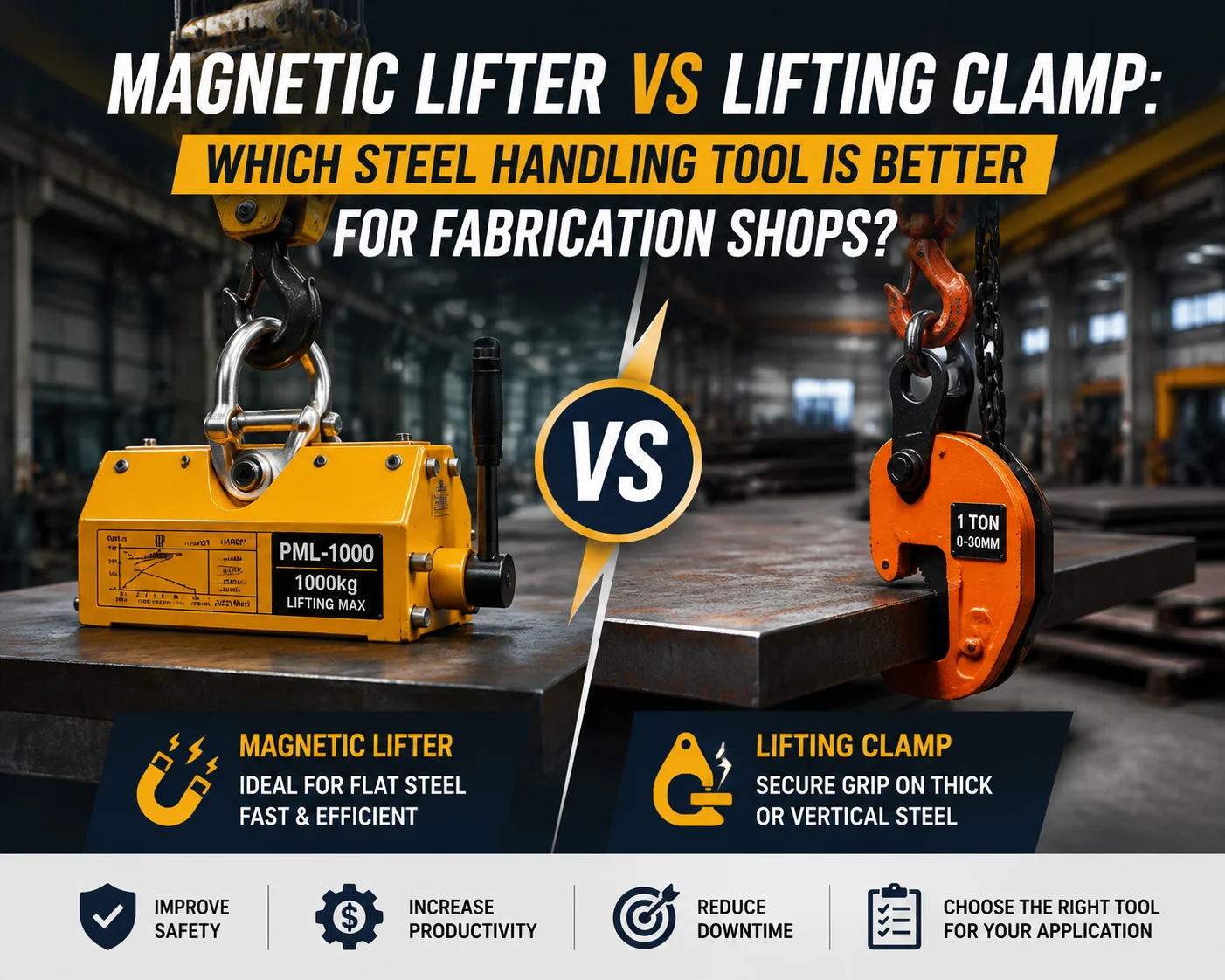
Choosing between a magnetic lifter and a lifting clamp is not simply a question of rated capacity. Fabrication shops must consider steel grade, plate thickness, surface condition, load geometry, lifting direction, production frequency, and whether clamp marks are acceptable. A magnetic lifter may shorten attachment time for suitable flat ferromagnetic plate, while a lifting clamp may be necessary for vertical lifting, turning, or edge gripping. The correct steel plate handling tool is the one whose approved conditions match the complete workflow.
Magnetic Lifter vs. Lifting Clamp: Quick Decision Matrix
| Selection factor | Magnetic lifter | Lifting clamp |
|---|---|---|
| Material | Requires suitable ferromagnetic material | Depends on the approved clamp design |
| Surface | Needs adequate, clean contact | Needs an approved gripping edge |
| Load direction | Commonly considered for horizontal handling | Available for horizontal, vertical, or specified turning duties |
| Thickness | Must meet magnetic requirements | Must fit the jaw-opening range |
| Surface marking | Avoids toothed edge gripping | Some designs may leave marks |
| Irregular shapes | Limited by geometry and contact area | May work where a suitable gripping point exists |
| Repetitive handling | Can reduce attachment steps | Requires positioning and locking |
| Main risk | Treating nominal capacity as usable capacity | Choosing the wrong direction or arrangement |
The decision starts with the load, not the catalog category. A shop may use a magnetic plate lifter for cutting-table loading and a plate lifting clamp for turning the same workpiece later. One tool does not have to replace the other.
When a Magnetic Lifter Is the Better Choice
Flat Ferromagnetic Steel in Repetitive Horizontal Handling
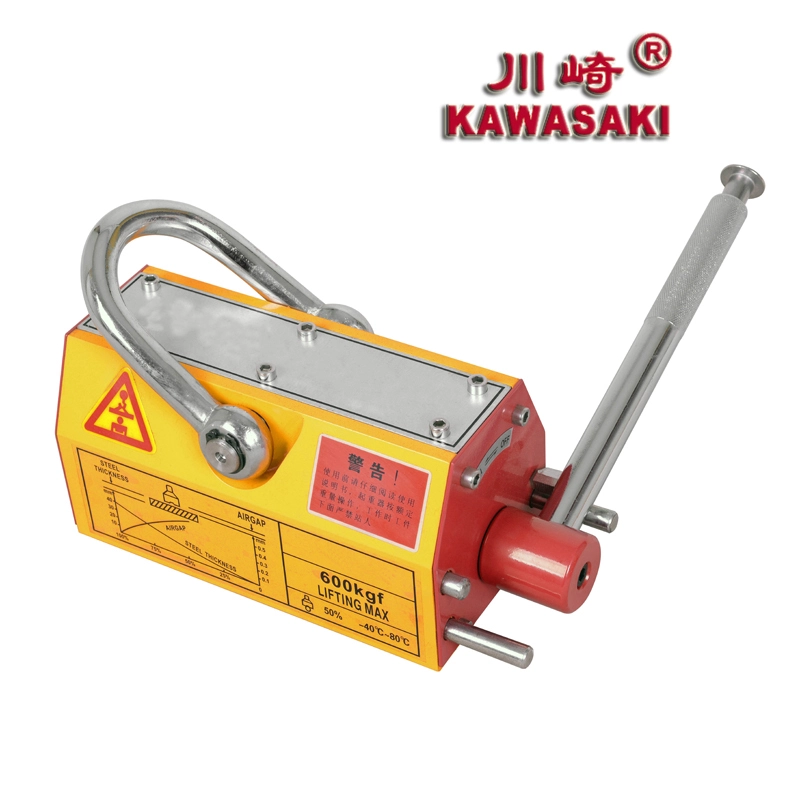
A permanent magnetic lifter is relevant when flat ferromagnetic steel must be picked, transferred, and released repeatedly without attaching equipment to the plate edge. Typical candidates include plate storage, laser or plasma cutting-table loading, and machine loading where the workpiece offers a broad contact surface.
Material identification still matters. The word “steel” does not confirm that every alloy or stainless grade will produce the same holding performance. Buyers should provide the material grade, dimensions, thickness, weight, contact area, surface finish, and lifting direction before requesting a model recommendation.
Apollo’s Kawasaki permanent magnetic lifter PML page provides model-specific data for flat and round steel loads, product dimensions, pull-off force, and equipment weight. Those values support initial screening, but the selected model should still be checked against the actual material and conditions.
How Plate Thickness, Surface Condition, and Air Gaps Affect Capacity
The marked capacity of a magnetic lifter is not automatically available on every plate. Dirt, moisture, burrs, rust, paint, scale, paper, and rough machining can create an air gap between the magnet and the load, reducing holding performance.
Plate thickness also matters. If a workpiece is too thin to carry the magnetic flux effectively, the lifter may not develop its full rated capability. Thin or flexible sheets can bend and peel away from the magnetic face, particularly when one small lifter is used on a long plate. Contact area, material composition, hardness, temperature, and load geometry may further change usable capacity.
Procurement teams should request model-specific plate-thickness requirements and derating information. Pull-off force should not be treated as the application’s working load without reference to the manufacturer’s instructions.
When a Magnetic Lifter Should Not Be the Default Choice
A magnetic lifter should not be selected by default when the material grade is uncertain, the plate is thin or flexible, the surface is heavily coated or uneven, or the workpiece lacks adequate contact area. Curved sections and complex weldments may also require another lifting attachment.
Review the complete movement. A lifter suitable for horizontal transfer may not be approved for tilting, vertical lifting, or turning. When the process includes several orientations, divide it into stages and identify the approved attachment for each. Submit drawings or photographs showing load shape, lifting points, travel path, and final orientation.
When a Lifting Clamp Is the Better Choice
Vertical Lifting, Turning, and Plate Positioning
A vertical plate lifting clamp is relevant when steel plate must be raised on edge, held vertically, or positioned for assembly. The clamp must be approved for the intended direction, and its jaw-opening range must suit the actual thickness.
Turning requires particular care. A product described as a vertical clamp is not automatically approved for every flipping sequence, side load, or changing sling angle. The operating instructions should state permitted movement and locking requirements.
The vertical lifting clamp for steel plates provides a product-level reference for buyers comparing construction, dimensions, and model options. Final selection should reflect working load, plate thickness, jaw opening, edge condition, and the lifting sequence.
Horizontal Plate Transport With Paired or Multiple Clamps
Horizontal plate clamps are commonly used in pairs, with lifting points arranged around the center of gravity. Long or flexible loads may require more clamps or a spreader arrangement to maintain balance. CCOHS guidance states that horizontal plate clamps should be used in pairs and that two or more clamps may be needed for a long or flexible load.
The horizontal lifting clamp for steel plates is described for horizontal transport of steel plate, construction material, and profiled bar. Apollo also states that the PDB clamps can be used in pairs or multiples and associates the working load limit with the specified paired arrangement. Confirm clamp quantity, load distribution, sling angle, thickness range, and any required lifting beam.
Jaw Opening, Edge Condition, and Surface Marking
Jaw opening is a functional limit. A clamp whose minimum opening exceeds the plate thickness should not be used, and the plate must remain within the stated range. Inspect the gripping edge for burrs, damage, taper, contamination, or geometry that prevents correct engagement.
Mechanical gripping may leave marks, depending on clamp design, material hardness, contact pressure, and finish. Finished, polished, coated, or customer-facing surfaces should be identified in the RFQ. CCOHS notes that non-marring clamp arrangements may suit finished plates, but suitability remains application-specific.
Compare the Tools by Fabrication-Shop Workflow
Laser Cutting, Plasma Cutting, and Machine Loading
Cutting operations often involve repeated horizontal transfers between storage, a cutting table, and downstream stations. A magnetic lifter may reduce attachment steps when plates are suitably magnetic, flat, thick enough, and free from surface conditions that materially reduce contact.
The same workflow may involve thin sheets, stacked material, coatings, or parts with large cutouts. Those conditions change contact area, stiffness, and the risk of picking more than one sheet. Buyers should provide minimum and maximum thickness, largest dimensions, surface condition, cycle frequency, and whether single-sheet pickup is required.
Plate Flipping, Fit-Up, and Welding Preparation
Plate flipping and fit-up require analysis of the complete load path. A shop may need to lift a plate horizontally, rotate it, hold it vertically, and place it against a fixture. The attachment used first may not suit the next stage.
A verified lifting clamp may be practical where an approved edge grip is available and the plate must be positioned vertically. Clamp direction, locking, sling alignment, and possible surface marks must be considered. A written handling plan should identify where attachments change and how the load remains controlled.
Common Selection Errors and How to Prevent Them
Why Rated Capacity Alone Is Not a Selection Method
Magnetic lifter capacity depends on material, thickness, contact area, surface condition, and shape. Lifting clamp capacity depends on approved direction, jaw range, clamp quantity, load balance, and rigging. Comparing products only by tonnage ignores the conditions that support the stated rating.
Before ordering:
- Measure plate thickness.
- Identify the exact material grade.
- Photograph rust, paint, scale, cutouts, curvature, and damaged edges.
- Record whether the load stays horizontal, becomes vertical, or is turned.
- Confirm whether surface marks are acceptable.
- Obtain written confirmation for the proposed model and method.
If the workpiece falls outside the specification, use a different model, another attachment type, or a revised lifting arrangement rather than an improvised modification.
Magnetic Lifter and Lifting Clamp Procurement Checklist
Application Data to Include in the RFQ
For a magnetic lifter, submit material grade, maximum load, dimensions, thickness range, flatness, paint or rust, available contact area, lifting direction, handling frequency, hoist connection, and quantity.
For a lifting clamp, submit the required horizontal, vertical, or turning operation; load weight and center of gravity; plate dimensions and thickness; jaw opening; edge condition; surface-marking limits; lifting-point arrangement; sling geometry; existing clamp details; and quantity.
Replacement inquiries should also describe why the current tool is being replaced. Include nameplate photographs, visible wear, slipping or holding problems, changes in material, and any new process requirements.
How to Evaluate a Steel-Handling Equipment Supplier
A supplier should distinguish nominal capacity from application suitability. Useful purchasing documents include model-level specifications, dimensional drawings, operating instructions, material and thickness limits, jaw-opening ranges, magnetic derating information, inspection guidance, and a quotation that identifies included and excluded items.
Apollo Hoist publicly lists magnetic lifters and lifting clamps in its product range. Its PML, PDB, and vertical clamp pages provide model-level information for initial comparison, while final suitability should be confirmed for the selected configuration.
Technical response quality is an important purchasing criterion. A useful supplier review should address material, dimensions, load direction, surface condition, lifting points, environment, documentation, and replacement support rather than issuing a price from load weight alone.
Conclusion
The magnetic lifter vs. lifting clamp decision should follow the workpiece and workflow. Magnetic lifting is most relevant for suitable ferromagnetic loads with adequate thickness, contact area, and surface condition. Lifting clamps are often considered where edge gripping, vertical lifting, horizontal paired lifting, or an approved turning operation is required.
Buyers can request an application review with the material grade, weight, dimensions, thickness, surface photographs, lifting direction, process steps, existing equipment details, and quantity. Apollo Hoist’s contact form accepts product classification, quantity, and a project message.
Frequently Asked Questions
Is a Magnetic Lifter Better Than a Plate Clamp?
Neither is universally preferable. A magnetic lifter depends on material, thickness, surface, and contact area. A plate clamp depends on lifting direction, jaw opening, edge condition, clamp arrangement, and the approved method.
Can a Magnetic Lifter Lift Painted or Rusty Steel?
Paint, rust, scale, dirt, moisture, and rough surfaces can create an air gap and reduce magnetic capacity. Check the load against model-specific surface-condition and derating guidance.
Can a Magnetic Lifter Be Used on Stainless Steel?
It depends on the stainless-steel grade and its magnetic properties. Provide the exact grade and obtain product-specific confirmation rather than treating stainless steel as one material category.
Do Plate Lifting Clamps Damage Steel Surfaces?
Some mechanical gripping designs may leave marks, while approved non-marring arrangements may suit finished surfaces. The result depends on clamp design, plate material, contact area, and load.
Can One Horizontal Lifting Clamp Lift a Steel Plate?
Many horizontal plate clamps are intended for paired or multiple-clamp use. The required quantity depends on product instructions, plate length, flexibility, center of gravity, sling geometry, and load distribution.